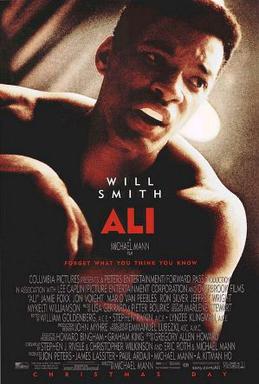
Ali (2001)

Ali (2001)

Will Smith captures The Greatest in a film that misses the fire and passion of Muhammad Ali

Director: Michael Mann

Cast: Will Smith (Muhammad Ali), Jamie Foxx (Drew Bundini Brown), Jon Voight (Howard Cosell), Mario van Peebles (Malcolm X), Ron Silver (Angelo Dundee), Jeffrey Wright (Howard Bingham), Mykelti Williamson (Don King), Jada Pinkett Smith (Sonji Roy), Nona Gaye (Khalilah Ali), Michael Michele (Veronica Porché), Michael Bentt (Sonny Liston), James Toney (Joe Frazier), Charles Shufford (George Foreman), Joe Morton (Chauncey Eskridge), Barry Shabaka Henley (Herbert Muhammad)

There is perhaps no greater sportsman of the 20th century than Muhammad Ali. Not for nothing did he call himself “The Greatest”. His impact on his sport is unrivalled, and his impact on our culture almost matches it. He’s one of those titanic figures that, even if you don’t care a jot for boxing, you know exactly who he is. Ali approved the film – and even more so, Smith’s performance – in Mann’s film that covers ten turbulent years in Ali’s life, from winning the title and changing his name, to refusing the Vietnam draft and losing his boxing licence and title, to reclaiming the title again in  the legendary “Rumble in the Jungle”.

If there is a major flaw about Ali, it’s that Ali was a man who was about so much more than just boxing – but Ali struggles to be more than a film about a boxer. It’s hard today to look at the film and not think that a black director would have had more connection with the emotional, cultural and political turmoil that defined Ali’s life in the 60s and 70s. Mann mounts all this well – and gives it plenty of empathy in the film – but his outsider perspective perhaps contributes to the film’s coldness.

Coldness is the prime flaw of the film. There was no sportsman larger than life than Ali. No public figure who demanded attention more, no boxer who fought his battles as much with wit, convictions and passion as well as fists as Ali. A film of his life needs to capture some of this magic alchemy: it needs to feel like a film that conveys the man Ali was. While there is no doubt there was a melancholy in Ali, a quiet inscrutability behind the pizzazz, this film leans too much into this. It does this while never really telling us anything about Ali’s inner life.

As two marriages are formed and collapse, we don’t get an understanding of what drew Ali to, and caused him to turn away from, these women. His relationship with the Nation of Islam ebbs and flows throughout, but other than a few on-the-nose statements from Ali, we don’t get an idea of how his faith defines him. We get his brave stand against serving in the Vietnam war, but not the emotional and intellectual conviction behind it (other than parading a series of famous quotes).

The film is packed with famous black figures – from Malcolm X to rival boxers and Ali’s support team – his father and family, not to mention three of his wives, but the relationship the film is most invested in is Ali’s mutual appreciation/attention-feeding verbal duels with boxing correspondent Howard Cosell (a pitch-perfect vocal and physical impersonation by Jon Voight). There feels something wrong about this film about a black icon, that his relationship with a white man feels the best defined.

But then it’s also a flaw with the film that its most striking, inventive and memorable sequences are all pitch-perfect recreations of filmed events. Will Smith perfectly captures the vocal and physical grace of Ali, and brilliantly brings to life his interviews with Cosell and his larger-than-life press conferences. The boxing matches are compellingly filmed, a perfect mix of slow-mo and immersive angles (they were largely fought for real, with few punches pulled). Ali’s final KO of Foreman in the Rumble in the Jungle, after several rounds of exhausting Rope-a-dope, is punch-the-air in its triumphal filming and scintillating excitement. But all of this stuff you could actually watch for real today. How essential is a film that uses actors to recreate, with better camera angles and superior editing, stuff that was filmed when it actually happened? Essentially if I want to see Ali stunning the world with his words, or sending Foreman to the canvas, would I choose to watch the man himself, or Will Smith’s perfect impersonation of him doing it?

There is nothing wrong with Will Smith’s performance though. For all his Oscar-winning work in King Richard, this is his finest performance. Bulked up to an impressive degree (Smith spent a year preparing for the film), he’s got Ali’s movements in and out of the ring to a tee and the voice is an unparalleled capture of The Greatest’s. It’s a transformative, exact performance – Smith has just the right force of character for the patter, but also brings the part a soulful depth that the film struggles to explore further. It’s a superb performance.

Enough to make you wish this was in a better, more passionate film. Ali was at the centre of a storm of civil rights and class war in America. He became the public face of a black community struggling to make its voice heard, sick of tired of being treated like second-class citizens by a country they were expected to die for in battle. The politics of the time is lost – Mario van Peebles has a wonderful scene as a troubled Malcolm X, but even he feels like a neutered figure – and the cultural impact of Ali is diluted.

The film ends with captions that dwell on Ali’s later boxing career and his marriages. That’s fine. But this a man who was so much more than what he just did in the ring. He used his position to take a stand on vital issues in America, at huge personal cost, when thousands of others would have settled down to mouth platitudes and make money. He took on the government and refused a compromise that would have allowed him to continue boxing, because he felt the war and America’s domestic policies were wrong. He was a brave leader of men, at a time of furious injustice. The film conveys the facts, but none of the glorious passion. It’s a photocopy of Ali, which is why its best bits are recreations of filmed events. It can’t quite understand or communicate the tumultuous feelings behind racial injustice in the 60s and 70s. It could – it should – have been so much more.

An American in Paris (1951)

An American in Paris (1951)

Romance, love and a lot of dancing in this charming Best Picture winning musical

Director: Vincente Minnelli

Cast: Gene Kelly (Jerry Mulligan), Leslie Caron (Lise Bouvier), Oscar Levant (Adam Cook), Georges Guétary (Henri Baurel), Nina Foch (Milo Roberts), Eugene Borden (Georges Mattieu)

“This is Paris. And I’m an American who lives here!” Those are almost the first words you hear in this charming but light and frothy Best Picture winner. They are pretty much an indicator of the loosely constructed, lightly plotted film that unspools. With the rights to the back catalogue of Gershwin, a story was swiftly thrown together to give us a reason to watch Gene Kelly and friends dance and sing their way through them. Tapping into a post-war romanticism about the delights of Old Europe, An American in Paris is a hugely entertaining technicolour delight that blew audiences away.

That American is Jerry Mulligan (Gene Kelly), an ex-GI hanging around in Paris to try and make his dreams of being an artist like Renoir and Toulouse-Lautrec come true (one glance at his paintings is enough to know he has no chance). His best friend is fellow ex-pat, ageing ‘child prodigy’ pianist Adam (Oscar Levant). Adam’s friend is Henri (Georges Guétary), a famous French singer (and war hero!). Henri is engaged to Lise (Leslie Caron), who meets Jerry by chance, neither knowing who the other is. Doncha-know-it Jerry and Lise fall in love. All this while Milo (Nina Foch), a wealthy would-be patron, longs to make Jerry her companion. How will these romantic complexities play out?

The story is by Alan Jay Lerner, but it can’t have taken him more than a long afternoon to come up with it: two friends unknowingly love the same woman, which will she choose? There is the odd sparkling piece of dialogue, but really this is a showcase for three things: Gershwin, Kelly’s dancing and Paris. Pretty much in that order, since the film is almost completely shot on a Studio backlot  (there are some brief second unit shots of the actual locations). Kelly objected at first to the lack of location shooting (“Ever tried dancing on cobble stones?” a producer pointed out), but actually it works for a film that is basically a fantasia on the city of romance, at points literally taking place in dream-like Parisian streets.

Constructed on a huge set (with some ingenious technical effects to expand the heights of the buildings, like Jerry’s apartment) the film is basically one delightful dance sequence after another, shot with a technicolour richness by Minnelli. We get introduced to our three male leads – Jerry, Adam and Henri – in overlapping voiceover, their faces unseen, as the camera roams over their Parisian locale. (We also get a neat repetition three times of the same joke as a camera settles on someone who nearly fits their description only to be told “no that’s not me”).

From there they meet each other and burst into a richly dynamic all-singing, all-dancing rendition of By Strauss in a classic Parisian café, that uses every prop going.  (It later gets mirrored with an equally amusing ‘S Wonderful where, unknowingly, Jerry and Henri sing of their love for the same woman, while a stressed Adam who knows the truth puffs seemingly a whole pack of cigarettes at once). Not to be out down, as Henri describes his fiancée to the boys, we see Caron perform a series of ballet steps each of them styled differently to reflect the different facets of her personality.

Kelly took on much of the choreography work and the film is a tribute to his grace. The man could move like almost no one else. One of the best bits of choreography in the film isn’t even a musical number: after his introduction Jerry gets out of bed in his tiny apartment and, with a stunningly witty musical grace, rearranges all the furniture from ‘night-time’ (bed) to ‘day-time’ (table and chairs). It’s just about a perfect bit of physical choreography, one of my favourite in the movies and at least as beautiful in its way (if not more so than) Jerry and Lise ballet stepping to Love is Here to Stay under a Parisian bridge. Not to complain about this number, which is a hugely influential routine of two dancers moving increasingly in rhythm with each other, shot with a luscious romantic beauty by Minnelli.

The numbers are so good, you give a pass to the fact that Jerry behaves like a bit of shit. His paintings are hilariously – and I believe intentionally – third-rate rubbish (he’d barely manage to land a job as a postcard painter), so its clear his aspirations to art are a fantasy. It’s also clear that Milo can’t seriously be interested him as an artistic prospect, as opposed to a bed one. Jerry of course knows this, but he still blows hard and cold on her with a slightly shabby selfishness. He’ll take her money for an apartment and whisk her away to a masked ball when he’s feeling low. But he’ll also flirt shamelessly with Lise right in front of Milo and her friends, and then act with a churlish “what’s the problem” harshness in the car with a tear-stained Milo on the way home.

I’m not sure how sorry the film wants us to feel for Milo, but one look at Nina Foch’s fragile face and her wobbling voice a few seconds away from tears as she deals with humiliation from her possible-boyfriend, always puts me on her side (at least at that moment). Jerry is borderline stalker in his pursuit of Lise, chasing her down in the café he has been bought to by Milo (after spending large chunks of the evening starring uncomfortably at Lise), dragging her into a dance and then pestering her later at her workplace into a late night meal. Just as well she loves him. Honestly if Kelly wasn’t so charming, you’d give Jerry a slap. Or a restraining order.

An American in Paris saves its final flourish for its last act: a seventeen minute ballet, taking place in a mix Jerry’s memories and wishes after it seems he and Lise will be kept apart for ever. Choreographed by Kelly, there isn’t anything else really like this in the movies (until La La Land stole the idea). Minnelli and Kelly sit in the ballet in a deliberately artificial Paris, essentially Jerry’s paintings bought to life and mixed with those of his artist heroes. This sequence is at times a little indulgent (some reviewers have unkindly compared Kelly’s desire to dance a ballet to a clown gracing us with his Hamlet) but it’s beauty and dynamism means it rewards investing in it.

Because Kelly and Caron (who is admittedly incredibly raw here as an actor) are wonderful dancers and the choreography here showcases them to perfection. Partially retelling the events of the film, partially telling its own romantic fantasia of a couple bought together and pulled apart, it’s a perfect mixture of several dancing styles and emotions and looks stunning, in its hyper-realistic design.

It makes for a unique ending to a classic musical that gets a bit overlooked – possibly because of the brilliance of Singin’ In the Rain that followed a year later, but was a flop compared to this mega-hit – but is an explosion of superb musical entertainment. Sure, the story is slight – only Nina Foch gets anything approach a hard-hitting role – but the joy is grand. Kelly is charm itself, Levant and Guétary very good in roles that riff on their personas and the whole thing will have you tapping toes and clicking fingers.

The Northman (2022)

The Northman (2022)

A viking tears through flesh and blood in quest for revenge in this bizarre, fascinating Viking epic

Director: Robert Eggers

Cast: Alexander Skarsgård (Amleth), Nicole Kidman (Queen Gudrún), Claes Bang (Fjölnir the Brotherless), Anya Taylor-Joy (Olga of the Birch Forest), Ethan Hawke (King Aurvandill War-Raven), Björk (The Seeress), Willem Dafoe (Heimir), Oscar Novak (Young Amleth), Gustav Lindh (Thorir), Ingvar Eggert Sigurðsson (He-Witch), Kate Dickie (Halldora), Ralph Ineson (Captain Volodymyr)

Ask people about Hamlet, and they picture a poetic Prince, plagued with doubt and vulnerability, talking to skulls rather than carrying out his mission of revenge. What you probably don’t think about are Vikings on a Berserker rage, slaughtering left, right and centre. But Hamlet has its roots in a bloody Scandinavian legend, where remorseless death is handed out by a ruthless killer. That’s the side of Hamlet, Eggers takes for inspiration in his bloody, bold and resolute Viking film, a blood-soaked acid trip it’s hard to imagine anyone else making.

It’s 895 and King Aurvandill (Ethan Hawke) returns from conquest to his wife Gudrún (Nicole Kidman) and young son Amleth (Oscar Novak). Amleth takes his vows of manhood with his father, guided by a demented He-witch (Willem Dafoe) – only for his father to be almost immediately killed by his half-brother Fjölnir (Claes Bangs), who seizes his throne and wife. Amleth escapes – and years later has grown into a berserker Viking warrior (and Alexander Skarsgård). He sees his chance for revenge when he disguises himself as a slave, and joins a shipment traveling to Fjölnir’s village (Fjölnir having lost his throne). There he forms an alliance with Russian slave Olga (Anya Taylor-Joy) and works to undermine and terrify Fjölnir, before he can enact his revenge and save his mother.

The Northman is, possibly above all, a shocking, absorbing deep-dive into Viking Culture. Eggers doesn’t shirk for a second from the bloody, ruthless mayhem of Viking life. Our introduction to the adult Amleth sees him first whipping himself (and others) into a (possibly magic mushroom fuelled) Berserker rage, dressed as wolves and howling at the fireside, before launching an unbelievably ruthless attack on a Russian village. The desperate peasants are butchered with savage fury (and blood lust). In the aftermath, rape, murder and other horrors occur uncommented on in the background, while those not seen fit for slavery are herded into a barn to be casually burned alive.

Amleth, at no point, expresses a jot of regret for his actions (as a Viking wouldn’t), and even after passing for a slave never questions the institution. His revenge uses the same ruthless, blood-dripping fury as his ravaging and his only passing moment of pause is about directly killing Viking women and children (he gets over it). In all this he is in no way different from the rest – in fact he’s even one of the more sympathetic – Vikings. Fjölnir – revealed as otherwise a wise and generous leader – ruthlessly murders and rapes his slave as he fancies and a weekend’s entertainment for all is watching two teams of slaves beat themselves to death in a no-holds-barred version of hockey.

Eggers leaves you in no doubt that, for all the grim fascination, this is a brutal and savage civilisation that you would in no way want to encounter. Saying that, despite Eggers’ clear intentions, with the film’s cast modelling a sort of chiselled, gym-trained super-human Aryanism, sweeping away Slavic peasants and enforcing a triumph of Nordic culture, parts of this film are surely being channelled into the wet dreams of elements of the right-wing.

The film doesn’t just explore violence. Family bonds are demonstrated to be all important to Vikings – Amleth and Fjölnir are dedicated to their families and go to huge ends to protect and mourn them. (A funeral of one warrior features elaborate blood-letting, as the deceased’s horse is decapitated and his favourite slave willingly butchered so both can join him on the journey to the afterlife). There is a mutual regard and affection between warriors – even opponents – in a culture that puts itself above others. Honoured slaves are respected – though told they can never be equal. Licensed fools and mystics are given a great deal of freedom – Willem Dafoe’s crazed He-witch at Aurvandill’s court mocks all and sundry with no repercussions. There is a huge faith placed in wise men and women who inspire awe and fear – even a slave, such as Olga, with possible mystic powers is treated with caution. Bonds and duties across generations and to the next life are revered. Prophecies and destinies are respected. Poetry and storytelling is highly valued.

For all the killing, there are elements of a rich culture here and strong family bonds. All these combine in the person of Amleth, who will not be shaken from his destiny but will enact it in his own time, in line with the prophecies he of a seeress (an unrecognisable Björk). Eventually it doesn’t matter if Amleth’s idealised memory of his parents turns out to be not the whole story, or if he has a chance to build a new life. Destiny is, in fact, all.

Eggers’ film takes place in what almost a state of heightened, fevered excitement. Beautifully shot by Jarin Blaschke, it mixes expressionistic near-black-and-white, with drained-out shots of violence and flame-lit moments of psychological and body horror. Visions shot in a piercing mix of blues, greys and icey chilliness puncture the film, with strange compositions of characters, Valkyries, Valhalla and the Gods. Supernatural elements pepper the film, with Amleth’s father influencing events in the shape of a raven and Amleth completing a quest for a fateful sword. These moments of hyper-reality are perfectly executed and in a visually unique, blood-drenched nightmare.

Where The Northman is less successful is exploring the inner-depth of its characters. Skarsgård is charismatic and physically perfect, but doesn’t give much inner-life to Amleth. Moments of doubt or uncertainty in Amleth never quite convince and he feels more a force of nature than a person. There are richer performances from others, Kidman in particular a revelation as a cryptic, unknowable woman with a mid-film encounter of heightened emotional (and sexual) tension between her Skarsgård. Bangs’ Fjölnir is strangely sympathetic. Anya Taylor-Joy carries a dominant, mystical force in her performance that helps make her character a bridge between multiple worlds.

All these combine into a film of shocking violence, jaw-dropping beauty and troubling emotional and psychological horror. There is no doubt the film is overlong – there are probably one too many deeply odd segues into drug-induced ravings of various prophets and seers – but as an exploration of a culture so uniquely alien, its sublime. As a piece of work from a truly distinctive and unmatchable director, it’s superb. You look it The Northman and can’t believe anyone else could have made it. If nothing else, that makes it a film worthy of your time.

The Batman (2022)

The Batman (2022)

Robert Pattinson presents a noirish Bat in Matt Reeves’ dark, moody vision

Director: Matt Reeves

Cast: Robert Pattinson (Bruce Wayne/Batman), Zoë Kravitz (Selina Kyle/Catwoman), Paul Dano (The Riddler), Jeffrey Wright (Lt James Gordon), John Turturro (Carmine Falcone), Peter Sarsgaard (DA Gil Colson), Andy Serkis (Alfred Pennyworth), Colin Farrell (Oswald Cobblepot/Penguin), Jayme Lawson Bella Réal) Rupert Penry-Jones (Mayor Don Mitchell Jnr), Barry Keoghan (Arkham Prisoner)

The rain pounds down on Gotham. In the shadows a masked man strikes terror into the hearts of wrong-doers. It could only be the start of a new Batman trilogy. At least that’s the intention, as DC Comics mines its strongest asset, in a dark, noirish version that positions Batman as a gumshoe pulp detective with fisticuffs. If Reeves film at times has more ambition than it knows what to do with, at least it is ambitious.

For two years Bruce Wayne (Robert Pattinson) has been crusading on the streets of Gotham as Batman, trying to fix the city’s problems one criminal at a time. He’s formed an uneasy alliance with police Lt James Gordon (Jeffrey Wright) and is just about tolerated by the official force. That starts to change when unhinged serial killer The Riddler (Paul Dano) begins a campaign of terror targeting Gotham’s elites, who he accuses of corruption. How far will the Riddler go? How do crime boss Carmine Falcone (John Turturro) and mysterious cat burglar Selina Kyle (Zoë Kravitz) fit in?

Reeves’ film is a grimy film-noir Batman. Pretty much the entire film is set at night-time, in seedy bars and filthy streets with barely a frame unaccompanied by the pounding of rain on the soundtrack. Atmospherically shot by Grieg Fraser, the film has a rain-sodden canvas with deep blacks and splashes of red. It’s sound design – and Michael Giacchino’s music – uses deep bases and reverbative sounds that give the film an intimidating rumble.

Reeves’ takes Fincher’s Seven and Zodiac as key inspirations, mixed with the shadowy darkness of Pakula and other 1970s filmmakers. Gotham is the hellish noir of Seven, where light is a stranger. The Riddler is radically re-interpreted as an ingenious psychopath, covering his crimes with cryptic clues, cultivating an online audience with videos where he conceals his face behind a sort of gimp mask and prominent spectacles – in methods and style he’s very similar to the Zodiac killer.

Batman is a tech-assisted private eye, working alongside the official forces, doing things they can’t do. Few other Batman films have zeroed in on the detective element of the character as much, but it’s possibly his main skill here: searching for clues, deftly cracking the Riddler’s cryptic clues, chasing down leads, utilising top-of-the-line surveillance equipment (a set of contact lenses that records everything he sees) and making connections from crime to crime. He’s a sort of miserable Sam Spade who punches lots of people.

Setting the film very early in Batman’s crusade allows for a rough and raw quality to Batman’s gear and approach, helped by Pattinson’s age. The suit has a homespun practicality to it, a hulking suit of armour that bullets bounce of, with various useful attachments. The batmobile is essentially a normal car with a massively souped-up engine. Batman often travels on a normal but powerful motorbike, and stakes out witnesses with his armour disguised under a hoodie. At times Bruce misjudges things: a fall from a building that almost goes horribly wrong, the odd fight where he bites of more than he can chew.

With an eemo look inspired by Kurt Cobain, Bruce Wayne is a surly recluse with serious emotional difficulties. He has a tense relationship with surrogate father Alfred (an effective Andy Serkis), who disapproves of how Bruce spends his evenings. The Batman has far less Bruce Wayne in it than almost any other Batman movie. This Bruce only feels comfortable behind the mask and has worked hard to crush all fear and emotion to find security in anonymity. He has cut himself off not only from the city, but from humanity, idealising his lost parents – and is a stern, humourless judge who describes his mission as one of vengeance.

There is a lot of vengeance needed in Reeve’s corrupt Gotham. The film bites off a huge chunk of content around corruption, class conflict and injustice. The Riddler’s crimes are all connected to corruption, people whose hands are actually filthy with drug money. His fury extends to the Wayne family – Gotham’s venerated philanthropists – and the film is at its best with this character when he functions as a sort of avenging angel of class war.

But it doesn’t quite manage to nail down exploring the morality of a serial killer, eliminating pernicious public figures. There is no discussion of the misguided merit in the twisted motives of the killer. He’s always presented as wicked and insane, with no scope given to understand or acknowledge the legitimate social points he makes. A late act reveal of his deeper plot comes from nowhere and (with its indiscriminate destruction) feels inconsistent with any point the film was trying to make earlier. It seems instead to exist to give us a big action set-piece. The film strains towards a coherent message about institutional, systemic corruption, but doesn’t quite give it the depth and shade it needs.

It’s all part of a film that isn’t quite smart enough, or a script that isn’t deft enough. Take a look at those riddles. Darkly fascinating as they are, their never quite strong or enigmatic enough. The film offers no ‘light-bulb moment’ when a hidden message is suddenly made clear. Batman cracks them all quickly, apart from one. Most audience members will quickly suss out that one and you suspect the only reason Batman doesn’t is that if he did the film would end quickly.

Ending quickly is something The Batman isn’t concerned about. At nearly three hours, it is far too long – particularly as it never quite works out what it is trying to say. There are too many sub-plots: an unrecognisable Colin Farrell is good value as The Penguin, but his entire presence is to set up future movies. The film drags out its ending with a sudden twists, which don’t feel like a wider plan playing out behind the scenes rather than slightly jarring extensions.

The Batman covers a lot, but none of it in enough depth. Very good as Robert Pattinson is, I don’t feel we learn a lot about Wayne. The Batman adds a romance with Selina Kyle (a dynamic Zoë Kravitz) and gives her a sub-plot of her own which largely just crowds the film. None of these plots are complex in themselves, but they all play out at the same time, reducing the focus on each of them. It’s all too much for you get to a handle on what the film is trying to be about.

Essentially, you feel Reeves had hundreds of ideas about what he wanted his Batman film to be – and didn’t have the heart to leave any of them out. But, even when over-ambitious, he’s an impressive and exciting film-maker. The Batman is crammed with great scenes (from action to disturbing splashes of horror). When the sequel comes, a clearer overall theme will help a great deal. But, with this dark but beautifully made film – and an impressive Batman from Robert Pattinson – I’ll be excited to see what Reeves does next.

Twister (1996)

Twister (1996)

Cardboard characters try not to get blown away in this extremely silly disaster movie

Director: Jan de Bont

Cast: Helen Hunt (Dr Jo Harding), Bill Paxton (Dr Bill Harding), Jami Gertz (Dr Melissa Reeves), Cary Elwes (Dr Jonas Miller), Lois Smith (Aung Meg Greene), Philip Seymour Hoffman (Dusty Davis), Alan Ruck (“Rabbit” Nurick), Sean Whalen (Allan Sanders), Todd Field (“Beltzer” Lewis), Wendle Josepher (Haynes), Jeremy Davies (Brian Laurence), Joey Slotnick (Joey), Zach Grenier (Eddie)

In 1996 Twister blew through cinema screens with a vengeance, becoming the second most biggest hit of the year. Yes, you read that right. Stop me if I am wrong, but has anyone thought about, even for a second, this bog-standard disaster film since? Staffed almost exclusively by characters so lightweight a puff of wind would blow them away, never mind a tornado, the whole thing is full of sound and fury and signifies absolutely nothing at all.

Drs Jo (Helen Hunt) and Bill Harding (Bill Paxton) are trying to get divorced. He’s finally had enough of risking his neck on their joint passion for storm-chasing, deciding to jack it in for a lucrative life on the media circuit and marriage to relationship therapist Dr Melissa Reeves (Jami Gertz). He arrives in Oklahoma to get Jo to sign the divorce papers – but doncha know it, he gets sucked in to “one more job”, to road-test the storm measurement doo-hickey device he and Jo dreamed of making but she’s actually built. And, handily, one of those pesky twisters is on the way.

The doo-hickey – I’m really not sure what it’s meant to do – is the sort of ludicrous scientific device that only exists in the movies. It’s basically a huge metal cauldron full of marbles that needs to be placed in the path of a twister. It’s also – in a terrible design flaw – hugely fragile and unstable, constantly falling over at the worst possible time. There are apparently three prototypes, of decreasing quality, each a back-up of the one before – you have one guess as to how many of these they burn through in the film.

In fact, you can pretty much one guess almost everything that might happen. Will Jo finally come-to-terms with the death of her father in a storm? (That’s right – she has a “I’m passionate and obsessed because a twister killed my dad” backstory!) Will Bill realise Jo is the one for him, not fish-out-of-water big-city-girl Mel? Will Cary Elwes’ lip-smacking, moustachio-curling copyright-stealing storm expert get his (fatal) comeuppance? Will sweet Aunt Meg (and her dog) survive her tussle with the storm? That “it’s almost never happened” super-storm they talk about at the start of the film – do you think it’s possible our heroes will find themselves in the middle of it before the end?

All of this is shuffled in a film with a hideously over-loaded deck. Jo’s team consists of around eight assistants, none of whom have so much as a character between them. They are a feeble collection of archetypes: the geek, the shy one, the techie, the religious one and the loud-mouthed one (a role of flamboyant indignity for Philip Seymour Hoffman, yet to be recognised as a great actor and instead relegated to feeble comic relief roles). But then it’s not like the leads are that interesting either: she’s committed, passionate but gosh-darn-it puts the storm before her personal life. He’s trying to move on but doncha-know-it he’s just lying to himself that he doesn’t love the storm.

In fact, as this rather smug ex-couple riffed on in-jokes, storm facts and their shared love for their doo-hickey made of marbles I felt rather sorry for Mel. Obviously, we are meant to scorn Mel, with her hand-wringing profession of counsellor (as opposed to the macho jobs of Bill and Jo) and her reluctance to run into a massive twister. Actually, I think she’s rather sensible. Bill and Jo are both clearly insane and take suicidal risks. She puts up with her fiancé flirting with his ex far longer than most of us would and she is hugely patient with the polite scorn she’s treated with by Jo’s rag-tag band of tedious risk-taking geeks playing at being alphas. She hangs around far longer than anyone else would do, before departing after maturely and sensibly telling Bill he should stick with his first two loves (Jo and storms – maybe not in that order).

People aren’t watching these films for the character or plot though – just as well as the film doesn’t really have either – but the special effects. These are impressive, I suppose, as the storm rips through sets, throws CGI buildings around and generally makes for loud and impressive noise. The film has a sort of goofy wit at times – at one point a CGI cow is blown through the sky in front of the Hardings, mooing rather sadly.

There are some decent set-pieces, even though they are basically all the same set-piece repeated over and over again at a different scale (first the storm blows over a car, then a building, then a village, then most of a town while our heroes duck and cover their heads). Lots of it was done with practical effects, shot with an alarming lack of regard for safety – Hunt got an infection from being flung into a drain and she and Paxton were temporarily blinded by a burst of artificial lightning.

De Bont directs all this with a personality-free competence. The film is at absolute best less than half as good as his first film, Speed – and de Bont’s subsequent film, The Haunting, would be half as good again in a career of ever-diminishing returns. Twister offers nothing new or even particularly interesting, other than some wind special effects that are of passing curiosity value but nothing else. It’s almost quaint that, in 1996, this was seen as something earth-shatteringly impressive. Now it’s as fearsome a burst of raw natural power as a fart.

Million Dollar Baby (2004)

Million Dollar Baby (2004)

Oscar-winning sucker punch (literally) movie as a woman goes against the odds to make her boxing dreams come true

Director: Clint Eastwood

Cast: Clint Eastwood (Frankie Dunn), Hilary Swank (Maggie Fitzgerald), Morgan Freeman (Eddie “Scrap-Iron” Dupris), Jay Baruchel (Dangerous Dillard), Mike Colter (“Big” Willie Little), Lucia Rijker (Billie “The Blue Bear” Osterman), Brian F. O’Byrne (Father Horvak), Anthony Mackie (Shawrelle Berry), Margo Martindale (Earline Fitzgerald), Marcus Chait (JD Fitzgerald), Riki Lindhome (Mardell Fitzgerald), Michael Pena (Omar), Benito Martinez (Billie’s manager)

Spoilers: I thought the end of Million Dollar Baby was pretty well known, but when I watched it with my wife, I realised half-way through she had no idea where it was going. I’ll be discussing it, so consider yourself warned!

We know what to expect from most Sports stories don’t we? A plucky underdog fights the odds and emerges triumphant, winning the big match or going the distance when everyone doubted them. So it’s not a surprise Million Dollar Baby was marketed as a sort of female-Rocky. It had all the ingredients: Swank as a dreamer from the wrong-end-of-the-tracks, tough but humble and decent; Eastwood as the grizzled trainer; a working-class backdrop; a struggle to put their pasts behind them on the road to glory. Then, imagine what a sucker punch the final act of the film is when you suddenly realise you’ve not been watching a feel-good drama, but the entrée to a heart-wrenching euthanasia story.

Maggie Fitzgerald (Hilary Swank) has spent months persuading grouchy boxing trainer Frankie “I don’t train girls” Dunn (Clint Eastwood) to train her. Frankie suffers from a string of lifelong regrets, from the daughter that returns his letters unread to not ending a fight decades ago that saw best friend Eddie (Morgan Freeman) blinded in one eye. Frankie’s resistance is eventually worn down by Maggie’s persistence and the two form a close bond. Maggie is on fire in the ring – until a foul punch leads to a terrible fall leaving her paralysed from the neck down. With Maggie having lost everything that gave her life meaning, how will Frankie respond when she asks him to end her life?

Of course, the clues should be there earlier that we are not about to settle down for a triumphant Rocky II-style yarn. Eastwood’s (self-composed) maudlin score constantly works against the action, until we realise it is sub-consciously preparing us. Expectations are overturned: Frankie’s reluctance to let his fighter “Big” Willie (Mike Colter) go for a title shot – hesitation that lasts so long, eventually Willie hires a new manager – is shown to be misjudged when Willie wins. Dunn spends hours in church every day, plagued with guilt about misdeeds he can’t begin to put into words. Maggie’s family are not a supportive working-class bubble, but trailer-trash dole-scum who react to Maggie buying them with house with fury as it may affect their (unmerited) benefit cheques. We even get several shots of the stool that will eventually play a crucial role in crippling Maggie.

What the film is actually building to in its opening 90 minutes is not a story of triumph, but how a close relationship builds between a man who has lost his family and a woman whose family is a grasping horror story. Eastwood charts this with a carefully judged pace, delivering one of his finest performances as the guarded and grouchy Frankie, who uses his gruff exterior to protect himself from the possible hurt of emotional commitment. Because it’s clear Frankie actually cares very deeply, frequently going the extra mile to help people, even while complaining about it.

It’s that buried heart, that draws him towards the determined and good-natured Maggie. Rather like Frankie, Hilary Swank makes clear in her committed performance Maggie’s optimism and enthusiasm is as much of a shield as Frankie’s gruffness. She knows that she’s nothing to her family except a meal ticket and her entire life seems to have been one of loneliness, working dead-end jobs to funnel money to her mother at the cost of any life of her own. Switching away from her grinning enthusiasm leaves her in danger of staring at her own life and seeing what a mess it is.

With their two very different shields, these two characters are exactly what the other needs and one of the film’s principle delights is to see them slowly confiding in each other, sharing their vulnerabilities and filling the void their own families have left in their lives. This all takes place inside a conventional “sports movie” structure, which writer Paul Haggis almost deliberately doubles down on, as Maggie builds her skills, via training montages and Frankie starts to relax about sending people into the ring to have seven bells beaten out of them and dreams about one more shot.

This all means it hurts even more when that (literal) sucker punch comes. Eastwood’s film doesn’t shirk from the horrors of Maggie’s disability – re-enforced by the previous 90 minutes establishing how crucial movement and reflexes are to boxing, and how this element in particular helps give her life meaning. She’s covered with bed sores, can’t breathe without a respirator, it takes over an hour to lift her into a wheelchair (which she cannot operate) and eventually her infected leg is amputated. Her family visit only to get her to sign over her assets (she tells them where to get off). She is reduced to biting through her own tongue to try and bleed to death, meaning she is left sedated to prevent self-harm.

It’s all more for Frankie to feel guilty about. Although the film could have given even more time to exploring the complex issues – and moral clashes – around the right to die, it does make very clear the crushing burden of guilt and the impact his final decision will have on him. In fact, it would have benefited from spending more time on this and giving more time to O’Byrne’s priest (who quite clearly states that it’s wrong), to help give more definition to the arguments around assisted suicide (I wonder if Eastwood’s agnostic views came into play here).

Perhaps the film spends a little too long on its initial – even deliberately formulaic – rags-to-riches boxing story. In its boxing club vignettes, you can see the roots of the film in a series of short stories by former boxing trainer FX Toole. Mackie’s cocky boxy and Baruchel’s gentle intellectually disabled would-be boxer run through the film play like short story anecdotes. The narrative is linked together by narration from Morgan Freeman. It’s a natural fit for Freeman – essentially a semi-reprise of Red in Shawshank – and fits him like a glove (it was no surprise he won an Oscar). But trimming this content could have given more time to the films closing moral dilemma.

Which doesn’t change the impact it has. Eastwood’s low-key style – with its drained-out colours and piano chords – make a perfect fit, and its expertly played by himself and Swank (who also won an Oscar). Even on a second viewing, Million Dollar Baby still carries a real impact, particularly as you appreciate how subtly the sucker punch that floored so many viewers first time around is built up to.

The Duke (2022)

The Duke (2022)

An eccentric Brit pinches a priceless painting in this cozy tea-time drama

Director: Roger Michell

Cast: Jim Broadbent (Kempton Bunton), Helen Mirren (Dorothy Bunton), Fionn Whitehead (Jackie Bunton), Matthew Goode (Jeremy Hutchinson), Anna Maxwell Martin (Mrs Gowling), Aimée Kelly (Iree), Joshua McGuire (Eric Crowther), Charlotte Spencer (Pammy), John Heffernan (Nedie Cussen QC), Charles Edwards (Sir Joseph Simpson), Sian Clifford (Dr Unsworth)

In 1961, a 60-year old working-class Geordie and social campaigner (in the “tilting at windmills” sense) Kempton Bunton (Jim Broadbent) made headlines. He went on trial, accused of stealing Francisco Goya’s Portrait of the Duke of Wellington from the National Gallery. Bunton was outraged that the British Government had spent £140k (about £3.3 million today) on preserving the painting for the public. Bunton believed the money would have been better spent paying for TV licences for veterans. When Bunton returned the painting, his trial became a media sensation.

Michell’s film (his final one, as he passed away before its Covid-delayed release) is an inoffensive, gentle, Sunday-afternoon cuddle fest, that never quite decides what it really wants to be. The tone frequently bubbles with a faint “caper”-like atmosphere, with its jazzy 60s score, split screen shooting and pops at the foolishness of the establishment, who never consider the painting could have been nabbed by a British eccentric from oop North (two sexist police officers rubbish a female handwriting expert who correctly identifies Bunton’s background). But it’s a slow, rather unfocused character study that has a melancholic grief at its heart. These elements never really fuse together.

Bunton is the quintessential plucky-British eccentric, railing against the system, that this country loves to love. He has a fixation on the injustice of the BBC licence fee (he even “fixes” his TV by removing the part of the cathode that receives the BBC signal, so that he can legitimately refuse to pay the licence), he’s a convinced class warrior. He’s fired as a taxi driver for (a) giving veterans and others free rides and (b) banging on endlessly about his political fixations to his passengers (even one of his charity rides begs him to shut up). He’s fired from a bakery for standing up for a Pakistani fellow worker in the face of racial discrimination. He sits in the rain vainly trying to get people to sign his anti-licence fee petition.

But he’s got no real idea how to use the painting to achieve his aims. While this lack of a plan fits his character, it does mean the central section of the film tends to drift, mostly taking some cheap shots at the British authorities‘ self-satisfied complacency, while Bunton tucks the painting in a cupboard and does nothing with it other than write the odd letter to the press, trying to leverage its return for support for his causes

The film has an odd, inverted snobbery about art throughout. It sees paintings as solely a preserve of the rich. A female journalist early in the film (who we are clearly meant to sympathise with) questions the money spent because of its small size (as if surface area was the best judge of Artistic value!) – and the director of the National Gallery is only allowed a vague defence of its quality in return (which we are clearly meant to sneer at). Bunton calls the painting “not very good” and disparages Goya as a “drunk Spaniard” (which feels rather like calling Turner a “blind idiot”), with the film offering no counter view. It never mentions that the picture was (a) placed in the National Gallery for all to see for free; or (b) that the government actually only put up £40k with the rest donated by a millionaire.

Instead, the film takes an odd angle that painting is the “wrong sort of art” to be spending so much money on – the writers and directors never mention that in the same year the Government spent £1 million on the National Theatre (25 times what they spent on the Goya). I’m pretty sure Bunton would have hated that as much, if not more (especially since no one could see a National Theatre show for free, unlike the Goya) but you can’t expect writers Richard Bean and Chris Coleman and director Michell to bite the theatre teat that fed them. The film ends with an odd caption stating the licence fee was made free for over-75s forty years later – but doesn’t explain that it was done in a way designed to hobble an institution loathed by the Conservative Government (and I doubt Bunton would have supported the action either!).

On top of this, there is a way more interesting film to be made here about grief. The loss of their daughter, aged 18, to a cycling accident hangs over everything the Buntons do. It’s the source of unspoken tension between Kempton and Dorothy. He visits the grave frequently and can’t understand why she won’t, and they can hardly bring themselves to talk about the loss or display her picture. While centring this would make for a more melancholic film, it feels like its heart.

But that would be a less crowd-pleasing film, and that’s what this film is trying to be. The final act is dedicated to the courtroom, and its mostly about watching Kenton and his lawyer (a lovely turn from Matthew Goode) running rings around the system. Of course every character in the film puts their differences aside to cheer on Bunton on the stand. It’s when the film gets a bit of the fizz back from the opening. Not enough for it to be anything more than passable entertainment – but it helps.

The lead performances are of course excellent, much better than the film deserves. Broadbent is absolutely perfect casting, playing this dedicated social-warrior to charming perfection. Mirren gives a performance way better than the thinly-written exasperated wife deserves. But they’re the main selling points of an otherwise fairly average movie. The film telescopes the events of four years into six months, but only rarely gives itself the sort of energy and fun it needs to be anything more than a something you can let pass before your eyes on a Bank Holiday.

Twentieth Century (1934)

Twentieth Century (1934)

A producer and his muse bicker, feud and fall in love in the theatre in this funny proto-screwball

Director: Howard Hawks

Cast: John Barrymore (Oscar Jaffe), Carole Lombard (Lily Garland), Walter Connolly (Oliver Webb), Roscoe Karns (Owen O’Malley), Ralph Forbes (George Smith), Charles Lane (Max Jacobs), Etienne Girardot (Mathew J Clark), Dale Fuller (Sadie), Edgar Kennedy (Oscar McGonigle)

Oscar Jaffe (John Barrymore) is the biggest showman on Broadway. He can take the rawest stone and polish it into the brightest diamond. Lily Garland (Carole Lombard) is just such a stone, a lingerie model turned superstar of stage and screen. Trouble is, Jaffe is also a control freak who turns mentoring into manipulation. After three years Lily leaves – and Jaffe can’t get a hit without her. Smuggling his way onto the luxurious 20th Century Ltd express train from Chicago to New York, can Jaffe use the journey to win Lily back?

Hawks’ comedy is, along with It Happened One Night, one of the prototype screwball comedies. In some ways its even the best model. It has all the elements you expect: lightening fast dialogue, farcical set-ups, mistaken identities, ever more overblown rows, a dull second banana as the ‘new’ love interest, ludicrous misunderstandings and its heart a mismatched couple who get more of a thrill from fighting each other than they do from loving anyone else. You can see the roots for half the comedies that Hollywood produced over the next ten years here.

The film also captures the greatest screen performance by the leading actor of the American stage in the early years of the 20th century, John Barrymore. Barrymore’s performance is a delight –something near a self-parody – a larger-than-life role of bombast and wild-eyed eccentricity that should feel ridiculously over-blown, but actually really works. Jaffe is a force-of-nature, and that’s the performance Barrymore gives. He hurls himself into the fast-paced dialogue, delights in the physical comedy (from prat falls to swooning fits) and he gives the film most of its understanding of the mechanics of theatre (Hawks famously said he knew nothing about it). It’s a delightful, hilarious comic performance.

He’s well matched by a star-making turn from Carole Lombard, in one of her first roles. Initially overawed by working with Barrymore, Hawks coached Lombard to worry less about “acting” and to focus more on bringing her natural sharp-edged comedic instincts to the film. Something she does to huge success: you can feel the performance getting larger, wilder and more hysterically funny as the film goes on. By the time she’s half playfully, half furiously kicking at Barrymore’s stomach during one late argument in a train compartment, we’ve seen a brilliant comic actress find her stride. Lily goes from a talentless ingenue to a grand dame of stage and screen – but never loses (only conceals) her chippy rumbustiousness nature.

It’s all wrapped up in a neat parody of the artificial, overblown, performative nature of acting and theatrical types. These two are always putting on a show: either for themselves or for each other. Everything is filtered through their understanding of scripts and stories and their trade has made them artificial and unnatural people. If they feel larger-than-life, its because small intimacies don’t shift seats in the theatre. And the theatre is of course the real calling of an actor – not those shabby temptations of the big screen.

Not that the theatre is really that different. The film is book-ended by rehearsals for two almost identical Jaffe productions. Both of them are feeble Southern Belle dramas, with shock murders, deferential servants and stuffed with secrets and lies and plot reveals which could have been thrown together by chimps with typewriters. Between these, Jaffe stages a ghastly sounding Joan of Arc play and flirts with the most tasteless Life of Jesus play you could imagine (with an all-singing, all-dancing role for Lily as Mary). But then art seems to be less important than exhibitionism to these guys.

It’s not as if Jaffe’s style is designed to explore depth of character with his actors. For all his fine words in rehearsals, Jaffe is soon drawing chalk lines on the floor to tell Lily exactly where to stand on every line (the floor soon resembles a spider’s web of crossed lines and numbers) and finally gets the scream he wants from her in a scene by sticking a pin in her derriere. Lily is both infuriated and delighted by these methods – she keeps the pin as a treasured totem for years – but it’s clear acting is really an excuse for all the attention seeking screaming and shouting that they do anyway.

Twentieth Century makes for a neat little satire on the artificial nature of some acting, but at heart its mostly a very fast-paced, witty film that bottles two cracker-jack performers who engage in a game of one-up-manship to see who can deliver the wildest, hammiest and most entertaining line readings. Hawks directs with a confident assurance and the train-based finale (it does take nearly half the film to board the eponymous train) is a perfectly staged farcical comedy of entrances, exits and misunderstandings. The film itself is as theatrical as the personalities of its lead characters – and all the more delightful for it.

Spider-Man: No Way Home (2021)

Spider-Man: No Way Home (2021)

Tom Holland’s Spider-Man encounters friends and enemies from another franchise or two

Director: Jon Watts

Cast: Tom Holland (Peter Parker/Spider-Man), Zendaya (MJ), Benedict Cumberbatch (Dr Stephen Strange), Jacob Batalon (Ned Leeds), Marisa Tomei (May Parker), Jon Favreau (“Happy” Hogan), Jamie Foxx (Max Dillon/Electro), Willem Dafoe (Norman Osborn/Green Goblin), Alfred Molina (Otto Octavius/Doctor Octopus), Benedict Wong (Wong), Tony Revolori (“Flash” Thompson), Andrew Garfield (Peter Parker/Spider-Man), Tobey Maguire (Peter Parker/Spider-Man), Rhys Ifans (Dr Curt Connors/Lizard), Thomas Haden Church (Flint Marko/Sandman), JK Simmons (J Jonah Jameson)

It’s been out long enough now – and Marvel are even advertising the Guest Stars – so I guess we can worry slightly less about spoiling this massive crossover event. Spider-Man: No Way Home became one of the biggest hits of all time. It’s not hard to see why, in our nostalgia-loving times. But its not just about nostalgia – lovely as it is to see all those old characters once again. It’s also a hugely entertaining, rather sweet film, crammed with slick lines and jokes, while also, like the best of Marvel’s films, having a heart. We’ve got a hero here so humanitarian he goes to huge risks to try and save the villains. That’s refreshingly human.

Picking up after the conclusion of Spider-Man: Far From Home, Peter Parker’s (Tom Holland) secret-identity is known. Parker finds himself at the centre of a massive, world-wide scandal, which ends the college chances of him and his friends MJ (Zendaya) and Ned (Jacob Batalon). Peter asks Dr Strange (Benedict Cumberbatch) for help: namely can the world forget who he is? When the spell goes wrong, people who know Parker’s identity from other realities start appearing. And these guys aren’t happy, with villains like Dr Otto Octavius (Alfred Molina), Electro (Jamie Foxx) and psychopath Green Goblin (Willem Dafoe) arriving. But, when Peter discovers sending them back will condemn them to die in the battle against their Spider-man, he decides to do everything he can to try and save them.

No Way Home’s success partly lies on the nostalgia factor, especially for those of us who loved the early Maguire films. And you can sign me up to that: I can’t believe it’s been 20 years since the first one came out! No Way Home throws in characters from all five pre-Holland films and zeros in on the best of the bunch. The films has a lot of fun shuffling and realigning these characters in interesting new combinations, often allowing them to moan about things like origin stories (there is a very funny exchange between Electro and Sandman on the danger of falling into experiments) or just to get on each other’s nerves (Molina’s Doc Ock is spectacularly grumpy).

You pretty much have to have a heart of stone not to enjoy seeing most of these characters again – particularly as they are played with such lip-smacking aplomb. Above all, Dafoe relishes the chance to cement his place as one of the great villains, switching perfectly between gentle and psychotic as the schizophrenic Norman Osborn/Green Goblin (and becoming the nemesis of no-less than two Spider-men). Molina is equally good: pomposity and rage turning into avuncular decency. These two landmark villains from the two best films take most of the limelight, with a smaller share for Jamie Foxx (far more comfortable here than he was in Amazing Spider-Man 2). But every villain is given moments of tragic depth and seeing them react to news of their deaths is strangely moving.

It sets the table rather nicely for a film about redemption. Peter believes he can save these villains from death if he can cure them and restore their humanity. While the pragmatic Strange sees this as pointless, Peter can’t turn his back on a chance to save people. On top of this, No Way Home also serves as a meta-redemption arc for the two previous franchises: Maguire gets a third film worthy of the first two and Garfield is given the sort of rich material he was denied in his failed series.

Which brings us nicely to the biggest returns. Denied by both actors for the best part of a year, this film throws not one, not two but three Spider-men at us, with Maguire and Garfield reprising their incarnations. All three delight in sparking off each other, riffing on everything from web-slingers to making normal life work (“Peter time”) alongside Spider-manning. Maguire settles nicely into the Big-Brother role, giving a worldly experience to the others without losing his gentle idealism. Garfield is sensational – lighter, funnier and warmer than he was in his own films, with a hidden grief that plays out with genuine impact.

Who couldn’t get excited about seeing these three together – or to see the film make these scenes work as well as it does? It shuffles and reassembles things we are familiar with, but presents them in new and intriguing combinations and above all feels true to the characterisations established in previous films. Maguire, Molina and Dafoe in particular feel like they’ve not been away since their own films, while Garfield and Foxx deepen and improve their characters. But it became a mega-hit because it has a truly strong story behind it.

A story staffed by strong, relatable characters. There is a genuine sense of alarm around how Peter and his friends in the film’s opening act are hounded and persecuted by a population scared of them. Even here redemption is key, with Peter going to dangerous lengths to try and get his friends a second chance at getting into MIT. These three characters have a sweet, warm friendship and the chemistry, in particular between Holland (who is sensational, endearing, funny but bringing the role great emotional depth) and Zendaya is stronger than it’s ever been.

And that’s before we hit the film’s genuinely endearing message. Holland’s still-optimistic hero (another excellent contrast with his more damaged alter-egos) is motivated by saving people. And that includes the villains. Maybe it’s the years of Covid, but there is something hugely lovable about a hero who wants to give people a second chance. It’s a living demonstration of “with great power comes great responsibility” (words this film introduces into the Marvel universe with powerful effect, in a mid-film climax). In fact the film is, in some ways, the origin-story Holland’s Spider-Man never had: it gives him a foundational tragedy, leaves him in an isolated position, strips him of his Iron Man style tech and leaves him in a set-up (alone in a cheap apartment, struggling to make ends meet and superheroing on the side) familiar from the comics.

Watts directs the film with real confidence and zest, especially outside the action set-pieces: there is frequent use of ingenious-but-not-flashy single takes and the film’s patient momentum for much of its first half, focusing on character and emotion, really pay off in the second half of fan-service and fights. The camera effects used for Peter’s web-slinging and his spider-sense have a delightful quirky invention. What he really does well though is zero in on the emotion and when events get tragic, he isn’t afraid to commit to that. It gives the film an emotional force that really connected with people.

That heart is what sustains it. It’s a joyful nostalgia trip – that redeems elements of the previous films – but this is a film that really cares about its characters – all of them – and wants you to as well. That gives difficult, emotional struggles to all its Spider-Men, that searches of the humanity in its villains, even the worst of them, making us sympathise with them even as they do dreadful things. Combined with the action and adventure – and the electric pace of the best of Marvel – No Way Home rightly stands as one of the best entries so far.

Smiles of a Summer Night (1955)

Smiles of a Summer Night (1955)

Sexual and romantic comeuppances abound in Bergman’s landmark comedy of manners

Director: Ingmar Bergman

Cast: Eva Dahlbeck (Desirée Armfeldt), Gunnar Björnstrand (Fredrik Egerman), Ulla Jacobsson (Anne Egerman), Björn Bjelfvenstam (Henrik Egerman), Harriet Andersson (Petra), Margit Carlqvist (Countess Charlotte Malcolm), Jarl Kulle (Count Carl-Magnus Malcolm), Åke Fridell (Frid), Naima Wifstrand (Mrs. Armfeldt), Jullan Kindahl (Beata), Gull Natorp (Malla), Gunnar Nielsen (Niklas), Birgitta Valberg (Actress), Bibi Andersson (Actress)

An Ingmar Bergman comedy? Surely a contradiction in terms, right? Like Da Vinci spraypainting graffiti or Austen writing a jingle. The Swedish master is near synonymous with glacial, Scandi-misery, not material that will be transformed into a Sondheim musical. But yet: Smiles of a Summer Night was the big smash-hit that guaranteed Bergman lifetime artistic independence (he followed it with the one-two punch of The Seventh Seal and Wild Strawberries that made him untouchable as Sweden’s premiere Artist). A Bergman comedy was never going to be a Ray Cooney farce, and while there are pratfalls and farce here, this film is an exploration of manners with more than hint of Shaw and Wilde, mixed with echoes of filmic greats like Ophüls and Renoir.

Set in turn-of-the-last-century Sweden, the film follows the romantic and sexual entanglements of a series of would-be couples. Fredrik Egerman (Gunnar Björnstrand) is a respected middle-aged solicitor, who hasn’t consummated his two-year marriage with 19-year old Anne (Ulla Jacobssen). This is partly due to her anxiety about sex. But really both of them are in love with someone else. Fredrik with his old mistress, celebrated actress Desirée Armfeldt (Eva Dahlbeck). Anne with Fredrik’s young son Henrik (Björn Bjelfvenstam) who is also in love with her. Henrik is flirting with house maid Petra (Harriet Andersson), who doesn’t seem averse to a relationship with any member of the Egerman family. Desirée is having an affair with Count Malcolm (Jarl Kulle), whose wife Charlotte (Margit Carlqvist) is considering infidelities of her own just to get his attention.

All of these potential couples merge, swop and work out their feelings overnight at the country house of Desirée’s mother (Naima Wifstrand) during one of the longest days of the year, where the sun hardly sets and people traditionally stay up until dawn. There is more than a touch of the theatrical about all of this – particularly with Bergman’s arch, intelligent dialogue – with the country house as a setting beautifully formal and strangely other-wordly. You can sense the theatrical influences here – Bergman had just directed a production of The Merry Widow – with the characters riffing with Wildean wit and insight, in typically Shavian set-ups.

What we get is a high comedy of manners, that’s also coated in a rich, insightful poetry that gives it a great deal of meaning. There is farce here – including a room with a switch that drags a bed from a neighbouring room (with occupant!) into it. There are several funny lines – many from Jarl Kulle’s hilarious heartless count, who doesn’t care who flirts with his wife until someone actually takes him at his word. There are pratfalls – Henrik has a superbly bleak bit of pure farce near the end that tips into erotic joy (“If the world is full of sin, then I want to sin”). The pompous Fredrik is constantly humiliated, from falling in a puddle to being thrown out of Desirée’s apartment in nothing but a borrowed nightshirt and a pair of slippers. There is no end of sexual suggestiveness, from Harriet Andersson’s gorgeously flirtatious maid (“Hurrah for vice!”) to hints about Mrs Armfeldt’s past (“I was given this estate for promising not to write my memoirs”).

Being Bergman though, this is the sort of romantic comedy that ends with a duelling game of Russian roulette and where we learn as much about human nature as we enjoy the scripted bon mots. Namely, that people – especially men – never seem to know what they want. Fredrik spends a huge chunk of the film persuading himself he is deeply in lust with Anne – although its pretty clear that he’s barely interested. Marriage and relationships in this case are gilded cages that lock people into things they barely want. They don’t even lend themselves to communication – the Malcolm’s marriage doesn’t seem to be based on any communication at all.

So, no wonder it needs a bit of Midsummer Night’s Dream style madness to try and sort it all out. Before that short night, the characters all down a particularly intoxicating wine that they are warned will bring down all their restraining impulses (whether that’s true or not, it certainly does). It’s part of a plot by Desirée – a superb Eva Dahlbeck, serene and glamourous, but also a battle-axe force-of-nature who knows exactly what she wants and how to get it – to resolve all complications for the (her) best, carried out in partnership with Caroline, a woman she’s far to savvy to let something petty like sleeping with her husband get in the way of useful friendship.

Contrasted with all these slightly restrained middle-class people who struggle to understand or express their real feelings, or (like the Egermans) seem to feel a slight guilt at sex anyway, we have the more earthy and free Petra, radiantly played by Harriet Andersson. Andersson gives Petra a flirtatiousness that sees her go from unbuttoning her top to attempt to seduce Henrik, to rolling in a bed with Anna. While the upper classes engage in a formal dance, she seizes life and opportunities – and ends up well-matched with the equally down-to-earth chauffeur Frid (an exuberant Åke Fridell), who like her doesn’t muck around when there is a chance to grab a bit of joy.

Not like the Egermans. Fredrik – a beautifully reserved Gunnar Björnstrand – should want Anna, but all the starring at her photos in the world won’t stop him muttering Desirée’s name while he sleeps. Not that it will allow him to try and rekindle his past relationship with her. Anna (a luminous Ulla Jacobsson), nervous about sex or rather nervous about her feelings with Hendrik, channels her feelings into jealous criticisms of his clothing after catching him naively succumbing to Petra’s flirting. Henrik (Björn Bjelfvenstam, very funny in his bemused wetness) is so inept in his romance of either woman, he barely seems to know what he wants.

Perhaps Desirée recognises all this is a bit of prime, Theatrical nonsense and tries to solve it all accordingly. After all her whole life is the theatre – from treading the boards, to singing and dancing while walking late at night with Fredrik. And it was for Bergman – that and film, which is why perhaps the film has echoes of Jean Renoir’s Le Regle de Jue with its country house romantic intrigues and Max Ophüls partner swopping La Ronde. And Smiles of a Summer Night is a beautifully mounted film, shot with a luscious, poetic beauty by Gunnar Fischer.

The whole film is a complex dance – you can see why it was ripe for Sondheim – that also explores profoundly the romantic and gender clashes between men and women. Men who are in a position to take what they want, but have no idea what that is. Women who know far more, but must be smart about how to achieve their goal – or like Petra willing to embrace a wild abandon to live in the moment. It may be a theatrical, drawing-room, sex comedy of sorts: but it’s also a film about humanity and people’s fates, all under the eyes the suggestively supernatural power of a smiling summer night. Perhaps its not such a contradiction of Bergman terms after all.