JFK (1991)

Kevin Costner goes on a quest for the truth in Oliver Stone’s crazy but brilliant JFK

Director: Oliver Stone

Cast: Kevin Costner (Jim Garrison), Sissy Spacek (Liz Garrison), Kevin Bacon (Willie O’Keefe), Tommy Lee Jones (Clay Shaw), Jack Lemmon (Jack Martin), Walter Matthau (Senator Russell B Long), Gary Oldman (Lee Harvey Oswald), Joe Pesci (David Ferrie), Donald Sutherland (Colonel X), Laurie Metcalf (Susie Cox), Michael Rooker (Bill Broussard), Jay O. Sanders (Lou Ivan), Edward Asner (Guy Banister), Brian Doyle-Murray (Guy Banister), John Candy (Dean Andrews), Sally Kirkland (Rose Cheramie), Wayne Knight (Numa Bertel), Priutt Taylor Vince (Lee Bowers), Tony Plana (Carlos Bringuier)

When great events happen, it’s hard for us to accept they might take place for random reasons. Rather than freak occurrences or boring individuals, we’d rather see them taking place due to an impenetrable web of shadowy figures. There is something in us that rejects randomness and embraces order. Conspiracy theories are the (ironic) result of these, with their exponents often the most passionate believers in the all-pervading genius of big government. Events like the death of President Kennedy can’t be because some nobody shot him. Instead it must be part of a wider junta of baddies, with every man you see merely a front for a cabal of the wicked. It’s hard not to be swept up by the lure of the conspiracy theories (they invariably have the best stories after all) – and Oliver Stone’s JFK is perhaps the definitive mainstream conspiracy theory essay.

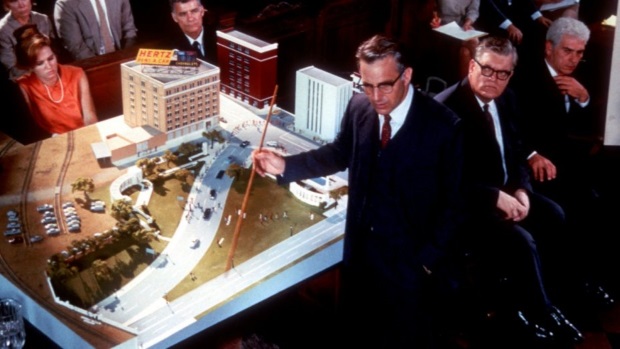
Taking the campaign of Louisiana DA Jim Garrison (Kevin Costner) to find out the “truth” about the murder of President Kennedy, Stone’s film is part a fascinating presentation of half-truths and “might-have-beens” and part a sprawling mess of irresponsible nonsense. Either way it’s assembled with astonishing panache, a level of filmic skill that makes it (literally) almost impossible to tell whether what you are seeing is true and what is invention. Stone’s film superbly interweaves a variety of film stocks and effects to seamlessly splice together newsreel footage, Zapruder film and his own reconstructions so brilliantly it frequently becomes hard to tell which is which.

The same logic also applies to the script. JFK is frequently engaging and fascinating. But you have to remember that it is the equivalent of meeting the most literate and articulate street corner “End-of-the-Worlder”. Such is Stone’s skill he could, I am sure, have created an equally compelling film which would have you questioning the Moon Landings or the shape of the Earth. JFK throws an army of questions, objections and theories at the screen. And while it rarely provides much in the way of answers, only points that it wants you to think about, these theories frequently fascinate. Imagine JFK as a sort of video essay, linked together with dramatic scenes, with its points delivered by authoritative and trusted actors like Donald Sutherland, Jack Lemmon and Walter Matthau.

There is absolutely no doubting the technique of Stone here, or his mastery of the language of cinema. The work of Robert Richardson’s photography, with its myriad styles, and of Joe Hutshing and Pietro Scalia’s editing, pulling together a host of images, snapshots and flash cuts into an insidiously convincing whole, is breathtaking. Light in particular is superbly used, casting some characters in shadow, flaring up to (literally) blind others – light frequently plays across Garrison’s glasses, a visual metaphor for his own struggle to see the light. The speeches he writes for his characters are superbly done, and make their points with great skill – Sutherland (superb) has a hugely convincing story of military black ops action (and inaction) before and after the assassination that fills almost 20 minutes of screentime.

There are compelling arguments made about the ability of Oswald to fire the shots, the triangulation of fire, the spurning of an easier shot before the fateful turn, Oswald’s seemingly illogical movements after the shooting etc. etc. There is decent reasoning behind all of this, and the points are marshalled very well. But, like all extremist theories, suddenly it will turn into something just a little batshit (Lyndon B Johnson ordering the hit or some sort of cabal of Cubans, CIA, FBI and Secret Service working together to conduct a coup).

Much of Stone’s passion for finding the truth (the film’s mantra) is rooted in his own romantic view of Kennedy, as some sort of lost “Prince Who Was Promised”. To Stone, Kennedy would have withdrawn us from Vietnam (news I am sure to the President who started and escalated America’s involvement in it), ended the military industrial complex (contrary to his platform when elected of a stronger US military), bought the Cold War to an end (again, running against his sustained opposition to the Soviet Union) and introduced full Civil Rights (a cause he was lukewarm on at best – unlike his brother or his successor Johnson).

But Kennedy was a romantic figure who had the ability to invite people to invest him with whatever qualities they wanted (both good and bad), a magic cemented forever by his untimely murder. In reality there is no indication that JFK would do (or want to do) any of the things JFK argues he was assassinated for. But that’s all part of the magic of the conspiracy. Facts and events can be marshalled into whatever you want them to be. (Tellingly the only member of Garrison’s investigative team who questions these theories is shown to be a creep in the pay of the conspirators.)

So Kennedy can be a saint, and the film can outline (with no evidence at all beyond a series of coincidences and unlikely or random events) a grand vision of master schemers reshaping America over the body of a dead President. Does it really stand up? Well no of course not. But I will say it is compelling viewing – even if it is essential to keep an open mind about it. Stone later wished he had made clearer that much of the work here was pure fiction (and speculative at best). Certainly it’s a point to keep in mind.

Perhaps Stone should also have looked again at some of the other beats in the film. The film’s version of Jim Garrison as a kind of saintly campaigner for justice flies in the face of many (then and later) who believed the Louisiana DA a shameless self-promoter – an argument made easier to believe by the real Garrison’s cheeky cameo in the film as his ‘nemesis’ Earl Warren. No mention is made in the film that the case he brings against Clay Shaw was dismissed by the jury after less than an hour, and the film avoids explicitly showing his lack of evidence. Costner delivers the final speech, with its famous “back and to the left” commentary on what seems like Kennedy’s unnatural movement after being hit by a bullet and breakdown of the “magic bullet” (both theories now largely discredited), with aplomb, but the film puts a halo on Garrison which doesn’t really stand up.

But again at least it’s entertaining. Other parts of the film don’t even manage that: the baseline narrative that links up the various compelling conspiracy lectures is frequently dull, insipid and lamely written. Sissy Spacek has perhaps the most thankless role in film history as Garrison’s wife whose nearly every line is a variation on “Honey please stop reading the Warren Report and come to bed”. Even that though pales against the exploration of the 1960s gay scene in Louisiana (which Clay Shaw and his “fellow conspirators” were leading members of) which has an unpleasant stink of homophobia, playing into a host of deeply unpleasant (and false) stereotypes of gay people as perverted, promiscuous and preying on the straight. One suspects there was more than a little truth in the idea that Garrison’s fury at Shaw was at least partly motivated by homophobia.

These sequences work considerably less well today – and frequently go on far too long – but when the film focuses on its Kennedy theories it is at least compelling, even if it’s all rubbish. The film made it mainstream to believe Kennedy was killed by a conspiracy in which Oswald was, if he was involved at all, only a patsy. How different would the world have been if Oswald had lived and been made to explain why and how he killed Kennedy? But then chances are, being such an average an unremarkable man, people wouldn’t have believed him anyway.

Stone’s film is a triumph of agenda-led fantasy. Stuffed with faults it makes you at least ask questions – even if you wisely use those questions to affirm many of its points are questionable at best. But any film buff will love the skill it’s told with and the beauty of its technical assembly. Costner was perhaps a little too bland to drive the thing along (although the film uses his innate morality very well), but there are several good performances not least from Gary Oldman who is brilliant as put-upon, used but unknowable Oswald. Nuts, crazy and packed with compelling nonsense, it at least always encourages you to find out more about the actual history.

Whatever Happened to Baby Jane? (1962)

Bette Davis and Joan Crawford rant and rage in Whatever Happened to Baby Jane?

Director: Robert Aldrich

Cast: Bette Davis (Jane Hudson), Joan Crawford (Blanche Hudson), Victor Buono (Edwin Flagg), Marjorie Bennett (Dehlia Flagg), Maidie Norman (Elvira Stitt), Anna Lee (Mrs Bates), BD Merrill (Liza Bates)

Age isn’t kind on the careers of Hollywood actresses. Move into your 40s and the part offered quickly becomes “the grandmother”. It’s a fate that saw the careers of some of the greatest actresses of the Golden Years of Hollywood crash screeching to a halt. However, these actresses remained popular with many cinema goers. So it occurred to Robert Aldrich, why not throw a couple of them into the sort of roles that can riff on their careers and public images? Match that up with jumping on the bandwagon of films like Psycho and you could have a hit on your hands.

That’s what he got as well with Whatever Happened to Baby Jane. Jane Hudson (Bette Davis) is a former “infant phenomenon” on the stage, whose career fell apart as soon as she hit puberty. Her sister Blanche (Joan Crawford), on the other hand, grew up to have a promising career in Hollywood – which then collapsed when a late-night driving accident (which Baby Jane is widely believed to be responsible for) left her paralysed from the waist down. Now in middle age, Jane and Blanche live in domestic disharmony, Blanche trapped upstairs at the mercy of Baby Jane, whose longing to rebuild her career sees her head down an ever steeper spiral of insanity.

Whatever Happened to Baby Jane started a new genre in Hollywood – the freak hag-horror or psycho-biddy genre (those names alone show that at its heart this genre was basically demeaning) which saw Hollywood Grande Dames (frequently Davis and Crawford, though others got a look-in as well) parley their reputations into ever more formulaic riffs. Films like this quickly became cult viewing. Their extremes of make-up and performance, matched with the arch camp of the leading ladies hamming it up, made the genre extremely popular – and left films like Whatever Happened… far more fondly remembered than they deserve.

It’s popular to see Sunset Boulevard as a sort of precursor to this genre, a first try-out in taking an older era of Hollywood and turning it into a ghastly waxwork show. But Sunset still has affection  for what it shows (and above all captures the tragedy of the death of Silent Hollywood, treating its characters as people rather than freaks), while Whatever Happened has none, basically seeing the past as a parade of monsters, and these relics as waxworks to be mocked. There is no affection here for the past successes and glories of either star, instead we are invited to sit back and wonder at how far they might be willing to go to see bums on seats again. All of this to make money for the producers. Far from the art of Sunset Boulevard, this feels more like the exploitation of screen greats.

Although of course both stars were more than happy to get involved, even if they were less than happy working with each other. The background to the film, to be honest, often carries more interest than the very long, often slow, horror/black comedy during the film’s over-extended run time. Famously Davis and Crawford were long-standing rivals and their relationship over the course of making and promoting the film disintegrated into cheap one-upmanship and bitter recrimination. While the feud does probably give some edge to the screen antics, the very fact that it’s nearly the first thing people remember about the film probably tells you how memorable the actual experience is.

Davis throws herself into all this with creditable abandon. (She was Oscar nominated and Crawford wasn’t – although Crawford got the last laugh, having arranged on the night to collect the Oscar on behalf of eventual winner Anne Bancroft, performing on Broadway that night.) Davis designed the freakish but iconic look of Baby Jane, all painted face and little girl mannerisms, and her demented attempts to recreate her childhood act in her 50s (culminating in a bizarre and skin-crawling “Writing a Letter to Daddy” dance which was weird enough watching a 12 year old perform) can’t be faulted for commitment. Davis also manages to invest the bullying and cruel Jane with a deep sense of loss, regret and guilt (for her sister’s accident) that frequently bubbles over into resentment. It’s certainly a larger-than-life performance and Davis frequently dominates the film, even if the role is basically a cartoon invested with Davis’ own grace and glamour.

It doesn’t leave much for Crawford, whose Blanche is frequently left with the more po-faced, dull and reactive lines. Crawford doesn’t often make Blanche as sympathetic as you feel she should be – although the part plays into one of her strong suits of playing the martyr – and the film saddles her with a late act twist that doesn’t have enough time and development to really make much sense. However again you can’t fault her commitment, either to screams or to a scene where she attempts to climb down the bannisters of the stairs from her trap on the upper floor, where the effort, strain and pain on Crawford’s face are astonishingly real.

Those stairs dominate many of the shots of Aldrich’s serviceable and efficient direction – although he lacks any sense of the mix of cruel poetry and dynamite sensationalism that Hitchcock bought to similar material in Psycho. But it works nicely to give a sense of Blanche’s confinement and as a visual metaphor for the trap the house feels like. Aldrich also throws in a couple of other decent flourishes, not least as Davis’ lounge turns into a proscenium stage as she imagines returning to the big time.

But the film itself is, despite it all, lacking in any sense of kindness or warmth really for either its stars or old Hollywood. We are instead invited to gasp at them in horror, while the film drags on at great lengths, stretching a very thin plot (barely a novella) into over two hours of screen time. There are effective moments, but it’s a film that seems barely serviceable today.

My Man Godfrey (1936)

Carole Lombard and William Powell flirt, fight and buttel in My Man Godfrey

Director: Gregory La Cava

Cast: William Powell (Godfrey), Carole Lombard (Irene Bullock), Alice Brady (Angelica Bullock), Gail Patrick (Cornelia Bullock), Jean Dixon (Molly), Eugene Pallette (Alexander Bullock), Alan Mowbray (Tommy Gray), Mischa Auer (Carlo), Pat Flaherty (Mike)

My Man Godfrey is one of the most beloved of all screwball comedies. It’s also the only film in history to be nominated in every acting category and the directing and writing categories at the Oscars and still not get nominated for Best Picture (proving comedy was devalued even then). Today it still carries a heck of a comedic wallop, splicing this in with an ever more acute and profound social commentary. It’s a gem of Golden Era Hollywood.

With New York in the midst of the Great Depression, affluent socialites the Bullock sisters – snob Cornelia (Gail Patrick) and ditzy, scatter-brained Irene (Carole Lombard) – are in hunt for a “forgotten man” so they can claim victory in their scavenger hunt. In a rubbish dump – turned home for the unemployed – they find the well-spoken Godfrey (William Powell). Godfrey is having none of the condescension of Cornelia, but finds the honesty and kindness of Irene more touching agrees to help her win the prize – whereupon he promptly admonishes the upper-class crowd at the Waldorf for their lack of concern for the working man. Ashamed, Irene offers him the job of Bullock family butler, which Godfrey accepts. But as he navigates the eccentric family, is Godfrey also hiding secrets of his own, secrets that suggest he is much more than he seems?

My Man Godfrey is a very funny film, centre-piecing the fast-paced comedic delivery of the era, the script never going more than a minute without a killer line or brilliant piece of comedic business. It’s helped as well by the casting, with every actor being perfectly selected for their roles, and each of them bringing their absolute A-game. Not least the partnership of Powell and Lombard – divorced in real life but still close – who spark off each other wonderfully and keep the will-they-won’t-they question beautifully balanced throughout the whole film. 

La Cava’s film – wonderfully directed with imagination and visual chutzpah – matches this up with an extremely neat, but not too preachy, line in social commentary. The self-obsessions and petty concerns of the Bullock family are frequently contrasted with the poverty and struggles of the working man, while the families’ lack of concern for the struggles of the vagrants and down-and-outs only a taxi ride away from their mansion home is striking. Godfrey frequently points up this lack of empathy in this ‘classless’ country (which is in fact defined by class), stressing he found more decency and kindness at the rubbish dump than he did in the palaces of the mighty. 

Sure Godfrey’s secret may well be that he is from loaded stock himself – but has given it all up in shame and self-disgust – but that only makes him all the better an observer of the whims of the rich treading on the poor. In fact My Man Godfrey could well be the film for today. The scavenger hunt dinner – a brilliantly directed, frenetic scene that looks years ahead of its time in its technical accomplishment – really captures this. The guests haw and shout over each other, clutching with an ironic glee their examples of poverty (from everyday objects to a goat to, of course. the ‘forgotten’ man, who has as much value as the goat to them). We get more of it at the posh clubs and cocktail parties the Bullock frequent, the guests (while not cruel) being as blasé and oblivious of their fortune as they are of the suffering in the rest of the city.

But that makes this sound like a civics lessons, whereas the film is first-and-foremost a comedy. It has a terrific performance from William Powell as Godfrey. Powell makes the part a mix of Jeeves and Wooster: the intelligence and calm of Jeeves with the warmth and tendency for scrapes of Wooster. Powell is brilliant at balancing the wry observer quality of Godfrey, while never sacrificing his warmer, generous soul. And also brilliantly suggests his wonderful judgement of situations and characters, without ever making him smug or a know-it-all. It’s a quite exquisite performance of unflappility covering emotional depth.

Lombard sparks off him very well as Irene, allowed to frequently head further over the top as Powell grounds Godfrey in normality (Lombard was a famously electric performer, and the outtakes reel for the film frequently show her screwing up her fast-paced dialogue with copious swear-words). Today the more ditzy Irene sometimes comes across as a more tiresome, less believable character – she is so obviously a narrative construction rather than someone who could be real that it becomes harder to connect with her (or to imagine Godfrey might find her attractive). But Lombard’s energy and drive carries the film through and the film highlights her electric qualities in several show-stopping scenes.

The entire Bullock household is in fact spot in, with gorgeous performances. Alice Brady (Oscar-nominated) is the quintessential disapproving society mother, archly self-obsessed. Eugene Pallette is wonderfully funny as the exasperated father of the household, barely able to understand either his family or his investments. Gail Patrick is a delight as Irene’s manipulative sister, proud and selfish. Mischa Auer (Oscar nominated surely off the bag of his extraordinary gorilla impersonation) is very funny as Angelica’s “protégé”, a preening, talent-free musician and freeloader who spends most of his scenes eating. Jean Dixon is smart and sassy as the maid Molly. There isn’t a bum note in this ensemble.

La Cava directs all this with great skill, framing the action with a beautiful sense of composition, pace and style. You know you are in save hands with the opening scene that show the credits appearing like neon bill boards during a slow, continuous tracking shot along the New York riverside. With dialogue that glides beautifully from humour to pathos, and delivery that creates comic archetypes that feel like real people, it’s a film that gets nearly everything right – which is why it’s still a classic today.

The Entertainer (1960)

Laurence Olivier excels as a faded music hall star in The Entertainer

Director: Tony Richardson

Cast: Laurence Olivier (Archie Rice), Brenda de Banzie (Phoebe Rice), Roger Livesey (Billy Rice), Joan Plowright (Jean Rice), Alan Bates (Frank Rice), Daniel Massey (Graham), Shirley Anne Field (Tina Lapford), Thora Hird (Mrs Lapford), Albert Finney (Mick Rice)

In the late 1950s Laurence Olivier was worried about his career. While he was still doing Shakespeare and Coward comedies (intermixed with the odd film), the world of acting and theatre was moving on. Not least as John Osborne’s Look Back in Anger was taking the West End by storm. Olivier seemed the polar opposite of the “Angry Young Men” of British theatre, a dusty relic. So Olivier changed gears – and his entire life – by asking to be cast in the lead role of Osborne’s next play The Entertainer. Olivier’s sensational stage performance – captured here on film – radically changed the path of both his career and his life, with his long-troubled marriage to Vivien Leigh broking down during it. But he also cemented himself as the leading British actor.

Olivier plays Archie Rice, a failing never-has-been end-of-pier comedy performer at an unnamed Seaside town in 1956. Rice’s routines are old-and-tired, his comedy tinged with desperation and he’s all but broke. Archie’s audiences are tired, bored and unamused. His home life, with his faded former beauty champ wife (Brenda de Banzie) is on the ropes due to his constant infidelity. His father (Roger Livesey) – a music hall celebrity with real talent – loves him but thinks he’s a disasater waiting to happen. His son Frank (Alan Bates) adores him but his daughter Jean (Joan Plowright) is more realistic. Archie through continues to peddle the idea of a success being round the corner, trying to put together a hit revue starring his latest mistress (Shirley Anne Field) and funded by her parents. Things will not end well.

The Entertainer’s main claim to historical note is that it captures that sensational stage performance of Laurence Olivier in the lead role. Olivier had always liked to claim that, with a few zigs and zags in his career, he would have become a third-rate comedian. His performance – with its ingratiating patter, it’s seedy sexually ambivalent campness, his selfishness and self-obsession and greed – is brilliant. Archie’s entire life is a desperate struggle to get himself the career he wants – while trying to shut his eyes to his own lack of talent (of which he is painfully aware). Olivier captures superbly not only the front of a man bent on self-promotion, but also the dead-eyed horror of a man who is aware all the time that he is dying inside.

Olivier’s eyes are drill-holes of death, and his life is an exhibition of selfish patter, with a constant sense of performance in every inch of Archie’s life. He’s a run-down, finished and disillusioned man trying to pluck what few moments of pleasure he can from a life he is only going through the motions in. All of it covered with a coating of self-delusion that quickly crumbles into sweaty desperation. While the film can only give a taste of the Olivier stage performance, it re-enforces Olivier’s energy, creativity and bravery. Olivier’s both bravura and tragically tired music hall performances alone are worth the price of admission.

Away from Olivier’s exceptional capturing of the washed up patter of the sleazy loser, it’s easy to overlook most of the rest of the film. But it’s directed with a kitchen-sink freshness by Tony Richardson, who brilliantly captures the faded grandeur and grubby failure of a failing seaside resort. Osborne’s play used the decline of music hall as a metaphor for the decline of the British Empire and while the film (for all its Suez references) doesn’t quite convey this, favouring instead domestic tragedy, it still perfectly captures the crumbling world of Rice and his ilk. Rice’s father – Roger Livesey, excellent and about a year older than Olivier – is a relic of the success of this era, and still carries some of its glamour, but still lives as a virtual tenant in the Rice home, eating spare cake where he can.

While the film is dominated by Olivier, this presentation of the play as a domestic tragedy works rather well. Brenda de Banzie (also reprising her role from stage) is very good as an ex-glamour puss (and former mistress of Archie) now turned into a faded, depressed matron, drunkenly bitter about what her life has (not) led to. Joan Plowright is excellent as the knowing daughter, alternately sympathetic and appalled at her father. Shirley Anne Field’s naïve lover is suitably naïve, under the control of her battleaxe mother, well played by Thora Hird. The cast is rounded out with Alan Bates and Albert Finney (both in debuts) as Archie’s sons.

While the film feels a little overlong at times, and is perhaps too much in thrall to Olivier, it offers a neat kitchen-sink view of failure and corruption in British life of the 1950s. There is, of course, no hope and no second chances here. Only the long, wearying decline and rotting as Archie’s life disintegrates under pressure and his own incompetent self-delusion. 

Barry Lyndon (1975)

Ryan O’Neal is Barry Lyndon in Kubrick’s brilliantly distant epic

Director: Stanley Kubrick

Cast: Ryan O’Neal (Redmond Barry), Marisa Berenson (Lady Lyndon), Michael Hordern (Narrator), Patrick Magee (Chevalier du Balibari), Hardy Krüger (Captain Potzdorf), Marie Kean (Belle Barry), Gay Hamilton (Nora Brady), Godfrey Quigley (Captain Grogan), Murray Melvin (Reverend Samuel Runt), Steven Berkoff (Lord Ludd), Frank Middlemass (Sir Charles Reginald Lyndon), Leon Vitali (Lord Bullingdon), Leonard Rossiter (Captain John Quin), André Morell (Lord Wendover), Anthony Sharp (Lord Hallam), Philip Stone (Graham), Arthur O’Sullivan (Captain Feeney)

Kubrick has been criticised as a director more interested in style and the technical tricks of cinema than emotion, and there is perhaps no argument for the prosecution than Barry Lyndon. It now seems to the cineaste’s choice du jour as the greatest Kubrick film (probably partly because it is less well-known). Barry Lyndon however is like an exercise in all Kubrick’s strengths and weaknesses, a film that you can admire at great length while simultaneously caring very little about anything that happens in it.

Based on a William Makepeace Thackeray (although it feels in spirit only), Barry Lyndon tells the story of Irish chancer Redmond Barry (Ryan O’Neal) in the mid eighteenth century. Fleeing Ireland after (he believes) killing an English officer in a duel, Barry goes from the British arm to the Prussian army, to card-sharping the courts of Europe to marrying into the aristocracy, as husband to Lady Lyndon (Marisa Berenson). But, however hard he tries, it’s difficult for an Irish chancer to be accepted by the British aristocracy, particularly when he suffers from the vocal hatred of his wife’s son Lord Bullingdon (Leon Vitali). 

Kubrick spent several years carrying out research for an epic biopic of Napoleon (he had Ian Holm lined up for the lead role – Holm read multiple biographies and spent months working on a script with Kubrick). The flop of Waterloo (with a deliciously hammy Rod Steiger as Napoleon) killed off the chances of that film making it to the screen. Never-the-less Kubrick now had a vast archive of research for the period – and how easy it was to shift the focus of this research back a few decades. Thackeray’s novel was his chance to put all this to use – and allow Kubrick to indulge what had become a passion for the style of the era.

Barry Lyndon won four Oscars – and all in the areas where the film deserves unqualified praise. This is a stunningly beautiful piece of work, surely a contender for one of the most strikingly gorgeous films ever made. Ken Adam’s set design utilises a superb range of locations across the UK, dressed to breath-taking effect. The costumes, completely accurate to the period, are exquisitely detailed (Milan Canonero and Ulla-Britt Söderland) and lusciously mounted. Leonard Rosenman’s score is a wonderful riff on a range of masterpieces from classical music, including Handel, Bach, Schubert and Mozart.

Most strikingly Kubrick decided to film as much as possible with natural lighting only, rather than the vast array of lighting bought in for most films. This was part of Kubrick’s intention to avoid any sense of the studio to his film – everything was to be shot on location and to help immerse the viewer in the detail of the period. Shots were framed to imitate artists of the period, in particular Hogarth. Evening scenes were shot lit only by candle-light, leading to truly stunning images, simply superbly lit. John Alcott’s photograhy utilised (and I’m serious here) NASA designed cameras used for the moon landings to capture images in such low light. Visually, Barry Lyndon may be one of the most perfect films ever made. It’s wonderful – and any doubts that Kubrick is not a true master of cinema should be dismissed.

But Kubrick’s problem, as always? He’s a technocrat artist who lacks some soul. So much time and energy has been expelled on the visuals and the design – the film took almost a year to shoot – that, while you are constantly almost hypnotised by its sublime imagery, it slowly occurs to you that you couldn’t care less about most of the events that happen in it. For all the film’s great length and beauty, it’s a cold and distant film. Kubrick turns Thackeray’s rogueish comic tale – a picaresque dance – into a chillingly sterile meditation on fate, with Barry transformed from a rogue and chancer into a lifeless, passive figure to whom things happen rather than ever attempting to instigate them. 

Is this Kubrick’s idea of humanity? Perhaps it suits the director who was the great master of intricate design and traps, that he would be tempted to turn this story into one where humans are just another piece of set dressing moved around and manipulated by an unseen force (fate, or rather a director?). The distancing effect is further by super-imposing an all-knowing narrator over the events, who frequently pre-empts what will happen and stresses the powerlessness of men. (On a side note, the book is narrated by Barry as were early screenplay drafts – perhaps the idea of O’Neal’s flat voice narrating so much of the action horrified Kubrick. It’s a definite improvement to get Michael Hordern’s tones talking to us for three hours.)

Perhaps though, the failure to capture any sense of Thackeray’s satirical wit, is a sharp reveal of Kubrick’s own inability to appreciate comedy – without the guiding hand of a Peter Sellers to support him. The problem is exacerbated by Ryan O’Neal in the lead role. Kubrick was ordered to hire one of the top ten box office draws of 1972 in the lead role – alas only O’Neal and Redford were the correct age and sex, and Redford (first choice) could never see himself as an Irishman masquerading as an Englishman. So O’Neal got the job – and the film is a damning indictment of his lack of charisma, flat and dry delivery and inability to bring life and energy to the proceedings (although O’Neal has blamed the editing partly for this, as well as the extended shoot). The film helped put an end to O’Neal’s career as a star (already on the wane) – and he is the film’s greatest weakness, in a role that needed more of the impish charm of Malcolm McDowell (although the lead actor from any of Kubrick’s films would have been superior). O’Neal’s presence turns Barry into a character we care nothing for, in a story already coldly distant.

O’Neal is also not helped by Kubrick’s utilising again his great love of striking British character actors – every role is filled with a recognisable face from 1970s British film and TV, each bringing colour and vibrancy to their (often brief) scenes. From Leonard Rossiter – weasily as you’d expect – as the captain Barry thinks he kills, through Patrick Magee’s ambivalently sinister Chevalier, Marie Kean’s loving mother, Murray Melvin’s obsequious priest, Godfrey Quigley’s matey army officer there is not a weak turn elsewhere in the movie. Leon Vitali brings real depth and energy into the film late on as Barry’s son-in-law and hated rival. Even Marisa Berenson – reduced to a dozen lines at most – makes an emotional impression as a woman trapped into serving the needs of the men in her life.

All these actors however are revolving in a movie that gets stuck and overwhelmed in its own grandeur and beauty. There are many wonderful sequences – with the film bookended by two duelling sequences that explore the strange rules and conventions with this society with a vicious black humour. Kubrick’s points about the oppressive insularity of the establishment – and the amount of forgiveness it has for its own, compared to the instant judgement of the outsider – are generally well-made, but are at times so laced with the director’s own cynical views of humanity in general (an increasingly clear trait in his later work) that they carry little impact. Despite this the film is never less than strangely captivating, even if its very easy to let it drift past you rather than invest in it.

But above all, while the film is stunning and the direction of Kubrick near faultless, the film itself gets so close to a great painting that it becomes something you hang on the wall to admire, but not to invest in. Kubrick couldn’t match his genius with the sort of emotion or wit that the story needed (much as it’s vastly superior to Tom Jones, that film gets closer to the spirit of authors like Thackeray than this ever does). Instead, he creates a coldly sterile world, like a perfect experiment in form and style that totally forgets such trivial elements as character and story. For all the film is full of character and events, you’ll find you care very little about them – and that the brilliance of Kubrick is only a partial consolation for that loss.

Gladiator (2000)

Russell Crowe dominates in Ridley Scott’s Oscar-winning Gladiator

Director: Ridley Scott

Cast: Russell Crowe (Maximus Decimus Meridius), Joaquin Phoenix (Emperor Commodus), Connie Nielsen (Lucilla), Richard Harris (Emperor Marcus Aurelius), Oliver Reed (Proximo), Derek Jacobi (Senator Gracchus), Djimon Hounsou (Juba), Tomas Arana (General Quintus), Spencer Treat Clark (Lucius Verus), David Schofield (Senator Falco), John Shrapnel (Senator Gaius), Rolf Moller (Hagen), Tommy Flanagan (Cicero), David Hemmings (Cassius)

When Gladiator hit the big-screen the swords-and-sandals epic genre was dead. A relic of the early days of technicolour Hollywood, where the widest possible screens were designed to tempt audiences away from the television and into the movie theatre, Roman epics were often seen as stodgy things, usually carrying heavy-handed Christian themes while gleefully throwing as much of the decadence of the empire on the screen as possible. Gladiator changed all that, bringing an emotional and psychological complexity to the genre, as well as a rollicking good story and some brilliant film-making. An Oscar for Best Picture confirmed the genre was back.

In 180 AD General Maximus Decimus Meridius (Russell Crowe) commands the final battle of the Roman forces to conquer the German tribes and bring them under the control of the Emperor Marcus Aurelius (Richard Harris). The humble, dutiful and principled Maximus is a natural leader and the son Marcus Aurelius wishes he had, rather than the son he has the insecure and ambitious Commodus (Joaquin Phoenix). When the Emperor decides that Maximus not Commodus will succeed him – with the brief to restore the Roman republic – Commodus murders the Emperor. When Maximus refuses to give Commodus his loyalty, the new Emperor sentences him and his family to death. Maximus escapes, although he is badly injured, but arrives too late at his home to save his wife and son from death. Collapsing, the General is taken by slavers, healed by fellow slave Juba (Djimon Hounsou) and sold to the North African Gladiator school of Proximo (Oliver Reed). Maximus will play the Gladiator game – because he longs to have his revenge on Commodus.

Gladiator is superbly directed by Ridley Scott, who perfectly mixes the epic scale of the drama with the intimate, human story at its heart. The film looks absolutely fantastic from start to finish, with the superb visuals backed by a breathtakingly beautiful score by Hans Zimmer and Lisa Gerrard that skilfully uses refrains and themes to instantly identify the core emotions in the audiences mind. These themes are associated with emotional beats that immediately plug us into the interior thoughts and emotions of the characters. 

It works because of the emotional truth at its heart. Basically it’s a love story between a man and his dead wife, and isn’t afraid to explore the depths of love that we feel for those closest to us and our pain of their loss. Maximus’ wife and child are represented in silent flashbacks and by two small icons Maximus carries with him on campaign. When, late in the film, he is reunited with these items his raw, tearfully quiet joy carry as much force as any real reunion would do. What drives the film is less a drive for revenge – although there is no doubt this is a motivator for Maximus – but of a continued sense that he must fulfil all his duties (in this case restore the Republic as his surrogate father wished) before he can return to his wife and son (i.e. die).

It’s that which makes the film so easy to invest in emotionally, and which makes Maximus (a hardened killer) so easy to relate to. If he was just a raging man out for revenge, the film would carry a leaner harsher look. But he is instead a man motivated by love, who yearns to be with his family again. Mortality hangs over the entire film – the first shot of the film, famously of the hands in the wheat, have buried themselves in the consciousness because we can all relate to a man who longs to lay down his labours and be with the people he loves. Christianity doesn’t appear too much in Gladiator (unlike older Hollywood Roman epics) but faith is there in spades. And Maximus will do nothing that will jeopardise a reunion with his family in heaven.

This deeply involving story of a man who remains faithful to the memory of his wife – and Scott wisely removed any love plot with Lucilla, which would have felt like cheatingso strongly does the film build Maximus’ love for his wife – that audiences are happy to go with the film through all the violence that follows. Gladiator hit the sweetspot of having something for everyone, from emotion to action. And the action is brilliant. The opening battles is hugely impressive, from its scale to the imaginative interpretation of Roman tactics. It’s trumped by the more raw and ragged action that comes in the Gladiatorial ring, as Maximus transfers his brutal efficiency at war into the ring for the amusement of the crowd.

Like all Gladiator films and series the film successfully has its cake and eats it – so we get a sense of the horror of people fighting to the death for our entertainment, while also heartily enjoying watching our heroes kick ass. The sequence that uses this most effectively, as Proximo’s outmatched Gladiators follow Maximus’ strategic experience and military training to defeat a group of deadly chariot fighters, would-be a stand out in any movie.

The film further works due to the assured brilliance of the Oscar-winning Russell Crowe in the lead role. Crowe exudes natural authority as a general – he genuinely feels like the sort of man that first his soldiers and then his fellow Gladiators will follow to the bitter end. Crowe also dives deep into the soulful sadness at the heart of Maximus, the romantic longing and the searing pain of the betrayal and murder of his family. It’s a performance of immense, small-scale intimacy that also never once gets over-shadowed by the huge spectacle around him. I’m not sure many other actors could have pulled it off.

But the whole cast is extremely strong, Scott encouraging great work across the board. Joaquin Phoenix in particular takes the villain role to a bravely unusual place. His Commodus, far from a sneering Caligula, is in fact a weak, anxious, jealous even strangely pitiable man, so insecure and riven with envy for others that he becomes twisted by it. But we never lose a sense of the humanity at his heart, the sense of a little boy lost, scared by the world around him. It makes sense the Connie Nielsen’s Lucilla – walking a difficult line as a character who has to play both sides – could both fear and hate him but still love the fragile little brother she still senses in him.

Scott’s trusting of experienced pros – many you feel hungry for an opportunity like this – is clear throughout the whole cast. Richard Harris was pulled out of a career slump and reinvented here as an elder statesman, with a wry, playful and eventually moving performance as Marcus Aurelius. Scott’s biggest risk was pulling Oliver Reed from a life better known for drinking bouts to play Proximo. Playing his best role for almost thirty years, Reed reminded us all for one last time that as well as a chat-show joke he was also a powerful and dominant performer, his Proximo a snarling scene stealer. Reed’s death – his final scenes completed with special effects – made this a better tribute than he could have ever imagined.

There are few feet placed wrong in Gladiator. As an action spectacular it’s faultless, but this works because of the truth and love at its heart. It creates an epic that is emotionally involving as it is exciting to watch. The reconstruction of Rome is hugely impressive and Scott paces the film perfectly, letting its force grow along. You never once feel thrown by its scope, and so completely does it wrap you up that, as it becomes more operatic in the final act, the film is never at risk of losing you. It deserves to be remembered with the best of the Hollywood epics.

8½ (1963)

Marcello Mastroianni plays a version of the director in Fellini’s inspiring

Director: Federico Fellini

Cast: Marcello Mastroianni (Guido Anselmi), Anouk Aimée (Luisa Anselmi), Rossella Falk (Rossella), Sandro Milo (Carla), Claudia Cardinale (Herself), Guido Alberti (Pace – Producer), Jean Rougeul (Carini Daumier), Mario Pisu (Mario Messabotta), Barbara Steele (Gloria Morin), Madeline Lebeau (Herself), Eddra Gale (La Saraghina), Ian Dallas (Maurice, clairvoyant’s assistant)

If there is a single director associated with self-reflecting films its Federico Fellini. Frequently recognised as one of the greatest and most influential directors of all time, many of his films use baroque imagery and a masterful interplay of reality and fantasy to delve deep into both its director’s own subconscious and the swirling pressures and internal conflicts that make us the people we are. is, perhaps, the greatest expression of this style of film-making, a giddy sensory delight that demands investment and wisdom to unpeel its layers and give you a chance of finding its meaning.

Frequent Fellini collaborator Marcello Mastroianni plays Guido, a thinly veiled portrait of Fellini himself. Like Fellini, Guido is a successful and visionary director, facing pressure to come up with his ‘next masterpiece’ after the glorious success of his previous film (in Fellini’s case La Dolce Vita). Like Fellini, Guido is struggling to work out exactly what statement he wants to make next, instead allowing himself to become distracted by personal issues and day-dreaming flights of fancy (literally so in the film’s opening, where Guido imagines himself flying through the sky before being tethered and pulled to earth by his producer). Most of all these distractions revolve around women, from his wife Luisa (Anouk Aimée), his mistress Carla (Sandro Milo) and recurring daydreams of Claudia Cardinale (playing herself) who could just be the muse he is looking for. 

To me one of the things that can make a film great, is when the ideas in it are not obvious and tired, but when they defy obvious characterisation but throw themselves open to further thought and different interpretation depending on your mood. definitely meets this criteria, combined with the fact that it’s beautifully made and very entertaining.

Fellini’s deep dive into his own subconscious is deeply involving and intriguing. The film dances from beat to beat between reality, memory and fantasy – often leaving the lines blurred about which of these we are watching at any one time. That’s part of Fellini’s idea, that our minds are complex enough to exist on all three plains at the same time, to juggle within ourselves what’s real, what we remember, what we imagined or wished could happen and how we create our own versions of all these. 

In the build-up to the film, Fellini famously struggled to identify what he wished to make and what it should be about. But while you could say that Fellini turned this creative block into a film – that, when unsure about what to make a film about, he made a film about a director who didn’t know what to make a film about – that’s to suggest a vagueness in its execution that isn’t the case. Fellini knows exactly what he’s doing here: every scene serves its purpose to explore the ennui and feelings of entrapment that an artist feels, both in his life and his craft. Far from being ambling, the film is carefully constructed and brilliantly focused.

Guido is hounded at every corner by people wanting something from him. Be it producers demanding progress, extras looking for roles in his film, actors demanding insight for their characters to his mistress looking for his attention or his wife demanding more focus from him on their marriage. The film is Guido attempting to identity among all these demands what he needs and wants from his own life – and how to build on that. It’s telling that most of Guido’s fantasies that litter the film revolve around his demands for other people to service him – be that romantically, literally or spiritually. Is part of the point of the film that we are all selfish to some extent? 

It’s the film’s exploration of day-dreaming fantasy that gives it some of its most extraordinary work, coupled with Fellini’s superb and striking visuals. The opening sequences of Guido imaging literally flying out of a traffic jam (and away from the stares of the other drivers) into the freedom of the sky – before being literally pulled back down to Earth – shows how these flights of fancy give us windows into our own desires. Guido’s a confused man looking for focus and something to believe in – his constant fantasies of Claudia Cardinale seem in part longing for her to solve his creative problems, part sexual, part almost motherly, as if she can take some decisions away from him.

Other fantasies – such as an imagined conversation with a priest for spiritual guidance – lean on finding the sort of structure his life seems to be missing. (And also, in a fantasy confession of his ennui to the same priest, perhaps a need again to be told what to do.) Most of his fantasies though revolve around romance. He imagines his wife and mistress sharing anecdotes before dancing away arm-in-arm. Most famously, an extended sequence shows Guido imagining a harem containing all the woman in his life, where he is the centre of attention – and women who age beyond his interest are politely banished upstairs “to be well looked after”. The women range from long-standing crushes and mistresses, to half-glimpsed dancers and an air hostess with a sexy voice. 

There is a striking honesty about Fellini putting something like this on film – and then use the fantasy he is displaying to both comment on and criticise his own internal fantasies. In the fantasy, unlike real life, his wife is an almost maternal figure (Guido has already jumped at one point in his reverie earlier in his film, to remember his mother only for her to turn into his wife), the women address Guido with harsh truths about everything from his character to his sexual performance, a revolt breaks out in the fantasy harem at Guido’s banishing of early crushes as they age (one which Guido stamps out). The harem is further set within his childhood home, adding a whole other layer of odd sexuality to it, as part of the women’s duties are to bath and wash him exactly as his grandmother did as a boy. It’s a sequence that lays itself open to multiple interpretations, but never feels exploitative or sleazy.

Large chunks of the rest of the film take place in a hard-to-define space between dream, memory and reality. Frequently scenes shift in nature half way through – Guido is followed throughout the film by a critic-turned-screenwriter, full of criticism of the intellectual shallowness of his work who, mid-rant, he imagines taken away for execution by some toughs. Gentle tracking shots around the retreat Guido is staying at – scored with a mixture of classical music and Nina Rota’s wonderful score – trip a line between real and imaginary in the sights we see. Conversations are intercut with imagined moments or might simply be happening in a pretence rather than a reality.

If it sounds like a difficult view, it’s not. Because for all the intelligent analysis of the ennui that can come from a creative block and the internalised struggle to find a balance between all the impulses that pull on us, it’s also a hugely entertaining film. Funny, wise and superbly acted. Mastroianni is brilliant as Guido, in turns giddy and world-weary, confused and resigned then ambitious and dreamlike. The rest of the cast are also excellent, with Anouk Aimée delightful as his long-suffering wife and Sandro Milo hugely entertaining as a needy but largely ignored mistress.

Fellini’s dives into memory also add both a richness and an emotional heft to the film. There are some beautifully nostalgic sequences that head back into the past. Guido’s childhood is explored with a series of wonderful vignettes. From his childhood in a wine distillery with his grandmother and aunts, full of playful energy, to the first stirring of a sexual awakening watching a prostitute dance on the beach (a quite extraordinary scene of playful flirtation, but still rather oddly innocent in its way). These scenes have captured the imagination of directors across the globe, with their power and ability to capture both the nostalgia of recollection, but also a distant magic of memory and the impact these still have on us in the present. But no body does this better than Fellini.

The best thing that can be said about is that I can imagine watching it hundreds of times, and each time seeing something fresh and new about it. And it works because its ideas are profound without being pretentious and easy enough to engage with, while never shallow. It brings depth and richness to complex internal struggles and repackages these into a rich experience that enlightens both memory and creativity. A great movie.

Deep Impact (1998)

It’s the end of the world in Deep Impact

Director: Mimi Leder

Cast: Robert Duvall (Captain Spurgeon “Fish” Tanner), Téa Leoni (Jenny Lerner), Morgan Freeman (President Tom Beck), Elijah Wood (Leo Biederman), Vanessa Redgrave (Robin Lerner), Maximilian Schell (Jason Lerner), James Cromwell (Alan Rittenhouse), Ron Eldard (Commander Oren Monash), Jon Favreau (Dr Gus Partenza), Laura Innes (Beth Stanley), Mary McCormack (Andy Baker), Bruce Weitz (Stuart Caley), Richard Schiff (Don Biederman), Betsy Brantley (Ellen Biederman), Leelee Sobieski (Sarah Hochtner), Blair Underwood (Mark Simon), Dougray Scott (Eric Vennekor)

Sometimes two Hollywood studies have the same ideas at the same time. When this happened in 1974 they clubbed together and turned two scripts about burning skyscrapers into one movie – The Towering Inferno. But it’s more likely they’ll do what happened with volcano movies in 1997, White House invasion movies in 2013 and asteroids movies in 1998: both make a film and rush to be the first one out. Usually that’s the winner (ask Dante’s Peak or Olympus Has Fallen). The exception was Deep Impact which made plenty of moolah – but was trumped by Michael Bay’s thundering Armageddon, with its far more straight-forward feel-good action.

A meteor is heading towards the Earth – and it’s an Extinction Level Event (ELE) that will wipe out all life on Earth. World governments keep it hushed up, wanting to avoid mass panic, and start planning to preserve mankind. Underground “arks” will be built in major countries to protect a small number of population. And a manned space mission, crewed by a team of young bucks and veteran astronaut Spurgeon “Fish” Tanner (Robert Duvall), will head out to the asteroid to try and use a nuclear bomb to blow it up. However news leaks when intrepid young MSNBC reporter Jenny Lerner (Téa Leoni) stumbles on news of a cabinet resignation, over a mysterious “Ellie”, leading to her accidentally uncovering the meteor. President Tom Beck (Morgan Freeman) announces all to the world – and mankind prepares, in hope, for the disaster.

Deep Impact is a well-mounted and surprisingly thoughtful adventure story, that tries to deal with its Earth-ending themes with a seriousness and humanity that’s a world away from the flag-waving crash-bangs of Armageddon. Well directed by Mimi Leder, who juggles effectively huge special effects and low-key personal stories (even if these have the air of movie-of-the-week to them), it’s an ensemble piece with a surprisingly downer ending (no surprise from the poster) that still leaves more than a touch of hope that mankind will persevere.

It’s poe-faced seriousness about reflecting on the end of the world may be dwarfed now by superior TV shows – it’s hardly The Leftovers – but felt quite daring for a 90s blockbuster, at least trying to be some sort of meditation on the end of the world. While the film does do this by focusing on the most mundane of soapy dramas – will Jenny Lind (Téa Leoni in a truly thankless role) manage to reconcile with her estranged father (Maximilian Schell, a bizarre choice but who manages to rein in most of the ham) who walked out on her and her mother (Vanessa Redgrave, if possible an even more surreal choice) before the world ends – at least it’s sort of trying.

Soap also soaks through the storyline about young Leo Biedermann (Elijah Wood), the geeky wünderkid who discovers the asteroid. The drama around a national lottery to select the chosen (very) few who will join the 200,000 essential scientists, artists and politicians in the bunker is boiled down to whether Leo will be able to sneak his girlfriend (Leelee Sobieski) and her family on the list. Needless to say, this plotline boils down into a desperate chase, some heroic sacrifices and a great deal of tears. This sort of stuff doesn’t re-invent the wheel, but it makes for familiar cinema tropes among the general “end-of-the-world” seriousness.

There isn’t much in the way of humour in Deep Impact, perhaps because those making it were worried cracking a joke might undermine the drama. There’s nothing wrong with this, but you start to notice more the film’s “not just another blockbuster” mindset being warn very firmly on its sleeve. The film’s third major plotline, around the mission to blow up the asteroid, is as much about whether grizzled, wise vet Robert Duvall will win the respect of the dismissive young bucks he’s crewed with (spoilers he does) as it is whether they will destroy the meteor. Anyone who can’t see sacrifices coming here btw, hasn’t seen enough films – but these moments when they come carry a fair emotional wallop, partly because the film never puts its tongue in its cheek.

It’s a film proud of its scientific realism, which makes it slightly easy to snigger at the sillier moments – especially when it takes itself so seriously. An astronomer (played by The Untouchables luckless Charles Martin Smith) drives to his death racing to warn the authorities (why not just call them from his office eh?). The astronauts, for all their vaulted training, hit the meteor surface with all the blasé casualness of high-school jocks. Jenny’s journalistic investigation is so clumsy and inept, it’s hilarious watching the President and others assume she’s way more clued up than she is (this also comes from a time when Jenny could key in “E.L.E.” into the Internet and get one result – I just tried it and got 619 million. Simpler times).

I’ve been hard on this film, but honestly it’s still a very easy film to like. Sure it’s really silly and soapy but it takes itself seriously and it wants to tell a story about people and human relationship problems, rather than effects, which is praiseworthy in itself. The best moments go to the experienced old pros, with Duvall rather good as Tanner and Morgan Freeman wonderfully authoritative as the President (it was considered daring at the time to have a Black President). The special effects when the meteor arrives (spoiled on the poster and the trailer) are impressive and while it’s easy to tease, you’ll still welcome it every time it arrives on your TV screen.

The Vikings (1958)

Kirk Douglas has a whale of a time as one of The Vikings

Director: Richard Fleischer

Cast: Kirk Douglas (Einar), Tony Curtiz (Eric), Ernest Borgnine (Ragnar Lodbrok), Janet Leigh (Morgana), James Donald (Egbert), Alexander Knox (Father Godwin), Maxine Audley (Enid), Frank Thring (Aella of Northumbria), Eileen Way (Kitala), Dandy Nichols (Bridget), Edric Conner (Sandpiper), Orson Welles (Narrator)

There’s a big market for stories about Vikings. Perhaps there is something attractive in our more staid world for a “noble savage” culture, with warriors romantically travelling far and wide. Perhaps a race of brave warriors just seems rather cool. Either way, despite their reputation for ravishing and raiding, Vikings often get a decent deal from films, usually positioned as a race of anti-heroes. That’s definitely what we get from Richard Fleischer’s enjoyable swashbuckler, which has a nodding acquaintance with history.

After the King of Northumbria is killed by fearsome Viking Ragnar Lodbrok (Ernest Borgnine), his queen is raped by Ragnar. Northumbria name a new King, the corrupt Aella (Frank Thring), while the queen sends her baby son (who she knows is Ragnar’s son) to Italy for his protection. Jump forward twenty odd years and, wouldn’t you know it, that young boy turns up as Eric (Tony Curtis) a slave of Ragnar’s, loathed by his unknown half-brother Einar (Kirk Doouglas), Ragnar’s son. The only person who knows who Eric is, is exiled Northumbrian load Egbert (James Donald). Things get even more complex when Aella’s intended Morgana (Janet Leigh) is kidnapped in a raid, and both Eric and Einar fall in love with her….

The Vikings is a great deal of fun, its tongue stuck firmly in its cheek. The plot veers from scene-to-scene from being too dense (various complexities around the rightful king of Northumbria get so confusing the film eventually abandons them) too being shunted off to the sides in favour of the action. But then it’s more about broad, brightly coloured action (very handsomely filmed by Jack Cardiff) with its stars having a good time fighting and shouting.

It’s interesting watching the film as almost a dry run for Spartacus, where Douglas and Curtis would re-unite. Here the film revolves around a rivalry between the two that turns into an alliance of mutual self-interest. Douglas clearly has a whale of a time playing a semi-baddie with depth, his Einar a typical “Viking’s Viking” who drinks hard, fights hard and wants a life of adventure on the high seas. But he’s also got a strange sense of nobility about home and – even though he makes a half-hearted attempt to rape her – he seems to fall genuinely in love with Morgana. Even his eventual comeuppance comes from a moment of decency. It makes for a villain more complex than normal, while Douglas roars through the movie.

Curtis is left with the duller part as the noble son-of-a-king. Looking rather too pampered for a life of serfdom, Curtis feels like a slightly too modern, New Yorkish presence for period pieces (Spartacus would use his pampered prissiness to better effect) but he charges into the sword swinging, high romance of the story with relish, while also shining during Eric’s several moments of brave principle. Morgana, very well played by his real-life wife Janet Leigh, sees a character who could have been a victimised love-interest turn into an independent and strong-minded woman, brave enough to take a stand on the things she believes in.

But the film’s real interest is in the world of the Vikings. There has been some very impressive historical research into their culture and shipping, while the battles and scenes of drunken merriment are well staged and carry a lot of boozy buzz. Most of the cast enter into relish, following Douglas and Ernest Borgnine’s lead (Borgnine, playing Douglas’ father, was at best a few months older) with plenty of shouting, ale swallowing and axe throwing. While the film’s score makes a number of odd choices – this really needed a Goldsmith or Morricone rather than the odd mix we get here – Fleischer’s direction is crisp and adept and keeps things charging forward.

The politics at the Northumbrian court gets a bit forgotten about, with Alan Thring turning Aella into a sneering, unprincipled villain who barely gets much of a look-in. However, the savage punishments that Aella meets out to his rivals – and his ruthless condemnation of anyone seen as being against him – makes a neat contrast with the Vikings who, for all their blood-curdling violence, do at least have some sort of nominal sense of justice and some willingness to compromise.

But the film’s heart is in the action. Douglas, acting as producer, jumped at the chance to take on as many of the stunts as possible – including famously walking across the oars of a Viking longboat while it is at sea (he nearly falls in twice, but it has the sort of excitement of seeing the star doing something for real that you still get with Tom Cruise). He and Curtis eagerly take part in assorted sword battles, while balancing a love/hate relationship (well probably mostly hate) that keeps the film powering forward. All in it makes for some really enjoyable B-movie shenanigans.

Captain Phillips (2013)

Tom Hanks is kidnapped by pirates in Captain Phillips

Director: Paul Greengrass

Cast: Tom Hanks (Captain Richard Phillips), Barkhad Abdi (Abduwali Muse), Barkhad Abdirahman (Adan Bilal), Faysal Ahmed (Nour Najee), Mahat M, Ali (Walid Elmi), Michael Chernus (Shane Murphy), David Warshofsky (Mike Perry), Corey Johnson (Ken Quinn), Chris Mulkey (John Cronan), Catherine Keener (Andrea Phillips), Max Martini (SEAL commander)

The best of Paul Greengrass’ directorial work brings documentary realism to compelling real-life events, laced with tragedy. He’s made extraordinary films about Bloody Sunday and 9/11 and bought his unique style to Jason Bourne and the Green Zone of Iraq. Captain Phillips continues this, bringing to life the true story of the hijacking of the container ship Maersk Alabama and the kidnapping of its captain Richard Phillips. And this is a brilliantly tense and dynamic film which seizes the viewer in a vice-like grip and never once lets up for a moment of its runtime. 

Tom Hanks plays Richard Phillips, dedicated and professional merchant captain, whose ship is eventually seized by four Somali pirates, led by Abduwali Muse (newcomer Barkhad Abdi, who landed BAFTA and  Oscar nominations for this work here). Phillips is determined to protect the crew (who are hidden around the ship), while the pirates are desperate for a life-changing score that could free them from lives of crushing poverty in Somalia. With such high stakes to play for, Phillips and Muse find themselves engaged in a battle of wills and wits – but with only one of them armed with a gun.

Greengrass’ film is almost unbelievably tense. From the first appearance of Muse’s skiff off the Maersk Alabama to the film’s end, Greengrass manages to keep the audience on a knife edge for over two hours – this despite it being based on a true story where we know the hero will come out in one piece. Shot in the typical Greengrass style, with an at-times jittery handheld camera – brilliantly shot by Barry Ackroyd, a master of this style – this is an immersive drama to an extreme degree. You really do feel part of the action, with the immediacy of the shooting infecting the entire viewing experience.

This is powered further by Greengrass’s superb work with actors – and he draws some marvellous performances here. Tom Hanks – inexplicably not nominated for an Oscar – gives a near career best performance as Phillips. Hanks’ natural skill at playing regular, relatable guys in impossible situations is perfect for Phillips, but he mixes it here first a slightly stern authoritative distance Phillips has with the crew and a deep sense of duty. On top of which, thrown into an impossible situation Hanks has Phillips walking a tight-rope of being seen to co-operate with the hijackers, while trying to work against them, while simultaneously becoming increasingly frayed around the edges. The final sequences alone – of a shocked and emotionally exhausted Phillips – were deserving of the highest honours, raw and honest work from Hanks who confirms he is a great actor.

To go toe-to-toe in scenes with Hanks would be a challenge for most actors – imagine how difficult it must be for a first time performer. Chosen from thousands of applicants, Barkhard Abdi is superb as Muse. Confident, determined but quietly, unspokenly, out of his depth, Muse is determined not to be taken for a ride, but also desperately improvising – a man who feels he doesn’t have choices in his own life, so must cling to an opportunity no matter how remote it becomes, until the bitter end. Abdi is fierce and strong – “Look me in the eye – I’m the captain now!” he firmly tells Phillips – but as the film progresses, it’s clear his control over the other pirates is loose and, smart as Abdi is, he’s also naïve in how much power he holds against the might of the US military sent to free Phillips.

Greengrass’ film skilfully adds enough beats of the poverty and desperation of Somalia to avoid these pirates ever becoming just faceless heavies and thieves. The group are introduced in a poverty-stricken fishing village, Muse choosing from dozens of desperate volunteers to man his crew. Muse stresses to Phillips that while there may be more choices than fisherman and pirate, in Somalia there aren’t – and that international shipping lines have disrupted the traditional fishing areas around the Somali coast. These are desperate and determined men –not blindly evil – and they need a massive score – the $30k they’re offered from the ship’s safe isn’t going to cut it.

The film brings this intensity into play for every action of the pirates. Early on, the smallness and decrepitude of Muse’s skiff is compared frequently with the height and vastness of the Maersk Alabama, with the pirates’ daring and dangerous boarding of the ship as tensely involving as the ship’s crew’s struggle to evade them and protect their own lives.

The wide open vastness and hide-and-seek of the Alabama is then expertly swopped for the claustrophobia of the escape ship that the four hijackers and Phillips spend the final hour of the film on. Here anger rises within the ship – cramped, hot, low on water, with some of those in the ship badly wounded – while outside, the US military masses to prevent the ship making it to the Somali shore. Any idea that the pirates will triumph is removed – but the tension still exists as to how Phillips himself can survive a situation on his small boat that is spiralling faster and faster out of control.

All this superbly marshalled by Greengrass from start to finish, the film a masterclass in wringing every drop of expectation and investment from a compelling real-life story. With wonderful performances from the two lead actors, the film never once lets up in its electric pace and all-pervading sense of danger. With Hanks and Abdi superb, it’s a film that won’t let you go for a second. Inexplicably, despite a Best Picture nomination, the main elements of its success (except Abdi) – Hanks, Greengrass and Ackroyd – all missed out on nominations. That’s the problem when you are so skilled you make it look easy.