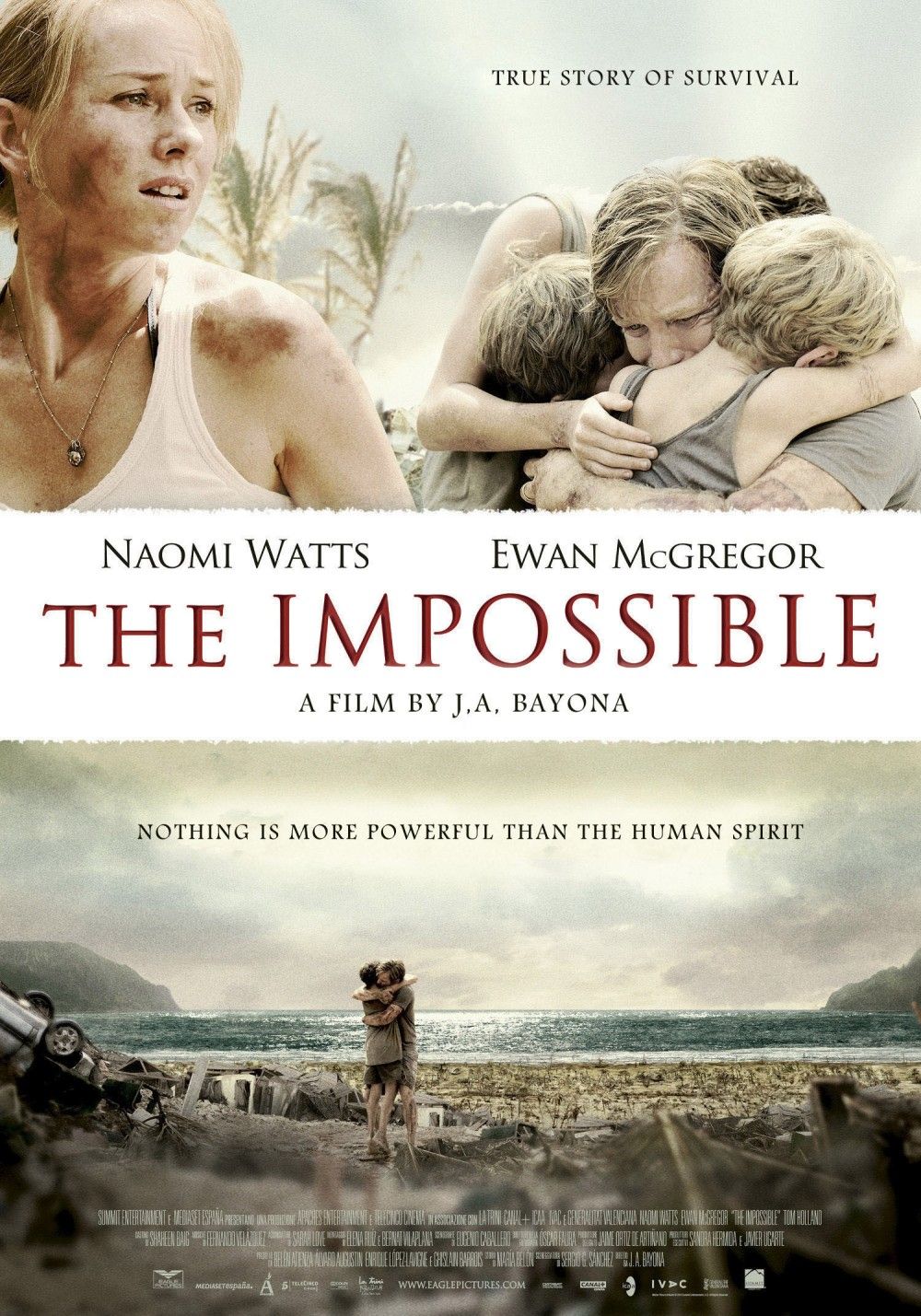
The Impossible (2013)

Naomi Watts and Tom Holland survive extreme circumstances in The Impossible

Director: JA Bayona

Cast: Naomi Watts (Maria), Ewan McGregor (Henry), Tom Holland (Lucas), Samuel Joslin (Thomas), Oaklee Pendergast (Simon), Marta Etura (Simone), Sönke Möhring (Karl), Geraldine Chaplin (Old Woman)

In 2004 the Boxing Day tsunami hit the Indian ocean. The resulting tidal waves devastated communities in several countries, with almost a quarter of a million casualties. The impact left rich and poor alike in a desperate struggle to survive. These terrible events form the basis of this emotionally powerful, if sometimes manipulative, film that recreates the remarkable story of a Spanish family, separated in the tsunami, who all miraculously survived.

Here the family is re-imagined as British (presumably to sell the film around the world a little easier, as they now all speak English). Maria (Naomi Watts) is a doctor who for the last few years has been a stay-at-home mum for her three sons Lucas (Tom Holland), on the cusp of becoming a teenager, Thomas (Samuel Joslin) and Simon (Oaklee Pendegast), both younger. Her husband is businessman Henry (Ewan McGregor). Staying in Thailand for a Christmas vacation, the family are separated when the tsunami hits their resort. Maria (badly injured) and Lucas make their way to a hospital, where Lucas struggles to get the life-saving treatment his mum needs. Henry is trapped in the resort with their other two sons, desperately trying to find his missing wife and child. Around them swirl an entire country of refugees and affected people, all of them trying to find family members.

The Impossible gets an awful lot right. The recreation of the tsunami is faultless. You’ll feel every moment of terror as the water rips through the family’s high-end vacation spot. As Maria and Lucas are swept far away by a deep swell of fast-flowing water (stuffed with mud, filth and debris) you’ll feel every blow to bodies as debris hammers into them, and feel like you’ve lived through every moment of desperation as the two fight against the current to reach each other. The sense of powerlessness and fear – a mother trying to be brave for her son, a son frightened and desperate for reassurance, ashamed at being scared – are powerful, deeply affecting and hugely immersive. Bayona’s experience of directing horror comes wonderfully into play here, as he knows exactly how to push our buttons and make us feel the emotion, fear and anxiety of the situation.

This tone continues through most of the film’s first hour which largely follows Maria and Lucas as they attempt to reach the hospital. Running on adrenalin, Maria only slowly begins to succumb to exhaustion as her grievous wounds (smashed ribs, a horrifically graphic leg injury) sap her strength, even while she tries to maintain an air of calm for her son. What is intriguing in this sequence is that, like a set of scales, as the mother becomes weaker the son becomes stronger – Lucas suddenly propelled into become an adult. Lucas increasingly takes decisions on how best to survive, argues at times for hard calls and becomes, in many ways, the adult in the situation.

This sequence is helped hugely by the performances of the two actors. The physical commitment of every actor isn’t to be doubted (Holland and Watts spent hellish weeks in water tanks filming – although this is only relative compared to the horror of the actual tsunami). Watts (Oscar-nominated) brings power to a mother who believes she is the only thing her son has left in the world, and must survive at all costs for him. Her buttoning down of her terror for as long as she can is deeply moving, and she brings the part significant heart. Tom Holland is simply a revelation as Lucas. He develops an authority well beyond his years, the complexity of the emotions he deals with – from fear to anger and defiance, determination, anxiety, relief and despair – would have challenged an actor three times his age. Holland never loses trace of the central kindness in Lucas – no matter how desperate the situation – and he is the undoubted star of the film, his portrayal of a child forced to grow up scarily quickly is deeply affecting.

Ewan McGregor offers similarly excellent work. Left searching through the rubble of his holiday home, McGregor brilliantly captures a sense of a father trying to deny that his control over events has disappeared. He excels in an extremely moving breakdown scene – after finally contacting his wife’s parents in the UK, he collapses in desperate, uncontrollable sobs of guilt and fear, apologising for not knowing what to do. It’s some of the actor’s best work, brilliantly tapping into his natural warmth for excellent effect.

Where the film struggles more is in its focus. While it is a story of one – affluent – Western family, so naturally its focus will be there, it does turn the rest of the cast into little more than extras. Some focus is given to the Thai people: a group of poor local people is crucial in saving Maria and Lucas’ lives and getting them to a hospital, their immediate humanity and generosity reducing Maria (and the audience) to tears of gratitude, but that’s the only real look we get at them. The hospital where a large part of the story is set is full of Westerners, bar the staff. All the victims we spend significant time with are white and Western (all are presented sympathetically, bar a pair of Americans for whom the tsunami is a holiday inconvenience).

But you could watch the film and not realise that so many of the people who died were part of the indigenous population – and while thousands of Westerners also perished, the survivors did at least return to their homes, whereas those living in affected countries lost everything.

The film’s other flaw is the manipulative tone it moves into late on, in particular a series of prolonged “missed moments” as the separated family walk around the hospital, just missing each other. This may well have actually happened, but is so contrived that it feels like a narrative flourish. The plot slows down in the second half as the characters search for each other. The film’s final title cards were a perfect opportunity to bring more focus to other victims – and to mention the death toll and impact on the countries – but avoids all of this to simply confirm it’s based on a true story.

The Impossible has lots of powerful moments. Its moments of emotion are raw and affecting and, manipulative as it is, you do celebrate when the family is reunited. But it’s also a film that loses its way a bit – which captures a superb survivalist story but then becomes too sentimental towards its end. And by not doing more to acknowledge the impact on the Thai people, among others, you can’t help but feel it turns this tsunami into something that affected rich, white, Westerners – which is harder to forgive.

Scarface (1983)

“Shay hell-o to my leetle friend!” Al Pacino puts it all out there in Scarface

Director: Brian de Palma

Cast: Al Pacino (Tony Montana), Steven Bauer (Manny Ray), Michell Pfeiffer (Elvira), Mary Elizabeth Mastrantonio (Gina), Robert Loggia (Frank Lopez), Miram Colon (Mama Montana), F. Murray Abraham (Omar), Paul Shenar (Alejandro Sosa), Harris Yulin (Detective Bernstein), Mark Margolis (Shadow)

Remember when Al Pacino played the softly spoken, chillingly self-contained Michael Corleone? Watching The Godfather, who could have imagined that performance would be the outlier in a career that gleefully embraced the insanely OTT in a way few other great actors have dared. And possibly no other performance in Pacino’s career was as large as in Scarface, a ball of nervous energy, foul-mouthed aggression and drug-fuelled instability, the burning heart at the centre of Brian de Palma’s wildfire of a film. Scarface dials every single thing up to about 11 and then some, becoming the director’s brashest and most enduring work – but it owes everything to Pacino’s furious, unreserved energy at its centre.

Pacino plays Tony Montana, a working-class crook from Cuba dispatched (along with boatloads of undesirables from Castro’s regime) to Miami in the early 80s. There, in refugee camps and the local community, it’s crime and violence that give these guys the best chance of grabbing a share of the American Dream. Montana is no different, graduating from hits to drug deals and swiftly moving up the chain with his determination, gruff no-nonsense attitude, fierce loyalty and ruthless focus. But once you hit the top and the world is yours, there is really only one way to go – back down again, made easier when you are hooked on snorting mountains of your own product, incestuously in love with your sister Gina (Mary Elizabeth Mastrantonio) and your increasing arrogance and unreliability put you on the wrong side of your partners and kingpins in South America.

A remake of the 1932 original by Howard Hawks (the film is dedicated to Hawks and the scriptwriter Ben Hecht), Scarface is a brash, unsettling, nervy and incredibly violent cartoon-style gangster movie that owes almost its entire legacy to Pacino’s snarling wit at the centre. Is Pacino taking the piss here with this performance? Surely, he must have wondered if he could get away with it. This is a whirlwind tour-de-force, Pacino throwing himself into it with nothing left in the locker-room. He delightedly wraps his vocal chords around a thick Cuban accent (turning words like cockroach into a three syllable delight – “Cock-ah-roatch”) and embraces his small stature by turning Tony into a little pressure cooker. Seemingly incapable (bar one scene) of staying still, he’s supremely tense, his shoulders hunched up, his teeth on edge, voice growling.

It gives the film an unpredictable energy, because you don’t know what Pacino the performer will do any more than the characters do. He’ll suddenly throw you off with a moment of silence, just as often as he will blast your eardrums with a roar of anger. Emotionally Tony is a complete mess. His obsession with his sister is obvious, a devotion that Tony seems to only half (if that) understand is sexual in nature. But he also has a slight homoerotic bond with best friend Manny Ray (Steven Bauer – the only actor of Cuban heritage in the film), their closeness and macho-posturing carrying more than a whiff of Top Gun-ish “he protests too much”.

Pacino also invests Tony with strangely sympathetic qualities. Sure he’s a violent and ruthless killer and dedicated criminal, but he’s also got a firm sense of loyalty and certain moral lines he won’t cross. He’s got no time for bullshitters and respects only strength and honesty – watch the scene where he brutally talks over the weasely Omar (F. Murray Abraham – jetting back and forth between shooting this and Amadeus for goodness sake!) during a negotiation with drug lord Sosa – he has no respect or regard for his more politically minded boss, only for straight-talking that makes a deal.

It’s all this that ends up making Tony an anti-hero the viewer sort of ends up liking – even while he dopes himself to the brim with coke and funnels piles of it onto the street (not that we see any of that). Tony is a violent killer, but he’s a sort of honest man, a monster yes but a public one that we enjoy seeing. Tony himself recognises this, calling out a crowd of people in a posh restaurant for treating him as a monster so that they can feel better about themselves (slightly undermined by the fact he’s coked to the eyeballs, incoherent and has brutally ended his marriage a second earlier).

So much is Tony a force of nature that, hilariously, it feels like many of the fans of the film – bling gangsters and wannabe street punks – miss that this film is a brutal satire of the culture of excess and greed. Tony’s life falls apart the more money he gets, his addictions and problems growing as his wealth does. He’s an instinctive, but not wise, man who builds a household of fantastic excess and tasteless ostentation (surely, like Saddam, his taps are gold-plated) but also manages to destroy his business and life in a few months due to his greed, stupidity and self-destructive streak.

The things that made him a high-riser are lost the more Tony surrounds himself with garish status symbols. Inevitable destruction walks hand-in-hand with Tony’s “more is more” attitude. The more he attempts to add class and polish to his life, the more he demonstrates his own lack of both qualities. Also, as he gets more obsessed with pointless status symbols he loses the very skills – honesty, energy, shrewdness – that made him a kingpin in the first place. Instead he becomes a drug-fuelled narcissist, making impulsively stupid decisions and wrecking everything he spent the first half of the film building up. Tony Montana is the face of a certain type of Reagan/Thatcher economics, where private enterprise rolls in and ruthlessly takes and takes, with no regard for the impact on other people and no interest in sustainability.

De Palma captures this pretty well – although he probably ends up making this satire of excess more of a hubristic tragedy. Largely because the film falls so hard for Tony – or rather Pacino – that the fact that Tony is, despite his own moral code, a pretty reprehensible person can be easily lost. Not that de Palma probably cares that much, since his main aim here seems to be to create a hell of a ride. And there are some great set-pieces, and some wonderfully character beats – not least a sequence where Tony seizes control of the empire from weak boss Robert Loggia and sinister corrupt cop Harris Yulin.

The film certainly does that, flying from set-piece to set-piece so swiftly and with such a sense of pace and shark-like momentum, you almost don’t notice that it runs for as long as it does. Every few minutes gives us a scene with stand-out moments of either Pacino grandstanding, shocking violence or both. Scarfaceis a very violent film – everything from chain saws to bullets are used to pull gangster bodies apart – and while it has a sort of moral message (“Excess is bad”) it’s really just an excuse like Cecil B DeMille to make us feel good about ourselves by watching someone pretty bad (but with a few redeeming qualities) dance like a bear for two and a bit hours doing terrible things (entertainingly) before being carved down in a hail of bullets as the devil comes round to collect.

Alien (1979)

Sigourney Weaver is last woman standing in Alien

Director: Ridley Scott

Cast: Tom Skerritt (Dallas), Sigourney Weaver (Ripley), John Hurt (Kane), Ian Holm (Ash), Yaphet Kotto (Parker), Harry Dean Stanton (Brett), Veronica Cartwright (Lambert)

For decades, space was seen as a place of wonder. But Alien reminded us it was also a place where no one can hear you scream. We dream the vast void out there contains life: but what if the life we found was a relentless killing machine, a seemingly invulnerable monster literally having humanity for breakfast? Ridley Scott’s Alien took science fiction and ran it through the blender of horror, turning its space ship into a terrifying haunted house with an alien straight out of slasher films. It’s still a landmark today.

In deep space, the Nostromo’s crew is pulled out of hypersleep early – long before arriving back in our solar system. A strange distress call from an unidentified vessel needs to be investigated, on standing orders from “the company”. The seven-strong crew lands their ship and a party heads out – only to return with third officer Kane (John Hurt) with a strange alien creature attached to his face. The creature can’t be removed until it detaches itself of its own accord. All seems well until an unfortunate dinner party – at which point the crew finds itself being hunted one-by-one by a relentless alien monster.

Scott’s film is so famous today it’s very hard not to forget your foreknowledge of what’s going to happen and to experience it as its original viewers did. But it still works brilliantly – even if almost everyone watching knows only Ripley is getting out of this alive. The film is a masterpiece of slow-burn tension punctuated by moments of shocking horror. The final Alien itself doesn’t appear until almost an hour into the picture – but before then we’ve had our nerves more than jangled by the unsettling disquiet of the film’s mood. From the Nostromo, to the storm-laden planet they land on, and the vast alien ship – now a tomb of dismembered corpses with an unsettling organic look, like a giant carcass – everything in the film is designed to put us ill-at-ease. You can’t watch this film and expect anything to turn out for the best.

The camera prowls around the dank, grimy and run-down ship – space travel has rarely looked this unglamorous – like the predator that will hunt the crew. It’s slow, stately lingering on the crew, their faces, the eerily unsettling sounds and score, all serve to act like an advance funeral. Every single beat of the film stresses claustrophobia and dirt. It looks like a horrible trap already, and the film embraces a sense of grim inevitability. The observational style of the editing and shooting as we follow the characters, overhearing their bickering and functional work-based conversations, also helps add to this mounting sense of unease. It’s a surprisingly quiet film for much of its opening act, ambient noise and unsettingly lingering music dominating.

There is a poetical eeriness about the whole film. This is also partly from the sense of the ship being a society in microcosm. Much of the bickering is around bonus pay shares, the working-class engineers of the ship (one of whom is also black) bemoaning their smaller shares. The officers sit at the top, a mixture of entitled, distant, officious and daring. They have their own feuds over status, professional boundaries and personal rivalries. The captain is a laissez-faire professional, who offers only a general guidance and could really be just another member of the crew. The ship is like a giant oil-rig in space, with the crew basically a group of “truckers”. The film is as much about interpersonal tensions as it is about an alien monster who hunts people down.

But it is mainly about an alien monster that tears people apart. After almost an hour of deeply unsettling and unnerving build-up, when the monster (literally) rears its head, it’s a terrifying sight. We usually only see it briefly for small shots, but what we see is pure nightmare fuel. The creature is terrifying in its violence and power. It is partly human but also completely revolting. Covered in slime, it looks like a bizarre mix of a man, a giant penis and a vagina (its designer, HR Giger, reasoned nothing would be more unsettling and disturbing to us than seeing a beast that’s partly inspired by our own sexual organs). It creeps in corners, embraces the many shadows of Scott’s set and its capacity for violence seems unstoppable. Sharp editing and suggestion elaborates the visceral horror of its extending jaws punching through bone and flesh. It moves like an interpretative dancer and leaves a trail of blood. It’s unstoppable and infinitely cunning. It looks like your worst nightmare.

It’s all washed down with body horror. An alien that smothers its victims and shoves an egg down their throat which hatches through their chest becoming a slaughtering beast. There is an uneasy sexuality about this, right down to the “birth” of the creature being a grotesque parody of childbirth. The “birthing scene” is a masterpiece, the first moment in the film when the tension between the crew has eased – and the film itself seems to have relaxed for a moment from the knot of tension – that turns into one of the most memorable moments of body horror ever. The actors were allegedly told what would happen – but not how graphic it would be – and their horror-struck disgust (Veronica Cartwright was nearly knocked over by a powerful jetstream of mock blood and guts) and and shock gives the film a priceless realism.

Watching the film, it’s striking to me how much John Hurt’s Kane is shot as the hero early in the film. It’s he who wakes first from hypersleep. It’s Kane we follow the most for the early part of the film – he’s the one piloting the ship, volunteering to answer the distress call, urging his crew mates on as they investigate the alien vessel – it’s Kane who seems to be the hero. Making his brutal demise even more of a subconscious shock. On the other hand, Ripley is introduced as an officious, unpopular, by-the-book officer who it seems few other members of the crew like (Sigourney Weaver’s praetorian attitude helps a lot with this) – if you had to bet on someone to bite it early on, you’d pick her. The film continues to defy expectations. Characters who seem like they might be invulnerable are slaughtered early. Those who looked vulnerable survive until late on.

It’s a very strong cast. Weaver magnificently grows in authority as the film progresses, turning her abrasiveness into strength of character and moral determination. Hurt is very good as the unknowing victim-in-waiting. Kotto, chippy and defiant, is another stand-out. The finest performance through might well come from Ian Holm as science-officer Ash. Precise, cold, distant – but always hiding his own secret agenda – it’s an unsettlingly controlled performance that leads to a pay-off reveal that still works brilliantly today (and the character would have one of the most memorable death scenes in film, if he wasn’t in the same film as the most memorable death scene).

Scott’s filmmaking is brilliantly controlled, and the film is a horrifying masterpiece of tension and terror. The monster is skilfully shown at its worst (you’d never even guess in actuality it’s little more than a Doctor Who man-in-a-rubber-suit) and its design is faultless perfection. It’s not completely perfect – its build up might be ten minutes too long, and a late sequence that sees Weaver wearing little more than her undies looks hideously dated today – but it’s pretty close. Science fiction has never been scarier than it is here – hell the movies have rarely been scarer. In space no-one really can hear you scream.

A History of Violence (2005)

Viggo Mortensen: Hero or Villain? A History of Violence

Director: David Cronenberg

Cast: Viggo Mortensen (Tom Stall), Maria Bello (Edie Stall), Ed Harris (Carl Fogarty), William Hurt (Richie Cusack), Ashton Holmes (Jack Stall), Peter MacNeill (Sheriff Sam Carney), Stephen McHattie (Leland Jones), Greg Bryk (Billy Orser), Heidi Hayes (Sarah Stall)

Cronenberg’s films redefined ideas around body horror. And one of his most accessible – and perhaps one of his richest and finest – films takes these ideas to another level by looking at the lasting – and damaging – impact of violence. That’s not just the immediate, visceral impact either – and lord knows Cronenberg doesn’t shirk on that here – but also the intense, long-term psychological impact and how it shapes entire lives. A History of Violence is a brilliantly told and superb piece of film-making that mixes thought-provoking content with a gripping, Western-tinged plot. It’s got a claim to being one of the best American films of the Noughties.

Tom Stall (Viggo Mortensen) is a regular Joe in a very small town in rural America. Running a small café, he lives a blissfully happy life of Americana with his wife Edie (Maria Bello), a lawyer, and their two children Jack (Ashton Holmes) and Sarah (Heidi Hayes). Their world changes forever though when Tom’s diner is held up late at night by two ruthless killers (Stephen McHattie and Billy Orser) and – with an instinctive ruthlessness – Tom ruthlessly dispatches the killers and saves the lives of his co-workers and patrons. His heroism makes him a local hero and brings plenty of excited press attention – but why does Tom seem so uncomfortable with this? Could it be linked to the swift arrival in the town of big-city criminal Carl Fogarty (Ed Harris) who claims Tom is none-other than Joey Cusack, psychopathic hoodlum from Philadelphia who gouged out Fogarty’s eye? Are Tom and Joey one and the same? And how will the doubts affect Tom’s family?

Cronenberg’s film brings brilliant tension to this question of identity, setting it in a very modern-feeling Frontier town, which has more than a sense of a classic John Ford western town, complete with disturbance from murderous figures from outside, shattering the peace. But the film adds that distinct Cronenberg touch by suggesting that, behind the quiet diners and picket fences, the real danger may already be at the heart of the town. Is Tom who he claims to be? Or is he a malignant dark force at the centre of the town (and his family) bringing destruction to everything? What other dark truths, you can’t help but think, might be hiding behind those shutters?

But then that’s what you get with violence. It taints and ruins everything it touches. Innocent lives are shattered. Families and loved ones are left mourning. But it also twists and shapes the personalities of its perpetrators. It marks them and changes them, washing out positive qualities and leaving those who use it the most drained, empty and uncaring. The film opens with a chilling long shot as McHattie and Orser check out of a motel. Cronenberg keeps the camera still and holds the camera still to study the casual body language and chilling lack of engagement of its killers (“Why the delay?” “I had a little trouble with the maid”). The scene continues for an agonising length, making us dread the reveal of what these clearly dangerous, amoral men have done in this motel – the reveal eventually shown with a clinical precision, which serves as an entrée to even greater horrors.

The final killing in the motel is the last time the film will shy away from the immediate horrors of violence. Even Tom’s heroic slaughter of the killers to save lives doesn’t shirk from showing us the impact on the bodies of the killers as Tom dispatches them – bodies torn apart by bullets, with McHattie’s killer left with most of his lower jaw destroyed beyond recognition. Later we’ll see the impact not only of bullets, but also the jerking death spasms of those who have had their noses smashed into their faces, necks snapped or bullets pass through their heads. Never is this glorified – and never are we allowed to simply categorise some killings as good or bad. No matter who it is, the human body will still suffer staggering trauma.

But violence’s impact isn’t only physical. As Tom’s increasing comfort with using his natural propensity for brutal killing (“Have you never asked, why is he so good at killing people?” Fogarty asks an Edie still in denial) grows, so violence takes over his family and starts to shape the actions and decisions of those around him. Arguments become more regular and more visceral. Tom’s gentle son brutally beats his bully at school. The loving father Tom suddenly slaps him across the face. Edie and Tom’s blissful life – we see them playfully making love on a date night – degenerates into conflict, distrust, flashes of violence and finally an angry, intense and passionate sex scene on the stairs that is an exact mirror image of their earlier love scene.

Edie is, for all her horror at Tom, partly excited by finding her husband has such a capacity for danger and brutality. That’s the dark attraction of violence in this film: it reveals secrets about ourselves. Tom seems to subtly shift within conversations from the gentle Tom into the chillingly distant Joey. Worst of all, the more that muscle is stretched the more Tom seems to take comfort and enjoyment in it. Taking what we want, with no regards for the consequences, is liberating and makes us feel strong. No wonder it’s so attractive. And no wonder violence has so shaped and defined humanity’s history. It tends to get people what they want and it can feel good. And it looks cool. Because despite the horrors of the impact of the violence, Cronenberg is also honest enough to admit that it’s exciting.

At the film’s centre is a superb performance of cryptic unknowability from Viggo Mortensen, in possibly his finest role. Mortensen uses micro expressions, small beats and body language that moves between casual and chillingly precise to show two personalities in one body. And Mortensen also demonstrates the struggle between these – between the man he wants to be and the man he might well be. He’s equally matched by Bello, wonderful as a woman who finds her whole life destroyed but can’t shake an unnerving attraction to this man of danger who has suddenly emerged.

The entire cast are pretty much faultless. Ed Harris gets a decent role of gruff menace, but the film is almost lifted in a final act cameo by William Hurt. Oscar nominated for (what amounts to) less than five minutes of screen time, Hurt is simply a force of nature as a Philadelphia crime boss kingpin, purring out his lines with all the fury of a caged lion, mixing a readiness for violence with a darkly comic menace. It relaunched Hurt’s career as a leading character actor – and arguably he should have nabbed the Oscar for it.

Cronenberg’s film engages with ideas of identity throughout. What defines us? The things we’ve done? The choices we’ve made? How many years need to pass before we can say that we’ve changed? What makes us better? And can we decide the sort of people we want to be? It’s impossible to say for sure. If your whole family life is founded on a lie, how do you know what about yourself is true or not? These are fascinating questions and the film offers no easy answers at all. Can Tom return to the life before a violent history shook everything up – perhaps he can, perhaps he can’t. But one thing’s for sure (and Cronenberg makes clear) it won’t be a simple overnight fix and a Hollywood ending. For all the hoodlums Tom dispatches, the real damage is on the workings of his family and the real casualty is the life his family thought they had. And those wounds don’t heal.

Tenet (2020)

John David Washington has to save the world in the tricksy Tenet

Director: Christopher Nolan

Cast: John David Washington (The Protagonist), Robert Pattinson (Neil), Elizabeth Debicki (Katherine Barton), Kenneth Branagh (Andrei Sator), Dimple Kapadia (Priya), Himesh Patel (Mahir), Aaron Taylor-Johnson (Ives), Michael Caine (Sir Michael Crosby), Clémence Poésy (Barbara), Martin Donovan (Fay), Fiona Dourif (Wheeler), Yuri Kolokolnikov (Volkov)

SPOILERS: I’ll be discussing Nolan’s film, which was kept so secretive, that even revealing what it is about might be considered a spoiler. So if you want to experience the film as intended, watch it first!

Tenet, at this rate the only blockbuster that is going to be released in 2020, was given the mission to save cinema from coronovirus. Match that with the near religious regard Christopher Nolan is held in by fans of cinema, and you had a major cinematic event on your hand. Is Tenet the second coming of cinema? Well of course not. But it is an enjoyable, if frustratingly tricksy, film shot on a jaw-dropping scale. If you ever had any doubt about whether Nolan grew up watching Kubrick intermixed with James Bond, this film dispels it.

Our entry point in the story is an unnamed character – he calls himself The Protagonist of the operation – played by John David Washington. A CIA agent, left critically injured after an operation at the Kiev Opera, is recruited to work for a mysterious organisation, Tenet. He discovers that Tenet is dedicated to preserving mankind in a war that is taking place across time. The tools of this war are “inverted” bullets and other materials. These bullets both backwards through time – explosions reform and bullets return to the guns that fired them. The Protagonist discovers that the inversion bullets are being funnelled through arms dealer Andrei Sator (Kenneth Branagh). Sator is working with a faction from the future, planning to invert time in order to save their world from destruction. Sator also has access to machines that can invert people, allowing them to move physically backwards through time giving him huge advantages in forging his empire and in collecting the components of a time-inverting super weapon that will destroy all life in our present and past.

Confused? Well as characters frequently say throughout the film – don’t think about it too much. I’ve seen Nolan’s epic twice. It’s a film that revolves around Temporal Pincer Movements – military tactics that use normal and inverted people moving backwards through time. The “forward” team lives through the events. The “Inverted” team move backwards, seeing events from the end backwards, supplying real-time information to the forward team. Those carrying out a Temporal Pincer Movement know the exact timeline of what is to happen and are therefore almost unbeatable.

Watching the film twice, I realise it places the viewer in the same position. First time I was lost in the maze of the film’s rushed explanations, hand-waved time mechanics and confused by working out who was inverted and who wasn’t at any one time. Watching the film a second time, knowing the plot, I did a Temporal Pincer Movement on it myself – my “past self” who knew basically how the film ended, helped my second viewing self to understand what was happening.

So you’ve kinda got to watch it twice to understand it properly. Or at least to begin to. Second time around you also know which details are important and which to ignore, which explanations are crucial to its understanding and which are not. Second time around I noticed a lot more how characters, such as Clémence Poésy’s scientist, who introduces inversion, stress “don’t think about it too much”. The science of it all is basically a red-herring. There is talk of various predestination and grandfather paradoxes (as you might expect in a world where the future is plotting to destroy the past). Again, second time around I realised: don’t worry about it too much. 

So the question is, will people rush to see the film a second time around to understand it better? I’m not entirely sure they will. And I think that’s because, unlike Nolan’s other films, Tenet lacks heart. Here’s a man who has been praised for the ingenuity of his films going a little too far. Look back at Nolan’s other films and underneath the trickery and “timey-wimey” there is a core of a beating human heart. Inception and Interstellar, at heart, are about a man trying to reunite with his children. Memento, a man mourning the loss of his wife. Dunkirk, frightened young men trying to get home. In Tenet, there is none of this. It’s literally a film about time-scheneanigans with a huge Macguffin at the middle that will wipe out the world. The Protagonist is just what who he seems, a character who (engagingly played as he is by John David Washington, very good) we feel so little connection with that you could easily not notice we don’t learn his name.

It’s this lack of heart that really weighs the film down. How much can we really care in the end about a world-ending Macguffin so briefly explained, we just take it on trust that it’s bad? Tenet is burdened by Nolan’s slightly-too-pleased-with-itself cleverness, as events are played and replayed from multiple angles throughout the film, in a way that demands repeat viewings rather than giving the first-time viewer more knowledge in each scene. If you fall for this sort of thing, then you will fall hard. But, Nolan’s other mega-hits charmed viewers because they cared about the characters at its heart, not the elaborate tricks about time and memory. We wanted to see DiCaprio find his kids, we wanted those boys on the beach to get home – and people were happy to let other things wash over them slightly, because the emotion was how they interpreted the story. Without that heart, the film is a massive, showy trick – and a bit empty as a result.

Which isn’t to say that Nolan doesn’t shoot the hell out of it, or that the scope of it isn’t incredible. It’s where his Bond influence comes in. Because while half the time, he’s paying homage to Kubrick’s mastery and precision – or wonderfully, with its early scene of objects moving backwards and thick rubber gloves, Cocteau’s Orphée – the other half is straight out of Roger Moore. Massive bases. Huge car chases. Big shoot-outs. A Russian villain who could have walked out of Spectre and straight into the film. Flemingesque touches with the hero infiltrating the villain’s world, taking part in a sport with him. A woman at the middle who has a foot in the camps of both hero and villain. This is all Moore-era Bond, repackaged with a sprinkling of PhD Physics.

If there is a heart in the film, its Elizabeth Debicki’s abused wife of Kenneth Branagh’s lip-smacking villain. The film’s most effective character scenes revolve around this pair, and the destructive, possessive ‘love’ of Branagh’s Sator, a man must possess or destroy a person. The film captures neatly the perverted “love” Sator claims to have for a woman he abuses, beats and terrifies – and Debicki beautifully captures the mix of shame, hate and fear people in such situations often feel. Nolan must have enjoyed BBC’s The Night Manager, as Debicki repackages her role from that film almost exactly, but given the most emotional and heartfelt plotline in the film, she becomes the one character you really care about and invest in. A better film might have put her even more front and centre.

Instead though, the action around time dominates, with Nolan’s brilliantly mounted action scenes that mix forward and backward motion with staggering (and seamless) effect. It’s yet another reason to see the movie twice. The film is big, loud and demanding – often too loud, with dialogue frequently drowned out (a problem you notice less second time around when you have a much better idea about when to concentrate and when to look away). The cast do terrific work. Washington is very assured as the lead, playing with wit and grace. Debicki is a stand-out. Robert Pattinson brings a quirk and originality to a role that has very little to it on paper. Branagh has been more controversial for his Bond-tinged Russian baddie, but I found a chilling horror in his domestic abuse and selfishness that works extremely well (again particularly second time around). Pattinson brings a playfulness to an underwritten role.

Tenet may not rework cinema – and I doubt it would make a top five list of Nolan’s best films – it’s bold and challenging, if a little cold and heartless. While demanding a double viewing, it’s not quite clear if it will make you long to see it again too quickly. But if you take the effort to do so, you will find a film that grows on you more with repeated viewing – and reveals its deliberately impenetrable mysteries much better.

Here Comes Mr Jordan (1941)

Here Comes Mr Jordan (1941)

Death, romance, body swops and admin abound in this rich comic fable

Director: Alexander Hall

Cast: Robert Montgomery (Joe Pendleton), Evelyn Keyes (Bette Logan), Claude Rains (Mr Jordan), Rita Johnson (Julia Farnsworth), Edward Everett Horton (Messenger 7013), James Gleason (Max “Pop” Corkle), John Emery (Tony Abbott), Donald MacBride (Inspector Williams), Don Costello (Lefty), Halliwell Hobbes (Sisk)

One of the best things about the Hollywood Studio system is that created an environment where middle-brow talents could suddenly lift themselves up to create something very special. That’s certainly the case with Here Comes Mr Jordan, the career high spot for its director and its main stars. It’s the sort of product of Classic Hollywood where everything comes together perfectly and delightfully.

Joe Pendleton (Robert Montgomery) is a boxer with a shot at the title. An amateur pilot, Joe flies his own one-man flight to New York for the match. On the way, his plane crashes. An officious Angel, Messenger 7013 (Edward Everett Horton), collects his soul – only to find on arrival in heaven that Joe was meant to survive the crash and live for another 50 years. Unfortunately, by the time the mistake is found out, Joe’s body has been cremated. Head Angel Mr Jordan (Claude Rains) has no choice other than to find Joe another body on Earth. So Joe winds up in the body of millionaire Bruce Farnsworth, recently murdered by his wife Julia (Rita Johnson) and secretary Tony Abbott (John Emery). In his new body, Joe decides to correct Farnsworth’s wrongs, returning his embezzled money to investors and helping to free the father of Bette Logan (Evelyn Keyes), who took the blame. Joe also wants to retrain for a boxer – recruiting, much to his confusion, his old coach Max Corkle (James Gleason) – and he and Bette begin to fall in love. But Joe’s destiny, it turns out, is to be the champ – and he can’t do that in Farnsworth’s body. How will Mr Jordan clean this mess up?

Here Comes Mr Jordan is a delight, a hilarious musing on reincarnation and afterlife, in which the next world is as weighted down by bureaucracy and red tape as much as this one. With neat, unobtrusive direction from Alexander Hall (who never hit the jackpot like this again), the film keeps its comic balls up in the air beautifully, while throwing in some neat observations around life, death and fate. The script bubbles with lovely bits of invention, from the Afterlife to a bureaucratic organisation to Joe’s inhabiting of Farnsworth’s body (after trying a few other bodies on first), while still appearing to himself (and we the viewers – a neat idea that the film invites us not to think about too much as Joe’s mannerisms and physicality must be completely different from Farnsworth) unchanged from his original body.

Around this the film gets some neat pot shots at big business corruption. In some ways this is a little like A Matter of Life and Death mixed with Capra. As in Capra, the humble, kind-but-not-super-smart regular Joe is the one who takes a long-hard look at the corruption and greed of Big Business and Corporate America and decides “there has to be a better way”. The kind of guy who solves major business problems simply by doing the right thing and listening to his heart. Counterbalancing that is Joe’s ongoing obsession with continuing his boxing career, from his determination to get a body that’s “in the pink” (a phrase that drives Mr Jordan up the wall) to roping in his ageing butler into a series of vigorous workouts.

A large part of the charm of Joe Pendleton lies in the brilliantly dry, witty, sweet but still a little selfish qualities that Robert Montgomery (Oscar nominated) brings to the part. Playing the part with a homespun Brooklyn honesty and simplicity, Montgomery also has a childish delight in finding he can pass unobserved as this new man (particularly funny after his initial terror that he will be “found out” any second), while his boxing obsession has an endearing genuineness to it. Montgomery, as well as getting the light comedic tone spot on (no surprise that Cary Grant was the first choice for the role – although he could never have played the working class Joe as well as Montgomery does he) he also builds a very sweet and charming romance with Evelyn Keyes (also in a career best role), who is ill-treated but defiantly assured of the importance of doing the right thing as Bette.

The whole cast is quite superbly assembled, seasoned pros, doing their thing with aplomb. James Gleason was Oscar-nominated as Joe’s befuddled manager, trying to wrap his head around incarnation. Gleason also gets some of the finest gags, as Corkle tries to interact with Mr Jordan, who remains invisible to the living – but also brings a genuine warmth and tenderness to his feelings for Joe, who he clearly sees as a son. As Mr Jordan, Claude Rains is smoothness personified, playing the entire film with a relaxed grin on his face, gleefully mixing in an obsession with ensuring the “rules” are followed, while offering a dry reaction to events such as murder. As his underling Edward Everett Horton brings his patented A-game of flustered middle-man.

Mr Jordan grins so much through the film it’s easy to forget that he’s basically the Angel of Death. Reasonable and supportive, Jordan is also blithely unaffected by death and murder. The film, among the jokes and the general air of a fairy tale, has a little vein of darkness. In his introduction Jordan is overseeing the collection of souls from some of the battlefields of World War II. Later he calmly informs Joe of Farnsworth’s murder taking place even as they speak. The film doesn’t hesitate to shy away from the details of Farnsworth’s killing – or from two further murders. It’s a little nugget of darkness in amongst the charm, and a reminder that this comedy on death and the afterlife took place while the world was tearing itself apart. No wonder death can sometimes not be as big as a deal to everyone as it is today (especially to the Angel of Death).

Because the film has a more Capraesque belief that what matters is not who we are but what’s inside. Joe will appear as Farnsworth to everyone, but eventually what people will respond to (he is told by Jordan) is the person inside not the outward appearance. The potential that Joe may have to move to a new body to fulfil his destiny of becoming the champ, doesn’t meant that he and Bette need to necessarily be apart if his heart remains the same. While the film does suggest (I feel darkly!) at one point that Joe may forget who he was originally the longer he is in a new body, the more it stresses the point that the basic qualities of his decency won’t be lost.

Its ideas like this – combined with expert telling and superb Classic Hollywood grace and skill in its shooting, directing and acting – that give Here Comes Mr Jordan a little bite, along with its comic impact. Nominated for seven Oscars it won two – and it stands to be remembered in what was a glory year for Hollywood. You might expect something rather slight – but this delightful comedy is as thought provoking as it is playful.

Queen and Slim (2019)

Jodie Turner-Smith and Daniel Kaluuya are on the run from injustice in Queen and Slim

Director: Melina Matsoukas

Cast: Daniel Kaluuya (Slim), Jodie Turner-Smith (Queen), Bokeem Woodbine (Uncle Earl), Chloe Sevigny (Mrs Shepherd), Flea (Johnny Shepherd), Sturgill Simpson (Officer Reed), Benito Martinez (Sheriff Edgar)

You could say Queen and Slim was the film of 2020 that was unlucky enough to be released in 2019. There can be few other films that have captured so effectively the injustice that the killing of George Floyd revealed to the wider world. But watching Queen and Slim reminds many of us in more privileged positions that the sort of systemic outrages that 2020 has brought to light existed for decades prior to this.

Our unnamed leads are “Queen” (Jodie Turner-Smith), a criminal defence lawyer, on an awkward Tinder date with “Slim” (Daniel Kaluuya). The date is not a huge success – possibly because the determined and ambitious Queen has little in common with the gentle, Godly and quiet Slim – but their lives are changed forever when Slim gives her a lift home. Pulled over by an increasingly aggressive police officer, innocent questions from Slim, and Queen’s challenge of his authority, lead to his gun being drawn, Queen shot in the leg and a scuffle with Slim that leaves the officer shot dead. Now wanted for killing a police officer – and convinced that their side of the story will never get an equal hearing – they go on the run. But their cause seizes the public imagination, and “the Black Bonnie and Clyde” end up inspiring others to take a stand across an unjust system.

Queen and Slim uses common conventions of a road movie: two young people on the run for a crime who discover new things about themselves and the world as they travel, drawing closer together. In that sense there is nothing too revelatory about it. Indeed half of the film’s impact – rather like Thelma and Louise – is taking expected tropes and presenting them to us from new perspectives. But what Matsoukas’ film does so effectively is to add a completely new political and social dimension to this. This road movie instead becomes a searing commentary on race in America and the injustice of the system.

Endemic unfairness runs through the entire movie. From the pulling over of the young couple at the start of the film – a search that becomes increasingly invasive and aggressive for no other reason than the officer’s reaction to their colour – to their final confrontation with a lethally trigger-happy police force, there is no fair crack of the whip for this couple. Queen’s restatement of her and Slim’s rights when pulled over is seen as a violent action. The media swiftly turn the couple into ruthless, dangerous killers. A parade of law enforcement (certainly all of the white officers) sink quickly to using crude, racially tinged stereotypes. And there is of course no question that an unjust, one-sided trial ending in (at best) a life-long prison sentence awaits this couple if caught.

But the film also shows brilliantly another side of America. On the road trip, Matsoukas’ camera captures the distant, sometimes run-down, ghettoised communities of non-White groups in America (to the extent that a traditional picket-fenced house visited late on by the couple seems like a foreign land). The camera pans through parts of America we rarely see – and also sees the communities there. These are people who know, in their hearts, that Queen and Slim are the victims here – that the police are more than capable of shooting black people who look like they might cause trouble, whether they have or not. But they also know that there is no chance of justice for them, that they are destined to become martyrs. And that like them, every Black person in America could be a breath away from falling victim to police brutality.

This gives the film a real edge, that gains extra force the more events from the news remind us that issues like this are far from fiction. It gives a political force to the film that serves as a superb snapshot of America today. Matsoukas’ film is shot with vibrant freshness and she draws a great couple of performances from the leads.

Both are contrasting souls, who find themselves drawn closer together as they slowly absorb each other’s qualities. Jodie Turner-Smith is superb as the lawyer with a chip-on-her-shoulder, whose unhappy family life has led to her putting up emotional safeguards that only slowly erode over the course of the film. In many ways the road journey gives her a freedom she has never had before – while Slim’s gentleness encourages her to express sides of herself she has kept long-hidden. Daniel Kaluuya is similarly wonderful as the devout and gentle Slim, who discovers in himself an anger and resentment at the injustice he had accepted as part of everyday life.

Queen and Slim marshals this altogether into a compelling package that will open many people’s eyes to the truth of racial politics in many parts of America – and the tensions underneath it. 

The Shining (1980)

Jack Nicholson loses his mind in The Shining

Director: Stanley Kubrick

Cast: Jack Nicholson (Jack Torrance), Shelley Duvall (Wendy Torrance), Danny Lloyd (Danny Torrance), Scatman Crothers (Dick Hallorann), Barry Nelson (Stuart Ullman), Philip Stone (Delbert Grady), Joe Turkel (Lloyd), Anne Jackson (Doctor), Tony Burton (Larry Durkin)

I’ve often had mixed feelings towards Kubrick’s films. He’s impossible not to admire and there is no doubt many of his films are landmarks in cinema. But I’ve also often found him a brilliant technician, a striking intellectual but an emotionally cold and distant director, who seizes the brain and sense but doesn’t always engage the heart. It’s perhaps unsurprising that a director who has such control over the tools of cinema should be able to use it to create one of the greatest horror films of all time. Because what else is horror but the expert use of technique to unsettle and scare the audience? It’s like the genre Kubrick was destined to try – and succeed at.

The Shining was itself partly born out of Kubrick’s disappointment at the reception given to Barry Lyndon, his cinematically rich, but emotionally unengaging (to many) Thackeray adaptation. It garlanded awards, but praise that was more respectful than fulsome – while audiences had largely stayed away. Kubrick may be an artist – but he still wanted people to see his work. He decided to direct a film based on a poplar horror novel – after all people have been seeing slasher and fright pics for decades, so why not get a piece of that action? Stephen King’s novel was one of the few that engaged him (allegedly the famously highbrow Kubrick spent months reading part way into various horror novels before flinging them across his office in contempt). Sure Kubrick – much to King’s annoyance – junked many of the author’s themes in favour of his own. But in doing so he created a terrifying and deeply unsettling experience that stands as his most effective late work.

In the abandoned, and snow isolated, Overlook Hotel during off-season, writer Jack Torrance (Jack Nicholson) is hired as caretaker to keep the building running. Accompanied by his wife Wendy (Shelley Duvall) and young son Danny (Danny Lloyd), Torrance hopes to use the isolation time to come up with a draft of his new novel. However, dark forces are at work at the hotel. Ten years ago the caretaker butchered his whole family there, and the deaths have left a psychic legacy on the building. This is picked up on by the ESP-powered Danny, but also begins to play on the psyche of Jack who slowly begins to become ever more short-tempered, twitchy and unhinged as time goes on.

The Shining is one of the most frightening and unsettling films I’ve ever seen. And I attribute that completely to Kubrick’s mastery of the language of cinema. Every single frame, every single note on the soundtrack, has been perfectly shaped to inspire dread in the heart of the viewer. There are no cheap tricks, no jump scares, no obvious cinematic parlour games. Instead this is Kubrick using his technical artistry. What else can you say when one of the most disturbing things in the film is the changing sound of Danny’s tricycle as he cycles round the hotel (in a single, low angle, tracking shot), going from near silence as he cycles over carpet to bursts of sound as he cycles over wooden floor? When the score overwhelms with discordant sound and high notes as Danny simply stares at a door? 

But Kubrick’s genius is everywhere. He understands how the human brain is unsettled by symmetry. Watch the film again and see how so much of it is perfectly framed, how still the camera often is, how images – such as shots of corridors or rooms – are set in such a way to make the image look symmetrical. Something is off in our minds about seeing a building that looks so precise. It transfers as well when the actors are caught in the middle of the frame, with the set either side of them looking identical. Our mind keeps telling us it’s wrong. It feeds into our own doubts and fears. It disturbs us completely. Stillness and quiet mix with bursts of colour. For every elevator door opening to deposit a tidal wave of blood, there is the quiet intimacy of Philip Stone (absolutely chilling) as a ghostly representation of a past janitor, urging Jack to “correct” his wife and child.

That fear of symmetry extends as well to Kubrick’s use of two girl twins as ghosts of the former caretaker’s murdered children (and their stillness and softness of voice is equally terrifying). The ghosts throughout this film that urge Jack on in his murderous rampage are almost uniformly softly spoken, calm and polite – qualities that carry more and more menace. Even when the horrors begin to erupt, Kubrick keeps the camera movement and editing slow, gentle and frequently employs tracking shots (naturally leading to the invention of a new type of Steadicam). Where jump cuts are used they are to give us flashes of Danny’s ESP visions of the hotel (sudden cuts to the murdered girls or other horrors), enough to jolt us and working all the more in the rest of the film’s measured pace and gothic chills.

Kubrick also brilliantly makes use of the psychological impact of isolation. Out in the middle of nowhere, it’s clear time quickly loses meaning. The film is punctured throughout with title cards that seem increasingly random, either naming days (with no indication of how much time has passed between them) or time jumps that seem unconnected with the previous scene. It’s quick to see how much the Torrance’s perception of time has been lost in never-changing surroundings. The impact of constant isolation on a fragile psyche is perhaps something we are even more acutely aware of in 2020, and it’s clear that it has a catastrophic effect on Jack, who becomes ever more susceptible to his bad angels.

Those bad angels are partly where Kubrick begins to deviate from King. Not surprisingly, with Kubrick’s often nihilistic view of humanity, he introduces the idea that Jack has a history of violent temper and even striking Danny. This is very different from King’s idea of a good man and father being bent out of all recognition by the hotel’s evil into a would-be murderer. It’s possibly the main objection King had against the film’s changing of the novel. That and Kubrick’s clear disinterest in “shining” – the name given to the ESP qualities some of the characters display. For Kubrick, what was more important was the unsettling impact environments can have on people’s psyches – amplified in this case by terrifyingly bloodthirsty ghosts. For King the corruption of the good from evil among us was crucial. Both are fascinating ideas – but you can see why the book’s author would not be pleased to see his concepts sidelined.

Part of this may also have stemmed from the casting of Nicholson. Probably the greatest American actor of the 1970s (his hits during that decade are astonishing), this was the first chapter in a new era. Now Nicholson became JACK, part actor but part personality, so larger-than-life that you only had to say his first name for everyone to know who he was. Sure, Nicholson is (like in A Few Good Men) a ticking time bomb, but the performance works. It’s the film where Nicholson embraced for the first time the demonic grin and leer of cruelty he would use so well. But seeing him attack the film’s gothic qualities, while still having a touch of humanity for its quiet moments, works a treat. Could any other actor in the world have pulled off “Here’s Johnny!” and still have us absorbed in the character and the film? It’s pantomime, but brilliance.

More controversial is Shelley Duvall’s weepy, slightly pathetic wife. Much of Duvall’s wetness in the role is surely connected to the reportedly miserable time she had on set. To draw the “right” reactions from her, Kubrick essentially bullied her on set, putting her through hell. Sometimes hundreds of takes were done of even the most trivial scenes to get them right (this film perhaps cemented Kubrick’s reputation for ludicrous perfectionism), a regime that reduced Duvall to a state of near psychological collapse. While this was perfect for her performance, it was hardly conducive to her well-being. And was in itself perhaps another sign of the lack of heart in Kubrick, a director concerned only in the end with effect not emotional truth.

So it’s a black mark against the film. But The Shining is still a masterpiece, perhaps one of Kubrick’s greatest films. The film was so dependent on its technical wizardry, detailed perfection and preciseness that its impact becomes almost unbearable. It focuses on all Kubrick’s strengths and almost none of his weaknesses – indeed his basic dislike of people becomes crucial to its effect rather than running counter to an audience’s need to invest. Tense, unsettling, troubling and in the end deeply scary, while never feeling cheap or exploitative. It’s a landmark in both its genre and its director’s career.

Moulin Rouge (1952)

Dancers a go-go in John Huston’s Moulin Rouge (not that one!)

Director: John Huston

Cast: José Ferrer (Henri de Toulouse-Lautrec/Comte Alphonse de Toulouse-Lautrec), Zsa Zsa Gabor (Jane Avril), Suzanne Flon (Myriamme Hyam), Claude Nollier (Comtess de Toulouse-Lautrec), Katherine Kath (La Goule), Muriel Smith (Aicha), Colette Marchand (Marie Charlot), Georges Lannes (Sgt Patou), Theodore Bikel (King Milan IV), Peter Cushing (Marcel de la Voisier), Christopher Lee (Georges Seurat)

John Huston’s biography of Toulouse-Lautrec is less well known than its exclamation marked name-sake. It would be easy to say there is little in common, beyond the name and setting, between Huston’s film and Luhrmann’s operatic jukebox musical. But that’s to overlook the sprightly and confident shooting that Huston gives many of the scenes in the Moulin Rouge, and the mood of depression and corruption that underlies all the glamour of the club. These are two films very much drinking from the same well – even if the aesthetic and style of both are drastically different.

This artist biography focuses mostly on the last decade of Toulouse-Lautrec’s life. Played by José Ferrer (who also does double duty as the artist’s patrician father), it’s an exploration of the self-loathing and depression that drives the artist and funnels itself into his art. Art which is bold, animated with strikingly unique use of colours and movement. It’s all very different from the more timid, self-conscious crippled artist, the growth of whose legs was arrested after an accident in his childhood. Huston’s film front-and-centres Toulouse-Lautrec’s quest for love, but it has enough to say about the rest of its subject’s life.

Similar to his later work on Moby Dick, Huston aimed for a very particular look for his film, inspired by the colours used in the artwork of its subject. Shooting in Technicolour – and much to the objection of that company, who believed all films should showpiece it’s particularly striking bold colours rather than the muted colours Lautrec at times used – he manages to assemble a picture that feels like it completely captures not only the style of the artist, but also captures something of the more grimy and seedy side of the Parisian streets he walked. There is a neat little scene in the middle of the film where Lautrec argues with a printer over mixing his own specialised colours, rather than the more traditional colours he works with. Hard not to see that as a commentary on Huston’s own struggles with Technicolour.

It gives the film though its own very distinctive look, in which Huston uses a number of cinematic approaches that really capture the vibrancy of the Moulin Rouge. The opening scenes, that showcase a flashy can-can dance at the club is shot with immediacy, the camera roving in amongst the dancers, throwing us into the atmosphere and excitement of this ground-breaking night club. Alongside which – within the confines of the Hay’s Code – we get a sense of the sexuality of the nightclub, captured in the tempestuous clashes between the dancers and the pettiness and suddenness of feuds that spring up over every subject matter.

The film doesn’t quite continue all this vibrancy in the rest of its length as it focuses more on Lautrec’s own personal life. José Ferrer, always a distantly patrician actor, is perhaps a little too stilted to really invest us in the emotional pain of a man who didn’t believe he was worth loving. However his commitment to playing the part physically can’t be faulted. To play the diminutive Lautrec, Ferrer wore a contraption that folded his lower legs up behind him (he could only wear it for about 15 minutes before he had to restore the circulation to his legs), wearing this even in scenes he could not be seen full length, so as to get the posture of Lautrec correct. It’s a shame that Ferrer’s slightly reserved manner and precision leaves you feeling like the character is being studied at arms length rather than up-close and personally.

This affects slightly the focus on romance that the film takes – art gets its place, but the style very much looks at these in context of romantic struggles. Lautrec is presented as man convinced of his own ugliness and the barrier of his disability, who could never find a woman who would love him. This drew him, it seems, either towards destructive relationships (in particular with a ‘prostitute’ – not that you would know thanks to the Hays Code – played with an Oscar-nominated richness by Colette Marchand) or to relationships he convinced himself could only be hopeless, platonic obsessions (Suzanne Flon as an art-lover who only the most self-loathing of men couldn’t tell is devoted to Lautrec).

The film interestingly rather misses a sense of fun that you might expect from a nightclub scene. Lautrec is of course miserable for most of his life, self-medicating his physical pain and depression with drink. His parents are either guilty at the accident that crippled him, or frustrated at his choice to spend his life painting the dancers of the Parisian night-life. Huston does get a great sense of the compulsion of the artist – Lautrec is rarely seen not sketching something – and his film is very successful at capturing the loneliness that can accompany art.

If the film does sometimes become a slightly old-fashioned a-to-b story of an artist and his inspiration, it counter-balances this with the flashes of creativity and vibrancy Huston brings to the film. Huston was himself critical of the film in the future, thinking it a missed opportunity – I would suppose due to the general lack of sex in a story set in an environment soaked in it – but working within the limitations he had, it’s a fine piece of work. While you could wish for a slightly more engaging lead performance, it certainly works very effectively to bring its setting and story to life.

Thelma and Louise (1991)

Susan Sarandon and Geena Davis hit the road in Thelma and Louise

Director: Ridley Scott

Cast: Susan Sarandon (Louise Sawyer), Geena Davis (Thelma Dickinson), Harvey Keitel (Detective Hal Slocumb), Michael Madsen (Jimmy Lennox), Christopher McDonald (Darryl Dickinson), Stephen Tobolowsky (Max), Brad Pitt (JD), Timothy Carhart (Harlan Puckett)

Two people on the run, dodging the police and doing what they can to survive. It’s a well Hollywood has gone back to time and time again. But in most cases the people were either two men, or maybe a man and a woman (romantically involved naturally). It was unheard of to make that most masculine of genres, the outlaw road movie, into one led by women. But that’s what we get here, in a movie that has become iconic in more ways than one, Thelma and Louise.

Louise Sawyer (Susan Sarandon) is a tough, independent-minded waitress. Thelma Dickinson (Geena Davis) is a shy housewife, whose husband Darryl (Christopher McDonald) is a jerk. With Darryl away for the weekend, Thelma and Louise head off for a weekend away together, to let their hair down and feel a bit of freedom. Unfortunately, disaster happens when Thelma flirts with a sleazy guy in a Texas bar (Harlan Puckett), who tries to rape her in the car park. Louise saves her – but guns the guy down. The two women now find themselves on the run from the law, terrified that no one will believe their side of the story. But as the women find themselves on the road, the experience changes them, with Thelma flourishing in an environment where she can make her own choices and Louise becoming more able to open herself up emotionally. But can they stay ahead of the law?

With a terrific (Oscar-winning) script from first-time writer Callie Khouri, Thelma and Louise offers a dynamic and daring twist on the Hollywood road movie. By placing women at the centre of a story like this, a fascinating new light is shed not only on the law, but also on the culture of the American South. It also gives what would otherwise be familiar situations, a fascinating new light as two underestimated people are forced to prove time-and-time again how ahead of the game they are.

Ridley Scott directs the film with a beautiful, confident flourish. The John Fordian iconography of the West is a gift for a painterly director like Scott, and this film hums with the sort of eye for American iconography that only the outsider can really bring. The film brilliantly captures the dusty wildness of the West as well as the neon-lit grubbiness of working class American bars. It looks beautiful, but also vividly, sometimes terrifyingly real. Scott then, with a great deal of empathy, builds a very humane story around this, with two characters it’s nearly impossible not to root for.

He’s helped immensely by two stunning performances from the women in the lead roles. Susan Sarandon’s is perfect for the brash and gutsy Louise, not least because she’s an actor brilliantly able to suggest a great emotional depth and rawness below the surface. Louise is a women juggling deeper traumas – past experiences (its implied a historic rape) that leave her in no doubt that the justice system will not be interested in hearing about a woman’s suffering. It’s the hard to puncture toughness that softens over the course of the film, as Louise becomes more willing to explore her emotions and allow her vulnerability to show.

Particularly so as the lead between the two is slowly taken over by Geena Davis’ Thelma. This is certainly Davis’ finest work, her Thelma starting as a beaten down housewife, just trying to let her hair down in a bar, into a scared victim, a horny teenager lusting over Brad Pitt’s hunky JD then finally into a road warrior who discovers unimagined determination and resources inside herself, toting guns and robbing stores. It’s the sort of once-in-a-lifetime part Davis seizes upon. She’s sensational and totally believable at every turn.

Placing these two women at the centre of a story like this puts the feminine perspective front-of-centre – and it’s alarming to think how little some things have changed. Can we imagine today that there wouldn’t be policemen and lawyers willing to blame Thelma – or claim she asked for it – for her near rape in a bar? Or that there wouldn’t be a fair crack of the whip in the system for Louise for gunning down an unarmed rapist? On top of that, the majority of the police tracking the two women (with the exception of Harvey Keitel’s decent cop – Keitel is very good in this) find it hard to take “these girls” seriously, finding it hard to imagine them being anything other than a joke.

Mind you the attitudes of men are laid bare at every turn. Thelma’s husband Darryl (a very good performance of selfish patheticness by Christopher McDonald) is a waste of skin, a man who can’t imagine a world where Thelma could be his equal. Timothy Carhart is all charm until Thelma denies him the sex he believes he was due for in exchange for a night if flirting and drunks, and promptly turns extremely nasty. The cops – gun totting with itchy trigger-finger – just seem to be waiting for an excuse to throw the ladies down. Even JD (a star marking early performance by a deeply attractive and charismatic Brad Pitt), who seems so charming – and proves the sort of generous and skilled lover Thelma has never experienced in her life – has no qualms about robbing the ladies of their life savings, leaving them hung out-to-dry.

Many men at the time complained (pathetically) about the presentation of men in this film (as if men haven’t had any films where they were sympathetically placed front and centre), but I think it’s a pretty clear judgement that women are not held to the same standards. Khouri’s script shows time and time again the casual sexism (and sexualisation) the women encounter – to the extent that when they finally confront (and pull guns) on the sexist, aggressive truck driver who has been following them for most of the film, you cheer along with them when they shoot out first his tyres, then his oil tanker. We’ve even had a warm-up with Thelma turning a tough intimidating cop into quivering jelly by taking control of the situation.

But that’s what this film is about – the unexpected taking control. Because this isn’t just a feminist statement because it puts women into a male genre. It does so by showing how few choices these women have in their lives before they take into the road and how liberating it is to be able to make their own choices. Because these characters have had all their choices made by men, from Thelma’s smothering marriage to Louise’s undefined past as a victim. And their futures are as much out of the control, likely to find themselves on death row for shooting a rapist. On top of all that, men continue to see them both as sex objects.

How could you not be moved by this? It’s why the films iconic ending carries such impact. These are women discovering they have the power to make their own choices and their own mistakes. It has an undeniable power to it. It’s a power that runs through the entire film, perfectly shepherded by Scott’s astute and sharp direction, with Davis and Sarandon superb. It will still give you shocking insights today into what life is like for women in a world still dominated by men.

More recently its writer and stars pointed out that the film actually ended up changing very little for women in Hollywood. There was no new wave of daringly different female-led movies, with “women’s drama” still mostly restricted afterwards to family drama and romances. There are still few exciting opportunities for female filmmakers. (And it’s a sign of the times back then that the very idea of a woman directing this feminist film was never even raised as a possibility.) Perhaps that’s why Thelma and Louise remains such an icon, because it’s still such a one-off. Either way, it’s a film that hasn’t aged a day since it was released.