Summerland (2020)

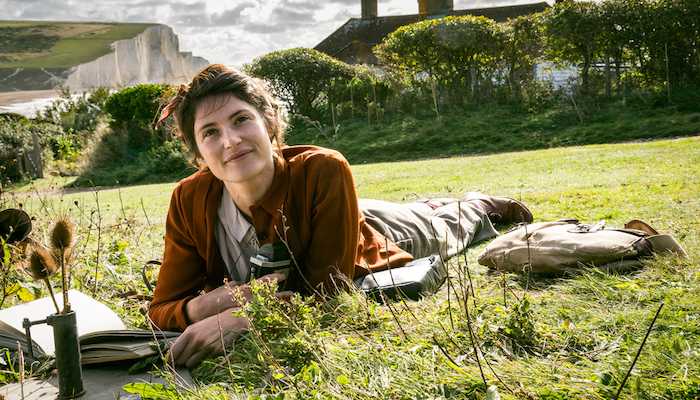
Gemma Arterton is a misanthrope with a buried heart of gold in Summerland

Director: Jessica Swale

Cast: Gemma Arterton (Alice Lamb), Gugu Mbatha-Raw (Vera), Penelope Wilton (Older Alice), Tom Courtenay (Mr Sullivan), Lucas Bond (Frank)

As London is suffering under the Blitz, in a sunny village in Kent reclusive writer Alice Lamb (Gemma Arterton) has her world turned upside down when she is forced to take in young evacuee Frank (Lucas Bond). Depressed and lonely after the collapse of her relationship with the glamourous Vera (Gugu Mbatha-Raw) at college, Alice has shut herself off and leads a solitary life. So it surprises her when she finds her heart thawing for Frank – though not as much as she will be by other revelations.

Jessica Swale has a successful career as a playwright. Several of her plays look at the place of women in history. Blue Stockings was a fascinating (and highly popular) story of female undergraduates in the late Victorian era, smart enough to excel academically but seen as second-class citizens in Cambridge. Nell Gwyn rehabilitated Charles II’s mistress as an intelligent and caring woman and a talented writer and actress. Summerland follows some of these themes – focusing on a lonely lesbian in the 1940s who, with her unconventional interests and academic leanings, is out of touch with her time. But Summerland softens this up by covering the whole story in a dreamy, luscious warmth where everything works out fine and acceptance and reconciliation is the name of the game. It’s both far less interesting than Swale’s stage work and also just as enjoyable.

Not there’s anything wrong with a a bit of cosiness in film. But Summerland is so relentlessly feel-good you end up missing a little bit of bite. Could there not be one character who questions Alice’s sexuality (which even by the 1970s, where Penelope Wilton plays an older version of the character, was hardly welcomed with open arms)? Surely in this seaside town of Kent there would be whisperings of a sort around the village’s multicultural population? Would the colour of Vera’s skin cause no comment from anyone at Cambridge or elsewhere? There are darker societal issues that could have been explored here that just aren’t touched on. I suspect the film is going for a “colour blind” casting, which works in theatre and with older time periods, but seems a bit more awkward when applied to a time period when race was a very real issue. You’d get a ton more social commentary from an episode of Call the Midwife which somehow feels a bit wrong.

But then the film isn’t trying to make a social comment, but is trying to be a bit of escapism. On that score it works very well indeed. With gorgeous Kent scenery, wartime Britain looks like the sort of idyllic Sunday tea-time drama-land you’d love to live in. The fundamental decency of everyone is somehow rather reassuring – even town gossip and busybody Sian Phillips has a heart of gold – and the film bubbles along through a series of events that are both utterly predictable (and at times hugely implausible) and also strangely reassuring. Because you could figure out most of the film early on, you never need worry.

It’s given a great deal of energy by Gemma Arterton’s performance of bad-tempered misanthropy, which of course hides great reservoirs of love and warmth for humanity. Arterton has some beautiful comic timing (an early scene where it appears she is using a ration coupon to buy chocolate for a child without coupons, only to trouser it herself is perfectly done, and probably the film’s highpoint) but also really succeeds in demonstrating the emotional trauma and pain Alice is experiencing. There is a beautiful lightness about how she opens up to Frank (scenes that are of course hugely predictable but still delivered with a genuineness and sweetness that really works).

The flashbacks allow a sun-kissed romance between Alice and Vera to play out, and leave enough questions to keep us guessing (for a bit) as to how this relationship failed to flower. (Needless to say, despite a brief line about flying in the face of society, we never see for a fraction of a second that anyone has any problem with this completely public relationship). Vera is warmly played by Gugu Mbatha-Raw, who brings a radiant life to the part. (A fun moment for Swale watchers – Arterton and Mbatha-Raw both played Nell Gwyn in Swale’s play.)

Summerland throws in a bit of thematic depth around a hunt for Fata Morgana mirages – the focus of Alice’s latest book – and the possibility that these cloud-based mirages of castles carry some sort of spiritual message from the afterlife. But this also serves as part of the film’s easy solving of problems. Any obstructions to the characters’ happiness are swept aside, either by not being mentioned or by the narrative swooping in (one offscreen “character” is easily dispatched, so that we feel no conflicted guilt at their existence getting in the way of the resolution). But this is a film that is offering a light, simple, gentle, escapist story. Nothing remotely challenging – or even really hugely dynamic – happens in it, but for those looking for Covid escape, Swale’s escapist, sweet film debut is worth a look.

The Bounty (1984)

The Bounty (1984)

Hopkins and Gibson present a more historically-accurate Bounty movie that’s serious but solid

Director: Roger Donaldson

Cast: Mel Gibson (Fletcher Christian), Anthony Hopkins (Lt William Bligh), Laurence Olivier (Admiral Hood), Edward Fox (Captain Greetham), Daniel Day-Lewis (John Fryer), Bernard Hill (William Cole), Phil Davis (Edward Young), Liam Neeson (Charles Churchill), Wi Kuku Kaa (King Tynah), Tevaite Vernette (Mauatua), Philip Martin Brown (John Adams), Simon Chandler (David Nelson)

The story of the mutiny on The Bounty has intrigued for centuries. It’s been made into plays, novels and no fewer than three films. Most versions have been inspired by a 1932 novel that painted Bligh as an ogre and Christian as a matinee idol. That image was cemented by the classic Best Picture winning Laughton/Gable version. The real story is far more intriguing – and operates much more in shades of grey – and this 1984 film tries to find a middle ground, with mixed success.

In real life, Bligh was a prickly, difficult but fundamentally decent man, who had worked his way up the naval ranks through merit. He was a superb sailor – as seen by his feat of navigating a small open boat of loyalists over hundreds of miles back to a British port. Cleared of any guilt for the mutiny, he had a successful career and retired as Vice Admiral. Fletcher Christian, on the other hand, was an entitled young man who owed everything to his rich family, rather than merit. The truth has been lost in fictionalised versions who were devil and saint. The truth was far more complex.

This film was a long-standing dream of David Lean, who planned the film for many years, before pulling out at the last moment. The script was written by long-time collaborator Robert Bolt (although ill health meant it was finished by an uncredited Melvyn Bragg). Producer Dino de Laurentis – not wanting to write off the money invested – bought in Australian Roger Donaldson to direct. The final product is a competent, if uninspired, middle-brow history film with a slight air of stodge, and a haunting – if incredibly 80s – electronic score from Vangelis. Where the film really lucked out is the superb cast of actors assembled, with Gibson on the cusp of mega stardom and the cast stuffed with future Oscar winners and nominees.

Anthony Hopkins had been attached to the film for almost seven years, and his carefully researched performance as Bligh is what really gives makes the film work. He gets closer to the personality of the real Bligh than anyone else ever has. Awkward, shy, uneasy with men under his command, insecure at his poor background and the West Country burr to his accent, Hopkins’ Bligh is a world away from a bad man. But he is a demanding and rigid leader, who inspires fear but not respect. He’s far from cruel, but he’s short-tempered, inflexible and has trouble empathising. All too often, he relies on his position alone to ensure obedience, rather than building respect. You sympathise with him, at the same time becoming deeply frustrated at his intransigence. You can understand why many would find him an extremely difficult man to work with (let alone work for).

Fletcher Christian is young, naïve and impetuous, a man whose experiences in Tahiti lead him to become surly and impatient with the confines of a naval life. Gibson later said he felt the film didn’t go far enough to depict Christian as selfish and motivated by a desire for the ‘good life’, and the film does try to show him standing up for the crew against Bligh’s demands for perfection. But Gibson is willing to embrace Christian’s darkness. He hurls himself into the (historically attested) near mental collapse, consumed with violent and unpredictable emotion, that Christian demonstrated during the mutiny, losing all control of himself in an explosion of self-pity and frustration.

The film’s highpoints revolve invariably around these actors. Hopkins’ demanding Bligh sets the tone on the ship. The roots of the mutiny can be seen in Bligh’s public bawling out (and demotion) of his first officer Mr Fryer (a disdainful Daniel Day-Lewis) in front of the entire ship, setting a precedent for disrespect. Every action he intends to build spirit and health in the crew has the exact opposite effect (from pushing them to excel, to enforced dancing sessions for exercise). Hopkins is perfect as man believing he is acting for the best but constantly getting the tone wrong, either too distant and reserved to inspire affection, or too enraged to inspire loyalty. Similarly Gibson, in the less intriguing part, really sells the growing self-absorption of Christian, especially his feckless weakness, easily manipulated into actions that go a step beyond his desires (Phil Davis is very good as a darkly Iago-ish Ned Young, using Christian’s popularity to his own ends).

However, the film itself is a little too traditional. Using Bligh’s trial (all captains who lost their ship were placed on trial to judge their responsibility) as a framing device brings us slightly too many interjections of the “and then you did this” variety – even if it allows actors as impressive as Olivier and Edward Fox to narrate us through the film. This stodgy structure carries us into a narrative that is professionally handled but lacks inspiration, ticking off events but not giving them a force outside of the performances of the actors. The film is competently but not inspiringly made, and never quite captures the sense of the epic that the location and scale should bring.

Perhaps this is because a true-to-life version of the mutiny is a little less traditionally dramatic. Despite some truly impressive performances from the leads (and the rest of the superbly chosen cast), it never quite shakes off the feeling of being a history lesson.

Groundhog Day (1993)

Bill Murray lives the same day over-and-over again. It’s Groundhog Day!

Director: Harold Ramis

Cast: Bill Murray (Phil Connors), Andie MacDowell (Rita Hanson), Chris Elliott (Larry), Stephen Tobolowsky (Ned Ryerson), Brian Doyle-Murray (Buster Green), Marita Geraghty (Nancy Taylor), Angela Paton (Mrs Lancaster), Rick Ducommun (Gus), Rick Overton (Ralph), Robin Duke (Doris)

Few films are so well known they’ve become a shorthand. But mention “it’s like Groundhog Day” to anyone, and they know exactly what you mean. That’s a tribute to the film’s brilliant concept – but also its superb execution. Never mind just comedies, this is one of the smartest and best films to come out of America in the 1990s, so good it doesn’t seem to have aged a day. Groundhog Day is an enduring classic and quite wonderful.

Phil Connors (Bill Murray) is a misanthropic weatherman on a Pittsburgh news network. Every February, he is dispatched to the small town of Punxsutawney to cover “Groundhog Day”, an annual festivity where a local groundhog is used to predict whether winter will last six more weeks. Phil makes no secret of his contempt for the event, the town, its inhabitants and indeed everything else. After being trapped in the town by a snowstorm he failed to predict, Phil wakes up the next day – to find it’s Groundhog Day again! When the same thing happens the next day, Phil realises he is trapped living the same day in the small town over and over again – and no matter what he does during the day, he will always wake up in his hotel bed at 6am on Groundhog Day. What will he use the never-ending time for? Personal advantage? Or just maybe, becoming a better man?

Groundhog Day works because its concept is gloriously simple, and yet endlessly intriguing. Who can’t relate to the idea of a prolonged déjà vu? And anyway, don’t most of us feel at some points life is a never-ending treadmill (one of the town’s residents, asked what he would do, stuck in the same place every day where nothing you did mattered, replies “That about sums it up for me”)? Whole books have been written about the film’s philosophical roots – from Nietzsche to Buddhism – and the time loop’s duration. The film invites this because it keeps these concepts gloriously unexplained.

Imagine how much less powerful (and funny) the film would have been if Ramis had caved to studio pressure to either include a scene explaining why the time-loop was happening or providing a definitive answer for how long Phil spends in it. Hilariously, studio execs settled on a short period of time measured in months – others have gone for anywhere between decades to millennia. It’s certainly long enough for Phil to learn by heart the complete biographies of the entire town’s population, know the timeline of every event in the day to the second, and master everything from the piano (to Beethoven-like proficiency), to French and ice sculpting. There is a magic about not knowing the answer to these questions, that make the story brilliantly charming.

It also helps that the film remains, at heart, not science-fiction (which explanations would tip it towards) but a Capra-esque morality tale. The time-loop is, essentially, a second-chance over-and-over again for Phil to become a better person: to change from being a selfish misanthrope into a kinder, generous soul. That’s a story everyone can relate to, and becomes more and more heartfelt as the film continues (culminating in its uplifting conclusion). It also has the Capra touch of a heartless professional from the big city discovering (eventually) a warmth and truth in small-town America where the people are straight-forward and unaffected.

Which makes the film sound tediously feel-good. It escapes this completely because of three reasons. Firstly, initially Phil uses his new super-power of 24-hour immortality for what most of us would do – gain and greed. No consequences ever. Theft is child’s play when you know the exact second bank staff will be looking the other way. Easy to seduce a woman when you can ask her a series of questions on one circuit, then use her answers to pick her up on the next one. You can do whatever you want, confident the next day you’ll wake up in your hotel bed to I Got You Babe.

Even on his journey to eventual self-improvement, Phil only begins to change after exhausting all other options, including repeated attempts at suicide, to try and break the loop. And Phil, for all his charm, is not a good guy for a long time. His attempted seduction of producer Rita (a charmingly winning Andie MacDowell) over a never-ending series of first dates constantly fails, because no matter what happens, she eventually sees through his lack of decency (Phil’s attempts to recapture moments of spontaneous genuineness in later circuits fail completely).

Secondly, the film is brilliantly, gloriously funny – even with repeat viewings. Ramis’ brilliant shooting and structuring of the film focus on its repetition. We see the same shots and sets, hear the same music cues, the film is edited to stress repetition. Few things in comedy are as funny as anticipation and watching characters fly in the face of all the social conventions we deal with everyday. Seeing Phil’s different reactions to the same stimulus each time never fails to raise a laugh. Knowing the events almost as well as Phil, we eagerly await unexpected reactions. The script – by Ramis and Danny Rubin – is packed with brilliant lines, wonderful set-ups and is superbly structured. The first loop establishes all the settings and situations Phil will spend the rest of the film continually interacting with, and the film allows us to often be in on the joke with Phil (making us like him more).

Thirdly, and perhaps almost most importantly, the film could never have worked without Bill Murray in the lead role. For all the pull for Lost in Translation, this is surely Bill Murray’s finest performance, and stands comparison with the best work of Jimmy Stewart and Spencer Tracy, laced with that classic Murray touch. There is no other actor who can present a character so grouchy, deadpan, cynical and selfish but still make us love him. And – for all the terrible things Phil does in this film – you never stop liking him. His comic timing is exquisite (his varying reactions from frustration, confusion, glee and despair at his predicament spot on) but he also taps brilliantly into moments of genuine heart, loss and despair. Murray has spoken of how the theme of redemption spoke very strongly to him – and he plays perfectly a man so selfish that only after he has exhausted all other eventualities – including death – does he start to become a better man. It’s one of the greatest film performances of the 1990s, and the film is impossible without him.

Groundhog Day is pretty much perfect. The town of Punxsutawney is presented to us at first much like Phil sees it – old-fashioned and twee, populated by well-meaning but dull residents – but over the course of the loop, like Phil, we learn to embrace it. It perfectly mixes a glee at breaking the rules and embracing your inner misanthrope, with learning to develop and improve. It’s both hilarious and heart-warming, with every scene a classic and every performance spot-on. It has a timeless (!) quality about it, and its focus on telling a rollicking good story, full of heartfelt emotion and fabulous jokes, means you can add as much or as little spiritual depth to it as you like. It’s a modern It’s a Wonderful Life that might even be better.

Waterloo (1970)

Rod Steiger chews the scenery as Napoleon in this epic restaging of Waterloo

Director: Sergei Bondarchuk

Cast: Rod Steiger (Napoleon Bonaparte), Christopher Plummer (Duke of Wellington), Orson Welles (Louis XVIII), Jack Hawkins (Lt-General Thomas Picton), Virginia McKenna (Duchess of Richmond), Dan O’Herlihy (Marshal Michel Ney), Rupert Davies (Colonel Gordon), Philippe Forquet (Brigadier-General Bédoyère), Ian Ogilvy (Colonel De Lancey)

In 1970 there was no CGI. Want to stage a battle scene? Well you’re going to have to use real people, rather than populating your screen with pixel soldiers. I’ve always had a fondness for epic films of this era, where you look at the screen and know everything is real. And one of the best examples of this battle-heavy genre is this 1970’s chronicle of the Battle of Waterloo in 1815. Because in 1970 the only way to recapture the battle on camera was effectively to re-fight it with a cast of tens of thousands of extras and horses, across a film set the size of the original battlefield. Can you imagine anyone attempting that today?

An international co-production, the film throws together an eccentric hodgepodge of actors. No more than you would expect of a film co-financed by Italy and the Soviet Union, shot in English, directed by a Ukrainian (with a team of four translators) with a lead actor from New York and the cast stuffed with dubbed actors from across Europe. In fact the slight air of Euro-tackiness about the film is one of the things I sort of love about it.

Rod Steiger as Napoleon delivers the sort of OTT performance he loved to give, capturing the self-aggrandising, larger-than-life nature of the Emperor while frequently chewing the scenery and oscillating between whispers and shouting. It’s perhaps no more than you would expect when playing a man whose entire life was a stage-managed performance of dangerous charisma. It does though make a nice contrast with Christopher Plummer who, perhaps aware of who he was working with, goes for an archly low-key, even wry touch, as the more austere Wellington.

The film covers the time period of Napoleon’s Hundred Days, from his arrival from Elba to the final defeat at Waterloo (with a neat prologue showing an exhausted Napoleon accepting he must abdicate and head into exile in 1814). Much of the first half hour is a showpiece for Steiger’s bombastic Napoleon. Few other characters get a look in (Welles cashes another of his cheques for one-scene cameos, as a bloated Louis XVIII fleeing into exile). To be honest, much of the first half of the film is a slightly stodgy (more-or-less) faithful trot through historical events leading to the battle.

But this is really to set the table for the film’s central appeal, which is that astonishing recreation of the battle itself. Shot in the Ukraine, the Soviet Union (as their part of the deal) effectively recreated the landscape of Waterloo, bulldozing hills, planting thousands of trees, sowing fields and laying over six miles of drainage to help create the muddy fields. On top of which, the USSR threw in 17,000 troops to serve as extras (insanely impressive, even considering it’s only a fraction of the nearly 191,000 troops involved at various stages in the battle).

Marshalling all this was Soviet director Sergei Bondarchuk. Used to commanding film sets like this – he had previously directed a four-part version of War and Peace, where similar number of Soviet troops had recreated Austerlitz and Borodino – Bondarchuk certainly knows how to show the money is all on screen. Aerial shots and long tracking shots take in regiments of soldiers taking up position. Cavalry charges of hundreds of horses are brilliantly shot. The French cavalry charge against the British infantry squares is stunning in its scale and size. Everywhere you look, wide-angled shots demonstrate the depth of extras, the vast scope of the battle and the huge numbers of soldiers marching across screen. If nothing else it’s a superb marshalling of resources.

Bondarchuk brings a number of stylistic flourishes from his War and Peace to the film here. Sadly many of these choices have dated badly – and even at the time, looked a little silly. Interior monologues are demonstrated with close-ups and the sound of actors whispering over the soundtrack (although Bondarchuk also mixes this up with a prowling Napoleon addressing the camera directly). The film loves crash-zooms and fast wipes – one crash zoom generates giggles as it zooms in on Napoleon as he turns fast to face the camera after particularly bad news. Bondarchuk at times drains out the noise of the battle to focus on small details, most notably in the British cavalry charge. It gives moments of the film an odd dreamy film, particularly striking because most of it is so baked in realism.

To be honest the film is workmanlike, rather than inspired, with all the focus on marshalling the thousands of extras. There are moments of character for both Napoleon and Wellington – flashes of doubt, insecurity, fear are mixed in with supreme confidence. The film also hits a neat line in the horrors of war. The camera tracks along the mangled bodies after the battle, while at the peak of the clash a British soldier has a mental collapse, breaking from his square to bemoan “Why are we killing each other?” Not exactly subtle, but it works.

But the film’s main appeal is that scope – and its breath taking. The film itself is more to look at than think about, but with the detail of its recreation of the battle makes it a must for any Napoleonic history buff. Peter Jackson has said his own cavalry charges in Lord of the Rings were inspired by this film – the difference being Jackson’s horses were CGI, while Bondarchuk literally charged hundreds of horses direct at the camera. And you won’t see scope like that anywhere else.

And that’s partly because the film was a bomb, putting an end to such huge scale films as this and also leading to Stanley Kubrick’s plans for a Napoleon biopic being cancelled. Perhaps the worst part of its legacy.

On the Rocks (2020)

Rashida Jones and Bill Murray deal with family problems in On the Rocks

Director: Sofia Coppola

Cast: Rashida Jones (Laura), Bill Murray (Felix), Marlon Wayans (Dean), Jessica Henwick (Fiona), Jenny Slate (Vanessa), Barbara Bain (Gran)

There is often a special bond between fathers and daughters. And it’s one that can be challenged if the father is “replaced” by a husband. After all, nobody wants to go from being the main man to second best. But how complex can this become when the father himself has a track record of selfishness and philandering? And is that the best person for the daughter to turn to when she starts to have doubts about her own husband? In Sofia Coppola’s gentle, light-weight film, Laura (Rashida Jones) reconnects with her roguish millionaire father Felix (Bill Murray), a successful retired art dealer, as she becomes increasingly worried that her husband Dean (Marlon Wayans) is having an affair with his attractive younger colleague Fiona (Jessica Henwick).

Coppola’s new film is an entertaining, low-key family and relationship drama that’s as light as a puff of air. Recycling many familiar ideas from her previous films – in particular the idea of women who seemingly “have it all” but are feeling discontented and trapped in their lives – it spins off into a fairly gentle parable of how doubts and insecurities can take over our lives, which mainly serves as a lovely little showpiece for two very engaging actors to entertainingly do their thing.

Rashida Jones balances the trickier part as a woman who’s half endearingly fond of her fun-loving dad, half infuriated and damaged by the way he wrecked his marriage to her mother and ruined her childhood (it seems her sister and mother are no longer on speaking terms with him). At the same time, she’s keen to hold onto her successful writing career and family life – while also facing an existential crisis as she feels herself becoming more and more stuck in a rut. There are distant echoes of the lack of focus Scarlett Johansson’s character felt in Lost in Translation, the many lonely women running the house in The Beguiled, or the rich girls cut adrift in The Bling Ring or Marie Antoinette.

Into all this drops the bombshell of her husband’s possible infidelity. Coppola gently uses this as a subtle investigation of human nature. Is infidelity and betrayal something all people have as common possibilities? Or does a history of infidelity in our families make us more ready to see it everywhere? Gentle is the word, as the film doesn’t really labour any of these points – perhaps worried that to do so would take it into deeper waters than it has the nerves to handle – and prefers to keep the mood light and frothy. This does mean that when – eventually – emotional moments come, they come rather from nothing, and a braver film would have balanced better the lightness of father and daughter chasing after a (possibly) cheating husband, with tension between that same father and daughter over his appalling past behaviour.

But then, the film perhaps falls rather in love with Bill Murray – and genuinely it’s pretty hard not to. Sofia Coppola again provides Murray with a part designed to match all his strengths. A charming performer, it’s very hard (near impossible) not to like Murray and as he coasts through the film with relaxed cool, arching an eyebrow there, a touch of glib lightness here, investing certain lines with a saggy sadness, others with a playful childishness, you’ll enjoy every moment. Murray makes perfect sense as the ageing rouéand cad, who has lived his life entirely for his own pleasure, and now is conducted by chauffeur from hotel to hotel, flirting with any woman who crosses his path.

It’s a delightful performance, with several scene stealing moments – not least when Felix is pulled over by the cops and charms his way out of a ticket with confidence, a bottomless contact book and charm. The cops even push-start his showy old sports car. Of course it’s the ultimate display of white privilege: I’m interested if Dean would have had similar success if it was him. The film shies away from any commentary on race at all, which feels like a missed opportunity. Does Dean put so many hours into work because he needs to prove himself in the ways people like Felix never had to? A different film might have wondered if sub-consciously Felix was even more jealous and concerned about losing his daughter to a black man. But these are areas the film chooses not to go into.

Instead it largely settles for being a charming meander, centred around Murray’s character, that doesn’t want you to look to closely and realise what a selfish cad he really is. Of course the film is really about Felix’s regrets about not having the relationship he would like to have with his children (and Murray more than gets this across with his skilful suggestion of sadness behind the eyes), but even this is a beat the film very lightly taps. What you end up with is a very light, almost whimsical film that moves through a series of events that wind up feeling rather inconsequential. A puff of air you feel would blow the film apart.

The Trial of the Chicago 7 (2020)

Sacha Baron Cohen leads a campaign for justice in Aaron Sorkin’s The Trial of the Chicago 7

Director: Aaron Sorkin

Cast: Eddie Redmayne (Tom Hayden), Sacha Baron Cohen (Abbie Hoffman), Joseph Gordon-Levitt (Richard Schultz), Mark Rylance (William Kunstler), Yahya Abdul-Mateen II (Bobby Seale), Michael Keaton (Ramsey Clark), Frank Langella (Judge Julius Hoffman), John Carroll Lynch (David Dellinger), JC MacKenzie (Tom Foran), Alex Sharp (Rennie Davis), Ben Shenkman (Leonard Weinglass), Jeremy Strong (Jerry Rubin), Kelvin Harrison Jnr (Fred Hampton), Noah Robbins (Lee Weiner), Daniel Flaherty (John Froines), Caitlin Fitzgerald (Daphne O’Connor)

Aaron Sorkin’s work celebrates the great liberal possibilities of America. Is there any writer who has more faith in the institutions of the American state – while being so doubtful of many of the actual people running those institutions? You can imagine Sorkin sees more than a bit of himself in Abbie Hoffman, jocular prankster and wordsmith, angry at his country in the way only someone who really loves it can be. This idea is at the heart of Sorkin’s biopic of the trial of seven activists for promoting violence in the build-up to the Democratic convention of 1968 in Chicago.

Vietnam is in full swing with young men dying in their thousands to defend a cause many are starting to believe isn’t worth it. Nixon has just been elected – and his government wants to make an example of these left-wing, hippies he believes are drowning out “the silent majority”. Student leaders Tom Hayden (Eddie Redmayne) and Rennie Davis (Alex Sharp), hippie activists Abbie Hoffman (Sacha Baron Cohen) and Jerry Rubin (Jeremy Strong), and pacifist David Dellinger (John Carroll Lynch) are arraigned in court for conspiracy to incite a riot, facing a ten year prison sentence. Black Panther Bobby Seale (Yahya Abdul-Mateen II), who wasn’t in Chicago at the time, is thrown in to make them look more threatening. With radical lawyer William Kunstler (Mark Rylance) in their corner, the defendants deal with a slanted case from the government, being backed all the way by the judge Julius Hoffman (Frank Langella) who can’t hide his contempt for them.

The Trial of the Chicago 7 feels like it’s on the cusp of making a grand statement about the rights and liberties of Americans, at a time of great civil unrest. With the country more divided now than it’s  ever been since the events of the film, this should be a timely message. But somehow the film doesn’t quite manage to deliver it. There is too much going on – an attempt to cover divisions in the left and counter-culture, the events in Chicago in 1968, the trial, clashes outside of court – it’s almost as if Sorkin the director has failed to marshal Sorkin the writer into making a clear and coherent thematic point. Instead the film becomes a chronicle of shocking courtroom events, affecting, but not as earth-shaking as it should be.

Part of this is the fragmented script. An occasional device is used, whereby Hoffman turns the events of the trial into a lively stand-up routine at some unspecified future point. This is a pretty neat idea as a framing device – however it only pops up at odd moments rather than giving a spine to the film (as well as missing the chance to filter events through the perception of one member of its sprawling cast). You end up thinking it’s just Sorkin the writer coming up with a way of giving us information Sorkin the director can’t work out how to do visually.

This tends to affect a lot of the stuff outside of the courtroom. Sorkin’s dialogue is surprisingly plodding here, too often ticking the boxes or establishing backstory and motivation that will play out later. He has his moments and his gift for capturing revealing details make for brilliantly inspired speeches and dialogue riffs that reveal acres of character while feeling very light. But, considering what he is capable with (and could have done with this material) it feels like autopilot.

That’s the problem here: it’s a little too pedestrian. Only an argument between frustrated liberal Hayden and his lawyer Kuntsler captures something of the dynamic pace of Sorkin at his best. Other scenes – such as an out of courtroom scene between decent just-doing-my-job prosecutor Richard Schulz (a low-key but very good Gordon-Levitt) and Hoffman and Rudin – are a little too on-the-nose in making their points about liberty, truth and justice. 

The strongest moments by far are in the courtroom – and the true-life staggering lack of proper procedure followed there. The film is rightly angry, without tipping too much into outright preaching. It’s shocking to see how little the rights of the defendants were respected. Much of this came from the attitude of the judge, Julius Hoffman: a traditionalist, his contempt for the defendants clear throughout, handing out contempt of court charges like sweeties. Frank Langella stands out as a man so convinced of his own morality – and so locked into his own certainty about right and wrong – that he is completely unaware many of his rulings are biased and is deeply hurt at being accused of racial imbalance, while having the only black defendant literally bound and gagged.

Yahya Abdul-Mateen II is superb as Bobby Searle, the Black Panther leader furious at being roped into the trial. Searle loudly – and vigorously – protests the trial has not been delayed to allow his lawyer to attend and that he has been refused (consistently) by the judge his right to represent himself. The treatment of him is shocking and appalling. But it feels like no attempt is made to put this in wider context either of civil rights at the time or in America since. And that feels like a major miss. We’re only a few degrees from the same effectively happening today.

This is part of the film’s general problem in finding its real focus, or wider context. I suspect its heart is probably in the views expressed by Hoffman on the stand – particularly those around not having his thoughts on trial before – but this film is too scatter-gun.

What the film does do well is with the quality of its performances. Sorkin may be a rather a visually flat director – his shooting of the convention riots completely fails to conceal the lack of budget – but he encourages great work from actors. Redmayne and Cohen give skilled performances as the acceptable and radical faces of left-wing politics. Strong is wonderful as a hippie with a firm sense of right and wrong, while Carroll Lynch is great as a pacifist driven to the edge. Mark Rylance excels as radical lawyer Kunstler, softly spoken but passionate, who brings fire to proceedings.

It’s a shame though that The Trial of the Chicago 7 settles for mostly being a walk-through of the trial. An attempt to really capture a sense of the deeper politics gets lost, and the failure of the film to really draw parallels with today or place these events in their wider context feels like a missed opportunity. Even the film’s end captions don’t give you as much information as you would hope – especially telling considering its abrupt ending. A well-meaning effort, but a middle-brow film.

The White Ribbon (2009)

The kids are not all right in Michael Haneke’s The White Ribbon

Director: Michael Haneke

Cast: Christian Friedel (Teacher), Ernst Jacobi (Narrator), Burghart Klaußner (Pastor), Steffi Kühnert (Pastor’s wife), Rainer Bock (Doctor), Susanne Lothar (Midwife), Roane Duran (Anna), Leonie Benesch (Eva), Ulrich Tukur (Baron), Ursina Lardi (Baroness), Maria-Victoria Dragus (Klara), Leonard Proxauf (Martin), Josef Bierbichler (Baron’s steward)

I think it’s fair to say Michael Haneke has a mixed view of humanity. His films look at the dark side of human nature, and the hypocrisies and cruelty underpinning much of our society. The White Ribbon explores these ideas further, a parable focusing on a small German village in the months before World War One, looking at how the life in one village perhaps helped lay the moral and societal groundwork for the younger generation to grow up and embrace Nazism.

In the fictional village of Eichwald, tradition is strong. The town, and its morals, are governed by traditional authority figures. However, each of these figures fails to live up to the values they – often brutally – enforce on the village and, most especially, its children. The Baron (Ulrich Tukur) is a distant autocrat, who talks of a duty of care but treats the villagers like property. The pastor (Burghart Klaußner) preaches morality and abstinence, but bullies his (many) children and condemns utterly even the slightest deviation from his own rules. The doctor (Rainer Bock) is a studious clinician, who humiliates and devalues his lover, the town’s midwife (Susanne Lothar), and sexually abuses his teenage daughter Anna (Roane Duran). In late 1913, a series of unexplained and increasingly violent events occur, from an attempt to cripple the doctor to arson, kidnap, theft and the beating of the midwife’s handicapped son. The perpetrators remain a mystery – one which the decent but ineffectual teacher (Christian Friedel) attempts to uncover – his older self (Ernst Jacobi) providing an, at times, naïve narration.

Haneke’s aim is to explore the conditions that led a generation to embrace a regime that promotes the unthinkable. While it’s clear that a future of Hitler and fascism – neither mentioned once in the film – hover over everything, this parable could serve for any totalitarian regime. Haneke is not interested in specifics. What fascinates the director is the creation of a mind-set that enables people to willingly align themselves with horrific actions. The brilliance of The White Ribbon is that could be as easily applied to Stalinism and the Khmer Rouge as it can to Nazism.

Shot in a beautiful black-and-white, the film presents a series of striking images, imbued with an immense psychological depth and haunting sense of dread. Haneke’s mastery of visual imagery is sublime, and he paces the film perfectly. While it is easy to claim the film is slow – and it does take its time – the deliberation of the pacing, and the precision of each shot, is all part of giving the film its thematic weight. It’s like a medieval passion play, with every moment giving depth to the whole.

The film’s focus is on the children – tellingly, only characters below the age of about 20 are named. It’s their faces the camera returns to time and again – and the film is set in a key moment of many of their lives, where disillusionment with adults begin. The age when they begin to realise their parents are far from perfect and even hypocritical. The film more than suggests that it is the children – working in some combination or alone – responsible for the crimes that take place in the village. Their motivations range from anger and resentment to despair and a longing for escape.

Many of these events centre around the pastor’s family. Played with a perfect emotional austerity by Burghart Klaußner, the pastor judges all around him as unworthy, with his children suffering the brunt of his discipline. It’s easy to see he is overly harsh, hypocritical (the sheer number of his children suggests he hasn’t worked hard to suppress his own sexual feelings) and unjust. His son is tied to his bed while he sleeps to prevent “impure touching” and his daughter is blamed, and publicly humiliated by him, for a school disturbance she is trying to stop. He’s a father who demands respect but cannot inspire love.

Almost worst of all, he requires his children to wear a white ribbon, to constantly remind them of moral standards they have failed to live up to. These acts of stigmatisation and bullying are not balanced with any outward affection – whatever he may actually feel, the pastor is far too restrained to show any warmth – and Haneke demonstrates his children are taking all the wrong lessons from him. The learn to be cold, distant and judgemental, and that strength is vital and weaknesses are not to be tolerated: they beat out individual thinking, and replace it with cold conformity. A basically good man – and the pastor clearly believes he is doing his best to protect his children – rears children who see others as inferior and different, and stigmatisation as an essential part of life.

The whole village lives in medieval thrall to the baron. You could be believe this village was hundreds of years in the past, not a single century. The villagers slave on the baron’s fields, meekly tugging their forelocks to him in church. The baron takes unilateral decisions affecting everyone’s lives. His own family life is cold – his wife doesn’t love him (and her sexual, not romantic, faithfulness is the only thing that matters to him), while his weak young son is the victim of at least two crimes. It’s a pattern of distant, selfish authorities who believe they work for the good of the community, while taking everything they can from it.

But then corruption is also endemic at the home. Rainer Bock gives a chilling performance as the local doctor, respected by the community for his dedication, who treats those closest to him with disdain at best, and abusive cruelty at worst. A controlling, cruel man, the doctor is the clearest example in the film of the hypocrisy of the older generation, demanding respect, decency and obedience from the younger, while treating them with selfish vileness.

Haneke’s film is a grim – and disturbing – study of this sort of everyday horror and it effect on the psyche. The dehumanisation of the young is clear, and the growing casual cruelty they begin to dish out to others becomes more and more striking. The film taps into a Wyndhamish fear of the young, the children moving in packs, their respectful words not matching their air of menace. This unsettling feeling only grows because, for many of the crimes, we are never given a firm answer to who carries them out (although we can guess). Saying that, at least three acts of violence and sabotage are explicitly shown, all of them carried out by the young – enough for the viewer to suspect the others can be tied to the same generation.

The film does pepper itself with touches of hope – enough to suggest not everyone is destined to succumb to malevolent forces. The schoolteacher – sweetly played by Christian Friedel – is well-meaning, if ineffectual, and his courtship of the baron’s dismissed nanny Eva (an endearing Leonie Benesch) has a charming bashfulness. (Although the fact the couple are brow-beaten into postponing their marriage by her domineering father reminds us of the dominance of the older generation). After the pastor’s pet bird is killed (by his daughter, who crucifies the creature on his desk), he is moved to tears when his youngest son offers him his own pet bird to make him feel better (although inevitably the offer only promotes a curt “thank you” from the Pastor while his son is in the room). The women of the older generation all show signs for reluctance or discontent with the behaviour of the patriarchs, although any protest is of course in vain.

It’s touches like this that prevent Haneke’s film from being a lecture. The village isn’t inherently bad, just terribly misguided. This all enforces the universality of the film. You’re kidding yourself if you think this could only happen in Germany. These generational clashes and the twisting of an entire generation could happen anywhere. The world is what we make it, and the white ribbons that help us remember our innocence can just as easily be used to categorise us as the worthy and the unworthy. Haneke’s film is a brilliant, profound and challenging piece of work that rewards thought, analysis and rewatching. Quite possibly his masterpiece. 

Being There (1979)

Peter Sellers is a void in the satirical Being There

Director: Hal Ashby

Cast: Peter Sellers (Chance, the gardener/Chauncey Gardiner), Shirley MacLaine (Eve Rand), Melvyn Douglas (Ben Rand), Richard Dysart (Dr Robert Allenby), Jack Warden (The President), Richard Basehart (Ambassador Vladimir Skrapinov), David Clennon (Thomas Franklin), Fran Brill (Sally Hayes), Ruth Attaway (Louise)

In movies honesty and simplicity often hide a deeper truth – a more pure view of the world, unaffected by cynicism. Being There takes these ideas and inverts them. What if we were so desperate to see a higher meaning in the words of the unaffected, that we kidded ourselves that even their blandest utterances carried deep meaning. It’s the central idea of Being There, proving again that a delusion only works when those affected are also those most invested in sustaining it.

Chance (Peter Sellers) is a child-like innocent. He works in the garden of “the old man” (implied to be his father). He has never in his life left the confines of his self-contained home. He can’t read, he can’t write. His meals are prepared for him by the old man’s staff. Apart from gardening his only other interest is television – and even that is a mute, hypnotic interest with Chance meekly watching anything screened in front of him. When the old man passes away, Chance (of whom there is no record at all) is asked to leave the house by the old man’s lawyers. He finds himself in a modern 1970s world, but still dressed (and with the manners) of a 1930s gentleman.

Accidentally hit by the chauffer driven car of Eve (Shirley MacLaine), the younger wife of wealthy businessman Ben Rand (Melvyn Douglas), Chance (his name mistakenly overheard as Chancey Gardiner) finds himself in the home of Ben where his manners, dress and polite comments about gardening are interpreted as being deep, intellectual musings on society and the economy. In a few days Chance is advising the President (Jack Warden) and his opinion is being solicited by the media. Will anyone notice that Chance is a harmless but basically empty man?

Being There is not just a hilarious satire of the capacity of the rich and powerful to persuade themselves of things. It’s also a satire on the Capraesque notion of the innocent seeing a truth that the rest of us can’t see. It throws in more than enough social commentary on the edges as well – Chance is revered because he looks right: well-dressed, courtly manners, softly spoken, polite and above all white. The film gets a few pointed blows in on this that look more and more central to the film the older it gets. Seeing Chance’s earnest musings on gardening being interpreted as deeply meaningful economic commentary on the television, the woman who bought him up in the old man’s house – a black servant Louise – announces “It’s for sure a white man’s world in America. Look here: I raised that boy since he was the size of a piss-ant… Shortchanged by the Lord, and dumb as a jackass. Look at him now! Yes, sir, all you’ve gotta be is white in America, to get whatever you want.”

And she’s right. Interpreted by the rich, white, entitled men of America as one of their own, it never occurs to them that Chance might be something else. And his statements carry such bland emptiness – precisely because Chance is merely stating genuine gardening tips – that it becomes easy to invest them with whatever depth they like, because they have no depth themselves. While in Capra, Chance would stumble upon some of the corruption at the top or make these people rethink their lives, here he drifts through, barely understanding what is happening around him, allowing these powerful men to interpret him as something that reassures them about their own lives.

In the 1970s the film was seen as a satire on the television generation. But watching it today – despite Chance’s mute, unengaged smile while watching TV – this isn’t about a mindless cabbage potato being seen as a sage. He’s a completely empty vessel that can have meanings poured into him – and then can all stick because not for a single second is Chance trying to get anything out of it. He would be as happy returned to the street as he is in the palaces of the mighty.

The film works due to the success of Peter Seller’s performance. Seller’s had pitched long and hard for the role: he had always believed himself a void beneath the mad-hat comic personas he had inhabited, and believed himself uniquely placed to understand the neutrality of Chance. That’s what he brings here. It takes true skill to play a character as blank as this one. Chance never responds to the situation he is in – and seems to have no understanding at all of the situation. He’s completely genuine and honest – exactly what gives his comments weight to people, because he is not even remotely trying to add any weight to them – and meekly accepts all the things that happen to him. He is honest on every question he is asked – that his only interests are gardening and TV – and sits quietly, smiling, until finally saying or doing things he has frequently copied from TV.

Seller’s restrains himself utterly in the role and eventually his very tame, sweet blankness makes him endearing. The performance would fall apart if even for a split second there was a tip of hat or wink to the camera. There’s none of that. Compare Chance to say Forrest Gump. Gump is the quintessential example of the cliché man who really understands the world better than all of us. Chance is the reality, a simple man, harmless but incapable of really engaging with the world. In Hal Ashby’s skilled and restrained hands this becomes crucial to the awe he is treated with by the rich. He’s a mystery we get no answers to and someone we know as little about at the end as we did at the start. But yet Sellers is mesmeric.

Melvyn Douglas’ provides a superb (Oscar-winning) performance as Ben Rand. How much does Rand really believe in Chance? He’s charismatic, determined and driven – but also nearing the end of his life. Does he want to believe in his faith in Chance, because it makes him feel better? Is Chance almost a sort of advance satire of movements like scientology – faiths that make rich people feel better about themselves, because it affirms their views and place in the hierarchy? It’s possible – and why not when they can craft an idea of Chance that is far superior to their nervy (and literally impotent) President (Jack Warden in a smart little turn).

Ashby at time overplays his hand a little. The final image – a benign Chance literally walking on water on the Rand estate lake – is famous, but its meaning is unclear. Does it imply that Chance is some form of second coming? Or does the naïve and clueless Chance simply walk across water because he doesn’t understand that he can’t? I feel the latter myself – the idea of him being a Jesus figure is so out of keeping with the film, I see it as a final physical representation of his own lack of knowledge about the world. Some hated the final flourish (visually wonderfully done as it is) – although not as much as the bizarre outtake of Sellers cracking up that plays over the credit (Sellers in particular loathed this, believing it shattered the magic of his performance and cost him an Oscar).

Being There isn’t perfect – it’s too long and Shirley MacLaine gets rather a thankless part as the wife who becomes infatuated with Chance (more could perhaps have been got out of her seeing the truth of Chance, rather than being as arrogantly deluded as the rest). Moments have dated less well than others. But it’s got a sharp idea at its heart – and its satire of the rich, Hollywood sentimentality and society feels sharper every day. Rather fittingly as well the film has an autumnal quality about it in Ashby’s coldly reserved shooting: Sellers and Douglas both died shortly after its release, the book’s author Jerzy Kosinski would be plagued after its release with accusations of plagiarism and Ashby’s (after a drug fuelled but successful 1970s) career would collapse almost immediately after its release. But it’s a smart, mysterious, witty and profound film that gains greater meaning with age.

Elizabeth (1998)

Joseph Fiennes flirts with a regal Cate Blanchett in this landmark Tudor history flick Elizabeth

Director: Shekhar Kapur
Cast: Cate Blanchett (Elizabeth I), Geoffrey Rush (Francis Walsingham), Joseph Fiennes (Robert Dudley, Earl of Leicester), Richard Attenborough (Lord William Cecil), Christopher Eccleston (Duke of Norfolk), Kathy Burke (Mary I), Fanny Ardant (Mary of Guise), Vincent Cassel (Duke of Anjou), Eric Cantona (French Ambassador de Foix), Emily Mortimer (Kat Ashley), Kelly Macdonald (Isabel Knollys), John Gielgud (Pope Pius V), Daniel Craig (John Ballard), James Frain (Alvaro de la Quadra), Edward Hardwicke (Earl of Arundel), Jamie Foreman (Earl of Sussex), Terence Rigby (Bishop Gardiner)

Not many people would think of Elizabeth as being an influential film. But I would say the roots of all modern costume drama can be found in this British Tudor epic. Classic costume drama before had seen the focus on “thees and thous”, Greensleeves, lovely costumes, well-lit sets and a certain grandeur. Elizabeth re-set the table. Mixing The Godfather with Elizabeth R, Elizabeth turned costume drama into a world of dark schemes, political intrigue, violence and lashings of sex and passion. It would leave prestige Hollywood dramas of the 70s and 80s behind and turn costume drama into something far darker, grittier and sexual than ever before.

The film follows the early years of the reign of Elizabeth I (Cate Blanchett). The queen is young, naïve and passionate. She’s well educated and smart, but still impulsive and too much in thrall to her emotions. She’s far too open about her sex-filled love affair with Robert Dudley (Joseph Fiennes), new-made Earl of Leicester, and too inexperienced to heed the advice of either William Cecil (Richard Attenborough), who is pushing her towards the middle-ground of European alliances, or Francis Walsingham (Geoffrey Rush), who argues for Elizabeth to lead a strong nation, willing to take on its enemies. Conspiracies whirl around the court, as disaffected Catholics led by the Duke of Norfolk (Christopher Eccleston) plot to seize the crown and restore the “true religion”.

Elizabeth’s style is triumphant. Many of the scenes take place in dimly lit halls at court, and candlelit private chambers. The palace is seemingly made of nooks and crannies where conspirators and lovers can silently retreat and keep their intentions secret. The music – wonderfully composed by David Hirschfelder – is a mixture of urgent marches and murky sounding chords, which brings a watery effect to the soundtrack, as if every moment could twist into swamp-like traps of treachery. The film is briskly cut, frequently jump-cutting and putting together impressive montages of conspirators or events. 

The film starts with such a montage of protestants being burned: moving swiftly from a death warrant being stamped, to heads being brutally (and bloodily) shaved to an overhead shot of the cart carrying the martyrs to their deaths, culminating in their cries as the fires reach hold and finally overwhelm the soundtrack. It’s a sign straightaway that this will be very different from the traditional taste and decorum of a costume drama – and this film won’t flinch away from the grimness. Shekhar Kapur’s direction throughout is stylish, dynamic and uses editing and cinematic tricks to great effect (if at times with a little too much flash).

And the film is soaking in political intrigue – conspiracies and plots swell and unfold, with the film finally culminating in a clearly Godfather-esque purge of the Queen’s enemies. This is Tudor drama as Mafia flick, the lords of England little better than the heads of the five families, and Elizabeth the young heir they underestimate at their peril. It takes historical action and brings it definitely into a very modern feeling conspiracy thriller, using cinematic tricks and good editing to break away from the more staid period pieces of the 1970s into something much darker and atmospheric.

That also carries across into its exploration of sex, something that has got even more play in costume dramas since. It’s odd to think that the film was quite controversial at the time for showing Elizabeth and Dudley engaged in a passionate sexual affair, or for suggesting that the Queen “became a virgin” as part of piece of political showmanship. The film fronts and centres the young naivety of Elizabeth and her all-consuming fascination with Dudley – well played by Joseph Fiennes as a part romantic dreamer, part tragic weakling – and her slow realisation that there is no place for romance and passion in the world of being a queen.

Because the film is also a coming of age drama: how did Elizabeth become the Greatest Tudor Monarch? Cate Blanchett is inspired casting choice, dominating the film with a multi-faceted performance that sees Elizabeth change from an excited young girl into the distant authoritarian figure. Blanchett gets to play it all here, showing her impressive range, charting this changing personality as not always linear – so a scene of giddy romance can be followed by her sharpness when challenging the lords of England over matters of religion and then back to weakness. While you can argue the film undermines Elizabeth’s intelligence (particularly early on) what it does capture supremely well is her determination and her wilfulness. It also triumphantly turns her into a very human figure, Blanchett brilliantly showing a character forcefully – and consciously – reshaping herself to meet the demands of her office.

Around Blanchett, Kapur assembles possibly one of the most eclectic casts in history. Can you think of another film where you could see John Gielgud one scene and Eric Cantona the next? Richard Attenborough and Angus Deayton side-by-side? Fortunately, the core roles are played by assured and impressive performers. Eccleston makes for a wonderfully imperious, self-important Norfolk. Cassel goes gleefully over-the-top as the camp Anjou. Frain, Craig and others excel in early roles. The pick of the lot is a mesmeric performance by Rush as the sinister but loyal Walsingham, an eminence grise willing to work things in the background Elizabeth wants but cannot ask for, a wartime consigliere, several steps ahead of the rest and whose loyalty to Elizabeth is matched only by his ruthlessness.

Historically the film has only a passing resemblance to reality. Elizabeth’s political astuteness was sharper from the first than the film gives her credit for (although, as its aim is to stress how humanity must be sacrificed for power, there are artistic reasons for this). Bishop Gardiner, leader of the anti-Elizabeth church faction, had died during the reign of Mary I. Cecil is played as an unimaginative old man, when he was in fact in his thirties when Elizabeth came to the throne, and her most trusted and wisest advisor. Numerous events are telescoped and combined – the Ridolfi plot which (roughly) climaxes the film took place 14 years into Elizabeth’s rule, not within at most a year. The film ends with a series of historical captions, not a single one of which is actually true. Michael Hirst’s script plays fast and loose with history (and with the odd dodgy line along the way) but he’s got a flair for bringing out the drama.

But does it matter? After all, who really looks to films for their history lessons? What Elizabeth is trying to do is to turn history into cinema, and this it does to glorious effect. It also managed to change our idea of what a “history film” was. After Elizabeth, history dramas would turn increasingly into darker tales, tinged with sex and conspiracy. But this film remains one of the best, directed with real flair and style by Kapur and powered by a superb performance by Cate Blanchett. Elizabeth gets more or less everything (apart from the facts of course) stylishly right and tells English history with gripping and entertaining intensity.

Alien 3 (1992)

Sigourney Weaver goes through the motions again in Alien 3

Director: David Fincher

Cast: Sigourney Weaver (Ellen Ripley), Charles S. Dutton (Leonard Dillon), Charles Dance (Dr Jonathan Clemens), Brian Glover (Warden Harold Andrews), Ralph Brown (Aaron), Paul McGann (Golic), Danny Webb (Morse), Lance Henriksen (Bishop), Pete Postlethwaite (David), Peter Guinness (Gregor), Christopher Fairbank (Murphy), Phil Davis (Kevin), Niall Buggy (Eric)

Few films feel more like a grim contractual obligation than Alien 3. If you want a real blood bath, you’d get more entertainment from reading about the tortured history of its production. Over nearly six years it saw off several scripts, at least two directors (including David Fincher resigning over continual studio interference) and Sigourney Weaver only agreeing to do the film if she was killed off at the end (well that and a big pay cheque).

All of this ended up as a depressing, grim and largely unenjoyable mess that goes over the same old ground as the first two films, but with diminishing returns. After the events of Aliens, our heroes ship crash-lands on a prison planet. Everyone on board is killed other than Ripley (we’ll come back to that…). The planet is populated by criminals who have embraced religion, led by Dillon (Charles S. Dutton) and a small staff of warders (Brian Glover and Ralph Brown) and Dr Clemens (Charles Dance). The company orders Ripley to sit tight and get picked up. But did an Alien on the ship lead to its crash? Is there now an alien on the planet? And is Ripley carrying an Alien inside of her?

It won’t surprise you to hear that the answers to all these questions are of course “yes”. And the film takes a painfully long time to get there. This is made all the more painful by the shockingly, uninvolving grimness of the story’s telling. Nowhere is this more clear than in the ruthless killing off of the surviving characters from Aliens. After the warmth and humanity of that story – and Cameron’s skilled creation of a family dynamic between Ripley, Hicks and most especially the mother-daughter bond between Ripley and Newt, it’s hard not to feel that their brutal off-screen deaths are a real slap-in-the-face. At a stroke all the character development of the previous film is negated. And so we get back on the treadmill of another monster hunt.

It’s not helped either by the fact there is hardly a character here you could give two hoots about. The prison is almost completely staffed by British character actors, peppered with the odd American. The script totally fails to give any of these people really distinctive personalities at all, before the Alien starts munching through them. On top of which the lazy script is littered with effing and jeffing, that serves to make the characters very angry all the time and even less engaging. The film’s most interesting new character, troubled Dr Clemens (a decent performance of world-weary sadness from Dance) is dead by Act Two, and the rest are basically an identikit pile of same-old-same-old. Dutton gets some good speeches as the prisoner’s morally complex leader, but he’s fighting an up-hill battle against turgid dialogue and tired old plotting.

Already by Alien 3 it feels like the franchise was out of ideas. Yet again “the company” is up to no good, only interested in making a buck off the creature. A post-industrial landscape again sees a number of people killed off in ever more familiar ways. The alien looks a bit like a dog this time (or an Ox if you watch the longer and even duller extended cut), but that’s about the most original thing here. And at the centre of the misery we have a grimly resigned and disinterested Weaver, who seemingly can’t wait for that Alien to burst out of her chest and end her association with the franchise for good.

It’s very hard to find anything enjoyable at all about this film. And it feels odd to say that about a film which is about people being brutally murdered one-by-one by an alien. But the others had touches of hope, humanity and demonic poetry to them. This is just a parade of slumming it British character actors, playing foul-mouthed rapists and murderers, getting torn apart. And then the film ends with a colossal downer even more downier than all the rest of the sludge you’ve had to sit through.

Basically Alien 3 reminds us that, with the monster as a motiveless killing machine, there weren’t many places to go with it. It’s not like it could suddenly reveal a motivation or something. So it seems the franchise was doomed – as it has been almost ever since this – to be a familiar parade of facehuggers, dark rooms, slow builds as people meander towards death down corridors, blood splatter and people who barely qualify as characters meeting grisily ends. Alien 3 is depressing and unrewarding in so many ways.