
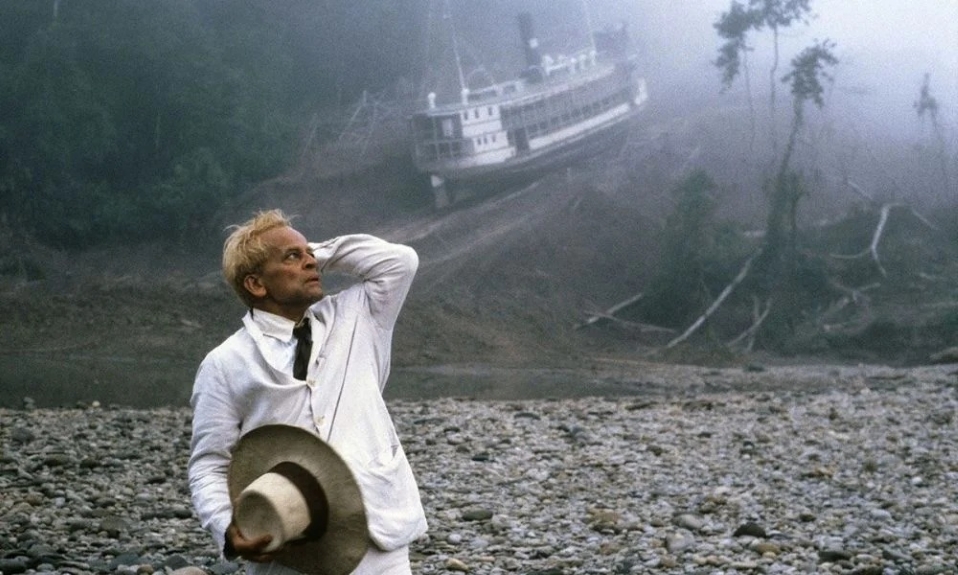
Almost as famous for the story of its making, a stunningly epic look at idealism and hubris
Director: Werner Herzog
Cast: Klaus Kinski (Brian Sweeney ‘Fitzcarraldo’ Fitzgerald), Claudia Cardinale (Molly), José Lewgoy (Don Aquilino), Miguel Ángel Fuentes (Cholo), Paul Hittscher (Captain “Orinoco” Paul Resenbrink), Huerequeque Enrique Bohórquez (Huerequeque), Grande Othelo (Stationmaster), Peter Berling (Opera manager), David Pérez Espinosa (Campa chief), Milton Nascimento (Opera house doorman), Ruy Polanah (Rubber baron)
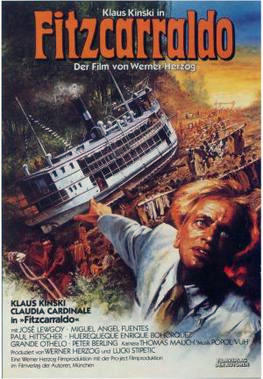
Possibly no film is as famous (if not more so) for its making, as much as the film itself. Fitzcarraldo is the epicentre of the Herzog myth (that’s saying something for a guy who once ate a shoe on film and dismissed getting shot by an air rifle during an interview as ‘insignificant’ before continuing). Herzog not only committed his crew to pulling a steamer ship up a jungle mountain for real, but also continued his tumultuous partnership with the notoriously unpleasant Kinski (who the indigenous cast even offered to bump off). Chuck in that Herzog spent had to reshoot most of the film from scratch after original stars Jason Robards and Mick Jagger dropped out, and you have a film that could almost become a film itself.
In the early years of the twentieth century, the shores of the Amazon are being exploited by business barons. Brian Sweeney Fitzgerald (Klaus Kinski) – known as Fitzcarraldo – wants to become one of them. But not because he hungers for money: his passion is opera, and his dream is to raise the capital to build an opera house in Inquitos. This leads to a final desperate throw of the dice: buying a claim to a stretch of rubber trees, inaccessible behind rapids on tributary stream of the Amazon. But there is only one way to get to it: take a ship down a parallel river, then drag it over a small mountain at the narrowest point, farm the rubber and drag the ship back to sail home. Simple right?
At one point, Fitzgerald calls himself the “Conquistador of the useless”. It’s also the title Herzog himself chose when he wrote about making the film, which was born out of his obsession with how ancient civilisations moved giant stone menhirs. You could (very easily) argue Fitzcarraldo is a self-portrait of a man compelled to bring his impossible ideas to life. There is no doubt a lot of the films power comes from knowing a real (admittedly 30-tonne rather than 320) steamship was pulled up a mountain by hundreds of people. It’s one of the reasons why the film’s more luxuriant pace sometimes drag – we want to get into the jungle as much as Fitzgerald does. We know it’s coming and the first hour leading to it, particularly on a first viewing, can try the patience.
Much like his last famous film in the jungles, Fitzcarraldo has a mystic, mythical and timeless quality. With Popul Vuh’s haunting music seeping into your soul, Thomas Mauch’s camerawork stresses the vastness of the jungle and the size of the ship. The riverbanks this ship will be dragged over seem to tower over it, but the ship itself is frequently framed in relation to the crew it dwarves. There is an impossible, suitably Operatic, quality to what Fitzcarraldo (film and man) is attempting, and Herzog’s film doesn’t shirk in presenting the awesome impossibility of it, the dizzying unlikeliness of success, that only the most obsessed would ever even think of attempting. When you watch this ship being winched painfully slowly up a hill, ropes screaming, it’s somewhere between awe-inspiring and rubber-neckingly compelling. Part of the magic of Herzog’s film is that you invest as utterly in its mad quest as its lead does.
Of course, even though the film nearly starred Jason Robards, the wild-eyed intensity of Klaus Kinski was the only suitable channel for this madness. Despite this though, Fitzcarraldo inverts your expectations by giving us Kinski at possibly his most boyish, sweet and endearing (the exact opposite of the actor’s own personality on set). He’s an excitable eccentric, giddy with joy at hearing Caruso sing live, bounding around, forming a natural bond with children and animals, pushing his vision forwards because he earnestly believes it can be done because it must be done. This might be Kinski’s least ‘dangerous’, most gentle role, Fitzgerald able to inject his passion into others.
Not all of course – its notable that, when he reveals his plan, almost the entire crew deserts en masse in shock, leaving him just the eccentric drunken chef, his world-weary captain and cynical indigenous engineer. But there is a messianic quality in Kinski’s Fitzgerald that sweeps up the indigenous tribes into making enormous sacrifices to assist his vision (Fitzgerald’s tragedy is that his naïve, optimistic excitement blinds him to the fact that their motives are radically different to his own).
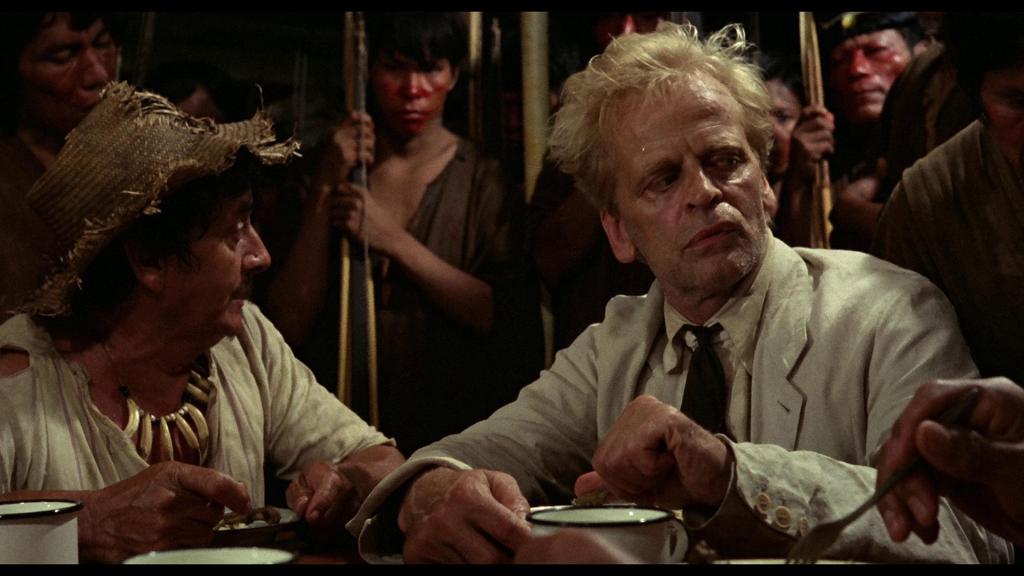
But then Fitzcarraldo, for all of the stunning excitement of the feat at its centre, doesn’t let you forget this is a grand folly, built on the back of oppression and colonial greed. That the sole reason Europeans have piled down to the Amazon is to dig bucketloads of cash out of the ground and that Fitzgerald also has no problem with sacrificing indigenous lives and tearing up the South American countryside to suit his needs. Fitzcarraldo for all its sanity-defying gorgeous, is about the selfish cost of this, and we are not allowed to forget that Fitzgerald is also a ball of monstrous vanity, the self-proclaimed “spectacle of the forest”. That there is a huge element of hubris in his desire to bend nature to his will to fulfil his artistic dreams.
Early in the boat haul, a slipped rope sends the boat rolling backwards and crushing (horribly) the life out of several workers, with others pulled out to die agonisingly slow deaths. At no point does Fitzgerald break off from his dance of celebration as the boat moves to notice this. Later he offers payment to the indigenous workers in the form of blocks of ice (“do they know it melts” he sheepishly asks his translator). The countryside around the boat is torn apart to produce a mud slope to pull the ship up, and Fitzgerald’s grand plan is to industrialise the area. Really, is he that different from the robber baron industrialists, who are full of self-satisfied, cigar chomping greed, talking about civilising the land but really only interested in lining their own pockets.
They take whatever isn’t nailed down from the tribes, feed bottles of champagne to their horses, mockingly keep bonfires going with bundles of bank notes and congratulate themselves over poker games in posh clubs. Herzog records this all with a calm, measured preciseness allowing us to draw our own conclusions. Soon, we can’t miss that even Fitzgerald’s girlfriend (a charming Claudia Cardinale) makes the money to finance their venture from training up a host of extremely reluctant looking indigenous women in the arts of bordello prostitution (“it’s better than working the street” she blithely says).
For all Fitzgerald’s mission is a last desperate throw of the dice, to raise funds for his opera house (it’s striking by the way how many viewers misremember the steamship as the opera house, as if Herzog was dragging a building up a hill), it’s also a quietly subversive look at the arrogance of the West (Fitzgerald is eventually thwarted, as it never occurs to him that the indigenous tribes have motives independent of his own). It’s a reminder that behind many dreams, is often a selfish obsession around gain – be that for glory, money or art. Fitzgerald loves the opera for sure – but he also loves the idea of himself as the ambassador for the art in South America. That’s the real dream and lives will be lost on the way. Fitzcarraldo is willing to forgive him this; even after death and failure, it gives him a sentimental coda that feels almost not quite real in its quiet optimism. But it won’t turn a blind eye to the losses he has caused. Herzog’s film (and you could accuse it, as some of, of doing the same exploitation of others as Fitzgerald does) is still an impossible, marvellous folly that no one else surely could have imagined or made.
 Movie Musings