Author: Alistair Nunn

The Godfather Part II (1974)

Al Pacino defines his career (and film history) as The Godfather Part II

Director: Francis Ford Coppola

Cast: Al Pacino (Michael Corleone), Robert Duvall (Tom Hagen), Diane Keaton (Kay Corelone), Robert De Niro (Vito Corleone), John Cazale (Fredo Corleone), Talia Shire (Connie Corleone), Lee Strasberg (Hyman Roth), Michael V. Gazzo (Frank Pentangeli), GD Spradlin (Senator Pat Greary), Richard Bright (Al Neri), Gastone Moschin (Don Fanucci), Morgana King (Mama Corelone)

For what shall it profit a man, if he shall gain the whole world, but lose his soul? It’s the question that drives this triumphant, Oscar-laden, sequel to Coppola’s cinema-defining masterpiece, The Godfather to create what is, without doubt, the greatest one-two punch in cinema history, two films that develop and contrast each other naturally it’s very easy to consider them as one perfect film.

It’s 1958 and Michael Corleone (Al Pacino) has seen his power grow to control Crime across several states. However problems confront him including rivalry from Hyman Roth (Lee Strasberg) his business partner, a disaffected capo Frank Pentangeli (Michael V Gazzo) talking to a Senate investigation and growing tensions in his marriage to Kay (Diane Keaton). The story is intercut with the rise to power of his father Vito (Robert DeNiro), a man raising his family in Little Italy and realising the temptations of a life of crime.

Happy with just one Godfather film, Coppola only agreed to a second in return for a pile of cash and complete creative control. He used that to create a film even deeper, richer and mesmeric (perhaps) than the first film. While The Godfather is high grade pulp fiction, shot and assembled with arthouse skill and layered with depth, Part II is a profound family saga, an arthouse epic spliced with rich vein of pulp fiction at its heart. A multi-generational story that illustrates the dark corruption at the heart of America from top to bottom, it also demonstrates the stark differences in personality and action between two ruthless, authoritarian father figures who do all that they do in the name of family, one of whom sees that family prosper and grow around him, the other who destroys everyone near to him.

Coppola’s film removes much of the slightly cuddily family element from the Corleone family to show a darker, bleaker, chillier movie than its landmark predecessor. Coppola uses his control to expand and deepen the Corleone saga both in the past and present, but also in the dark hearts and secrets of a family built on crime, extortion and murder. It’s a thematically rich, engrossing and beautifully assembled piece of film-making. Exquisite in every touch and beat, completely convincing and breath-taking in its confidence it is clearly the greatest sequel ever made.

The film charts the final descent of Michael Corleone into the dark recesses of his own worst desires and instincts. The brutal, unforgiving, unrelenting coldness and absolute certainty matched with the overwhelming hunger to win that has left him hollowed out and unrecognisable from the naïve, idealistic young war hero we were introduced to at the wedding that opens The Godfather. Of course, even at the start of the film, as Michael holds court with a chilling coolness and maintains only awkward contact with his family – all of whom must submit to him and his wishes or face lethal consequences – it’s clear that the man who talked of “it’s my family Kay, it’s not me” is a long, long way away.

During the film we see Michael seem to harden even further, an adamantine chillness captured superbly by Al Pacino. In, without doubt, the greatest performance of his career, Pacino restrains bar maybe three times, the explosive energy and ferocity that has been the hallmark of his career (a feat that allegedly made him physically ill). Instead, he presents a Michael who is an almost pathologically cold fish, a fiercely intelligent, scheming observer with eyes that observe and understand everything, jet black boreholes that suggest only whirlpools of emptiness behind them. He’s unrelenting, lacks any doubt and (it becomes clear) has not a vestige of pity left in him, with empathy forced out of his body like water from a squeezed sponge. Pacino prowls every frame like a quiet tiger, oozing sharpness, intelligence and lethal, ruthless ambition.

Everything is done to protect and secure his family and its legacy, but each action seems to strip him one by one of everyone he claims to be protecting. His children seem to live in intimidation and later terror of him. His wife turns from misery to loathing to being ejected from the family home, even aborting her pregnancy to prevent herself bringing another Corleone into the world (a reaction that leads to a final, relationship severing explosion of rage from Michael). His brother Fredo, poor sweet, foolish Fredo, is sacrificed to an unrelenting desire for revenge. The man who did everything for “the family” ends the film by having his last surviving brother executed. The brother who, the film’s coda reveals, was the only member of the family to support his signing up for service in World War Two.

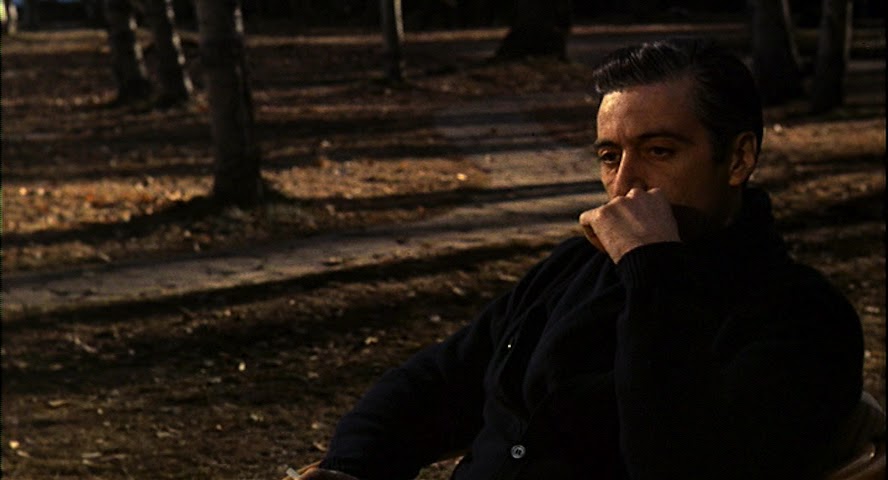
As Coppola’s camera drills into the face of Michael, cold, greying, alone in an autumnal garden – and how often the film simply studies the ruthless calculation of Michael, the man who understands every move everyone makes before they even make it – you know we are looking at a man who has damned himself, who has destroyed everything who claims to hold dear while working to protect it.

Brilliantly, Coppola intercuts the storyline of Michael’s damning collapse into complete moral damnation with the rise of his father. The Young Vito Corleone – played with Oscar-winning skill by De Niro who superbly channels the basic facets of Brando’s performance mixed with his own charm – arrives in America to find it a land as in thrall to the rule of the gangs as his hometown in Sicily. Like Michael in the first film, he is tempted by the world of crime and finds he has a natural aptitude for it: like his son he is a man who people follow, and the man who has the will to do what must be done. Like him he is an empire builder who commands respect and honour.

But unlike his son, he is a man capable of warmth, of empathy. He is man who can be playful, who respects others, who can feel forgiveness, who sees others as people, not just (as Michael does) simply being tools to be manipulated. Vito may be a murderer like his son, but he loves his wife, he loves his children and he can form bonds with them – natural, warm, loving bonds – that Michael can only dream of doing. For Vito it is all about the family, and providing for them is what inspires his actions. For Michael it’s words, but for Vito – it is everything.

Coppola masterfully intercuts these two storylines so they brilliantly comment and contrast with each other. Each step of Michael’s struggles to overcome the plots around him, are perfectly bookended with contrasting moments of Vito’s own rise to power, and the bonds of loyalty he builds even as Michael destroys those own bonds in his own life.

But then Michael is dealing with high stakes. While Vito’s early life shows Mafiosi running Little Italy, and calling the shots on the neighbourhood, a local tradition inherited en masse from the mother land, Michael moves in the worlds of government corruption. The empire we see Vito start to build is destined under his son to interfere in the rule of whole countries in Cuba, and commit unspeakable crimes to bring Senators and witnesses under their control in Senate Hearings into Organised Crime.

Coppola had intended the storyline around the reluctant family witness to be Clemenza, but Richard Castellano famously refused to reprise his role unless he was allowed to write his own dialogue. (The Godfather Part II was blighted with actor disputes: Brando refused to reprise his role in the film’s coda, while James Caan was paid more for a day’s work than he was for the whole of the first film). Instead the role was passed to Michael V Gazzo (Oscar nominated) as Frankie Pentangali, a loud-mouthed Capo manipulated into thinking he has been betrayed by the family. This threat hangs over the second half of the film – but Michael barely seems to break sweat under interrogation.

He has more problems with the Meyer Lansky inspired Hyman Roth (played by Pacino’s teacher, the legendary Lee Strasberg – also Oscar nominated). Roth it is who immerses Michael in a corrupt takeover of the Cuban government by the Mafia – an attempt foiled by the revolution – and Roth who becomes his nemesis, an old man in a hurry, who believes he can match the ruthlessness of this man without a soul. Coppola’s scenes of Cuban excess – not to mention the danger on the street as the country starts to tear itself apart – are of course masterful.

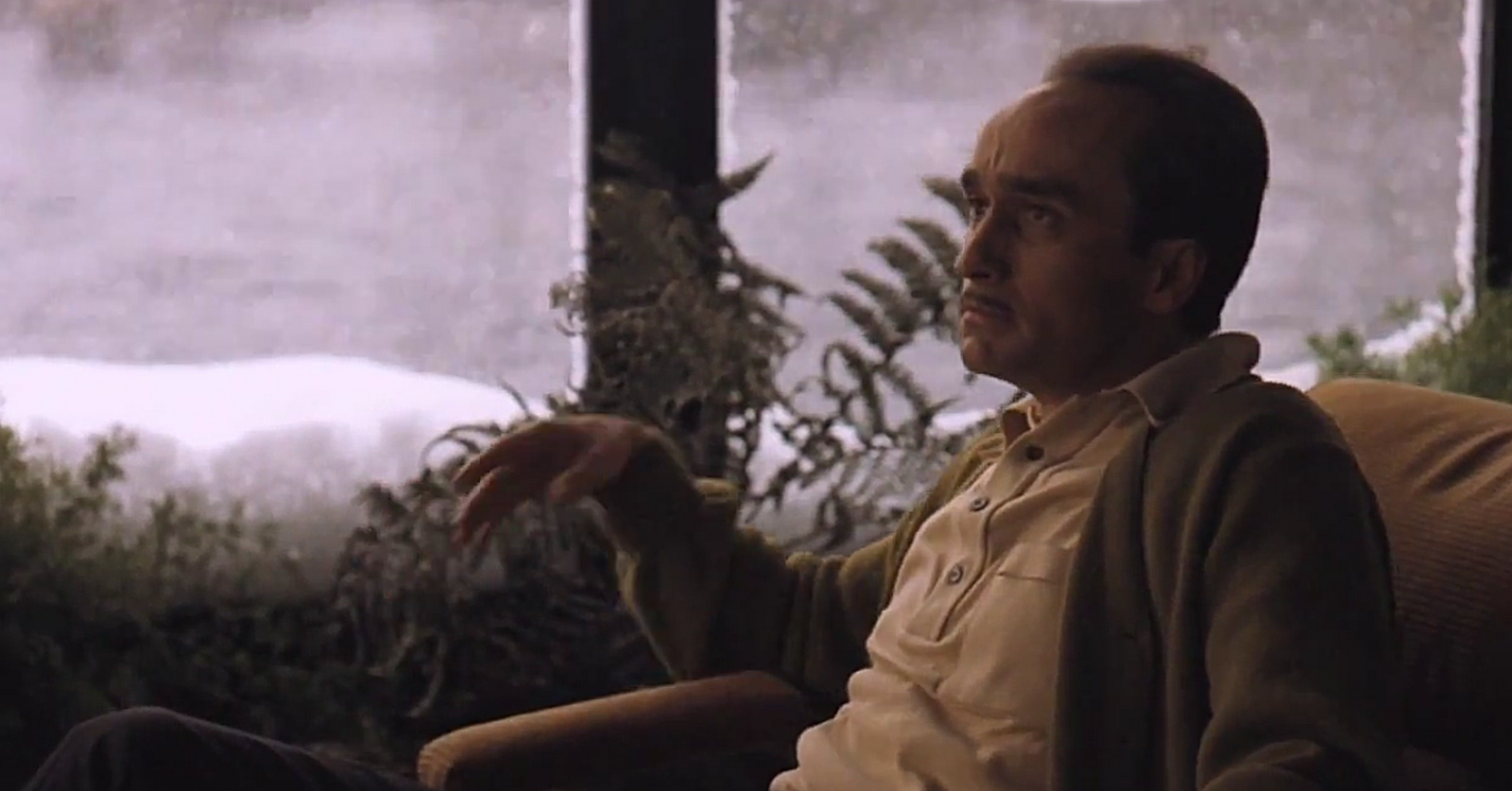
Cuba destroys Fredo, a snivelling John Cazale (inexplicably not nominated, despite extraordinary work here – never mind nomination he arguably should have won). Cazale’s Fredo is endearing but simple, a fundamentally weak man in a family of wolves, whose guilt is almost embarrassingly easily unveiled. Petulantly – but terrifyingly – raging late in the film at Michael at being passed over, he sits (sweaty and veins throbbing) in a reclining chair that bounces on each point he makes – a simple touch that makes him seem more and more impotent and pathetic every second.
The film echoes much of the structure of the first film, but here retold with a chilling coldness as the warm heart that – for all his crimes – Vito bought to this family is removed. The opening family event, Anthony’s confirmation, is a public show with no personality at all, where the Italians feel all at sea, their culture not known or cared for. Doors are closed on Kay with an alarming regularity – their marriage is so non-functional that even at the start they seem to have very little to say to each other. Vito returns to Sicily, as Michael did, but this time to extract revenge for his parents not to fall in love. The ending of the film culminates in a dark, ruminative and tragic hinged cleansing of Michael’s – crucially not the families but Michael personally – enemies.

The film is blessed with a brilliant array of supporting turns, from Diane Keaton’s soft-faced sadness masking deep and lasting resentment as Kay, to a flashily amusing tone from GD Spranlin as the greasily corrupt Senator. Robert Duvall does unsung but powerful work as a Tom Hagen coldly loyal, perhaps even in slight fear of his adopted brother, but despite his seeming decency willing to carry out truly terrible deeds for the family. Talia Shire (also nominated) is great as the rebellious Connie who pleads in vain for Fredo’s salvation.
This is all beautifully packaged together by Coppola into a film that meditates on the building and the destruction of a family, two stories neatly told together in parallel, with each echoing the other. It is a film shot at a riveting but controlled pace, that uses the classical filmic style of the original but mixed even further with the genius shooting of Gordon Willis to add a dark tinged 1970s style to ever shot. The film is an art house classic, but also a superb plot boiler, a gangster film that tells us profound truths about the attitudes that make us men and those that destroy us, just as it suggests that the darkness at the heart of crime will eventually consume the very thing it starts out to protect (even if it does take generations). While it is not as entertaining or engaging perhaps as the first film – it is perhaps an even greater achievement, a superb triumph of atmosphere and tone and a terrifying insight into the darkness that man can achieve.

For at the end Michael has won utterly. But he is also utterly defeated.

Portrait of a Lady on Fire (2019)

Noémie Merlant and Adèle Haenel are part of an illicit affair in Portrait of a Lady on Fire

Director: Céline Sciamma

Cast: Noémie Merlant (Marianne), Adèle Haenel (Héloïse), Luàna Bajrami (Sophie), Valeria Golino (The Countess)

There have been several well-known, successful films made that have focused on male gay couples but, perhaps because female directors are simply fewer in number, there have been fewer films that have focused on lesbian love stories. Portrait of a Lady on Fire is a triumphant course correction to this, a film that is both a beautiful artistic statement and also a deeply moving and involving romance drama, subtly and truthfully told. 

Marianne (Noémie Merlant) is a young female artist in late eighteenth-century France, who is summoned to an isolated island to paint the daughter of a Countess (Valeria Golino). The daughter – Héloïse (Adèle Haenel) – has been plucked from her chosen life in a convent after the death of her sisterm and is now set to marry a Milanese nobleman. A painting of her is needed to “seal the deal”. Problem is, Héloïse refuses to sit for any artist – so Marianne is to pretend to be her companion in order to study her and paint her from memory. However, as the trust between the two women grows, Marianne confesses to Héloïse – and destroys the painting – an action that finally leads to her agreeing to sit for a new painting. As the Countess leaves the two women alone on the island with just a maid, Sophie (Luàna Bajrami), the painting continues – as does the bond between them.

Sciamma’s film is beautifully made, an artistic triumph of intense feeling that helps us forge a deep emotional bond with these two women. Sciamma uses mid shots and close-ups for almost 70% of the film, an effect that brings the women’s faces – and the often micro-emotions that cross them – into sharp focus, as well as building a stunning sense of intimacy between them and the audience, as if we are pressed close up against them. It allows us as well to really feel the growing physical closeness between the two women, as they more and more share the frame. 

Sciamma only breaks away from these to longer shots when the camera moves outside of the house – to capture the women walking to and from the house across the island’s beach – or when disagreement has broken between them. The effect is stunning, totally immersive, and allows the two actresses to beautifully convey a deeply felt courtship that takes well over half the film to flower into an actual relationship after a prolonged, hesitant, second-guessing courtship.

Noémie Merlant is wonderful as Marianne, the artist who has struggled all her life as a woman in a man’s world, restricted by what she is and is not allowed to paint (from themes to nude men – which are of course out). Marianne is a woman with a thick skin, who is careful to avoid opening herself up, but eager to form a bond beyond this. The “artist” of the relationship, she has spent her life observing the world but only rarely allowed herself to be part of it. Her quietness is neatly contrasted with Héloïse’s more noticeable immediate chill, which is itself a careful shield from a world where she has no choices, but reveals a deep longing for emotional and intellectual freedom and a humming tenderness and gentleness. It’s an equally superb performance from Adèle Haenel.

Both women are struggling to express themselves in a men’s world. A man hardly speaks in the entire film (and other than in the film’s opening and coda, they don’t even appear) but the presence of men hangs over the entire film. The little commune of independence that Marianne, Héloïse and Sophie form – a very equal, comfortable naturalness where they cheerfully exchange roles, with the maid relaxing while the mistress cooks – can only exist while men are distant. The judgements and decisions of men affect all their lives – from Marianne’s painting to Sophie’s pregnancy, which the women work together to avert. 

When we do see men they are distant and selfish. On the boat over to the island at the start of the film, not a single man lifts a finger to save her painting gear after it is dropped in the ocean (forcing Marianne to dive in herself); at the film’s conclusion, the male servant who arrives promptly takes the centre of the kitchen and demands to be served dinner. The women’s enjoyment of leading their own lives – from their relationship, to Marianne’s triumphant decision to sketch a recreation of Sophie’s abortion, capturing a moment no man would ever choose to paint (or have a clue how to) stresses that, never mind sexuality, women got to make very few decisions of their own in the eighteenth century.

But it’s the relationship that is central, and it’s beautifully and organically developed with an immensely involving delicacy. Every beat is perfectly placed and the effect is overwhelmingly emotional. Sciamma uses music only three times in the film: once Marianne’s enthusiastic to recreate Vivaldi on a harpsichord for Héloïse’s enjoyment early in the film (a touching sign of her eagerness to share her passions), again for a haunting but beautiful moment of singing from a group of peasant women on the beach, and finally a powerful echo of the movie’s first use of music, surely bound to take its place as one of the great endings of film. 

For the titular painting itself, the one that captures Marianne’s feelings about Héloïse rather than the one she paints for the suitor, it appears only briefly on screen and we never see its creation. What we see is the moment that inspired it – a Héloïse so wrapped up in Marianne that she never even notices her dress catch fire in a bonfire on a beach – and it’s that which is truly important. At that moment we know everything about what that moment means to both women, and the force of a love that will last the lifetime of both women and shape their emotions and lives in profound ways. Sad, beautiful, joyful, triumphant Portrait of a Lady on Fire is a great piece of film-making.

Batman Begins (2005)

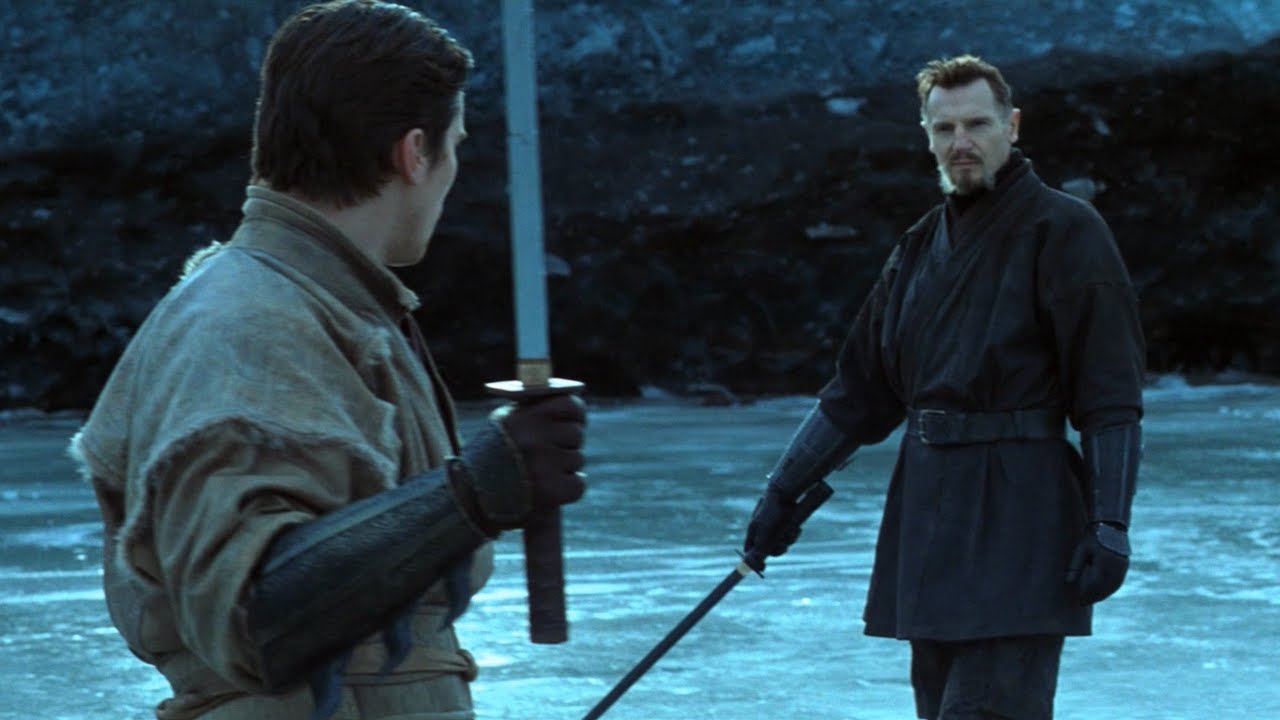
Christian Bale redeems the Batman in Batman Begins

Director: Christopher Nolan

Cast: Christian Bale (Bruce Wayne/Batman), Michael Caine (Alfred Pennyworth), Liam Neeson (Henri Ducard), Katie Holmes (Rachel Dawes), Gary Oldman (Lt James Gordon), Morgan Freeman (Lucius Fox), Cillian Murphy (Dr Jonathan Crane/Scarecrow), Tom Wilkinson (Carmine Falcone), Rutger Hauer (William Earle), Ken Watanabe (Ra’s al Ghul), Mark Boone Jnr (Detective Arnold Flass), Linus Roache (Thomas Wayne), Colin McFarlane (Commissioner Loeb)

In the mid-2000s, Batman on film was a joke. A series that started with the Gothic darkness of Tim Burton had collapsed into the pantomime campness of Joel Schumacher. The franchise was functionally dead, so why hot burn it all down and start again from scratch. It was a radical idea – one of the first big “reboots” of a comic book saga. It was a triumphant success, changing the rule book for a host of film series and one of the most influential movies from the last 15 years. 

After the death of his parents, Bruce Wayne’s (Christian Bale) life drifts as he is unable to get over his own guilt at believing he was partly responsible for getting his parents into a situation where they were killed. In a Gotham run by organised crime boss Carmine Falcone (Tom Wilkinson), Bruce exiles himself for years to try and learn the skills he will need to return and try and find some peace and deal with his fears by tackling crime head on. Recruited by his mentor Henri Ducard (Liam Neeson) into the League of Shadows – a dark group of ninja inspired vigilantes – Wayne eventually rejects the group’s ruthlessness and returns to Gotham. There, working with his old guardian and family butler Alfred (Michael Caine), he starts to build a new identity: by day shallow playboy Bruce Wayne, by night The Bat Man ruthless vigilante, fighting crime. 

Why did it work so well? Because Christopher Nolan understood that the key to making a film that will kickstart a series and win the love of both the casual viewer and the fan is ‘simple’ – just make the film good. Make it a film powered by ideas, characters, a deliberate story and intriguing beats and audiences will love it. Make it a lowest common denominator film offering only bangs and crashes and ‘fan service’ and audiences will reject it. Because at the end of the day we know when we are being manipulated, and the assumption too many people behind making films like that is that people don’t really want intelligent films. They do.

Batman Begins works so well because it places character front-and-centre in a way no other Batman film – and very few superhero films – had before. Unlike all the other Batman films, here Bruce Wayne (and it is definitely Bruce Wayne) was the lead character, not a staid stick-in-the-mud around whom more colourful villains danced. Combine that with Nolan’s inspired idea to return Batman to something resembling a real-world, a more grounded, recognisable version of Gotham which has problems with organised crime that we could recognise from the real world. This are intelligent, inspired decisions that instantly allowed the film to take on a thematic and narrative depth the other Batman films had lacked. 

It’s Bruce Wayne’s psyche at the centre of the film – in an excellent performance of emotional honesty and physical commitment by Christian Bale – and his attempts to find solace in a sense of duty from his fears and his loss of a father figure. It’s Fear that is possibly one of the central themes of Batman Begins and the power it has over us. Fear is what Bruce must master – on a visceral level his fear of bats, on a deeper level his fear that he has failed his parents by failing the city they loved – and fear is the weapon all the villains use. Fear is the petrol for Falcone and his gangsters. Fear is the weapon Batman utilises. Fear is the study of choice of disturbed psychologist Joanthan Crane (a smarmily unsettling Cillian Murphy). A weaponised Fear gas is the WMD that the film’s villains intend to introduce into Gotham.

Understanding fear, working with it, finding its strengths and using these for good is at the core of the film. It’s there from the first beat – a traumatised young Bruce attacked by bats after falling into an abandoned well they nest in – and it’s there at the very end. Bruce’s training with mentor Ducard is as much about understanding and living with these terrors as it is physical prowess. His impact as Batman on the city is central towards channelling his own fears – bats, the dark, violence on an empty street – into universal fears he can use to terrorise criminals. 

It’s all part of the film’s quest to work out who Bruce Wayne is. With Bale superb at the centre, the film throws a host of potential father characters at Bruce, all offering different influences. He has no less than three father figures, in his father (a fine performance of decency by Linus Roache), the austere and understanding Ducard (Neeson channelling and inverting brilliantly his natural gravitas and calm) and the firm but fair and caring Alfred (Michael Caine quite brilliantly opening up a whole new career chapter). 

The influences are all there for Bruce to work out. Should he follow a path of compassionate justice as his father would do? How much muscular firmness and earnest duty, such as Alfred represents, should this be spiced with? How does Ducard’s increasingly extreme views of justice, combat and social order play into this? Which influence will win out over Bruce – or rather how will he combine all this into his own rules? It’s telling that the film’s villain turns out to be a dark false-father figure – the entire film is Bruce’s quest to come to turn with his own legacy and allow himself to accept his father and forgive himself.

It’s also telling that both hero and villain are driven by similar (but strikingly different) agendas. Both are looking to impose justice on the world. But where Bruce sees this as compassion with a punch – a necessary evil, protecting the good in the world while bringing down the evil – the League of Shadows see their mission as one of imposing Justice through chaos, of letting a world destroy itself so that a better one can rise from the ashes. 

Its ideas like this that pepper Christopher Nolan’s film. Throw in his superb film-making abilities and you have an absolute treat. Nolan’s direction is spot-on, superbly assembled with a mastery over character and story-telling. Beautifully designed, shot and edited it’s a perfect mixture of comic book rules and logic – the very idea of the League of Shadows – with the real world perils of crime, vigilanteeism and violence. With a superb cast led by Bale – and Gary Oldman also deserves mention, Nolan finally unleashing the decency, honesty and kindness in the actor that revitalised his career – Batman Begins relaunched Batman as a serious and intelligent series, that matched spectacle and excitement (and there is tonnes of it) with weighty themes, fine acting and superb film making. There is a reason why it’s been a touchstone for every reboot of a series made since.

North by Northwest (1959)

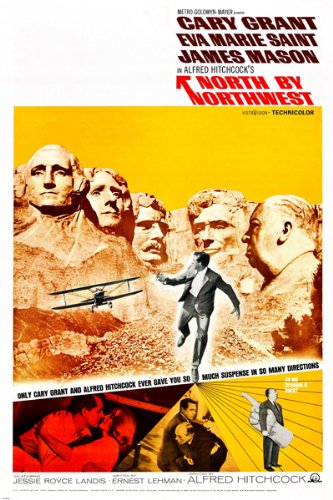
Cary Grant is on the run in the sublime North By Northwest

Director: Alfred Hitchcock

Cast: Cary Grant (Roger Thornhill), Eva Marie Saint (Eve Kendall), James Mason (Phillip Vandamm), Jessie Royce Landis (Clara Thornhill), Leo G. Carroll (The Professor), Martin Landau (Leonard), Josephine Hutchinson (“Mrs Townsend”), Philip Ober (Lester Townsend)

What is it about? Ernest Lehman went in wanting to write the “ultimate Hitchcock film”. And I think you can say he pulled it off. North by Northwest is the perhaps the most electric, fun, dynamic and nonsensical of all Hitchcock’s action-adventures, a neat bookend with The 39 Steps for Hitchcock’s career. It’s such good fun you scarcely notice the plot makes very little sense and the film is barely about anything at all other than a man getting chased. It has the most Macguffiniest MacGuffin in the whole Hitchcock career, an item of such little interest to the viewer that it never appears on screen and is only cursorily discussed. 

Cary Grant is Roger Thornhill, nifty Mad Man-esque ad executive (you can imagine that Don Draper dreamed of being Roger Thornhill) who accidentally gets mistaken by shady goons for the mysterious “Mr Kaplan”, actually a non-person used as a distraction by the FBI. Cue Thornhill’s kidnapping, interrogation by the goon’s suave leader (James Mason, never more James Mason than here), escaping a murder attempt, getting embroiled in the murder of a UN official and fleeing New York in the train compartment of smart and sexy Eve Kendall (Eva Maria Saint). And that’s before we even mention killer crop dusting planes, faked shootings, auction house shenanigans and a vertigo inducing game of cat-and-mouse on Mount Rushmore. Is there a more fun film in the world?

North by Northwest gained its Hamlet inspired title (“I am but mad north-north-west. When the wind is southerly, I know a hawk from a hawksaw”) and it’s pretty meaningless – Lehman basically liked it and throws in a fictional “Northwest airline” so Thornhill can fly ‘North’ at one point (geddit?!) – but it also captures a sense of manic powerlessness in the film. Thornhill spends a good slice of the film telling anyone who will listen he is notKaplan, while every action he carries out seems to serve only to convince his pursuers he definitely is. The film’s echo of madness in its title carries across to the frantic energy of the film, and Thornhill’s belief that he must surely be the only sane man in a world of lunatic chaos. 

And it’s prime Hitchcock chaos here in his most engaging, fast-paced and funny action adventure. The sort of prime piece of entertainment assembled with such skill, energy and excellence it looks really easy (but of course isn’t). Hitchcock keeps the momentum of this crazed chase perfectly pitched, and stages each of the set pieces so well that all of them have become icons of adventure cinema. Who can look at a crop dusting plane without thinking of Thornhill running in desperation, in the middle of nowhere, from a lethal plan swooping down on him from above? Who can look at Mount Rushmore without imagining Grant and Saint climbing all over it with Landau in pursuit?

It’s Grant as well that really makes the film work. He’s such an accomplished screen presence, so smooth and practised, it’s very easy to see this as a film where he is barely acting. But that would be to do him a major disservice. Not only is such a balance of light comedy and action so hard to pull off (so much so that Harrison Ford as Indy is possibly the only one who can get close – and that character is chalk and cheese with Thornhill) – but Grant builds a character who develops perceptively and clearly over the course of the film. 

Initially the typical Grantish stereotype – so suave, confident and shallow that even his middle initial “O” literally stands, Harry Truman like, for nothing – Thornhill begins as a man who blithely assumes he can drift through his life and getting anything without question. Events – and his embroilment in them – however see him develop from a deeply selfish and lazy man into one who carries moral force, loyalty, determination and dedication to duty and an increasing sense of confidence and derring-do. From the man who is the victim of circumstance at the start of the film, failing to get anyone to believe him, he becomes a man who saves himself and everyone else with his pluck, daring and resourcefulness. And he does it all while never losing his light, almost put-upon, wit and playfulness. It’s a truly great personality performance with real depth and development: a hollow man who becomes a real man of standing and purpose.

He’s backed superbly by the cast who seize their roles with gusto. James Mason drips British superiority and suaveness (has there ever been two such cool actors facing off?) as VanDamme, Eva Marie Saint is every ounce the brave, resourceful, daring and clever lady that prompts Thornhill to man-up. Jessie Royce Landis gets some lovely comic mileage from Thornhill’s pecking-hen mother (hilariously she’s only 8 years older than Cary Grant). Martin Landau simpers rather effectively as VanDamme’s fey sidekick.

The script is crammed with great lines from Lehman, all of which delivered superbly by the cast. But it’s a director’s treat, and Hitchcock delivers it brilliantly. I’ve mentioned that MacGuffin – it’s some microfilm or something in a statue that’s the root of the all the problems – but it hardly matters. The film powers forward with the dynamic energy of a comic farce crossed with action adventure. Thornhill’s initials spell out “ROT” and in an affectionate thing that’s what the film is – something that doesn’t take it self seriously but sets out to entertain at all costs. 

So we get Hitchcock splicing in rom-com flirtations between Grant and Saint (and no less than two shots of trains speeding down lines and into tunnels, just to hammer home exactly what they are doing to kill time on the ‘sleeper’ train) with edge-of-the-seat sequences (the slow tension build at an abandoned bus station while Grant waits for “Kaplan” only to fall victim to assault from crop duster) then segues back into comedy (the hilarious “pretend to be drunk” to escape assassination at an auction) it’s perfectly assembled. And that end sequence at Mount Rushmore – a near perfect mix of comedy, action, adventure, suspense, thriller and romance. It’s flawless.

William Goldman famously stated North by Northwest had the finest, most economical ending of all time – and it ties up perfectly and beautifully about six plot threads and cliffhangers in less than 70 seconds – but the entire film is a perfect package. Hitchcock’s glossiest chase adventure is wonderfully directed and in Cary Grant it perfectly married up possibly the only actor in the history of film with both the charisma and the acting chops to play the part with one of the greatest entertainments in the history of film. It’s mad, meaningless nonsesense – but who cares, it’s a great, great, great film.

Midnight Cowboy (1969)

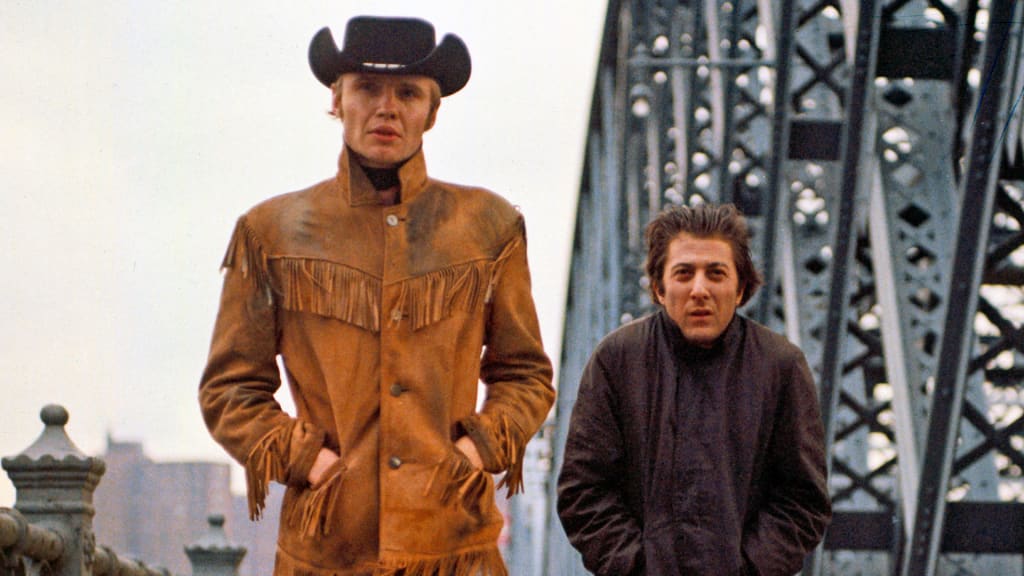
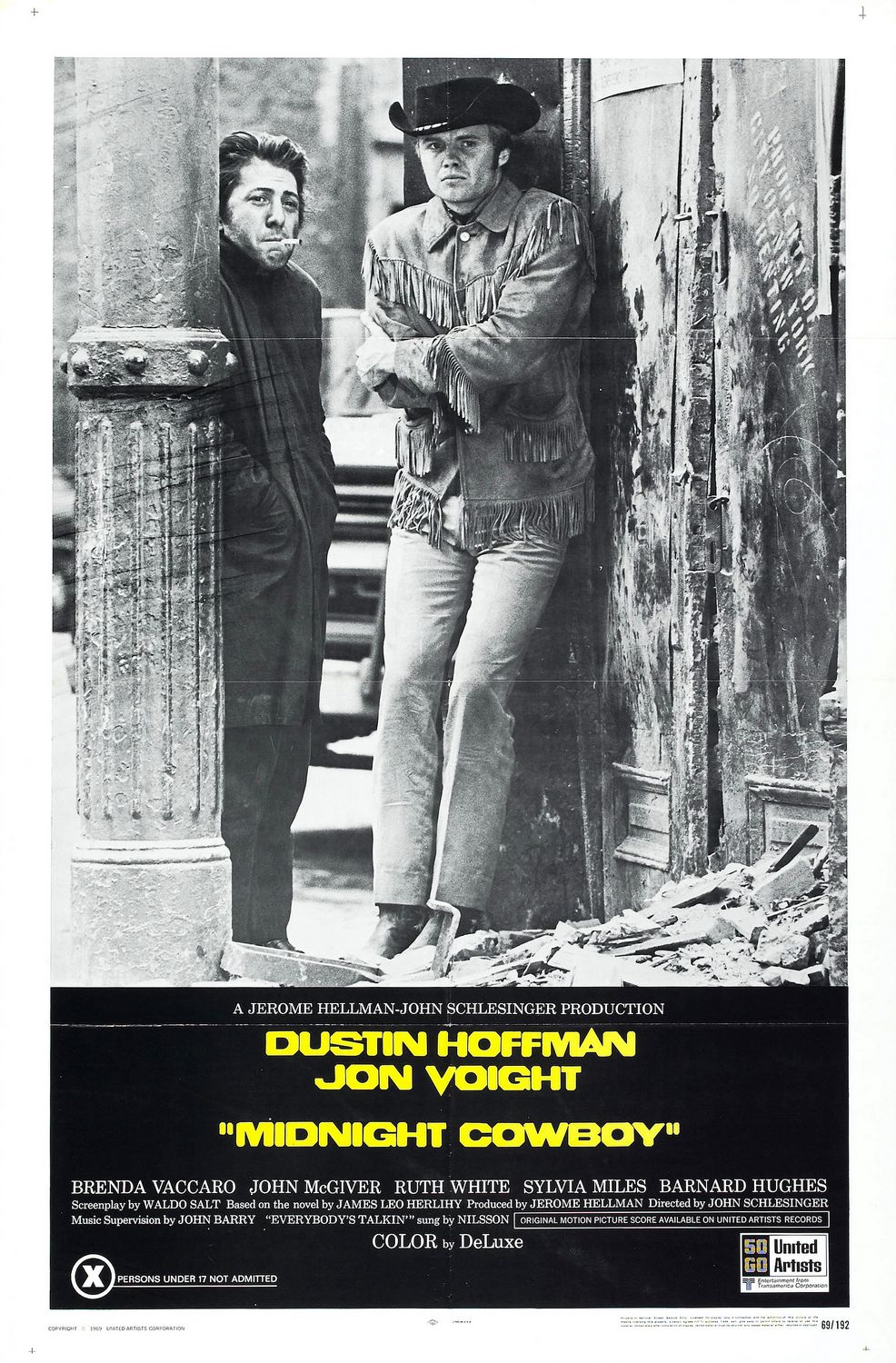
Jon Voight and Dustin Hoffman are an odd couple in the Big Apple in Midnight Cowboy

Director: John Schlesinger

Cast: Jon Voight (Joe Buck), Dustin Hoffman (Enrico “Ratso” Rizzo), Sylvia Miles (Cass), John McGiver (Mr O’Daniel), Brenda Vaccaro (Shirley), Barnard Hughes (Towny), Bob Balaban (Young Student), Ruth White (Sally Buck), Jennifer Salt (Annie)

Even today it still feels like an odd Best Picture winner: two down-and-outs in the slums of New York, both trying to hustle, develop a strangely symbiotic relationship part brotherly, part semi-romance. It’s even more bizarre when you remember the year before the Academy had given the Big One to the super-safe family-friendly charms of Oliver! Still the only X-rated film to win Best Picture (though it looks hilariously tame for such a rating today), Midnight Cowboy is both the first step towards the fresh, modern film-making of the 70s and also a dated landmark of a particular era of film-making.

Joe Buck (Jon Voight) is the would-be Cowboy, escaping the hum-drum life of dishwashing in a run-down restaurant in Texas (not to mention a backstory darkly hinted at of a childhood of neglect and traumatic sexual encounters of the past) to make the trip to the Big Apple to find a new career – as a gigolo. After all he “ain’t a for-real cowboy. But [he is] one helluva stud”. Sadly making a career of sleeping with rich women for money ain’t half a lot harder to pull off than you might think. Not least when you are quite the naïve rube, certainly compared to more practised hustlers like “Ratso” Rizzo (Dustin Hoffman), a crippled, seriously ill born-and-bred New York who lives a hand-to-mouth on the streets desperate for each coin he can find. Both hustlers team up to try and make their wealth from Joe’s attractions – but life is tough for the desperate underclass of American society.

Released in 1969, the film stunned the States with Brit John Schlesinger’s insight into the dark underbelly of the American dream. Schlesinger, in a way few film makers before had, focused on the scuzzy poverty of the American loser, the two dreamers who fantasised about turning their lives around into the American ideal, but instead met failure and depression at every turn. This was a million miles from the “poor boy made good” vision of past films, or the sort of Capraesque spin of small-town guys winning out in the big city due to their inherent pluck and honesty. There’s none of that in Midnight Cowboy

Throw in Schlesinger’s style – the way his camera immerses you in New York with its “on the hoof” immediacy (Schlesinger couldn’t afford to get the streets closed, so simply shot the actors in medium or long-shot in real streets and locations, with real people) – and you got a vision of America you hadn’t seen before. The use of locations gives triumphant shots – Jon Voight emerging head and shoulders above the New Yorkers as he walks through bustling streets – and also moments that hum with authenticity. Most famously Hoffman’s “I’m walkin’ here” outburst when the actor was nearly mowed down by a taxi mid-shot while crossing a road. Midnight Cowboy takes you down in the gutter with these characters, and makes you feel part of their world. When we see the freezing poverty they live-in – in an abandoned apartment block – you practically shiver with them.

Throw in with this Schlesinger’s (and Waldo Salt’s fabulous script) careful and sensitive exploration of the bonds between the two men. Starting as strangers, both Ratso and Joe slowly find themselves drawn together in a symbiotic way that’s part soul mate, part unspokenly romantic. It’s implied throughout that the two characters feel a connection towards each other that they lack both the emotional and intellectual language to understand. But it’s there for the audience to pick up on, even if the sexuality of the two characters is something they seem barely able to understand (Joe’s sexuality is certainly far more fluid than he can even begin to grasp, while Ratso hurls around homosexual slurs so often you can tell he doth protest too much). These characters become inseparable, tending to each other (at one point an ill and soaking Ratso loosely embraces Joe, while Joe uses his shirt to dry his face and hair), sharing dreams and hopes for the future, forming a bond that goes way beyond questions of sexuality. For both of them it’s more than clear that an emotional bond like this is something alien to them both, a connection they have long feared in a cruel world.

Both actors excel in the two roles. Voight – in a career making performance – is understanding as a man who is naïve, easily fooled, caring but distant, who slowly begins to replace his wide-eyed innocence with a greater understanding of himself. Joe is a hopeless hustler – a failure as a seducer of women, and twice reduced to tragically mismanaged male prostitution, a stud who ends up paying his first customer to spare her feelings. The film carefully sketches in a backstory of emotional frigidity which adds context to a character who is charmingly selfish but learns to make a connection with another human being.

Hoffman was equally keen for the role, desperate for a part that would be the polar opposite of Benjamin from The Graduate. While Voight plays with a grounded naturalism and unaffected genuineness, Hoffman’s performance pushes the envelope of quirk. There is no end to the affectation of the role – scruffy, limping, sweaty, loud, twitchy – it’s a show-off of a role, with the moments of emotional vulnerability seized on with an actorly relish. But it still works because, despite it all, Hoffman communicates a genuine empathy and sorrow in the role, and because the performance bounces so well off Voight’s stiller, more balanced work.

The film works less well when it drifts away from this central pairing. The “marks” get short shrift, with the women in particular either hornily manipulative (Sylvia Miles, receiving a generous Oscar nod for five minutes work) or serenely wise (Brenda Vaccaro as a woman with more insight into Joe’s fluidity of sexuality than himself). Joe’s male marks are a tragically ashamed young student (Bob Balaban in an effecting debut) or full of messed up self-loathing (Barnard Hughes). 

Similarly, Schlesinger’s directorial flourishes may have looked like modern cinema verite at the time, but don’t half look like dated, heavy-handed touches today. Joe’s backstory – told in wordless sequences with different film stock – not only seem tiresome and alienating but also flimsy in the extreme in their psychological insight. Schlesinger’s satire on the Warholesque arty high-life of New York is heavy handed in the extreme, and its filming style outrageously clunky. The film’s psychological depth is thin and insight often blunted, while Schlesinger’s analysis of character often seems dependent on actors (some overindulged) rather than a true vision.

But despite that, Midnight Cowboy works because the characters are so rich and the insight into the life down-and-outs in New York still feels real. Voight and Hoffman (for all his indulgence) are excellent and the sexless romance between the two characters is intriguing and, by its conclusion, carries real emotional weight. While dated and lacking in as much insight as you might wish, it’s still a film that reflects on the damaging gap between dreams and reality, and the difficulty of casting the former aside.

Fat City (1972)

Stacy Keach and Jeff Bridges excel as boxers failing to live The Dream in Fat City

Director: John Huston

Cast: Stacy Keach (Billy Tully), Jeff Bridges (Ernie Munger), Susan Tyrell (Oma Lee Greer), Candy Clark (Faye), Nicholas Colasanto (Ruben), Art Aragon (Babe), Curtis Cokes (Earl)

The American Dream has an underbelly. For all those dreamers who find fame, fortune and glory in the Land of Free there are thousands who never made it. Thousands who stayed rooted at the bottom of the rung of the ladder and saw their dreams disappear and lives head into turnaround. Fat City – the good life, according to the slang of San Francisco, the crazy goal you’ll never achieve – is all about those left behind by their dreams.

Billy Tully (Stacy Keach) is a former boxer, now down on his luck and now possibly struggling with alcoholism. Ernie Munger (Jeff Bridges) is a young prospect who shows some promise in the ring. Both of them dream of getting into the limelight – but what hope do they have when it’s nearly impossible to turn your life around in smalltown America?

John Huston’s film is unflashily assembled, but carries a fundamental emotional power as it investigates with a simplicity and honesty the difficult dynamics of real life. It’s a film which has no pat answers, no simple solutions and doesn’t offer much in the way of hope. Which is not to say that it is a depressing vision of the world. Just a recognisable one. Because, sure, for most of us there isn’t any real chance of seeing our lives change. 

Huston’s film – brilliantly shot with a 1970’s muddy graininess mixed with flashes of revealing light by Conrad Hall – is wonderfully well observed and beautifully paced and keeps refreshingly loyal to its essentially downbeat vision of life. There is nothing forced in Huston’s well-paced touch and his embracing of the ordinariness of the drama and the lives of the characters. Because for both of them what we see in this film – and it ain’t much – is still clearly the high point of their life. Just getting into the ring and being beat (and only one fight in the film ends with one of our heroes winning – and even then he’s unaware of his win, he’s so punchdrunk) makes them something rather than nothing. These small moments are the best they can hope for.

Because both men have lives of nothingness in front of them. Keach’s Tully is a man whose best years are already behind them, but keeps up a touching air of hope and belief that maybe that could change, even while he drunkenly stumbles from one moment to the next. And maybe he did have something in the past – but he certainly doesn’t have something to come. Keach captures this superbly – like a reliable pro embracing what he feels might be the highlight of his career – investing Tully with a gentleness but also touch of fantasy, a man who can’t quite accept where his life is, but despite a lack of bitterness he’s still a man balancing fantasies. 

Jeff Bridges makes a perfect balance to this amiable failure of a man as Ernie, a young man who may well have more promise than Tully but lacks any sense of personal drive. He’s a friendly but empty shell. While Tully at least goes through spells of wanting success – even if he drifts and falls into alcoholic patches of non-achievement and becomes lost in recollections – Ernie has no desire. He’ll allow himself to be put forward but will do no work at all to push himself forward. He’s a young man with no hurry, a man who seems destined to never achieve anything because he has no desire to do so. It’s a great performance of amiable emptiness from Bridges.

But then you hope that Ernie won’t be heading to the alcoholism that consumes Tully and his romantic interest Orma. Played by an Oscar-nominated Susan Tyrell, Orma is the picture of a failed life, a semi-bloated, rambling alcoholic who oscillates between small insights and far more common drunken ramblings and bitter drunken whining but believes strongly in what she does. Huston’s film places her firmly as much of a drifter through life as Ernie in her way, taking up with Tully while her lover serves prison time – and moving easily and with little impact from one domestic set-up to another. Tyrell and Keach give outstandingly strong performances of drunkenness, never over-playing and totally convincing in their slurred speech, attempts to not appear as drunk as they are and emotional swings from calm to sudden and consuming fury.

But then what is there to look forward to in this life than the next drink? Certainly not the fights. For all the dreams of trainer Ruben (Nicolas Colosanto – very good) to find the next big thing, every fight we see is a tragic and painful affair mostly ending in defeat. Ruben drives carfuls of beaten, ring fodder from place to place, watches them get duffed up and then takes them home all the while dreaming of a title shot. It is dreams shared by Tully – even while we watch his slow, alcoholic fuelled body struggle to get through a few minutes of shadow boxing.

But then that’s the message of Fat City the anti-Rocky – and probably more realistic for it. Huston;s simple touch and pure vision help to make this one of his finest films, his unfussy and naturalistic camera encouraging truthful and powerful performances from his leads. And every small moment is full of it, including a marvellous wordless sequence that sees Tully’s Mexican opponent arrive in town (on a rundown bus), wordlessly check into a motel, piss blood and then head to the ring to be (only just) beaten – a moment of victory so fleeting and small it barely counts (and is only a hiatus on Tully’s return to shambling from bar to bar on the streets). The American Dream is a great thing – but for many people it’s just that: a dream.

Marriage Story (2019)

Scarlett Johansson and Adam Driver are an estranged couple in Marriage Story

Director: Noah Baumbach

Cast: Scarlett Johansson (Nicole Barber), Adam Driver (Charlie Barber), Laura Dern (Nora Fanshaw), Alan Alda (Bert Spitz), Ray Liotta (Jay Moratta), Azhy Robertson (Henry Barber), Julie Hagerty (Sanda), Merritt Wever (Cassie), Wallace Shawn (Frank), Martha Kelly (Nancy Katz)

It’s a scenario that more and more marriages in our modern world head towards – divorce. And it’s never easy to separate from something that has dominated your life for years, and the more that bonds two people together, the harder to pull them apart. As the film says, “it’s not as simple as not being in love any more” – and the complex emotional bonds that form between people, and the inability we have to switch these on and off like lights, are what drive Noah Baumbach’s film, heavily influenced by his own real-life divorce from Jennifer Jason Leigh.

Nicole Barber (Scarlett Johansson) is a former child-star who has built a career as a respected theatre actor in tandem with her husband Charlie Barber (Adam Driver), an acclaimed and visionary theatre director. Living in New York with their young son Henry (Azhy Robertson), their marriage is dissolving with Nicole frustrated at Charlie’s selfishness, just as Charlie is angered by what he sees as her refusal to take full responsibility for her career choices. As mediation fails, Nicole returns to LA for a role in a TV series, taking Henry with her. With divorce papers filed in LA, the couple engage in a cross-state legal battle for custody and finances, with their positions increasingly weaponised into hostile encounters by their respective legal teams. No one is coming out of this one unscathed.

Baumbach’s film is tender, sympathetic and offers a fine line of arch comedy and even farce (at points), that works over time to be as even-handed as it possibly can. The film’s sympathies are aimed not solely at husband or wife, but at the couple themselves wrapped up in the hostile, money-spinning world of divorce where, it’s strongly implied, the only real winners are the lawyers making thousands of dollars spinning out clashes as long (and as aggressively) as possible in order to cement their positions and keep their industry going.

The film is a solid denunciation of the entire industry that has grown up around divorce, where it’s seemingly impossible to find any arrangement alone without lawyers giving it a legal force, or to come out without that process consuming most of the wealth of the couple. Even worse in this case, the main battle-ground becomes the rights of each parent to access to their son, Henry’s college fund disappearing into a legal battle and the child becoming the centre of both fraught attentions and an unseemly competition for affection between both parents, effectively offering bribes for preferential responses from their son. All in order to prove that their link to him is the stronger.

The tragedy of all this – the way the system seems designed to turn personal relationships poisonous and bitter – becomes Baumbach’s focus. Brilliantly the film starts with a voiceover from both Nicole and Charlie in turn, over a montage, stressing the wide list of things they loved about their partner in the first place: part, it is revealed, of a mediation session that ends in disaster and Nicole’s walkout. But the closeness, the bond, the intimacy of these two people is revisited time and time again in the film. Legal dispute scenes and lawyer confrontations are followed by perfectly friendly home visits and regretful conversations. Legal meetings are bizarrely punctuated by coffee with conversation from the lawyers suddenly turning light and breezy. Then, as events hit a courtroom, moments like Charlie’s failure to properly install a car seat are spun out by lawyers as evidence of his risky disregard of his child’s safety while Nicole’s glass of wine after work becomes incipient alcoholism. 

For a film about divorce, it’s striking that it’s the process of divorce that turns the couple’s relationship increasingly toxic (culminating in a brutal scene where each throws increasingly personal and cruel abuse at each other for other five minutes). Sure there are resentments and anger at the front, but these are kept under reserve and still allow the couple to chat and negotiate amicably when they’re by themselves. As soon as the lawyers are involved, the mood steadily turns worse and worse. 

This is part of the film’s attempt to present the couple even-handedly. I’d say it only partially succeeds at this – with a 55/45 split in favour of Charlie, who is presented as the most “victimised” by the system, as the New York man having to prove he has a link to his now-LA-based-son. While Nicole does get a fantastic monologue (brilliantly performed by Johansson, full of regret, apology, anger and confusion) where she outlines Charlie’s selfishness, distance and probable (later confirmed) affair to her lawyer, the focus soon shifts to Charlie’s travails in the system. It’s him hit by a blizzard of demands from court and lawyer. It’s him who is separated from his son. It’s him who pays the biggest financial burden. It’s him who takes the biggest blows and has to bend his whole life to try and claim a residency in LA. It’s not a surprise Baumbach marginally favours his surrogate, but it does leave you wanting a few more scenes – especially in the latter half of the film – for the impact on Nicole.

However you keep on side with both halves of the couple thanks to the superb performances from Johansson and Driver. Johansson is both fragile and acidly combative, a woman who feels she has led someone else’s life for far too long. Driver is a bewildered gentle giant, but carrying a long streak of self-justifying self-obsession, clearly believing himself the only victim, but deeply hurt by the situation he finds himself in.

Supporting him are three very different lawyers. Laura Dern is on Oscar-winning form as Nicole’s brash, confident, ruthless defender with a smile so practised it’s hard to tell when it’s false or when it’s true. Alan Alda is endearing – but also gently out of his depth – as Charlie’s more conciliatory first lawyer (in one brilliant moment, Charlie interrupts a lengthy joke from Alda’s Bert during a sidebar with the frustrated put down “sorry Bert am I paying for this joke?”) while Ray Liotta channels De Niro roughness as his fiercely competitive second lawyer.

Marriage Story is a bittersweet, superbly made, moving but occasionally strangely funny story of a couple falling out of love and trying to find the way of converting that into a functioning co-parenting friendship. Throughout it’s not the couple, but the system making money from their dysfunction, that’s to blame in this marvellously written and superbly played drama.

City of God (2003)

Violence is a way of life in Fernando Meirelles calling card sensation City of God

Director: Fernando Meirelles, Katia Lund (co-director)

Cast: Alexandre Rodrigues (Rocket), Leandro Firmino (Li’l Zé), Phellipe Haagensen (Benny), Douglas Silva (Li’l Dice), Jonathan Haagensen (Shaggy), Matheus Nachtergaele (Carrot), Seu Jorge (Knockout Ned), Jefechander Suplino (Clipper), Alice Braga (Angélica), Emerson Gomes (Stringy), Edson Oliveira (Older Stringy)

After Parasite’s win for Best Picture, it’s easy to remember the last foreign language film that made such a comparative impact at the Oscars – and it didn’t even win anything! Capturing the public imagination, City of God is that most American of things: a gangster film. Chronicling the life and death danger of the lawless slums of Rio de Janerio in the 1960s and 1970s, the film is an electric mixture of Latin and US film-making, a compelling shot of adrenalin that captured the imagination of the film-going public and made many Hollywood films look staid and dull. 

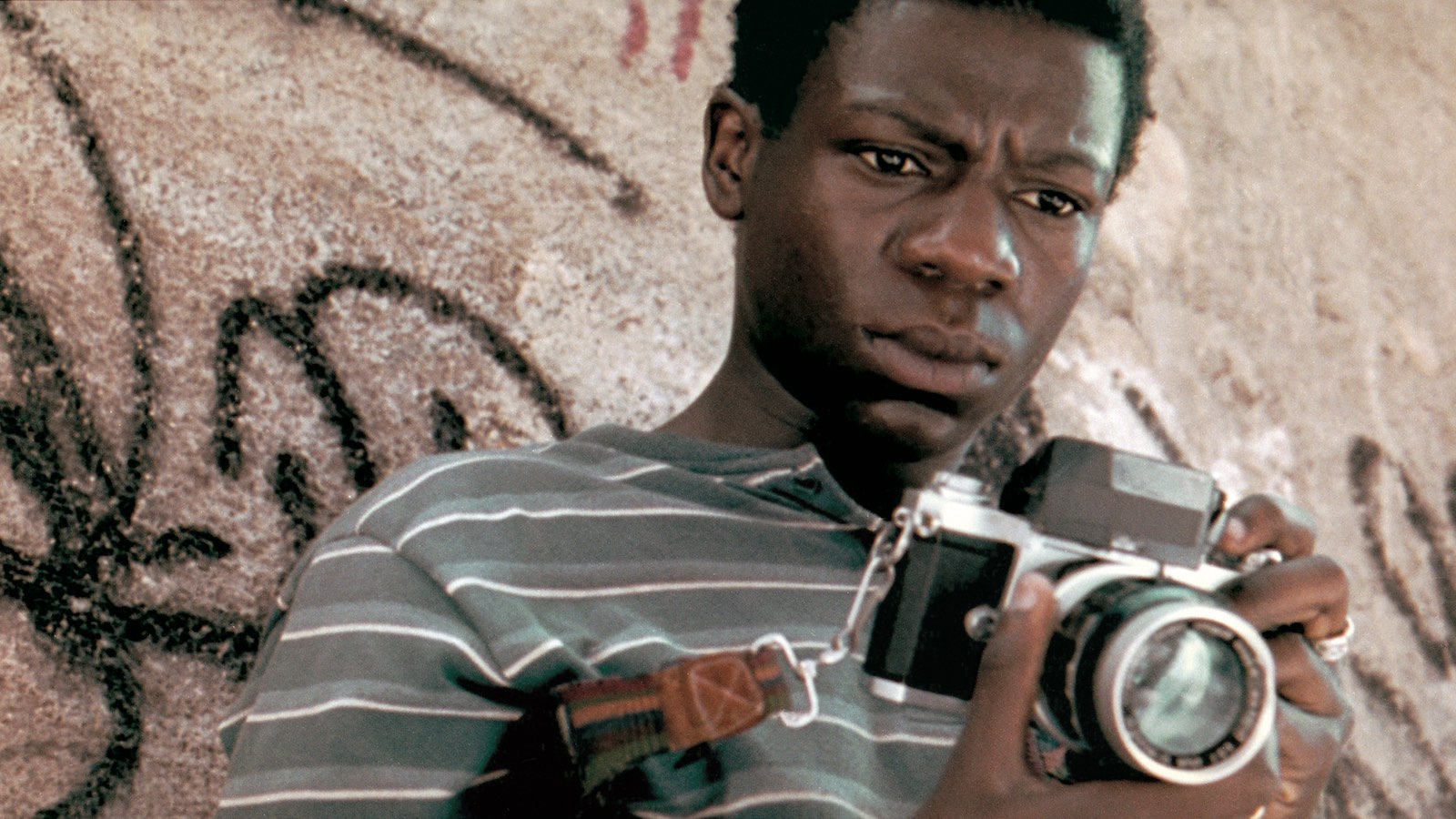
Shot on location with a largely non-professional cast, the film uses as our window into this world aspirant photographer Rocket (Alexandre Rodrigues), who has a front-row seat for an emerging (true life) gang war that erupts in the slumps between unstable psychopath Li’l Zé (Leandro Firmino) and his rival Carrot (Matheus Nachtergaele) and bereaved former sniper turned bus conductor and killer Knockout Ned (Seu Jorge). Starting at the end, the film rewinds through time and moves from perspective to perspective in a series of dynamic short stories that slowly merge and meld together to complete the film’s whole.

The film is directed by Meirelles (who got an Oscar nomination) and Katia Lund (who didn’t). Meirelles invited Lund to collaborate with him on the project, and is generally credited with the film’s look, editing style, frenetic pace and distinctive style of sharply exposed Latin colours mixed with the look of a rock video, all dynamic angles and immersive action. Lund bought her documentary realism to the film, as well as working closely with the actors and helping to shape their parts of the story. Agreeing to take a specific “co-director” credit probably cost Lund the nomination, and it feels inexplicable she was unrecognised today, even more so since Lund has pioneered several successful TV series based around the world of the film.

Controversy aside, it’s a high water-mark certainly for Meirelles who has never quite managed to match it since (The Constant Gardener remains his best work since, marrying the dynamism here with one of Le Carré’s most emotional and strongest stories). With its lashings of Scorsese, Tarantino and De Palma (among others), City of God remains a hugely engaging and engrossing gangster flick that really feels like it captures the threat and grimy reality of the streets of Brazil. Each section of the city we see feels like a lawless wild west, where guns rule, the police have no say and a whole population of ordinary people keep their heads down and just try to avoid getting caught (literally) in the crossfire. 

In this world violence is endemic, life is a short and brutish cycle of slaughter where danger leads inevitably to death, short-termism is the norm and a series of essentially childish young men see the excitement of crime turn into the brutality of a life of violence. None more so than the film’s vicious dark heart, Li’l Zé a young man with a flickering temper, a love of violence and death, barely able to relate to other people, unanchored in the world whose life is a self-destructive quest to be the biggest fish in his pond. Played with a swaggering panache by Leandro Firmino (and a chilling coldness as a child by Douglas Silva), the self-named Li’l Zé dominates the film as the sort of life-wire threat Joe Pesci used to be for Scorsese, never certain whether he will laugh or shoot.

Which makes him perfect for the unpredictability of the slums, where everyone wants to be a hood, drugs are rife and crime and murder is a legitimate way of living. The film splices together several short story narratives to illustrated this with Altmanesque confidence. Each section of the film is introduced as “the story of X”, all of them expanding from the starting story based around three wanna-be-hoodlums whose mixed fates reference everything from The Third Man to A Bout de Souffle. From this the film organically expands, using Li’l Zé as the fulcrum who hinges every other story around him towards disaster. It’s neatly cross-cut as well, starting the end before rewinding through a neat transition shot into the past to explain how we got where we are.

There seems to be no good deeds in the city. The most likeable character, Benny, is himself a gangster (and Li’l Zé’s only friend and restraining influence) who is fun-loving and cool while not adverse to theft and murder when needed. Kingpin Knockout Ned starts out as a man of good intentions, determined to clean up the town that has left him bereaved and hurt, but becomes consumed by the dark impact of violence. All the time, many of these gangsters are in love with their public image both the awe and fear they inspire in those around them as the most powerful people in the neighbourhood, and from their growing coverage in the press.

It’s a cycle that seems doomed to repeat itself, not least through the film’s introduction of “The Runts” a group of trigger happy pre-teen would-by gangsters, who roam through the streets waiting their chance to turn small stick-ups into a criminal empire. They are no more than following in the footsteps of Li’l Zé, shooting his gun and experiencing murder at their age and now zeroing on owning the whole slum. It’s the dark ambition of capitalism playing out on the streets.

The film works however as framing it around the jaunty, relaxed narrative of Rocket gives it the feeling of a series of shaggy dog stories and coming-of-age tales (and the film carefully mixes in among the gangsters plenty of reminiscences from Rocket around his teenager upbringing, his first love and his passion for photography). With someone as easy-going as Rocket as our guide, the film never becomes overbearing or depressing but instead as entertaining and engrossing. In a way it’s a shock to remember it features as much killing (including of a child) and mayhem as it does, as well as a world-weary nihilism too it that the odd person may escape the streets, but the general world there will never change. 

A staggeringly confident piece of film-making, City of God remains an exciting and compelling piece of cinema.

The Lonely Passion of Judith Hearne (1987)

Maggie Smith excels in stately literary drama The Lonely Passion of Judith Hearne

Director: Jack Clayton

Cast: Maggie Smith (Judith Hearne), Bob Hoskins (James Madden), Wendy Hiller (Aunt D’Arcy), Marie Kean (Mrs Rice), Ian McNeice (Bernard Rice), Prunella Scales (Moira O’Neill), Alan Devlin (Father Quigley), Rudi Davies (Mary)

Judith Hearne (Maggie Smith) is a lonely, frustrated Irish spinster who never found her place in the world. Arriving at her new lodgings in Dublin, Judith leaves behind her a whiff of scandal and a slight air of being someone you don’t want in your home. However, while her superior manner may not fool everyone, it’s enough to spark the interest of chancer James Madden (Bob Hoskins) brother of Judith’s lodger Mrs Rice (Marie Kean) – who is not remotely fooled by Judith’s pretence at upper-class gentility. While Judith wonders if romantic love may, after all, finally be round the corner for her with Madden, Madden himself wonders if the starting investment for his next dream is in his grasp.

Jack Clayton’s adaptation of Brian Moore’s novel is a stately passion project. An adaptation that Clayton had worked for years to bring to screen, it’s a quiet and respectful picture that moves with a graceful serenity over its runtime, covering emotional territory but never quite sparking into life. Clayton’s adaptation of the book is precise and perfect in nearly every way, with the film very true to Moore’s style and his ability to capture the domestic tragedy of small-scale, disappointed lives. But it’s not quite a film that hums with inspiration.

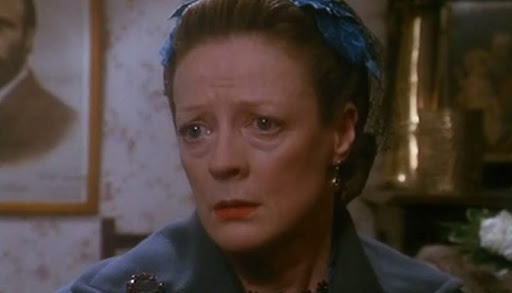
What inspiration it has is bound up with Maggie Smith’s superb (BAFTA winning) performance in the lead role as Judith herself. This is surely some of Smith’s finest work on screen, perfectly capturing every beat of this character study. Judith Hearne is a woman who relies on her upper-class background – her airs and manners – to cover up the facts of her poverty and, even more importantly, her chronic alcoholism. Couple this with her self-loathing, her confused attitudes towards God and her (barely consciously aware) mixed feelings for her deceased aunt (Wendy Hiller in imperious form in flashbacks) and she is a woman reeking of disappointment, depression and oppression as much as she does the booze she knocks back.

Smith’s performance progresses throughout the film, from a veneer of assurance to an increasingly poignant and tough to watch collapse into starkly raw emotional disintegration. Desperate in ways she hardly understands for emotional (and physical) content for another, she’s almost touchingly over-enthusiastic when offered the olive branch of friendship of a man, and the self-loathing and loneliness that channel her collapse into brutal alcohol-driven meltdowns show Smith holding nothing back but never once heading over the top. Smith totally understands how to get the balance between quiet tragedy and emotional force, constantly balancing the two expertly. 

It’s her performance that is a triumph of small moments that build over time to carry emotional force, from her careful arrangement of a room to her confused slightly timid eagerness to please when in conversation with Madden. Smith’s superb in the role, never anything less than real her eyes little windows to the depths of sadness in her soul.

It’s a shame that the rest of the film doesn’t quite measure up to her and that, despite the force of her performance, the film never quite manages to capture the overall impact of domestic tragedy that the film needs in order to be something more than just a gracefully filmed package around a superb central performance.

Too many other plot directions end up in cul-de-sacs or never get explored. Madden’s frustrated sexual feelings – and his eventual assault on housemaid Mary (a decent performance by Rudi Davies) are simply never explored any further. Bob Hoskins gets short-changed with a character that doesn’t really go anywhere and whose darker side is demonstrated but then never referenced again. The film gives such force to the damage of Judith’s alcoholism and depression that her struggles with the church never quite gain the force they need. This is despite some sterling work from Alan Devlin as a bullying but empty churchman, not interested in hearing about problems that can’t be solved with doggerel and dogma.

The finest subplots feature Ian McNeice is superb as the bloated wastrel son of the landlady, a spoiled, lazy former student claiming to be working on the next great Irish poem (a work he estimates will take him at least another 5 years), but largely spends his time swanning around the house causing problem and sniping arrogantly at the residents. Marie Kean is also fine as the arch landlady who sees through all deceptions, other than her son’s.

It’s a shame that the film itself – for all the excellence of Clayton’s work – doesn’t quite come together into a really coherent package. What it kind of misses is perhaps the sort of sharp, knowing observation and dry wit that Alan Bennett bought to so many similar small-scale stories of wasted lives in Talking Heads. The film is on a grander scale than those, but somehow carries both less weight and less insight than an average Bennett monologue. Smith is superb – possibly a career best – but the film itself is more something to be admired than remembered.

Inception (2010)

Leonardo DiCaprio caught between dreams and reality in Inception

Director: Christopher Nolan

Cast: Leonardo DiCaprio (Dom Cobb), Joseph Gordon-Levitt (Arthur), Marion Cotillard (Mal Cobb), Ellen Page (Ariadne), Tom Hardy (Eames), Ken Watanabe (Saito), Dileep Rao (Yusof), Cillian Murphy (Robert Fischer), Tom Berenger (Peter Browning), Pete Postlethwaite (Maurice Fischer), Michael Caine (Professor Stephen Miles), Lukas Haas (Nash), Tallulah Riley (Disguise woman)

What is reality? It’s a question that for many of us never comes up. But in the artificial and exciting world of film, it’s a legitimate question. These worlds we watch unspooling before us on the cinema screen, so large, so real, so exciting. Could we get lost in them? And how much do the films we love echo the dreams that fill our nights, the movies we create in our mind to keep our brain active during those hours of complete physical inactivity? And what happens when the world of imagination and possibility becomes more compelling, more comfortable – and perhaps more real – to us than the actual flesh-and-blood world around us? These are ideas tackled in Inception: the blockbuster with a brain. 

Set in some unspecified point in the not-too-distant future, Dom Cobb (Leonardo DiCaprio) and his partner Arthur (Joseph Gordon-Levitt) are “extractors”, shady corporate espionage experts who use experimental military technology to enter shared dream states with their targets. While in their dreams, they have complete access to their subconscious mind, where secrets can be extracted. A wanted man in the States, Cobb is forced to ply his trade despite his yearning to return home to his children. After a job goes wrong, their would-be target Saito (Ken Watanabe) hires the pair to take on a far more challenging role: rather than extract an idea he wants them to plant one – a technique called “inception” – into the mind of a business rival (Cillian Murphy) to get him to dismantle his father’s empire. To do the job, Cobb needs a new team, including dream “architect” Ariadne (Ellen Page), dream identity forger Eames (Tom Hardy) and dream compound chemist Yusof (Dileep Rao) – and needs to try and control his own dangerous subconscious version of his late wife Mal (Marion Cotillard) who is determined to destroy his missions.

Just a plot summary should give an idea of the twisty-turny world of imagination and ideas that Christopher Nolan mixes in with big budget thrills and excitements, in the most original sci-fi/philosophy film marriage since The Matrix. Of course it helps when you have the clout of having directed a hugely successful comic book series, but Nolan was brave enough to trust that an audience for this sort of action-adventure caper wanted to have their brains stretched as far as their nerves. So he creates a dizzying and challenging piece of escapism that plays around with the audience’s perceptions and understanding of the nature of dreams. 

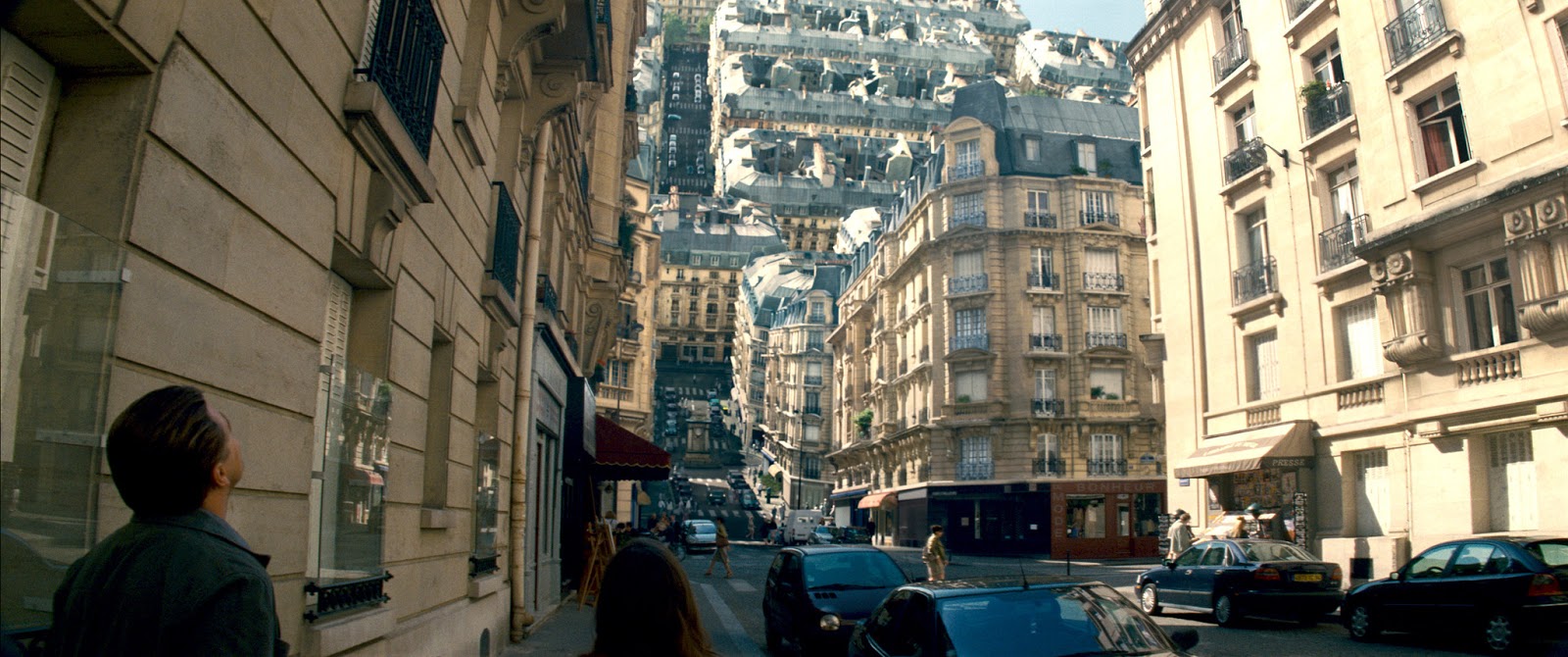
In the world of dreams, the film is a fabulous tight-rope-walk of dazzling concepts. Here everything is possible, with Nolan throwing at us worlds from film fantasy: intricate Samurai houses, brawling third-world streets, luxurious hotels, Bond-style winter bases and entire cities that literally fold, bend and reinvent themselves around the film’s dreamers, worlds that defy conventional rules of physics and time. This world is presented with genuine visual panache at every point, Nolan’s mastery of the language of film leading to a sensational series of slight-of-hand tricks and compelling set-pieces, all the while making you question which events are real and which are dreams or even dreams within dreams. In these worlds, the characters have the ability to literally shape a world to meet their needs, and the dangerous attraction of these worlds – even if they are not real – is the dark temptation that hangs over every frame. 

Because it’s those ideas beneath the action that give the film depth as well as excitement, that ability to ask questions and openly invite the audience to begin theorising themselves to fill in any blanks. Within the world of Inception, characters can create dream states within dreams, to share one person’s dream while simultaneously all being inside the dream of someone else. These multiple levels are cleverly established as being as much of a risk for the characters in getting confused as they are for the audience, with the characters carrying personal “totems” to help them judge if what they are seeing is reality or not. This is made all the more difficult by the establishment that your subconscious will manifest people to populate the dream worlds – and these will turn on invaders they detect in the dream.

All of this tunnels down into the deep limbo of our subconscious – and also introduces as a concept Nolan’s fascination with time. In dreams, time moves at a different pace, and this differential becomes all the greater as you descend down levels in dreams within dreams. A few minutes can become an hour in a dream and become almost a day in the dream within it – and years within the dreams beyond that. This is brilliantly demonstrated by Nolan in the film’s dazzling central sequence as the film intercuts between three timelines in three different dreams – each impacting the other.

It’s another masterful touch – the impact of actions on dreamers’ bodies in the level above can be felt in their world. A slap to the face in the real world can send someone in the dream flying across a room. A bucketful of water turns into a tidal wave in the dream. The dreamer falling in the world above removes gravity in their dream (giving Joseph Gordon-Levitt a cult fight scene in a gravity free world that sees him gracefully leaping from floor to ceiling to wall). The visuals are extraordinary, but the intriguing logic of the inter-relation between reality and the dreams – and the way dreams struggle to explain external effects – lend all the more credence to the mixing of reality.

But then, as Nolan suggests, isn’t that film after all? In dreams we move from location to location and struggle to remember the journey in between. We find ourselves doing tasks and not knowing how we started. Chases, faulty logic, sudden reversals and changes – these are the rules of film, it’s editing slicing out the boring bits and focusing on the reality. We are dropped into the middle of Cobb’s story and only slowly find the backstory, a gun filled chase through an African city is almost indistinguishable from similar sequences in the dreams. The final sequence of the film is a purposefully cut series of images that are very true to the rules of film, but feel alarmingly close to the rules of dream (unsettling us about whether what we see at the end is truth or dream, a debate that continues today). It makes for fascinating stuff, as well as a commentary on film itself.

Nolan’s film is gloriously entertaining, even if in its haste at points it does fail to explain how certain events and concepts truly work – but doesn’t really matter so compelling is the journey. The cast, enjoying the chance to mix action hijinks with genuine characters and dialogue are very strong, with DiCaprio anchoring the film wonderfully as the conflicted, lonely, defensive and daring Cobb. Hardy made a name for himself in a cheekily flirtatious performance, which sparks wonderfully with Gordon-Levitt’s more po-faced Arthur. Page creates a character both naïve and at times almost gratingly intrusive. Cotillard makes a difficult balance look easy playing a character part real and part dream figure. Watanabe is archly dry as the investor. There isn’t a weak link in there.

It may at times move too fast and not always make itself completely clear. It might be a bit too long in places and take a little too long to make its point – but it’s ambitious, challenging, intriguing film-making that rewards repeated viewing. Not least with its cryptic ending in which we are forced to ask how much of what we have seen is real and whether – like Cobb perhaps? – we should even care at all if the end result is so positive. With the fascinating world of dreams – and the rules there that we encounter – it gives us a firm grounding for the its meditation of the dark attraction of fantasy, embodied by the genial wish fulfilment of the movies where adventure lies around each corner and the heroes triumph.