Category: Relationship film

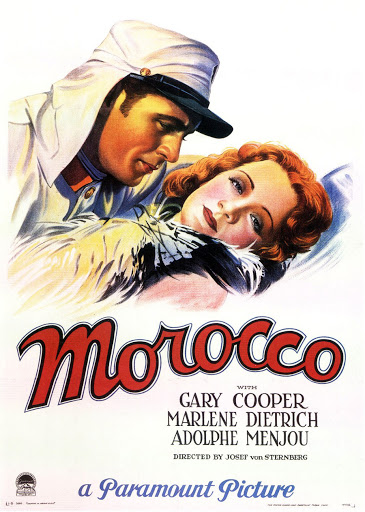
Morocco (1930)

Morocco header
Marlene Dietrich and Gary Cooper romance in the heat of Morocco

Director: Josef von Sternberg

Cast: Gary Cooper (Legionnaire Tom Brown), Marlene Dietrich (Mademoiselle Amy Jolly), Adolphe Menjou (La Bessiere), Ulrich Haupt (Adjutant Caesar), Eve Southern (Madame Caesar), Francis McDonald (Sergeant), Paul Porcasi (Lo Tinto)

Josef von Sternberg was one of the greatest directors of early cinema – and Marlene Dietrich was his muse. Or was he her Svengali? Either way, they first worked together on German film The Blue Angel and such was the impression made by Dietrich, Hollywood was desperate to get her and von Sternberg together for a new picture that would channel her star power into ticket sales. Morocco is the picture they come up with, a romance tinged with heartbreak set in French occupied-Morocco around a Foreign Legion troop passing through town.

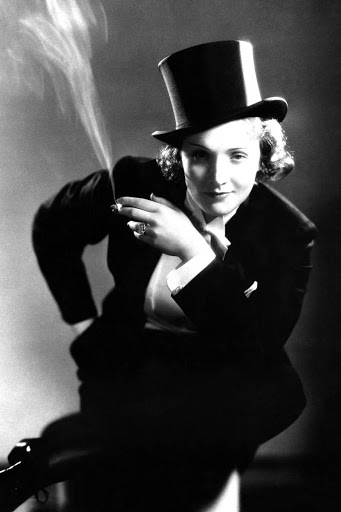
Dietrich was Amy Jolly, a woman of uncertain and shady past, new in town and making a living as a night club singer. There here routine encompasses everything from erotic singing in top hat and tails (complete with a bisexual vibe – you can tell this is pre-Code Hollywood?) to an apple selling singing routine. She’s loved by La Bessiere (a rather bland Adolphe Menjou), a stuffed shirt rich guy. But her heart belongs to man’s-man legionnaire Tom Brown (Gary Cooper), a toughened old soldier with a girl in every barracks town. Who will Amy end up with? Will she follow her heart or her head? Can she bear to live the life of a soldier’s mistress amongst the camp followers?

Writing it all down, there are probably few mysteries about the resolution you get from Morocco, which even at its 90 minute run time feels like an impossibly slim piece of fluff. But that hardly really matters when von Sternberg shoots the film with a romantic flourish and with Dietrich and Cooper as such compelling leads. It’s odd to think, looking at it now, that Morocco was acclaimed as one of the greatest films ever made on release (it’s not even the best or most lasting Dietrich/von Sternberg Hollywood collaboration of which there were five more to come).

But it lasts in history because it introduced Dietrich to the wider world. Von Sternberg took control over every aspect of her image to best present her to the world – including a torturous 45 takes of her first line (because after all the first line was the one that will make the first impression on an audience). Von Sternberg and cinematographer Lee Garmes choose lighting methods and angles that would enhance her features, and shot huge parts of the film to favour her (much to the annoyance of Gary Cooper, who resented von Sternberg’s shunting of him to the sidelines).

Von Sternberg was determined that Dietrich would make an impression: and she certainly did with her cabaret act, still probably the film’s highlight. Dressed in a striking male garb, her rendition of When Love Dies is sold on her confidence, sexual allure and tinge of bisexuality (viewers were scandalised and titalated that the routine ended with Dietrich playfully kissing a woman in the audience) to make a lasting impact. Von Sternberg lets the tension build as well by holding the camera calmly on Dietrich (in drag) while the audience at first boo before silencing and then being swept up in her performances. This is the approach taken for the rest of the film – and its rather weak plot – focusing on the a magnetic quality, the indefinable star quality some people have to just make you watch them.

It’s recognised by von Sternberg, who builds the film around her. It’s tempting to see Adolphe Menjou – the jilted would-be husband, in awe of the star – as a von Sternberg self-portrait, dressed as he is to resemble the director. But von Sternberg felt so confident over his control of Dietrich and her career, I suspect there is actually far more of him in lothario Tom Brown, the sort of man who may love a woman but also very much likes her to submit her will to his own. Brown may have his moments of decency – he wants Amy to have the best chance in life, which is clearly with La Bessiere rather than him – but he’s also an at times ruthless opportunist and adventurer, with a string of broken hearts behind him. Interestingly, considering their later films and her reputation, Dietrich’s Jolly is actually a fairly passive figure throughout the film, to whom events happen and who never feels in charge of her destiny. Perhaps more than a little of life drippling through to the screen?

Saying that the film has some bite in it, with the dialogue from Jules Furthman often rich, rough and ready, creating characters who speak at times bluntly but with a sort of urban poetry. Sadly, the dialogue scenes are often frequently the dullest in the film. Von Sternberg was still at the time a natural director of silent film, not the talkies. Hollywood itself had still not really learned how to do record dialogue and do camera movements at the same time, so most of the dialogue scenes are visually flat and rather forced (not helped by the storyline itself being often less then enthralling).

Where Morocco really comes into its own is when it falls back on visuals. As a director of pictures, von Sternberg is outstanding. The camera perfectly captures the bustle of the Moroccan market town. There is a beautiful sequence where Amy raises through a seemingly never-ending row of soldiers to try and find Tom. The Morocco in this film may bear almost no resemblance to the real Morocco – it’s clearly a Hollywood fantasy land – but it also looks at no time like it was shot on a Hollywood backlot. Tom Brown’s slow and sad browse through Amy’s dressing room, before deciding he should leave for her own good is hauntingly well done in near total silence, matched with beautifully empathetic camera moves. The final imagery, as our heroes head out into the sands of Morocco, is marvellous, a perfect collection of shots and reactions leading to an image for the ages.

And Morocco is a film of images strung together with a rather dull plot and a very stilted scenes of dialogue. Marlene Dietrich is at the centre of many of these images. This was her only Oscar nomination – but it’s not her finest performance. She’s still learning her craft and – above all you feel – still very much an elaborate prop for von Sternberg. The more they became something like equals the stronger the pictures would become. Gary Cooper was unhappy on the film – but actually his performance is remarkably strong and assured, dripping sexuality (von Sternberg also works a lovely little scene that pokes fun at Cooper’s height).

Morocco seems like a landmark of cinema that is of greater academic interest at times than it is dramatic. But when the dialogue fades away and the film is able to relax into the series of arresting images that make up most of it, it’s still a marvellous and intriguing work.

Cold War (2018)

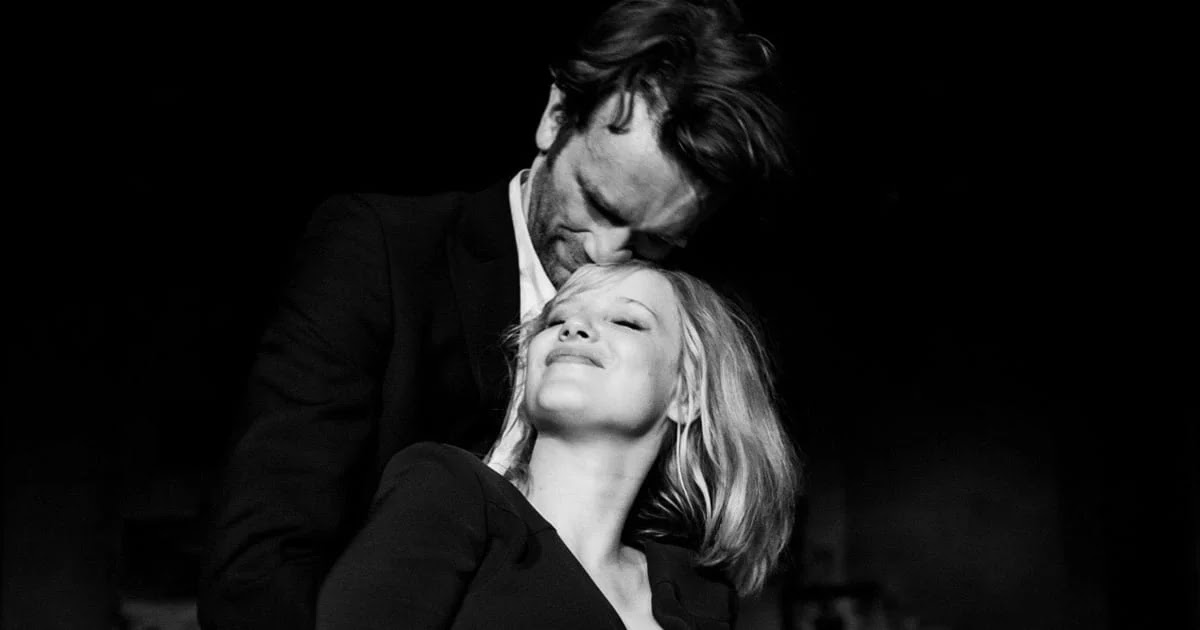
Tomasz Kot and Joanna Kulig are lovers divided in Cold War

Director: Paweł Pawlikowski

Cast: Joanna Kulig (Zula Lichon), Tomasz Kot (Wiktor Warski), Borys Szyc (Lech Kaczmarek), Agata Kulesza (Irena Bielecka), Jeanne Balibar (Juliette), Cédric Kahn (Michel)

Pawlikowski’s film is a heartfelt, heavy fictionalisation, of his own parent’s marriage. Or at least the emotions and clashes that lay at the heart of this turbulent marriage, rather than the actual events themselves.

In post-World War II Poland, the Polish government are funding the creation of a folk-music ensemble, to promote Polish culture. Wiktor (Tomasz Kot) is the lead conductor, helping to select the members. One of the applicants, Zula (Joanna Kulig) is a talented musician who has misled the committee on her background. Wiktor recruits her anyway and she swiftly becomes lead singer of the troupe – just as she and Wiktor begin a heated relationship. When the troupe journeys to perform in Berlin, Wiktor takes the opportunity to cross the border – but Zula, frightened of the risk, refuses to go with him. Over the next fifteen years the couple intermittently come together again. When apart, they long for each other. When together, it never takes long for joy to transform into envy, bitterness, anger and frustration.

The film is called “Cold War” – but it’s about the feuding relationship between these two different but very similar people, and the clashes between them caused by their hearts. Pawlikowski creates some neat commentary around how the Cold War – that division of Europe into two opposing camps – throws up even more boundaries between the two. The defection of one from Poland instantly makes it nearly impossible to meet. Both long for their Polish homes, aware that they can never lead the life they want there.

What’s a shame is that these themes don’t mix very well with the dark romance of the main storyline. It’s impossible watching the film not to think about Pawlikowski’s previous film Ida. Like Cold War, Idawas shot in gorgeous black-and-white (using the non-widescreen Academy ratio 4:3) and explored family problems in post-War Poland. But Ida managed to be both a deeply emotional investigation into the traumas historical and political events have inflicted on a family, while also giving a riveting insight into the scarred land Poland was for much of the twentieth century. Cold War misses this additional layer, focusing excessively on the personal, with two characters at its centre that it’s harder to relate to.

I always feel bad when I’m reduced to saying that the film didn’t work so well for me because I didn’t care for the lead characters. There is very little to fault in the performances. Both have an absorbing chemistry, and develop characters that are prickly, difficult, passionate, firey figures. Kot is, by turns, reserved and obsessive, prone to rash decisions he regrets at leisure. It’s something he shares with Zula. Joanna Kulig is very impressive here, carrying a defensive coldness at her heart that she only rarely allows to melt. She is a character rife with contradictions – decisive (except when she isn’t), passionate (except when she’s rational), loving (except when she hates). She’s a cocktail of confused emotions – perhaps stemming from a troubled childhood.

Both characters have striking self-destructive streaks. The film – like many of Pawlikowski’s films told in a very tight runtime, little more than 80 minutes – charts how these two characters time-and-time again find themselves in a position where they could seize happiness – only too promptly ruin it with jealousies, bitterness and narrow-mindedness. After a while, I confess, I found it wearing. Their decisions are so often – so obviously – wrong, naïve and stupid, that it gets too much. Their relationship is so fuelled by selfishness and disregard for others – partners, spouses, children – that after a while I found myself wanting to give them a shake and tell them to sort themselves out.

Essentially, for all its heartfelt passion and poetic beauty, it’s a “can’t live with, can’t live without”  tale. Its told with pace, but I felt I could actually do with a few more minutes to understand these two people better. There is probably one too many rural peasant troupe performance eating up runtime that could have been better spent getting a grasp on the characters.

The black-and-white shooting is extraordinarily beautiful, and Pawlikowski’s direction is, as always, perfectly judged, well-paced and tender. But for me this becomes a slight film about two people its’ hard to warm to, with an ending that suddenly tips into something both far more operatic and also slightly too pleased with itself. I missed the grace, beauty, wisdom and depth of Ida, which looks more and more like a perfectly judged masterpiece that balances the personal, the emotional and the social perfectly. Cold War, on the other hand, only feels like it scratches the surface of many of these themes.

The Constant Gardener (2005)

Rachel Weisz and Ralph Fiennes in the brilliant and moving The Constant Gardener

Director: Fernando Meirelles

Cast: Ralph Fiennes (Justin Quayle), Rachel Weisz (Tessa Quayle), Danny Huston (Sandy Woodrow), Hubert Koundé (Dr Arnold Bluhm), Archie Panjabi (Ghita Pearson), Bill Nighy (Sir Bernard Pellegrin), Gerard McSorley (Sir Kenneth Curtis), Pete Postlethwaite (Dr Lorbeer), Donald Sumpter (Tim Donohue), Richard McCabe (Arthur Hammond), Juliet Aubrey (Gloria Woodrow)

John Le Carré’s reputation as a spy novelist without peer can lead people to forget his books are often scathing condemnations of Western policy. The Constant Gardener, a superb adaptation of one of his finest novels, is no different. It’s a passionate, angry denunciation of how Western pharmaceutical companies, and their government partners, exploit the people of Africa. But it carries real force as it’s interwoven with a moving and tender study of grief and how it changes us, pushing us to see things from a different perspective. It’s that which gives the film its force.

Justin Quayle (Ralph Fiennes) is a middle-ranking career diplomat, serving in the high commission in Kenya. His wife Tessa (Rachel Weisz), an idealist determined to make a difference, is murdered. Justin determines to get to the bottom of her murder – and finds Tessa was investigating a British drugs company using the distribution of AIDS drugs to poverty-stricken Kenyans to test an experimental TB drug, covering up the harmful side effects and disposing of the dead. As flashbacks reveal Tessa’s investigation and motivations, Justin becomes ever more determined to unmask the drugs companies, and the figures in the British government protecting them.

Directed with vibrant urgency by Fernando Meirelles, The Constant Gardener is part thriller, part romance and part study of loss. Continuing his style from City of God, Meirelles’ camera work is jagged, hand-held and often unsettling, becoming ever more disjointed and edgy as the plot itself heads into darker and darker territory. The film throws us into its Kenyan setting, not shying away from the poverty of the villages. At one point, an aerial shot travels from the golf course, where the British are at play, across a train track and settles on the neighbouring slums.

This is all part of the film’s anger, which translates Le Carré’s feelings from the book. Inspired by the story of an aid worker he met in Cambodia in the 1970s (and who died in Kosovo in the 90s), the film is as furious as the novel at the heartless exploitation of Africa for the benefit of Western companies. Who counts the cost of Kenyan lives lost to experimental drugs? Certainly not the rich and powerful, who keep any consequences at a distance and rationalise them as for the greater good.

And not many have the courage to stand up to this. Most it seems are like Justin – good people who prefer not to think about, or look to deeply at, the impact we are having on the world. It takes a firebrand like Tessa to shake things up – and she pays a huge cost for it. Starting with Tessa’s death, the film feels at first like a mystery, but the culprits are all too obvious. Instead the question is why, not who, and the dark conspiracy that unfolds is really about establishing who knew what rather than who was involved (everyone, of course, was involved).

Rachel Weisz (winning the Supporting Actress Oscar for her work here) excels in a part that could have been a holier-than-thou left-wing agitator, but which she makes warm, human and real. Tessa is a woman who cares deeply, but also loves deeply, who is genuine, unaffected and speaks her mind. Weisz’ performance hits just the right notes, passionate but playful. The bond between her and Justin is real and based on a deep love on both their sides.

So warm is her performance, that you totally understand the all-consuming grief and loss Justin suffers at her death. It’s a very different sort of part for Fiennes – gentle, vulnerable, sweet, far different from his more patrician roles. He nails the part perfectly, bringing out of it a great deal of emotional force. The film is a tender exploration of the impact of grief on a person, and the mixture of shock, sorrow, anger and confusion in Fiennes’ performance feels completely real. This stillness and sombre approach to loss carries real weight.

The film becomes both a crusade – the husband taking up the cause of his slaughtered wife – but also an unusual romance. The greatest pain for Justin is discovering that his wife kept so much of her life secret from him. She did it to protect him, but he longs for the chance to prove to her that he could have been her “secret sharer”, that she could have trusted him. Effectively the film – and Justin’s quest – is to emotionally reunite with his wife, to fully understand her. The emotional heart of the film is this story, the husband effectively communing with the ghost of his wife, wanting there to be no more secrets keeping them apart.

This does mean that, at times, the conspiracy angle of the film gets slightly rushed. A late sequence effectively is four confessions from supporting characters to Justin in a row. The film gets a little bogged down in the mechanics of Justin chasing down various pieces of paper. The eventual quest to find the doctor behind the scandal (a wizened with guilt Pete Postlethwaite) offers a rather neat resolution. But it doesn’t matter too much as the film culminates in an ending that is as bizarrely bleak as it is hopeful.

Beautifully shot by Meirelles, with a raw immediacy that keeps the tension up, with a genuine sense of Kenyan life, it has a wonderful cast of character actors doing their bit (Bill Nighy as an arrogant senior diplomat and Danny Huston as a weasely coward stand out). It’s a film that is full of righteous fury at the West – but also with a tender beating heat for the pain of grief and the struggle with mourning. Emotional and political, it’s the finest Le Carré adaption on film.

The Graduate (1967)

Dustin Hoffman is out of his depth in coming-of-age comedy The Graduate

Director: Mike Nichols

Cast: Dustin Hoffman (Benjamin Braddock), Anne Bancroft (Mrs Robinson), Katharine Ross (Elaine Robinson), William Daniels (Mr Braddock), Murray Hamilton (Mr Robinson), Elizabeth Wilson (Mrs Braddock), Buck Henry (Room clerk), Brian Avery (Carl Smith), Walter Brooke (Mr McGuire), Norman Fell (Mr McCleery)

In 1967, the world went crazy for The Graduate. This comedy of manners and sex tapped into a whole generation’s growing sense of rebellion. Who wants to be told their life has already been mapped out for them? The Graduate seemed to capture that mood and was celebrated as the ultimate example of how someone could break out of the mould. It’s a young person’s film, and perhaps you need to be young to watch it. The older you get – and the further away from those dreamlike days of the late sixties where everything seemed possible – the more the film feels like an amusing but soulless story, with a privileged bore at its heart.

Benjamin Braddock (Dustin Hoffman – actually nearly 30) is a fresh-faced young graduate, top of his class and a sports star. Arriving back home in California, he’s depressed, lost, uncertain about what he wants from life, but pretty sure it isn’t the litany of office, marriage and a career in “plastics” that his parents expect. His isolation brings him to the attention of Mrs Robinson (Anne Bancroft – only 6 years older than Hoffman), the wife of his father’s business partner. She sets about to seduce him, partly out of boredom, partly perhaps because she feels the same ennui and depression as he does (not that Benjamin ever notices – more on that later). They start a long summer affair, conducted with supreme awkwardness on Benjamin’s part, which suddenly becomes complex when he falls for her daughter Elaine (Katharine Ross). Can true love triumph?

The good first. The film’s popularity was grounded in its wit – and it has a very funny script by Buck Henry, who also appears in one of the film’s funniest sequences, as an overly helpful desk clerk at the hotel where Benjamin is awkwardly trying to book a room for his assignation. The film is pacey and energetic and full of imaginative cuts (a brilliant one sees Benjamin flopping out of a pool, jump cutting to him descending onto Mrs Robinson in bed) and directorial flourishes. It’s a dynamic and sexy young film, full of bounce and appeal, with some great jokes.

Mike Nichols – who won the film’s only Oscar for Best Director – shoots the film with real vibrancy. He does a fantastic job getting us to invest in Benjamin. A huge percentage of the film sees the camera focus in on Benjamin, usually in medium-shot or close-up – and it’s a rare moment when he isn’t in frame. The camera rarely leaves him for the first ten minutes, first zooming out from a close-up of him sitting on a plane, following him along a conveyor belt to the terminal (where his blankness slowly changes to fearful anticipation of what waits at home) to tracking along beside him at his welcome home party. This party is stuffed with his parents’ friends, and Ben’s isolation, claustrophobia and insecurity seem all the more striking as the camera gets closer and closer to him. It’s a superb example of using the camera to build empathy for the character.

Nichols’ excellent work continues throughout the film, which makes excellent use of shots, editing and zooms to make us experience Benjamin’s emotions, helping us root for him. It also helps that the film is scored to some of the finest music Simon and Garfunkel ever performed. The slightly sad, wistful feel to their songs – from Sound of Silence to Scarborough Fair – seems to perfectly frame Benjamin’s doubts, just as the slightly more hopeful beats of Mrs Robinson seem to capture him embracing freedom at the film’s end.

The decision to cast Hoffman pays off in spades. Hoffman is no one’s idea of a WASPy sports-star alpha male, but he’s everyone’s idea of an outsider. His performance is pitched perfectly – awkward, shy, uncertain, unaffected and natural. In fact, the film is pretty much perfectly cast. Anne Bancroft’s performance defined her whole career, the predatory Mrs Robinson whom she invests with touches of emotional vulnerability and more than a trace of the very same depression and fear that Benjamin is feeling. An entire generation effectively fell in love with the charming Katharine Ross.

Freedom is what the film is all about. But today, you feel the film skims only lightly on depths it could explore in detail. Benjamin can feel all the ennui he likes: he’s got it so made, I wish I had his problems. With his wealth, his fast car, the vast array of businessmen falling over themselves to offer him low-work-high-reward jobs, not to mention the gallery of attractive women throwing themselves at him, it’s the sort of misery only the rich enjoy. Almost constantly dressed in suit and tie, with his combed down hair, he looks a million miles from the generation that would party at Woodstock and protest Vietnam. Benjamin probably went on to vote for Reagan (twice). There is nothing counter-culture about him whatsoever. He ticks off noisy teenagers at a drive in and seems to find the young as hard to understand as the old. He’s less a generation adrift, more of an individual misfit.

The film though loves him to pieces, in the same way it largely treats Mrs Robinson as somewhere between a joke and a monster. She’s written as either a horny exploiter of youth, or a vengeful harpy. Rather than a ruthless cougar, today she seems to be more of a vulnerable, damaged figure. Every scene with Bancroft carries moments of pain, sadness and world-weary depression. Why else is she so able to spot these traits in Benjamin? Watch her desperation and hurt when Benjamin starts to date her daughter. That’s real humanity there, miles from the empty selfishness of Benjamin, who genuinely doesn’t get why she could take it so amiss that he intends to replace her with her own daughter.

The most striking moment in the film that captures this is the scene where Benjamin attempts small talk during one of their nights together. The film wants us to think Ben is looking for something real, and that Mrs Robinson just wants the sex. But the conversation is a masterclass from Anne Bancroft of suppressed pain and regret, as she talks of having to drop her art degree because she was seduced by her husband, of years of living an empty life. Benjamin of course doesn’t get it – he guesses she dropped the art because she wasn’t interested – and then gets cross when he feels he’s being belittled. Mrs Robinson’s sad eagerness to persuade him to stay is rather affecting – more than the film really allows. I credit Anne Bancroft with much of this.

And then we have Elaine. The second half of the film shifts gear dramatically from the first. While the first half is a sex comedy and study of suburban discontent, the second seems to change into the sort of celebration of youthful energy that the first half could be said to be partially satirising. Elaine is an independent young woman, embracing her education and the opportunities it offers. Suddenly, an energised Benjamin is tearing across country to win Elaine back (let’s put aside that Benjamin behaves in this section like something between a stalker and a creep).

However, as the film nears its conclusion, that celebration of the promise of youth is undercut somewhat, as Elaine chooses to make  all the same mistakes her mother made. The film even hints at this with its famous ending shot. After eloping from her wedding, Elaine and Ben sit on the back seat of the bus. The camera holds the shot as they laugh, until they stop laughing and then sit next to each other, and then awkwardly look this way and that as if waiting for someone to tell them what to do. What do they really have in common? Having made a spontaneous decision like this, what happens next? It’s another little genius flourish by Nichols – although it’s also the film having its cake and eating it, selling the sequence before this as a triumph of true-love, then asking us to question if the world is that simple.

Some of these ideas felt lost in the excitement of the film’s first release, when it captured a wave of public feeling. But the older the film gets, the more awkward it looks. As if the kids who watched it in the sixties and turned into the Reaganite Baby Boomers of the 1980s, slowly realised that the message it was selling was not quite true and perhaps their parents weren’t that different after all.

Watching The Graduate today, I found it hard to shake the feeling that if I flashed forward to the characters’ lives in 1997 I would find a very different, but still very similar story. Benjamin Braddock would be a wealthy businessman, still dressed in suit and tie, who went into plastics or computers or some such and swallowed the “greed is good” mantra from his corner-office. Elaine a depressed housewife, mother to a couple of kids, who left her dreams of forging her own life behind to marry the subject of a youthful fling. Who, with her own regrets, finally understands the sadness and misery at the core of her mother’s life. And is making eyes at that attractive young man next door…

Badlands (1973)

Martin Sheen and Sissy Spacek are killers on the run in Terrence Malick’s masterpiece Badlands

Director: Terrence Malick

Cast: Martin Sheen (Kit Carruthers), Sissy Spacek (Holly), Warren Oates (Father), Ramon Bieri (Cato), Alan Vint (Deputy), Gary Littlejohn (Sheriff), John Carter (Rich man)

If American cinema has a poet, it’s Terrence Malick. His career is the most elliptical of any major American filmmaker. Shunning interviews or any discussion of his work, his mystique is built upon Kubrickian isolation (he took a 20-year gap between his second and third films) and the powerful mystique of his first film – and still his masterpiece – Badlands. A luscious, beautifully filmed, profound piece of film-making, perfectly paced and told with a poetic sensibility, it’s  powerful and brilliant. Nothing Malick has done since has reached the same beautiful balance between story, profundity, poetry and realism.

Kit Carruthers (Martin Sheen) is an aimless young man, recently fired from his job as a garbage collector in South Dakota. His imagination is captured by a teenage girl, Holly (Sissy Spacek), freshly arrived from Texas. He romances the young girl – who is naively swept up in the possibility of Kit’s poetic soul – but her father (Warren Oates) disapproves. So, in a casual confrontation at their home, Kit kills the father, burns down the house and he and Holly head out on the run. Travelling across the country, Kit kills with a casual lack of maliciousness, all the time building in his head his self-image as a James Dean-like hero in his own movie, a poet turned outlaw. Holly narrates the film, her guileless, innocent and often unreliable narrative revealing her own naivety. Sheen is outstanding as Kit, idealistic but empty, while Spacek gives Holly a sublime blankness that makes us never sure how much she understands the situation she is in.

Malick based the film on the killing spree of Charles Starkweather, who carried out a murderous journey across several states in the mid-West with his underage girlfriend in the late 50s. But what Malick found in this story was a fascinating insight into how people can become absorbed by the romanticism of the American pioneer spirit, to try and turn their own lives into something with meaning and depth. So, Kit can be little more than a not particularly bright casual killer, but he builds his own self-image as something part-way between movie star and philosopher poet.

What the film does quite brilliantly is balance the ruthlessness of Kit with this dreamlike poeticism. Much as you shouldn’t, you end up caring a little for Kit and Holly, while deploring their brutality. Perhaps it’s because both of them feel so young. After the murder of her father, they build a cabin in the woods and live off the land, with all the enthusiasm of kids. There is something very vulnerable about both of them, their abilities to really understand the situations they are in and the moral implications of their actions non-existent. In a way they are playing – but with real guns.

Their life has been so filtered through the Hollywood celebrity culture growing around them, that they see their actions like part of a film. Death is as unreal and without impact as it is in Hollywood. Kit twice, early in the film, prods dead animals with nerveless curiosity – the same blankness and lack of reaction that he will later treat dead people with. Holly is briefly shocked by the death of her father, but then builds all Kit’s actions into a narrative of romantic drama.

Kit and Holly build their own narrative the whole time – but with a shallow emptiness that reveals their own pretensions. Both of them are collectors of odds-and-ends – Kit picks up mementos and strange souvenirs from where they have been, treating these as near religious icons that future generations will use to mark his presence. Objects from lamps to paintings to rocks are invested with artistic value by the pair. Kit’s shallowness is clear: early in the film he picks up a large rock from under the tree where they first made love, determined to keep it forever as a memento. After walking a few metres, he drops it and decides to take a lighter rock. Later, when Kit is finally cornered by the police, his main concern is to build a small cairn to mark the location where he was caught.

Kit wants to be more than he is. He is delighted when his physical resemblance to James Dean is noted by the police (his appearance is carefully studied to cultivate this). At a rich man’s house, he decides to record messages for posterity – words so bland, predictable and lacking in depth they reveal the total lack of imagination and original thought in Kit. He is polite, generally kind to his victims (before killing them) and thinks of himself as a sort of poet of the wilderness. Neither he nor Holly understands the horrific finality of death. The couple have a fatally corrupted innocence, a childlike, romantic understanding of the world that becomes a sort of fairy-tale. And you can totally see why a naïve young girl like Holly might see Kit as a romantic figure who can set her free.

Malick’s film wraps this up in a film of dreamlike beauty. In later films, Malick became so obsessed with beautiful images, and increasingly pretentious in his themes, that they became self-important artefacts. But Badlands balances these instincts beautifully with a fascinating and revealing story.

The shooting of the film offers up one beautiful image after another, reflecting the poetic longings of the couple at its heart, while underpinning sharply their blandness. Malick captures the awesome grandness of the Badlands themselves, a dusty stretch of emptiness that goes on forever. Malick shoots moments, like the house-fire, with such grace and perfection that they take on deep psychological meaning (what else is that house fire but the death of Holly’s early life?). Shots of nature – the sort of wildlife photography that would go too far in later films – place the couple in exactly the sort of tranquil independence, free from the burdens of the real world, that they long for. It’s an American dream, the celebration of the pioneer spirit deeply and darkly inverted.

The film is an enigma that avoids ever casting easy judgements on its characters. Their actions may be awful, but how much have they been bent and twisted by the world around them? The film’s eclectic musical choices – Carl Orff to Nat King Cole – bring the film a sense of magic, again a dreamlike mysticism. It’s fitting for a young couple who are living in a dream, with no consequences and no morals. This impressionistic masterpiece, which mixes in moments of shocking realism and casual violence, reflects the inner life of its leads, both yearning to be more than they are, and directing these longings into disastrous ends. Badlands is one of the greatest debut films in history, and still the perfect fusing of Malick’s poetic leanings with narrative film-making.

A Separation (2011)

A Separation (2011)

Compelling drama of a family under pressure, in Farhadi’s brilliant film

Director: Asghar Farhadi

Cast: Payman Maadi (Nader), Leila Natami (Simin), Sareh Bayet (Razieh), Shahab Hosseini (Hodjat), Sarina Farhadi (Termeh), Merila Zare’I (Miss Ghahraii), Ali-Ashgar Shahbazi (Nader’s father), Babrl Karimi (Judge), Kimia Hosseini (Somayeh), Shirin Yazdanbakhsh (Simin’s mother)

It’s very easy today to imagine Iran as another world. A mysterious country, locked behind an oppressive regime that we are constantly told by our leaders is a frightening, distant place not to be trusted. But this prosperous country, with its rich historical background, isn’t some sort of Mars. It’s full of regular, normal people just trying to do their best for their families. It’s the strongest thing you’ll take out of Asghar Farhadi’s heartfelt, low-key, deeply moving masterpiece: deep down, we are all united by how circumstances push us into desperate situations with few good options.

Married couple Nader (Payman Maadi) and Simin (Leila Natami) have petitioned for divorce. Secular Muslims, they want to emigrate to find better opportunities for their teenage daughter Termeh (Sarina Farhadi). Simin wants to leave now – but Nader won’t leave while his aged father (Ali-Ashgar Shahbazi), suffering from Alzheimer’s, is alive. Their only option, under Iranian law, is divorce. However, separation makes it impossible for Nader to care during the day for his father. He hires Razieh (Sareh Bayet), a devout Muslim – but the position causes her a host of problems, from concerns about touching another man (she calls her Imam to ask if she can change the old man’s trousers after an accident), to her worries about what will happen if her husband Hodjat (Shahab Hosseini), a feckless man in and out of prison, finds out she is working for a single man. After Razieh ties  Nader’s father to a bed to keep him safe, she and Nader argue, during which he forces her out of his flat. Razieh then has a miscarriage that night. Did Nader know she was pregnant? If so, he could face prison for murder. Both families find themselves in desperate straits.

A Separation is a superb piece of film-making, deceptively simple in its assembly and shooting, but carrying a huge emotional force as we become invested in the lives of the people it follows. Farhadi never passes moral judgement over his characters. All of them have strong reasons for doing what they are doing, rooted in what’s best for the family. Everyone acts in the way they feel will best protect their loved ones. Arguments become profoundly personal and damaging – but they don’t start out that way. It’s simply a question of things slipping out of control.

That’s not helped by the laws of the Iranian state. Farhadi’s film is very careful to never pass explicit comment on Iran’s laws. But the nature of the regime – and the mood it encourages – is at the heart of all the problems. Tensions are perhaps inevitable between the middle-class and secular Nadar and Simin, and the more working-class and traditional Razieh and Hodjat. This is class and religion in one cocktail, both sides carrying impressions that are nearly impossible to shake off.

But it’s the laws of the state that amplify this: where a man and a wife must go through a demanding pantomime for divorce or a man can be sentenced for murder for the lightest push on the shoulder of a woman who then miscarries. The judge hearing the pre-trial arguments (a very gentle and dignified performance from Babrl Karimi) may be the very soul of reasonableness, but it doesn’t change the fact that the laws he must rigidly uphold continually inflame the situation.

The story is brilliantly constructed, a tightly plotted melodrama that frequently presents new information that forces us to reinterpret what we have seen and heard. It mixes superbly domestic drama and crime procedural, and frequently only the audience has the complete picture of everything that has happened. Key arguments – the loss of money, Razieh’s unexplained absence from her duties, the difficulties of keeping Nadar’s father safe – are shown to us from every angle. But still, we understand the very natural – and human – reactions that people who do not have all the facts, as we have, make. Perhaps it’s the constant stress of simply living – magnified in a crowded and difficult city like Tehran – that seem to put every character on a knife-edge, terrified that a wrong step could land them in a host of trouble.

But that’s the power of Farhadi’s film-making – he invests every shot with sympathy and empathy. He wants us to understand everyone. It would be easy to make Hodjat exactly the sort of chippy, argumentative, working-class figure Nadar clearly thinks he is – but we also see his desperation, poverty, shame at not being able to provide for his family. Simin is easy to see as a woman trying to escape to live her own life – but she is also willing to cause collateral damage to the rest of her family. Nadar is the picture of a more liberal Iranian – but he also refuses to listen to people and is selfish in equating what he wants with what everyone else should want. There are no easy moral choices here – and no clear “heroes and baddies” for us to invest in.

The film reminds us that on every side of a dispute there are real people, with real concerns. And that the collateral damage can be just as bad. Nadar’s father is left even more catatonic than he was at the film’s start. Nadar and Simin’s daughter Termeh becomes consumed with guilt and disillusionment over the moral compromises her parents are forced to make. Her distress plays constantly at the edges of scenes – and even her morals eventually end up compromised – only coming fully into focus with Farhadi’s heartbreakingly open-ended conclusion.

The acting is superb. Payman Maadi is harassed and desperate under a veneer of controlled reason. Leila Natami plays a modern career woman, compromising herself every day, with great power and intensity. Sareh Bayet’s vulnerability is matched only with her profound sense that she cannot compromise her morals, in a performance that brilliantly mixes fear, resentment, warmth and anger. Shahab Hosseini superbly brings to a life a loud, brash man who is secretly profoundly weak, scared and trapped. There isn’t a wrong note in the entire cast, and Farhadi’s patient and intimate direction and shooting allows each of them to bring their characters superbly to life. This is a brilliant film which shows an intriguing – but sensitive – insight into life in Iran. But it most strongly demonstrates how human we all are. Everyone in the film is doing what they feel is best for their family – be that trying to hold them together, forcing the issue of emigration, earning money from work, or suing for compensation for the loss of a child. It’s a glorious reminder of how our lives can be altered by circumstances, and our intentions drastically different from their impact.

Georgy Girl (1966)

Lynn Redgrave excels as permanent odd-girl out in Georgy Girl

Director: Silvio Narizzano

Cast: Lynn Redgrave (Georgy Parkin), James Mason (James Leamington), Alan Bates (Jos Jones), Charlotte Rampling (Meredith), Bill Owen (Ted Parkin), Clare Kelly (Doris Parkin), Rachel Kempson (Ellen Leamington), Denise Coffey (Peg), Dandy Nichols (Hospital Nurse)

Made at the height of the Swinging Sixties – when London was the coolest city in the world – Georgy Girl is, in some respects, a time capsule. It was seen at the time as almost impossibly naughty and subversive, with open talk of abortions and affairs, mothers who feel their lives have been changed for the worse by having babies and young people struggling to accept their responsibilities. Now of course, it all looks rather tame. But there remains a charm to the film – helped above all by its performances – that still manages to make it a winning film, despite some of its attitudes raising entirely different questions today than its makers intended.

Georgy (Lynn Redgrave) is the plain-looking (and doesn’t the film keep reminding us of this!) daughter of the devoted butler (Bill Owen) to millionaire James Leamington (James Mason). Leamington has supported Georgy while she grows up – even letting her use his house for her children’s performance classes – but now his interest in her is changing. With his wife dying, James offers her the chance to become his mistress (with an actual contract). Georgy turns it down – not least because of her growing interest in Jos (Alan Bates), the fun-loving boyfriend of her flatmate Meredith (Charlotte Rampling), a drop-dead gorgeous violinist who treats him and everyone else with disdain. When Meredith falls pregnant with Jos’ baby, the two of them marry – but Meredith wants nothing to do with the child, a contrast to Georgy who has always dreamed of family.

It’s actually a film of cold, hard realities. Beware any film which gives you a conventional happy ending – the hero chasing a woman down a street crying out that he loves her – around the half way mark. All the characters are presented with choices, and are forced to either compromise or run away. It’s telling that the characters who most fit the mood of the era invariably run away, while those with a more traditional outlook stick it out. You could argue that far from being a celebration of the 60s, Georgy Girl is a fierce critique.

At the time, Georgy was seen as something of a free spirit. Perhaps this was because of her unconventional looks or her playful imagination when working with the children in her performance class. Maybe it was the opening sequence, which sees her getting a fashionable haircut, only to instantly wash it out in a sink. Or could it be because she treats her father’s wishes for her to listen to her elders and betters with disdain? (Let’s skirt over the fact her father seems to be effectively pimping her to his employer.) The way she makes a scene at Leamington’s birthday party by performing a raunchy cabaret number? Most of all though it may well have been due to the catchy (and instantly recognisable) Seekers song that plays over the opening and closing of the movie and serves as her calling card.

Interestingly though, watching it now, there is something incredibly conservative about Georgy – and quite possibly about the film itself. While she lives in the heart of the buzzing metropolis, Georgy’s dreams seem to come from another age: to become a mother, in a comfortable domestic setting. It’s hardly a feminist rallying cry. Georgy is so keen for this, she is perfectly willing to step (almost literally) into the shoes of Meredith, inheriting her husband, child and home. The film also misses no opportunity to remind the viewers Georgy is plain, dumpy and sexually inexperienced. Redgrave has been dressed to look like a sort of Teutonic housekeeper. The film doesn’t seem to quite know where to land between praising Georgy and slightly encouraging us, to chuckle at her.

Georgy isn’t in fact the swinging 60s icon in the film. That unquestionably is Charlotte Rampling as Meredith. Looking absolutely stunning, dressed by Mary Quant, Meredith is everything we expect from the era: confident, outgoing, ambitious, sexually liberated. But Meredith is also a stone-cold, ruthless, heartless bitch. Superbly played by Rampling, she treats Georgy as a servant, Jos as a mix between comfort blanket and vibrator, and decides to get married and have the child (rather than abort it as she has two others of Jos’ children – without telling him) because she’s bored. Once the poor child is born, the idea of sacrificing anything from her life is anathema to Meredith who promptly disappears over the horizon.

Georgy Girl is actually a film with much more mixed – even satiric – views of women and its era. The sort of liberation Meredith enjoys goes hand-in-hand with a selfish shirking of responsibility and using her beauty as a justification to treat everyone she meets as supplicants. Georgy is stuck in the middle, a woman in an era of growing freedoms but whose aims remain solidly in the Victorian era. The men are an equally mixed bag. Today we would certainly call what Leamington has been doing grooming. Jos has a happy-go-lucky 60s charm to him, but is flighty, unreliable, selfish and disappears with a smile the second the going gets tough. For all the film is sort of remembered for its joie-de-vive, it’s actually a searing look at the era with mixed feelings about its characters.

The fact we really end up caring for Georgy is due to Lynn Redgrave’s wonderful performance. A second choice for her sister Vanessa, the role typecast Redgrave in Hollywood’s minds as sort of dumpy loser (especially after her Oscar nomination). But she brings the role a real magnetism. Georgy is doomed to play second fiddle in people’s lives (and perhaps even her own). Perhaps the most 60s thing about her though is her determination to get what she wants – whether that is avoiding an affair with her father’s employer, or securing a good life for Meredith’s baby.

The rest of the cast are equally strong. Bates brings the best of his impish charm to the part (even if at times he tries too hard), as well as a metrosexual edge to Jos as someone very comfortable with joking around and being a bit camp. James Mason (who took a massive pay cut for the role, a decision which paid off with an Oscar nomination) is superb as fragile but creepy Leamington, a man who believes he is genuinely in love and is also excited at the prospect of replacing his bed-ridden wife (played by Redgrave’s actual mother Rachel Kempson, adding a nice Oedipal touch) with a younger model. Bill Owen mixes both a hilarious servility with assertions that his daughter “owes” Leamington something for all he’s done for her.

Georgy Girl works well because it is – and remains – funny as well as being dramatic and thought provoking. It might not be a feminist tract – and the character most likely to be seen as a feminist in the thing is its least sympathetic by far – and it might well affectionately scorn a woman who doesn’t look like a conventional man’s idea of attractive, and give her a traditional outlook behind a playful exterior – but it’s an energetic and rather charming film that does make you care. Separating it from the era it’s set in, might well do it a world of good.

Summerland (2020)

Gemma Arterton is a misanthrope with a buried heart of gold in Summerland

Director: Jessica Swale

Cast: Gemma Arterton (Alice Lamb), Gugu Mbatha-Raw (Vera), Penelope Wilton (Older Alice), Tom Courtenay (Mr Sullivan), Lucas Bond (Frank)

As London is suffering under the Blitz, in a sunny village in Kent reclusive writer Alice Lamb (Gemma Arterton) has her world turned upside down when she is forced to take in young evacuee Frank (Lucas Bond). Depressed and lonely after the collapse of her relationship with the glamourous Vera (Gugu Mbatha-Raw) at college, Alice has shut herself off and leads a solitary life. So it surprises her when she finds her heart thawing for Frank – though not as much as she will be by other revelations.

Jessica Swale has a successful career as a playwright. Several of her plays look at the place of women in history. Blue Stockings was a fascinating (and highly popular) story of female undergraduates in the late Victorian era, smart enough to excel academically but seen as second-class citizens in Cambridge. Nell Gwyn rehabilitated Charles II’s mistress as an intelligent and caring woman and a talented writer and actress. Summerland follows some of these themes – focusing on a lonely lesbian in the 1940s who, with her unconventional interests and academic leanings, is out of touch with her time. But Summerland softens this up by covering the whole story in a dreamy, luscious warmth where everything works out fine and acceptance and reconciliation is the name of the game. It’s both far less interesting than Swale’s stage work and also just as enjoyable.

Not there’s anything wrong with a a bit of cosiness in film. But Summerland is so relentlessly feel-good you end up missing a little bit of bite. Could there not be one character who questions Alice’s sexuality (which even by the 1970s, where Penelope Wilton plays an older version of the character, was hardly welcomed with open arms)? Surely in this seaside town of Kent there would be whisperings of a sort around the village’s multicultural population? Would the colour of Vera’s skin cause no comment from anyone at Cambridge or elsewhere? There are darker societal issues that could have been explored here that just aren’t touched on. I suspect the film is going for a “colour blind” casting, which works in theatre and with older time periods, but seems a bit more awkward when applied to a time period when race was a very real issue. You’d get a ton more social commentary from an episode of Call the Midwife which somehow feels a bit wrong.

But then the film isn’t trying to make a social comment, but is trying to be a bit of escapism. On that score it works very well indeed. With gorgeous Kent scenery, wartime Britain looks like the sort of idyllic Sunday tea-time drama-land you’d love to live in. The fundamental decency of everyone is somehow rather reassuring – even town gossip and busybody Sian Phillips has a heart of gold – and the film bubbles along through a series of events that are both utterly predictable (and at times hugely implausible) and also strangely reassuring. Because you could figure out most of the film early on, you never need worry.

It’s given a great deal of energy by Gemma Arterton’s performance of bad-tempered misanthropy, which of course hides great reservoirs of love and warmth for humanity. Arterton has some beautiful comic timing (an early scene where it appears she is using a ration coupon to buy chocolate for a child without coupons, only to trouser it herself is perfectly done, and probably the film’s highpoint) but also really succeeds in demonstrating the emotional trauma and pain Alice is experiencing. There is a beautiful lightness about how she opens up to Frank (scenes that are of course hugely predictable but still delivered with a genuineness and sweetness that really works).

The flashbacks allow a sun-kissed romance between Alice and Vera to play out, and leave enough questions to keep us guessing (for a bit) as to how this relationship failed to flower. (Needless to say, despite a brief line about flying in the face of society, we never see for a fraction of a second that anyone has any problem with this completely public relationship). Vera is warmly played by Gugu Mbatha-Raw, who brings a radiant life to the part. (A fun moment for Swale watchers – Arterton and Mbatha-Raw both played Nell Gwyn in Swale’s play.)

Summerland throws in a bit of thematic depth around a hunt for Fata Morgana mirages – the focus of Alice’s latest book – and the possibility that these cloud-based mirages of castles carry some sort of spiritual message from the afterlife. But this also serves as part of the film’s easy solving of problems. Any obstructions to the characters’ happiness are swept aside, either by not being mentioned or by the narrative swooping in (one offscreen “character” is easily dispatched, so that we feel no conflicted guilt at their existence getting in the way of the resolution). But this is a film that is offering a light, simple, gentle, escapist story. Nothing remotely challenging – or even really hugely dynamic – happens in it, but for those looking for Covid escape, Swale’s escapist, sweet film debut is worth a look.

On the Rocks (2020)

Rashida Jones and Bill Murray deal with family problems in On the Rocks

Director: Sofia Coppola

Cast: Rashida Jones (Laura), Bill Murray (Felix), Marlon Wayans (Dean), Jessica Henwick (Fiona), Jenny Slate (Vanessa), Barbara Bain (Gran)

There is often a special bond between fathers and daughters. And it’s one that can be challenged if the father is “replaced” by a husband. After all, nobody wants to go from being the main man to second best. But how complex can this become when the father himself has a track record of selfishness and philandering? And is that the best person for the daughter to turn to when she starts to have doubts about her own husband? In Sofia Coppola’s gentle, light-weight film, Laura (Rashida Jones) reconnects with her roguish millionaire father Felix (Bill Murray), a successful retired art dealer, as she becomes increasingly worried that her husband Dean (Marlon Wayans) is having an affair with his attractive younger colleague Fiona (Jessica Henwick).

Coppola’s new film is an entertaining, low-key family and relationship drama that’s as light as a puff of air. Recycling many familiar ideas from her previous films – in particular the idea of women who seemingly “have it all” but are feeling discontented and trapped in their lives – it spins off into a fairly gentle parable of how doubts and insecurities can take over our lives, which mainly serves as a lovely little showpiece for two very engaging actors to entertainingly do their thing.

Rashida Jones balances the trickier part as a woman who’s half endearingly fond of her fun-loving dad, half infuriated and damaged by the way he wrecked his marriage to her mother and ruined her childhood (it seems her sister and mother are no longer on speaking terms with him). At the same time, she’s keen to hold onto her successful writing career and family life – while also facing an existential crisis as she feels herself becoming more and more stuck in a rut. There are distant echoes of the lack of focus Scarlett Johansson’s character felt in Lost in Translation, the many lonely women running the house in The Beguiled, or the rich girls cut adrift in The Bling Ring or Marie Antoinette.

Into all this drops the bombshell of her husband’s possible infidelity. Coppola gently uses this as a subtle investigation of human nature. Is infidelity and betrayal something all people have as common possibilities? Or does a history of infidelity in our families make us more ready to see it everywhere? Gentle is the word, as the film doesn’t really labour any of these points – perhaps worried that to do so would take it into deeper waters than it has the nerves to handle – and prefers to keep the mood light and frothy. This does mean that when – eventually – emotional moments come, they come rather from nothing, and a braver film would have balanced better the lightness of father and daughter chasing after a (possibly) cheating husband, with tension between that same father and daughter over his appalling past behaviour.

But then, the film perhaps falls rather in love with Bill Murray – and genuinely it’s pretty hard not to. Sofia Coppola again provides Murray with a part designed to match all his strengths. A charming performer, it’s very hard (near impossible) not to like Murray and as he coasts through the film with relaxed cool, arching an eyebrow there, a touch of glib lightness here, investing certain lines with a saggy sadness, others with a playful childishness, you’ll enjoy every moment. Murray makes perfect sense as the ageing rouéand cad, who has lived his life entirely for his own pleasure, and now is conducted by chauffeur from hotel to hotel, flirting with any woman who crosses his path.

It’s a delightful performance, with several scene stealing moments – not least when Felix is pulled over by the cops and charms his way out of a ticket with confidence, a bottomless contact book and charm. The cops even push-start his showy old sports car. Of course it’s the ultimate display of white privilege: I’m interested if Dean would have had similar success if it was him. The film shies away from any commentary on race at all, which feels like a missed opportunity. Does Dean put so many hours into work because he needs to prove himself in the ways people like Felix never had to? A different film might have wondered if sub-consciously Felix was even more jealous and concerned about losing his daughter to a black man. But these are areas the film chooses not to go into.

Instead it largely settles for being a charming meander, centred around Murray’s character, that doesn’t want you to look to closely and realise what a selfish cad he really is. Of course the film is really about Felix’s regrets about not having the relationship he would like to have with his children (and Murray more than gets this across with his skilful suggestion of sadness behind the eyes), but even this is a beat the film very lightly taps. What you end up with is a very light, almost whimsical film that moves through a series of events that wind up feeling rather inconsequential. A puff of air you feel would blow the film apart.

The Shining (1980)

Jack Nicholson loses his mind in The Shining

Director: Stanley Kubrick

Cast: Jack Nicholson (Jack Torrance), Shelley Duvall (Wendy Torrance), Danny Lloyd (Danny Torrance), Scatman Crothers (Dick Hallorann), Barry Nelson (Stuart Ullman), Philip Stone (Delbert Grady), Joe Turkel (Lloyd), Anne Jackson (Doctor), Tony Burton (Larry Durkin)

I’ve often had mixed feelings towards Kubrick’s films. He’s impossible not to admire and there is no doubt many of his films are landmarks in cinema. But I’ve also often found him a brilliant technician, a striking intellectual but an emotionally cold and distant director, who seizes the brain and sense but doesn’t always engage the heart. It’s perhaps unsurprising that a director who has such control over the tools of cinema should be able to use it to create one of the greatest horror films of all time. Because what else is horror but the expert use of technique to unsettle and scare the audience? It’s like the genre Kubrick was destined to try – and succeed at.

The Shining was itself partly born out of Kubrick’s disappointment at the reception given to Barry Lyndon, his cinematically rich, but emotionally unengaging (to many) Thackeray adaptation. It garlanded awards, but praise that was more respectful than fulsome – while audiences had largely stayed away. Kubrick may be an artist – but he still wanted people to see his work. He decided to direct a film based on a poplar horror novel – after all people have been seeing slasher and fright pics for decades, so why not get a piece of that action? Stephen King’s novel was one of the few that engaged him (allegedly the famously highbrow Kubrick spent months reading part way into various horror novels before flinging them across his office in contempt). Sure Kubrick – much to King’s annoyance – junked many of the author’s themes in favour of his own. But in doing so he created a terrifying and deeply unsettling experience that stands as his most effective late work.

In the abandoned, and snow isolated, Overlook Hotel during off-season, writer Jack Torrance (Jack Nicholson) is hired as caretaker to keep the building running. Accompanied by his wife Wendy (Shelley Duvall) and young son Danny (Danny Lloyd), Torrance hopes to use the isolation time to come up with a draft of his new novel. However, dark forces are at work at the hotel. Ten years ago the caretaker butchered his whole family there, and the deaths have left a psychic legacy on the building. This is picked up on by the ESP-powered Danny, but also begins to play on the psyche of Jack who slowly begins to become ever more short-tempered, twitchy and unhinged as time goes on.

The Shining is one of the most frightening and unsettling films I’ve ever seen. And I attribute that completely to Kubrick’s mastery of the language of cinema. Every single frame, every single note on the soundtrack, has been perfectly shaped to inspire dread in the heart of the viewer. There are no cheap tricks, no jump scares, no obvious cinematic parlour games. Instead this is Kubrick using his technical artistry. What else can you say when one of the most disturbing things in the film is the changing sound of Danny’s tricycle as he cycles round the hotel (in a single, low angle, tracking shot), going from near silence as he cycles over carpet to bursts of sound as he cycles over wooden floor? When the score overwhelms with discordant sound and high notes as Danny simply stares at a door? 

But Kubrick’s genius is everywhere. He understands how the human brain is unsettled by symmetry. Watch the film again and see how so much of it is perfectly framed, how still the camera often is, how images – such as shots of corridors or rooms – are set in such a way to make the image look symmetrical. Something is off in our minds about seeing a building that looks so precise. It transfers as well when the actors are caught in the middle of the frame, with the set either side of them looking identical. Our mind keeps telling us it’s wrong. It feeds into our own doubts and fears. It disturbs us completely. Stillness and quiet mix with bursts of colour. For every elevator door opening to deposit a tidal wave of blood, there is the quiet intimacy of Philip Stone (absolutely chilling) as a ghostly representation of a past janitor, urging Jack to “correct” his wife and child.

That fear of symmetry extends as well to Kubrick’s use of two girl twins as ghosts of the former caretaker’s murdered children (and their stillness and softness of voice is equally terrifying). The ghosts throughout this film that urge Jack on in his murderous rampage are almost uniformly softly spoken, calm and polite – qualities that carry more and more menace. Even when the horrors begin to erupt, Kubrick keeps the camera movement and editing slow, gentle and frequently employs tracking shots (naturally leading to the invention of a new type of Steadicam). Where jump cuts are used they are to give us flashes of Danny’s ESP visions of the hotel (sudden cuts to the murdered girls or other horrors), enough to jolt us and working all the more in the rest of the film’s measured pace and gothic chills.

Kubrick also brilliantly makes use of the psychological impact of isolation. Out in the middle of nowhere, it’s clear time quickly loses meaning. The film is punctured throughout with title cards that seem increasingly random, either naming days (with no indication of how much time has passed between them) or time jumps that seem unconnected with the previous scene. It’s quick to see how much the Torrance’s perception of time has been lost in never-changing surroundings. The impact of constant isolation on a fragile psyche is perhaps something we are even more acutely aware of in 2020, and it’s clear that it has a catastrophic effect on Jack, who becomes ever more susceptible to his bad angels.

Those bad angels are partly where Kubrick begins to deviate from King. Not surprisingly, with Kubrick’s often nihilistic view of humanity, he introduces the idea that Jack has a history of violent temper and even striking Danny. This is very different from King’s idea of a good man and father being bent out of all recognition by the hotel’s evil into a would-be murderer. It’s possibly the main objection King had against the film’s changing of the novel. That and Kubrick’s clear disinterest in “shining” – the name given to the ESP qualities some of the characters display. For Kubrick, what was more important was the unsettling impact environments can have on people’s psyches – amplified in this case by terrifyingly bloodthirsty ghosts. For King the corruption of the good from evil among us was crucial. Both are fascinating ideas – but you can see why the book’s author would not be pleased to see his concepts sidelined.

Part of this may also have stemmed from the casting of Nicholson. Probably the greatest American actor of the 1970s (his hits during that decade are astonishing), this was the first chapter in a new era. Now Nicholson became JACK, part actor but part personality, so larger-than-life that you only had to say his first name for everyone to know who he was. Sure, Nicholson is (like in A Few Good Men) a ticking time bomb, but the performance works. It’s the film where Nicholson embraced for the first time the demonic grin and leer of cruelty he would use so well. But seeing him attack the film’s gothic qualities, while still having a touch of humanity for its quiet moments, works a treat. Could any other actor in the world have pulled off “Here’s Johnny!” and still have us absorbed in the character and the film? It’s pantomime, but brilliance.

More controversial is Shelley Duvall’s weepy, slightly pathetic wife. Much of Duvall’s wetness in the role is surely connected to the reportedly miserable time she had on set. To draw the “right” reactions from her, Kubrick essentially bullied her on set, putting her through hell. Sometimes hundreds of takes were done of even the most trivial scenes to get them right (this film perhaps cemented Kubrick’s reputation for ludicrous perfectionism), a regime that reduced Duvall to a state of near psychological collapse. While this was perfect for her performance, it was hardly conducive to her well-being. And was in itself perhaps another sign of the lack of heart in Kubrick, a director concerned only in the end with effect not emotional truth.

So it’s a black mark against the film. But The Shining is still a masterpiece, perhaps one of Kubrick’s greatest films. The film was so dependent on its technical wizardry, detailed perfection and preciseness that its impact becomes almost unbearable. It focuses on all Kubrick’s strengths and almost none of his weaknesses – indeed his basic dislike of people becomes crucial to its effect rather than running counter to an audience’s need to invest. Tense, unsettling, troubling and in the end deeply scary, while never feeling cheap or exploitative. It’s a landmark in both its genre and its director’s career.