Category: Relationship film

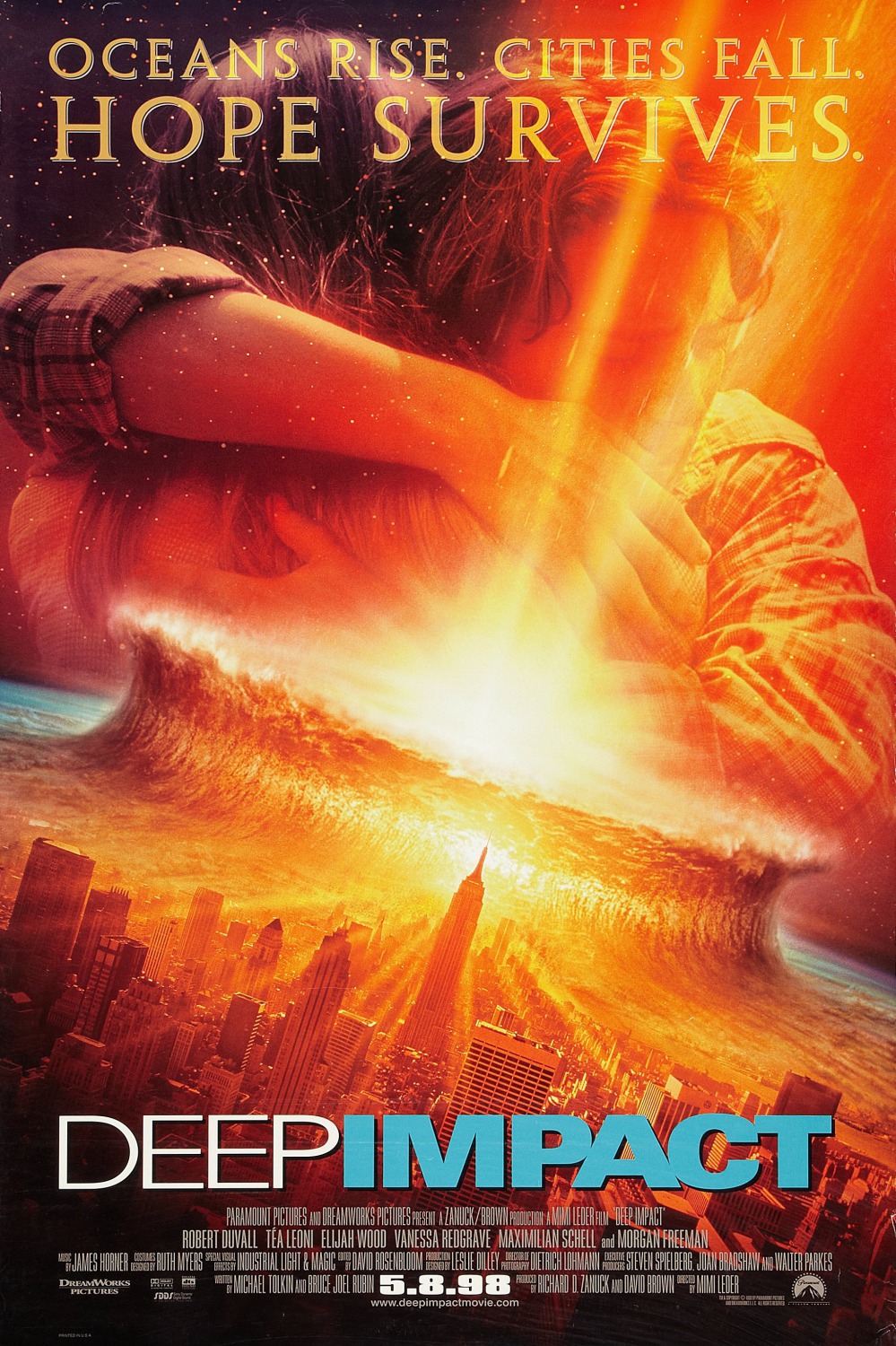
Deep Impact (1998)

It’s the end of the world in Deep Impact

Director: Mimi Leder

Cast: Robert Duvall (Captain Spurgeon “Fish” Tanner), Téa Leoni (Jenny Lerner), Morgan Freeman (President Tom Beck), Elijah Wood (Leo Biederman), Vanessa Redgrave (Robin Lerner), Maximilian Schell (Jason Lerner), James Cromwell (Alan Rittenhouse), Ron Eldard (Commander Oren Monash), Jon Favreau (Dr Gus Partenza), Laura Innes (Beth Stanley), Mary McCormack (Andy Baker), Bruce Weitz (Stuart Caley), Richard Schiff (Don Biederman), Betsy Brantley (Ellen Biederman), Leelee Sobieski (Sarah Hochtner), Blair Underwood (Mark Simon), Dougray Scott (Eric Vennekor)

Sometimes two Hollywood studies have the same ideas at the same time. When this happened in 1974 they clubbed together and turned two scripts about burning skyscrapers into one movie – The Towering Inferno. But it’s more likely they’ll do what happened with volcano movies in 1997, White House invasion movies in 2013 and asteroids movies in 1998: both make a film and rush to be the first one out. Usually that’s the winner (ask Dante’s Peak or Olympus Has Fallen). The exception was Deep Impact which made plenty of moolah – but was trumped by Michael Bay’s thundering Armageddon, with its far more straight-forward feel-good action.

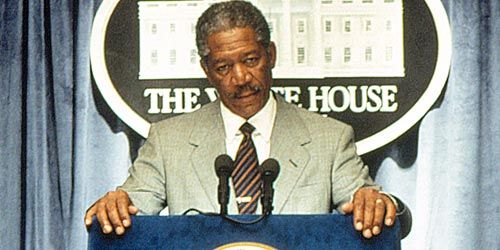
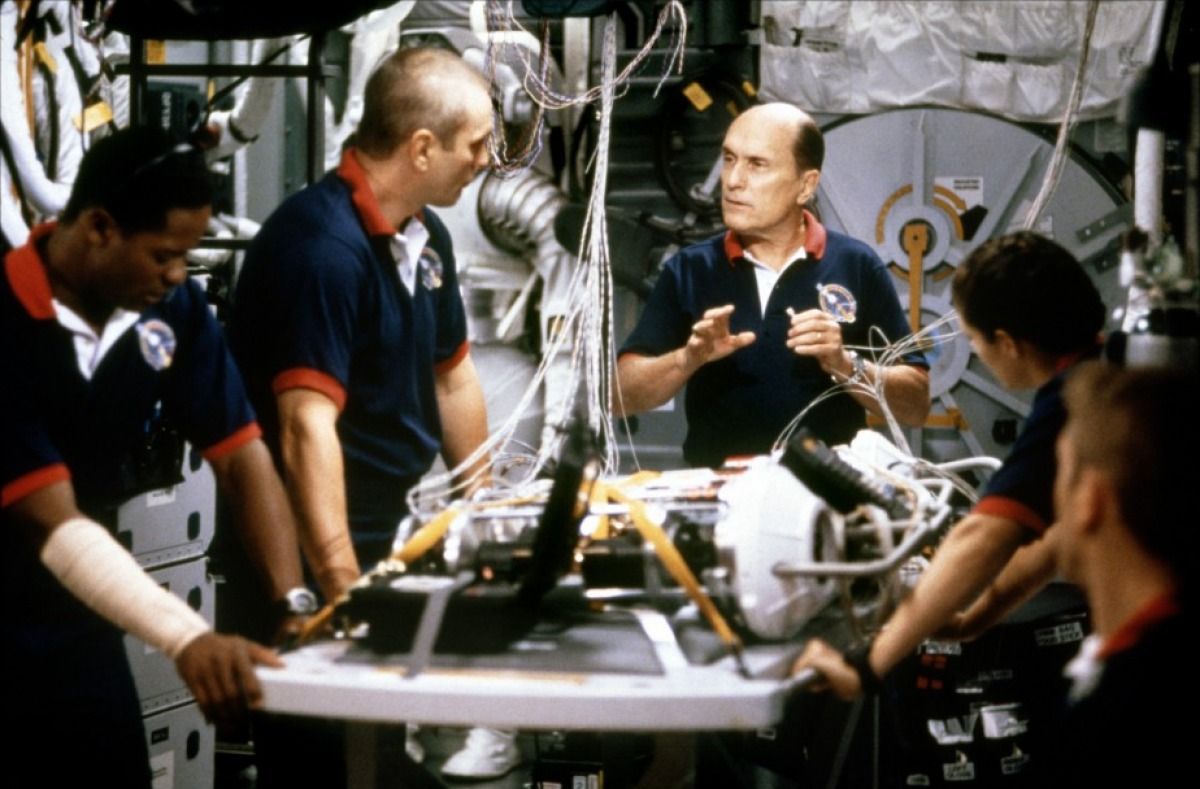
A meteor is heading towards the Earth – and it’s an Extinction Level Event (ELE) that will wipe out all life on Earth. World governments keep it hushed up, wanting to avoid mass panic, and start planning to preserve mankind. Underground “arks” will be built in major countries to protect a small number of population. And a manned space mission, crewed by a team of young bucks and veteran astronaut Spurgeon “Fish” Tanner (Robert Duvall), will head out to the asteroid to try and use a nuclear bomb to blow it up. However news leaks when intrepid young MSNBC reporter Jenny Lerner (Téa Leoni) stumbles on news of a cabinet resignation, over a mysterious “Ellie”, leading to her accidentally uncovering the meteor. President Tom Beck (Morgan Freeman) announces all to the world – and mankind prepares, in hope, for the disaster.

Deep Impact is a well-mounted and surprisingly thoughtful adventure story, that tries to deal with its Earth-ending themes with a seriousness and humanity that’s a world away from the flag-waving crash-bangs of Armageddon. Well directed by Mimi Leder, who juggles effectively huge special effects and low-key personal stories (even if these have the air of movie-of-the-week to them), it’s an ensemble piece with a surprisingly downer ending (no surprise from the poster) that still leaves more than a touch of hope that mankind will persevere.

It’s poe-faced seriousness about reflecting on the end of the world may be dwarfed now by superior TV shows – it’s hardly The Leftovers – but felt quite daring for a 90s blockbuster, at least trying to be some sort of meditation on the end of the world. While the film does do this by focusing on the most mundane of soapy dramas – will Jenny Lind (Téa Leoni in a truly thankless role) manage to reconcile with her estranged father (Maximilian Schell, a bizarre choice but who manages to rein in most of the ham) who walked out on her and her mother (Vanessa Redgrave, if possible an even more surreal choice) before the world ends – at least it’s sort of trying.

Soap also soaks through the storyline about young Leo Biedermann (Elijah Wood), the geeky wünderkid who discovers the asteroid. The drama around a national lottery to select the chosen (very) few who will join the 200,000 essential scientists, artists and politicians in the bunker is boiled down to whether Leo will be able to sneak his girlfriend (Leelee Sobieski) and her family on the list. Needless to say, this plotline boils down into a desperate chase, some heroic sacrifices and a great deal of tears. This sort of stuff doesn’t re-invent the wheel, but it makes for familiar cinema tropes among the general “end-of-the-world” seriousness.

There isn’t much in the way of humour in Deep Impact, perhaps because those making it were worried cracking a joke might undermine the drama. There’s nothing wrong with this, but you start to notice more the film’s “not just another blockbuster” mindset being warn very firmly on its sleeve. The film’s third major plotline, around the mission to blow up the asteroid, is as much about whether grizzled, wise vet Robert Duvall will win the respect of the dismissive young bucks he’s crewed with (spoilers he does) as it is whether they will destroy the meteor. Anyone who can’t see sacrifices coming here btw, hasn’t seen enough films – but these moments when they come carry a fair emotional wallop, partly because the film never puts its tongue in its cheek.

It’s a film proud of its scientific realism, which makes it slightly easy to snigger at the sillier moments – especially when it takes itself so seriously. An astronomer (played by The Untouchables luckless Charles Martin Smith) drives to his death racing to warn the authorities (why not just call them from his office eh?). The astronauts, for all their vaulted training, hit the meteor surface with all the blasé casualness of high-school jocks. Jenny’s journalistic investigation is so clumsy and inept, it’s hilarious watching the President and others assume she’s way more clued up than she is (this also comes from a time when Jenny could key in “E.L.E.” into the Internet and get one result – I just tried it and got 619 million. Simpler times).

I’ve been hard on this film, but honestly it’s still a very easy film to like. Sure it’s really silly and soapy but it takes itself seriously and it wants to tell a story about people and human relationship problems, rather than effects, which is praiseworthy in itself. The best moments go to the experienced old pros, with Duvall rather good as Tanner and Morgan Freeman wonderfully authoritative as the President (it was considered daring at the time to have a Black President). The special effects when the meteor arrives (spoiled on the poster and the trailer) are impressive and while it’s easy to tease, you’ll still welcome it every time it arrives on your TV screen.

A Star Is Born (1954)

James Mason and Judy Garland deal with ups and downs in Hollywood in A Star is Born

Director: George Cukor

Cast: Judy Garland (Esther Blodgett/Vicki Lester), James Mason (Norman Maine/Ernest Gubbins), Jack Carson (Matt Libby), Charles Bickford (Oliver Niles), Tommy Noonan (Danny McGuire)

A Star is Born’s story had effectively been told twice already in Hollywood – once under the same title in 1937 and once before that as What Price Hollywood?, directed by none other than George Cukor. But Judy Garland’s husband Sid Luft saw the project was perfect for her. Luft thought the volatile Garland needed a director who could draw the best from her – and who better than Cukor, who worked with actors perhaps better than any other director in Hollywood. Cukor had been worried about repeating himself – but the chance to direct his first musical, first technicolour epic and work with Garland was too tempting.

The story is of course familiar. Esther Blodgett (Judy Garland) is an aspiring singer who – with quick thinking and performance nerves of steel – saves drunken Hollywood star Norman Maine (James Mason) from humiliation by involving him in a musical number at a charity event. When he sobers up, Maine goes to visit Esther to thank her – and is blown away when he hears her singing. Convinced she will be a major star, Maine arranges for a screen test with studio head Oliver Niles (Charles Bickford) and later pitches heavily for her to be considered as a last-minute replacement on the studio’s big new musical when the star drops out. Esther – or Vicki Lester as the studio renames her – becomes a major star when the film is a smash hit. But as her career goes up and up, Maine’s alcoholism and unreliability start to catch up with him and his own career hits the skids.

Cukor’s A Star is Born is a big, charming, impressive film that mixes emotional desperation with moments of joyous celebration. The film was not the box-office bomb it’s often believed to be (although it did do disappointing business) but, worried about its length, the studio cut the film several times during its release. The film we have today is a slightly neutered version, with several scenes reassembled by film historian Ronald Haver using audio, the odd clip and still photographs (it adds an impressionistic section of the film which you can’t imagine Cukor would have cared for) – but Haver did locate several missing musical numbers which add to the film’s impact.

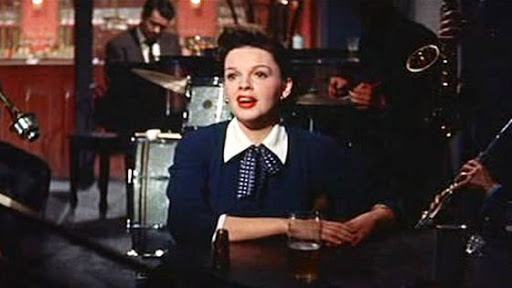
Garland sings all the numbers, and some of her best work ever is in this film. Her late night bar rendition of The Man That Got Away (the performance that wins Norman’s heart) is superb. I love the affectionate spontaneity of Someone at Last, Esther’s recreation to amuse Norman of the sequence she has spent the day filming in the studio. This scene is playful, sweet, funny and has a freshness not all the numbers have.

Some of the other numbers go on too long – and it’s hard to escape the feeling that they are in there solely because of Garland and not because they serve the plot. Because this isn’t really a musical as such, more of a romantic tragedy with the odd tune, with each number a performance. It works superbly because Cukor’s sympathetic direction draws some of her best work from Garland – and a truly superb performance from Mason. 

Cukor works particularly effectively with Garland who, in real life at this point, was far more similar to the destructive Maine (she delayed the film frequently with her absences and fluctuations in health). Garland is of course too old for the part – but it doesn’t really matter as she brings it such freshness, naturalness and emotional openness that you can persuade yourself that she’s a young ingénue at least ten years younger than she looks.

Garland was also surely helped by being paired opposite Mason. Not the first choice – that was Cary Grant – or indeed the second, Mason was hired as his professionalism and expertise could deal with Garland’s erraticism. Under Cukor’s direction he gives his finest work on screen here. His turns Maine into someone decent, charming, kind – but overwhelmingly self-destructive. His slightly slurred speech and ability to turn on a sixpence to anger makes for some of the best drunken acting you’ll ever see. But it works especially as we are desperate for Maine to kick the bottle. Because when he’s sober he’s the perfect husband and gentlemen. But Mason uses that to mine the deep tragedy of the character, his intense shame and self-loathing. The later sequences of drunken misbehaviour are heartbreaking (Maine’s drunken interjections at Esther’s Oscar-winning speech are almost unbearably painful to watch), and it’s all powered by Mason’s humanity in the role. It’s a truly great performance.

The film itself is perhaps a little slow and uneven around these performances. The musical numbers – whisper it – frequently slow the action down or grind the plot to a complete halt (none of them add anything to the story at all, and exist to showcase Garland). The film is so tightly focused on its two leads that it never develops any sub-plots to contrast with the main action. There is some light satire on Hollywood studios and their rapacious desire for more money – but not too heavy as the villain here is the odious press man (a weasly Jack Carson) while the studio head is a kindly, affectionate, fatherly figure who would never make a call based on business. The matter of fact way both stars have their names changed (the moment when Esther discovers Norman’s real name is a hilarious throwaway moment) is a neat gag. But the film takes a long time, frequently stopping for another Garland set-piece.

Perhaps the studio instincts were right that the film needed to be tighter – and some of the dialogue sequences reinserted by Haver hardly add much too the plot. Cukor’s direction is calm but assured though and the superb performances of the two leads make the film what it is. It looks fabulous with its technicolour depth, and it carries a genuine emotional force that pays off dramatically by the film’s conclusion. A Star is Born is uneven at times and overindulgent but it has more than enough going for it to reward the viewer.

The Life and Death of Colonel Blimp (1943)

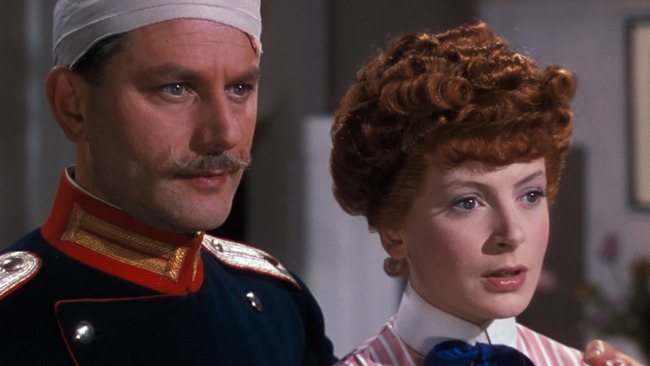
Roger Livesey and Anton Walbrook are friends who war cannot divide in The Life and Death of Colonel Blimp

Director: Michael Powell, Emeric Pressburger

Cast: Roger Livesey (Clive Candy), Deborah Kerr (Edith Hunter/Barbara Wynne/Angela “Johnny” Cannon), Anton Walbrook (Theo Kretschmar-Schuldorff), Ursula Jeans (Frau von Kalteneck), James McKechnie (Lt “Spud” Wilson), David Hutcheson (Hoppy), Frith Banbury (David “Baby Face” Fitzroy), Muriel Aked (Aunt Margaret), John Laurie (Murdoch), Roland Culver (Colonel Betteridge)

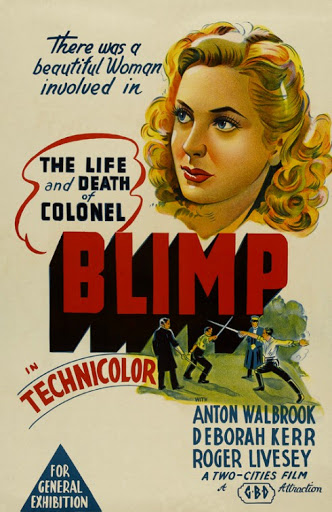
Is there a film that has better captured the curious state of being British than The Life and Death of Colonel Blimp? Could any other film makers than Powell and Pressburger take a doltish buffoon from newspaper comic strip, and turn him into a tragi-comic figure worth of Hamlet? Could any other film make a wartime propaganda film that features the most sympathetic depiction of the Germans anyone would see for decades to come? Winston Churchill was so scathing of the film that its US release was delayed for two years – and even then it was cut to ribbons. But then, I guess we knew already the guy wasn’t right about everything.

During the Blitz, Clive Candy (Roger Livesey) is a retired Major-General and now a senior commander in the Home Guard. Ambushed in a Turkish bath on the eve of a training exercise (by young officers keen to follow the German example of effective pre-emptive strikes), Candy rages at their dismissal of him as a relic from yesteryear. In flashback, we see Candy’s entire life over the course of the rest of the film. The film charts his military cross, from the Boer War to World War One and his life-long friendship with German officer Theo Kretschar-Schuldorff (Anton Walbrook), after both men are hospitalised after a 1902 duel over insults to the German military. Both men fall in love with the same woman, Edith Hunter (Deborah Kerr) although Clive realises it far too late – and their friendship ebbs and flows over the next forty years.

Powell and Pressburger’s film is, of course, quite beautifully made. The film has that distinctively radiant technicolour look of their most successful works, but it works so well because Powell assembles the whole so wonderfully. Powell knows when to hold a shot and when to look away and his judgement is never wrong. In the duel where Clive and Theo meet (Theo has been randomly selected to fight), the camera at first covers the detail of the prep, then moves to an over-the-head shot as it begins, before pulling out of the gymnasium and away, gliding into a long shot with Berlin sprinkled with snow. Because after all, the actual fight is immaterial to the sense of this being one event in the tapestry of life – and the moment of real importance being the friendship that came from it.

Then, much later, Powell does the exact opposite, holding a shot with powerful, emotional, simplicity. It’s 1939 and Theo is trying to remain in England – his wife having passed away, his sons being lost to Nazism and this adopted country being far closer to his old Prussian ideals of duty and fairplay. In a heartbreakingly low-key, simple speech – just exquisitely delivered by Anton Walbrook – Powell lets the entire speech play out in a single take, giving the moment room to breathe and magnifying its impact enormously – not least by the background extra who switches from shuffling his papers to listening intently to this heartfelt appeal.

It’s this mastery of technique that makes the impact of the film so wonderful – and helps it to masterfully capture the changing of an entire nation. Other the film’s forty years the entire world changes utterly, from one of simple truths where right is right and evils are punished, to the morally complex world of World War Two, where bending the rules and playing dirty might be just what is needed to defeat enemies with no principles. 

Candy is a man of unshakeable morals and ideals, who does not believe ends justify means and is determined that fighting honourably for defeat is far better than victory at all costs. It’s an idea the film affectionately praises, at the same time it sadly shakes its head and admits that such ideals were for the last century not this one. These are ideas Theo has captured far sooner than Candy – and Candy’s tragedy, among his many virtues, is that he always fails until it is almost too late to understand the truth of the world around him (be that politically or romantically).

It doesn’t matter really though, because we always know Candy’s heart is in the right place. In a sublime performance by Roger Livesey, this is a man with an upper-class bombast and a paternalistic regard for his duty and for others. His country and the ideals of that country come first and foremost – but it’s not about pushing those home. He will console honourable foes – as he does with Theo after World War One – and when the battle is over will be the first to say by-gones are by-gones. The film he is in a way a somewhat ridiculously old-fashioned character – but he’s always well-meaning, decent and honourable.

Candy also has the tragedy tinged sadness of not knowing what he wants until it’s too late. He doesn’t realise his affections for Edith Hunter, until she and Theo are telling him of their engagement (although we the audience are already well aware that Edith had feelings for him), and the look of realisation of a deep and lasting love that will last his whole life, is fabulously conveyed by Livesey in a perfect reaction shot. Candy will eventually marry Edith’s near doppelganger, but this unspoken love will last his whole life – and form another bond between him and Theo. Which in itself is what we like to think is a quality the British have at their best.

Along with that British fair-play that is so important to him, it also settles in the friendship between Theo and Clive. A friendship unaffected by tragedy or war (or at least not for long) and which, despite years apart, Clive frequently returns to with all the warmth and openness they first shared. These are bonds of loyalty forged on the playing fields, that operate on unspoken feelings (for a portion of their friendship Theo can’t even speak English). 

These are also the ideas and principles that Clive keeps alive in himself, even while the world becomes ever more bleak around him. He’s a character that never loses his essential positivity and kindness. Deaths or disappointed love are met with regret and then losing yourself in sport (whole years are hilariously shown to pass by montages showing Clive’s hunting trophies appear on walls). But always that British idea of (as Churchill put it) “keep buggering on”, and not letting infinite sadnesses and disappointments undermine or define you.

Powell and Pressburger use all this to make Candy not a joke – as the Lieutenant in the film’s prologue sees him – but as a deeply sympathetic and real man. It’s a film also about our disregard for the old, our failure to ever imagine that they were young. The flashback structure fills in this story beautifully. All this, and it’s not even to mention Deborah Kerr’s superb performance as all three of the women in this story, each subtle commentaries on the other and her return throughout somehow representing the perfect ideals that Clive and Theo are living to. The Life and Death of Colonel Blimp is about understanding how the “rules” of British behaviour are underpinned by a deeper sadness it’s almost a duty to hide – and it understands that better than almost any other film.

The Dead (1987)

Donal McCann and Anjelica Huston in a marriage with a past in The Dead

Director: John Huston

Cast: Anjelica Huston (Gretta Conroy), Donal McCann (Gabriel Conroy), Cathleen Delany (Julia Morkan), Helena Carroll (Kate Morkan), Rachael Dowling (Lily), Ingrid Craigie (Mary Jane), Dan O’Herlihy (Dan Browne), Marie Kean (Mrs. Malins), Donal Donnelly (“Freddy” Malins), Sean McClory (Mr. Grace), Frank Patterson (Bartell D’Arcy), Colm Meaney (Raymond Bergin)

John Huston’s final film was a long-standing passion project, anfaithful adaptation of James Joyce’ short story from The Dubliners. Huston had only a few months to live when shooting the film – he was hooked up to an oxygen supply for the course of its film-making and confined to a wheelchair. His children Anjelica and Tony (who wrote the screenplay) helped to nurse him through this final project. The final film makes for a beautiful wistful, heartfelt and tragically toned story that’s small in scale but carries great emotional force.  It’s a beautiful adaptation.

The film is set at a Christmas house party for family and friends, a regular thrown by two spinster sisters, Julia (Catheen Delany) and Kate (Helena Carroll) Morkan. The soiree – with recitals, dancing and wonderful meal – is an annual treat, with a regular guest list of family and old friends. The Morkan’s nephew Gabriel (Donal McCann) frequently serves as unofficial master of ceremonies – this year nervously checking and rechecking his after-dinner speech. However, at this year’s dinner Gabriel’s wife Gretta (Anjelica Huston) is caught-off-guard by a moving song, that brings back to her a flood of memories from her younger days of a late first love – a revelation of a past life that in their bedroom after the party, stuns Gabriel and causes him to reassess everything he thought he knew about his wife’s past and how his own life has been bereft of the sort of passion she has displayed over a memory.

The summary above essentially captures the entire story of this James Joyce tale that is short on events but deeply long on emotional meaning. Critics have sometimes said it can only be a shadow of the original – but it’s an adaptation not a replacement. Huston’s film is a gentle, unhurried, carefully presented chronicle of everyday lives and the emotional depth that’s can lie buried beneath them. The Dead is short on flash, but it has such warmth, love and respect for its characters, and vibrancy in its playing that it hardly matters that for almost an hour nothing (as such) actually happens. Instead, Huston and his actors so completely understand and communicate the warm bonds between its characters – from decades of knowing each other – and the entire party has such an air of truth to it you can genuinely just enjoy watching the characters enjoy it.

It’s full of perfectly observed moments that ring true – and all straight from Joyce. The younger men who attend the party, and duck out of a gorgeous piano recital for a quick drink, to return and lead vigorous applause at its end. The awkwardness of small talk between two people that don’t really know each other, but are too polite to turn away. The affectionate indulgence of the drunken son of an old friend (“sure, he’s not as bad as he was last year”) who is quietly not passed the port and leads a praise for Julia’s slightly-off-note singing that is so lavish it manages to be as touchingly well-meant as it is grin-inducingly embarrassing. Huston had a long-held regard for the warmth and generosity of Irish hospitality and feeling and this seeps into every pore of the film.

But the film is stuffed full of moments of simple, real-world pleasure crafted by a director who understood that the impact of the stories late emotional revelations depended on the everyday low-key presentation of the film’s first hour. And there is no end of delight be had from the Morkan sister’s tearful pleasure and pride at Gabriel’s sincere speech of gratitude at the dinner’s end (even if it is overladen with classical parables). Or in the quietly supportive way Gabriel goes about organising events for them in the house, from shepherding the tipsy Freddy to a bathroom to sober up to ending events by gently wakening Protestant Dan Browne at the party’s end from his drunken doze in the cloakroom. Around all these events is the conversation of people who have known each other for years and are comfortable to sink back into the patter of familiar themes.

All of which is then perfectly counter-pointed by Gretta’s quiet revelation of a past of passion and deeply held first love that she has never spoken of before – and causes Gabriel to certainly look anew at everything in his life. It’s a sad and delicate Proustian revelation of how the slightest nudges to our memory (in this case the soulful rendition of an old Irish song) can unlock sudden wells of feeling, making events from years ago suddenly seem as painfully recent as yesterday. 

For suddenly Gabriel moves from initial jealousy into a deep and abiding sadness at how nothing in his own life could ever have motivated such depth of feeling from himself – that frankly he has nothing in his experience to match the grief and unforced emotion his wife has displayed. It’s a very Joycian revelation in which the present and the future is readdressed in light of the past. Suddenly Gabriel must reflect that his life has been one of competent and forgetful mediocrity and that he himself will die – and that fate awaits us all, with the snow falling on us all living or dead, and that Gabriel will forever lack the emotional depth and poetry to express it.

The film’s elegiac qualities match perfectly with the end of Huston’s career – and maybe the sad regret of Gabriel is Huston judging whether he made an impact either. The film however is beautiful, recreating Ireland perfectly in California with a superb cast of Irish theatre stalwarts specially imported. Donal McCann is wonderful as Gabriel, Anjelica Huston quietly moving as his wife while the rest of the cast are faultless: from Cathleen Delany and Helena Carroll’s carefully judged spinsterish generosity to Donal Donnelly’s garrulously friendly drunkenness (perhaps motivated by the impossibility of living up to his mother’s – an imperious Marie Kean – high standards). The Dead may not capture all the depth and beauty of Joyce’s writing (what can?) but it captures more than enough to be a beautifully judged film.

Born Yesterday (1950)

Judy Holliday gets a tutorial in class from William Holden – much to the chagrin of Broderick Crawford – in Born Yesterday

Director: George Cukor

Cast: Judy Holliday (Billie Dawn), Broderick Crawford (Harry Brock), William Holden (Paul Verrall), Howard St John (Jim Devery) Frank Otto (Eddie), Larry Oliver (Congressman Hedges)

Perhaps George Bernard Shaw should have tried to copyright the Pygmalion concept. After all no end of films and plays have tried their best to replicate the magic of having one working class classless type (usually the woman) learning how to use their own natural intelligence effectively by a wiser tutor (usually the man). Born Yesterday is a near text-book example of this – she’s as ill-informed as a young baby so might as well have been “born yesterday” y’see – that offers very little in the way of surprises, but a lot in the way of charm – most particularly from Judy Holliday who carries the entire the film with aplomb.

Harry Brock (Broderick Crawford) is a corrupt, uneducated businessman who has arrived in Washington to buy up a few congressmen. Brock may be a boreish bully, but he’s worried that his mistress, former Chorus-girl Billie Dawn (Judy Holliday), is so brash and ill-educated that she will show him up in front of his new political contacts. So he hires investigative journalist Paul Verrall (William Holden) to educate her. But Paul and Billie have an immediate romantic frisson – and as she learns about politics, literature and the state of the world Billie starts to realise that maybe all those shares she holds in her own name (for tax purposes) in Brock’s dodgy dealings might give her the chance to put his wrongs right.

Born Yesterday was an adaptation of Broadway hit that had made Judy Holliday a star. Written by Garson Kanin, bullying Harry Brock was allegedly based on Colombia Pictures head Harry Cohn. He clearly didn’t care when he smelt a hit – and even confirmed some suspicions by ordering Kanin to do re-writes of the rewritten script for no extra payment. Cohn had been deeply uncertain about bringing the unknown Holliday along for the ride (she had made only three small appearances beforehand) so Cukor cast her in a key role in Adam’s Rib (where Hepburn generously ceded many scenes to her) to prove Holliday could make it on the big screen.

Thank goodness she did make it to the film, as Holliday makes the film. Winning the Oscar – famously beating Bette Davis and Anne Baxter in All About Eve and Gloria Swanson in Sunset Boulevard – Holliday is superb in the role. Billie Dawn may be brassy, may be load, she might have the sort of screeching Brooklyn accent that sometimes feels like nails on a blackboard – but she’s not dumb. She’s smart – as she shows by repeatedly beating Harry with ease at games of gin rummy – she’s capable and she cares. She just hasn’t learned any better, and having spent her life being told that her opinions don’t matter, she’s decided to not mention them.

But Holliday shows Billie is a woman fast – and eager to learn – and a week or so with Paul won’t turn her into a genius, but she’s more than sharp enough to work out what’s wrong about her life and her sugar daddy, and to give her the oomph to do something about it. Holliday demonstrates this endearing growth of engagement and curiosity with a superb lightness – her comic timing is faultless – and a touching sweetness. 

The script gives Billie a hilarious tendency towards malapropism and her wide-eyed innocence and desire to do her best works wonderfully in getting us onside. While she is often the source of jokes she is never the butt of them, and Holliday makes clear her decency and sharpness is innate. She’s far from a dumb blonde – although she certainly looks and sounds like it – and watching her apply good-old fashioned Hollywood liberal ideas to confound boreish businessmen is good fun.

Her co-stars give sterling performances. Broderick Crawford channels his Oscar winning turn from the year earlier as corrupt bullying Willie Stark in All the King’s Men as the loud, bullying and dim Harry Brock. Throw-away lines suggest he has killed in the past – and at one point he strikes Billie – but he’s always a comic blusterer rather than a real threat. William Holden generously cedes much of the ground to Holliday as her Henry Higgins, although unlike that guy he’s humble, supportive and pleasingly democratic (quite the year for Holden, having also played a similar supplicant role in Sunset Boulvard).

Cukor directs with his usual lack of flash, quietly setting the camera in place and letting the actor’s go about their business meaning, for all the location shooting in Washington, this still feels very much like a Broadway piece. Cukor does skilfully manage to smuggle a lot under the censor wire – not least that Billie is clearly Harry’s mistress – and keeps a fine romantic tension between Billie and Paul, even if having the pair of them kiss early on does undermine some of the “will-they-won’t-they” magic.

But then basically this is a very straight forward film that just looks to entertain. There are some dirty dealings in Washington – but it’s all sorted out very easily and we are reassuringly told that there are only a very few bad apples in this barrel, and we can trust in the decency of our leaders. It’s no surprise who ends up with who, and no real revelations in character. The most surprising character in many ways is Harry’s disillusioned, self-loathing lawyer played by Howard St John, constantly on the verge of alcoholic self-disgust.

The film is really a showcase for its star though – and Holliday delivers with a terrifically entertaining performance that hammers home even more the sad fact that she passed away at 43 with only a handful of films to her name. Pygmalion Goes to Washington it maybe, but this is still a lovely epitaph to a talented actress.

The End of the Affair (1999)

Julianne Moore and Ralph Fiennes in a doomed romance in The End of the Affair

Director: Neil Jordan

Cast: Ralph Fiennes (Maurice Bendrix), Julianne Moore (Sarah Miles), Stephen Rea (Henry Miles), Ian Hart (Mr Parkis), Jason Isaacs (Father Richard Smythe), James Bolam (Mr Savage), Sam Bould (Lance Parks), Deborah Findlay (Miss Smythe)

The End of the Affair is one of Graham Greene’s most autobiographical novels, based strongly on his relationship with Catherine Walston, wife of a friend in the civil service. Unlike the affair in the book, Greene’s continued for decades, long after the publication of the novel in 1951 (which had led to the husband demanding an end to it – a demand ignored). Greene’s novel recounts the dangerous passions of an affair, mixed with the powerful anxieties and uncertainties that the Catholic faith can have on relationships. Jordan’s film captures much of this – but in places fails to fully understand the spirit of Greene’s compelling novel.

Maurice Bendrix (Ralph Fiennes) is a moderately successful popular author, excused war service due to having injured his leg in the Spanish Civil War. In 1946, a chance meeting with Henry Miles (Stephen Rea), a staid civil servant brings back vivid memories of Maurice’s wartime affair with Henry’s wife Sarah (Julianne Moore). The affair ended abruptly for reasons Maurice cannot understand, and his love is twisting into jealous resentment. With Henry now concerned Sarah is having an affair – and seemingly unaware of Maurice and Sarah’s wartime relationship – Maurice takes it upon himself to hire Parkis (Ian Hart) a private investigator to find out more. The results though give him profound and affecting insights into both the present and the reasons for the end of his own affair with Sarah.

Jordan’s adaptation gets so much right, it’s almost more of a shame that it gets things wrong as well. The atmosphere of the film is simply perfect. It looks and feels exactly like a classic slice of Greeneland, with its dreary London, rain-soaked settings and gloomy period setting. Roger Pratt’s Oscar nominated photography is perfect for the tragic beauty of Greene’s work, and its matched with a sublime musical score from Michael Nyman that wrings every inch of emotion from the story.

Ralph Fiennes is also the perfect idea of a Greene hero – slightly imperious, bitter, arrogant with an air of prep school smugness mixed with an underlying sense of grim inferiority. It’s hard to imagine any other actor – maybe except Colin Firth – better suited to the slight air of dissolute, not obviously sympathetic world-weary struggle that a Greenian hero needs to exhibit. Fiennes barely puts a foot wrong and could have practically walked off the page.

Equally good is Julianne Moore, who nails a very English type of person, a woman determined to do her best and to set standards, but who carries just below the surface a deep well of emotional pain and sorrow that briefly is allowed to peek through. It’s a heart-rending performance of a person desperate for happiness, but hiding that longing under a veneer of acceptability, who sacrifices what she wants from life to meet the obligations of her faith. 

Because, it being Graham Greene, Faith is the big issue here – the idea of the private deals we make with God and the cost that those impose on us, the sacrifices of our own happiness in surface of something higher than ourselves. Greene’s novel intrinsically understand the eternal struggle felt in Catholicism to do the right thing, to accept the love of God into your life even if it means turning your back on more earthly loves and passions. How these journeys can be hard – unbearable even – but carry a level of reward in themselves. 

It’s that feeling for God – who Bendrix grows to believe has cheated him from happiness on earth – that powers his “diary of hate” that he is writing as the book opens. It’s an idea the film only fitfully engages with. Jordan deviates from the novel’s real intention at a key point, in particular “correcting” a dramatic error he feels Greene makes by having Sarah die “off camera” in the book, of a sudden cold, after confessing to Bendrix her reasons for ending the affair, her pact with God.

This narrative change allows a sequence in Brighton as the two reignite their affair – but it also undermines the tragedy of the book, that suddenness of loss, and also makes Sarah’s death feel like a tit-for-tat punishment for going back on her word. More to the point, the affair restarting has the air of an atheistic view of the Catholic complications here, an idea that these can be easily brushed aside because the “heart wants”. It’s to miss the point of Greene’s world thinking and undermine the small everyday tragedy in favour of something more conventional and “epic”.

It’s a major tweak that undermines the strength (otherwise) of Jordan’s work here – his directing and scripting is otherwise largely faultless. Other changes to the source clarify the message – I think changing Smythe (a gently but arrogantly certain Jason Isaacs) into a priest rather than an atheist Sarah is using to test her faith makes sense, even if it does suggest that she acts under the influence of someone else rather than on her own opinions. Making Bendrix a Spanish war veteran rather someone suffering the effects of a childhood illness adds a political and moral romanticism to the character entirely absent from any of the rest of his personality. But it’s fine.

Jordan’s film has many strengths. Its tone is excellent and it’s passion inspiring (the tender explicitness of the sex scenes landed it with a bizarre and controversial 18 certificate) and there are superb performances, not just the leads but Stephen Rea excellent as the meek but noble husband and some lovely comic work from Ian Hart as a haplessly efficient private eye. But the film slightly misses, in the end, the point of the novel – which is a real shame. If Jordan had stuck to the book, and its complex themes of guilt and grief and Catholicism we could have really had something here.

Dangerous Liaisons (1988)

Glenn Close and John Malkovich play games of lust and sex in Dangerous Liaisons

Director: Stephen Frears

Cast: Glenn Close (Marquise Isabelle du Merteuil), John Malkovich (Vicomte Sébastian de Valmont), Michelle Pfeiffer (Madame Marie du Tourvel), Uma Thurman (Cécile de Volanges), Swoosie Kurtz (Madame de Volanges), Keanu Reeves (Raphael Danceny), Mildred Natwick (Madame du Rosemonde), Peter Capaldi (Azolan), Valerie Gogan (Julie)

Christopher Hampton’s adaptation of Pierre Choderlos de Laclos Les liaisons Dangereuses had been a stunning success in the West End and on Broadway – so a film adaptation of this lusciously set story of sex was inevitable. Stephen Frears’ film keeps the story grounded in its setting of pre-Revolutionary France, but deliberately encourages a modern looseness, even archness, from its actors that makes it feel grounded and modern.

The Marquise du Merteuil (Glenn Close) and Vicomte de Valmont (John Malkovich) are two French aristocrats who fill their time with seductions and sexual manipulation of other people, while conducting a dance of attraction around each other. Du Mertuil wants revenge against her ex-lover by getting Valmont to seduce the lover’s innocent intended bride Cécile de Volanges (Uma Thurman). But Valmont is more interested in setting himself the challenge of seducing the unimpeachable Madame du Tourvel (Michelle Pfeiffer) – du Merteuil so convinced the task will be impossible that she bets him if he seduces du Tourvel, she will sleep with him as well. These games of sexual manipulation develop with disastrous consequences for all involved, as unexpectedly real emotions of love and affection intrude on the heartlessness and contempt.

Frears’ film won three Oscars for its most striking elements: production design, costumes and Hampton’s script. Hampton’s script provides a series of striking scenes and tongue-lashing dialogue for its stars. Meanwhile the film looks marvellous, it’s use of French locations superb in creating the world of decadence that these characters move in, while the costumes are so strikingly, elaborately intricate they practically become characters themselves. The film opens and closes with scenes of dressing and de-dressing: the opening sequence shows Merteuil and Valmont being dressed in their elaborate finery, a sequence uncannily reminiscent of knights being dressed for war, ending with shots of their defiantly cold faces starring down the lens. The film bookends this with the film’s key survivor, brokenly wiping away from their made-up “public face” probably forever. It’s a film that uses the intricacy of the period, to strongly suggest modern, dynamic tones and emotions. 

The film is shot with a series of tight shots, intermixed with the odd long shot, that is designed to bring us in close with the film’s serial seductions and envy-powered clashes. This brings us straight into the middle of the events, giving them an immediacy and suddenness that makes this feel like anything but a traditional costume drama. Seductions have a steamy immediacy, while the growing moments of tension in the relationship between Mertuil and Valmont is similarly bought in close to us, to allow us to see the mix of emotions these two have for each other – both a deeply, unexpressed, love and a strange sense of loathing linked together with a possessive jealousy.

Frears makes marvellous use of mirrors in the film. These reflective surfaces appear in multiple shots and frequently expand the world, mirrors reflecting characters as others discuss them, or forcing into shot (usually between two other characters) the subject of conversations. They reveal (to the viewers) eavesdroppers hiding and, in one striking shot, as Valmont and Mertuil’s latest lover argue she is framed in reflection hanging above them on the wall mirror. There’s a reason why one of the film’s final sequences revolves around the smashing of a mirror in grief. 

The film’s modernism also stems from its use of very modern American actors – apeing the success of Milos Forman’s Amadeus – with everyone using their own accents. Glenn Close is superb as Mertueil, a woman projecting a cold, manipulative authority but does so to suppress and hide her own emotional vulnerability. Mertueil has convinced herself that she is a champion of her sex, but her every action seems to be motivated by finding indiscriminate revenge on all those who have found the sort of happiness she has been denied (or denied herself). Close lets little moments – wonderfully captured by the intimacy of Frears’ camerawork – where moments of micro-emotions and pain flash briefly across her face, only to be wiped away.

Malkovich is an unusual choice as Valmont – and his serpentine swagger and arch mannered style at first feels quite a disconnect with a character renowned as the most successful lover in France. But Malkovich’s eccentricity, his very oddity, in a way makes him believable as a man women would find intriguingly irresistible. Malkovich, while naturally perfect for the coldness of the character, is also highly skilled at expressing the slow, non-continuous growth of conscience and feeling in Valmont, as his feelings for Tourvel dance an uncertain line between manipulation and genuine feeling – and while his confused feelings for Mertuil alternate from possessive devotion to revulsion.

The whole cast respond well to Frears guidance, and his ability to draw relaxed performances from an odd selection of actors. Michelle Pfeiffer is particularly fine in a role that on paper could be very dull – the perfect, kind woman – but which she invest with such a seam of emotional truth and longing for deeper connections, combined with naked emotional honesty that she becomes the most compelling character in the film. Uma Thuman is very good as a naïve young girl, Kurtz and Natwick suitably arch as society bigwigs, Peter Capaldi creepily willing as a manipulative servant and even Keanu Reeves has a certain sweetness about him, even if he is at the height of his “Woah” dudeness.

The film’s principle problem is perhaps the very archness and coldness that makes it affecting. While it’s intriguing and intelligent, it is never perhaps as engaging as it should be and its characters are so jet-black, deceitful and cruel that it becomes hard at points to really invest in this chilling story of unpleasant people using other unpleasant people and manipulating innocent ones. It becomes a film easier to admire, perhaps carrying too much of the freezing chill of imperial French greed and selfishness. Come the denoument for all the skill it is played with the actors, it is hard to feel your emotions invested or your heart moved by any of the fates of the characters. Perhaps, in presenting a heartless world of selfishness and lies, it does its job too well.

Once Upon a Time in America (1984)

Robert De Niro and James Woods are gangsters in Sergio Leone’s sprawling indulgent masterpiece Once Upon a Time in America

Director: Sergio Leone

Cast: Robert De Niro (Noodles), James Woods (Max), Elizabeth McGovern (Deborah), Joe Pesci (Frankie), Burt Young (Joe), Tuesday Weld (Carol), Treat Williams (Jimmy O’Donnell), Danny Aiello (Police Chief Aiello), Richard Bright (Chicken Joe), James Hayden (Patsy), William Forsythe (Cockeye), Darlanne Fluegel (Eve), Scott Tiler (Young Noodles), Rusty Jacobs (Young Max), Jennifer Connelly (Young Deborah)

It had been thirteen years since Leone had made a film. During this time he turned down The Godfather in favour of his own dream of filming Harry Grey’s novel The Hoods. The final film, Once Upon a Time in America, seems destined to live in the shadow of The Godfather, from its settings and many of its themes through to its graphic design and cast. It’s a challenging, over-indulgent, sometimes difficult film that, never-the-less has its own sense of hypnotic power to it.

Told in a partly non-linear style, it opens with Noodles (Robert De Niro) a Jewish gangster on the run from thugs in 1930s New York days after the fall of prohibition. With his friends and his girl dead and his money stolen, Noodles flees the city – returning only in 1968 after a mysterious summons suggests his past is not as buried as he thought. Within this, the film weaves an intricate series of flashbacks that fill in the story of Noodles and his friend Max (James Woods) turning their teenage gang of hoodlums into an effective crew, muscling in on the money that can be made from prohibition. Carrying the story from 1918 all the way back to 1968, we discover why Noodles was on the run, what the money was, where it’s gone and who or what summoned him back to life.

Leone originally envisioned the film as a two-part epic: two films of three hours length. His original cut was almost ten hours long, cut down to six and then finally to just over four. This cut was released to critical acclaim at Cannes – but was still too long for the producers, concerned about making their money in America. To the fury of the cast (James Woods continues to be vocal about the butchering of the film), and the heartbreak of Leone, the film was cut again to just over 2 hours before its release in the States – a move that rendered it nearly incomprehensible and led to reviews that labelled it one of the worst of the year. Only with the much late release of the European cut (and work continues to restore something closer to Leone’s six hour cut) did the film find acclaim.

But you can see why the producers worried. Leone was never a director who felt the need to get where he was going quickly. As his films became ever more dominated by his love for artful compositions, meditative longeurs and drawing the tension out for as long as possible, so their running times ballooned. Leone matched this with a yearning to tell a story that was to be nothing less than about defining “America” – or at least, give a symbolic weight and depth to the Americana he loved. The film is overflowing with the feel of Old Hollywood gangster films and classic imagery of the immigrant experience in Manhattan. It’s like a brilliant coffee-table album bought to life and covered with blood.

So Once Upon a Time in America is a slow, lethargic even, film that takes its time to build up a picture of an immigrant community drawn together through bonds of culture and shared past that are nearly impossible to express – but fractured by the greed and capitalism of the American Dream, temptation to make an even bigger killing leading to old loyalties being sacrificed. Leone juggles some big ideas here, and if the film never quite comes to grips with any of them as it charts the fractured relationship of Max and Noodles, from brothers-in-arms to ambition, pride and private frustrations leading to betrayal it’s never less than strangely engrossing. 

In many ways this is a hugely indulgent film, but it is also remarkable (strangely) for how restrained and elegiac it is. The razzamatazz of some of Leone’s Westerns are mixed in with a golden age romantic view of the past – and its lost opportunities and loyalties – in a film particularly fascinated with the coming-of-age of young men. The film is nothing less than an old man taking a ruminative journey through the past (both Leone and Noodles in his memories), looking back at a life time of bad choices and lost chances. It all makes for one of cinema’s greatest mood pieces ever, with faultless period reconstruction, but also a piece that for all its focus on personal lives at cornerstones of histories, makes its characters seem strangely impersonal.

Part of that lies in Leone’s clear love for the film’s long second act (nearly a third of its runtime), which charts the young Jewish hoodlums teenage lives in 1918 New York – their meeting, first scores, rivalries with other gangs and inevitably the loss of virginity. For all its overextended backstory, the section of the film hums with love and elegiac romance. It’s the richest part of the film. There is a beauty in beats of the watching the boys encounter everything from first crime to first love – and easy as it is to mock a good 3-4 minutes watching one of them eat a cake intended as an offer in exchange for a first sexual experience with the local floozy, moments like that have an innocence and a beauty to them that Leone really captures.

It’s a shame that it’s the back-end of the film that suffers – and its plot and narrative drive. It feels like Leone fought to keep the beauty of this early section and sacrificed drive and narrative later. The fracturing of the relationship between Max and Noodles is less clear, and their adult characters never quite come into focus. Perhaps there isn’t quite room for actors in the long sequences of wordless silence and atmosphere, punctuated by bursts of shocking violence, in Leone’s world. Certainly the cut doesn’t help, with most of the supporting cast (Joe Pesci, Treat Williams, Burt Young, Danny Aiello) reduced to little more than one scene each, their storylines – particularly a crucial Teamsters plot – barely making any sense.

Max’s growing distance from Noodles is perhaps rooted in everything from his ambition being frustrated by Noodles small-time viewpoints, perhaps even in suggestions of a frustrated homosexual love for the defiantly straight Noodles. James Woods does very well to piece to together a suggestion of deep psychological unease and confusion in a character who remains unknowable, a man to whom loyalty is everything until it isn’t.

As Noodles Robert De Niro anchors the film with one of his quietest, most reflective performances. Noodles is a deeply flawed, low-key, humble character who carries in him a capacity for self-destructive and vicious violence. Leone’s film suggests Noodles is perhaps troubled by feelings and longings he can’t begin to understand or appreciate. He is a romantic character, deeply infatuated with both Max and his childhood sweetheart Deborah, but unable to express or communicate his feelings until it is far too late, a man traumatised by emotional connection.

Not that this excuses Noodles for his actions, particularly towards women. If there is one troubling aspect of the film it is its attitude towards women. There are two prominent women in the film, both of whom are raped. One of them, Carol, is a shrewish temptress, who deliberately provokes Noodles to rape her and is then shown enjoying it. The second rape, this time of Deborah, comes from Noodles after a romantic date where he has finally done everything right. While Leone shoots the scene with an almost unwatchable grimness – Elizabeth McGovern’s screams and distress make for very hard viewing – the film still asks us to feel not only for her pain, but also (perhaps more so) Noodles regret. Further when they encounter each other late in life, Deborah matches him in sadness at chances lost – an unlikely reaction you feel for someone who has suffered as traumatic experience as she has. 

But then to Leone perhaps this is part of the corruption of America – or rather the vileness of gangsters. The gangsters are a grotesque bunch in this film, killing without compunction, torturing, stealing, using violence as second nature. Loyalty is barely skin deep and arrogance abounds. There is no romantic sense of family behind it all – perhaps the thing Leone rejected most from The Godfather – just a series of people on the make and on the take. 

But for all its faults and over extended length the film is increasingly hypnotic and engrossing, Leone’s understanding of mood being near faultless. While the ideas are perhaps not quite pulled into sharp focus in the film – and leave the audience having to do a lot of supposition – it still works over time. And the film has so many astonishing merits – from its awe-inspiring shooting and production to the sublime score from Ennio Morricone that gives the film even more poetic depth – it more than merits its existence.

And of course there is the cheeky sense Leone throws in that some – or indeed all – of what we are seeing may not even have happened. The film opens and closes with Noodles in an opium den, stoned out of his mind, in the 1930s. In the opening he lies there, haunted by the sound of a ringing phone (the memory of the phone call he made betraying Max), and we see him arrive at the film’s end taking his first puff and lying back with a grin. Is the film’s off-kilter 1968 even real? Or just an opium den dream? Is the past – and the film’s disjointed narrative flying back and forth – just a stoned man lost in his own fantasies? Who knows? What we do know is that Leone’s indulgent epic is a flawed but genuine masterpiece – and the opium fantasy angle may just be the perfect cover for the fact more than half the film is on the cutting room floor of history.

The Magnificent Ambersons (1942)

Tim Holt can’t understand how the world is changing in The Magnificent Ambersons

Director: Orson Welles

Cast: Joseph Cotton (Eugene Morgan), Dolores Costello (Isabel Amberson Minafer), Anne Baxter (Lucy Morgan), Tim Holt (George Amberson Minafer), Agnes Moorehead (Fanny Minafer), Ray Collins (Jack Amberson), Erskine Sanford (Roger Bronson), Richard Bennett (Major Amberson), Don Dillaway (Wilbur Minafor), Orson Welles (Narrator)

In early 1940s, Orson Welles was given the sort of contract by RKO directors normally only dream of. The freedom to write, direct and star in films of his choice and, most of all, the power of “Final Cut” – the dream of all his contemporaries. All this for a 25-year-old who had never made a film. It was unheard of – and it was never heard of again. The reaction to Citizen Kane had been full of praise from the critics but that hadn’t saved it from box office disappointment – nor the savages of the Hearst press or the jealousy of his peers. The chickens would well and truly come home to roost on The Magnificent Ambersons, the second picture in Welles’ deal.

The film itself is an adaptation of Booth Tarkington’s Pulitzer prize-winning novel. The Ambersons are a powerful and rich Midwestern family at the turn of the century – but the film charts their decline and fall as the modern age (represented by the motor car) slowly leads their world of genteel wealth and entitlement to a close. It’s a particularly challenging concept for the youngest member of the clan, George Amberson Minafer (Tim Holt) to come to term with, the spoilt young son of Isabel (Dolores Costello), who has grown up expecting his every whim to be met without question. His hostility focuses on Eugene Morgan (Joseph Cotton), his mother’s rejected suitor (now renewing his interest with her widowhood) and inventor who has patented a new form of motorcar. Things are complicated by George’s own love for Eugene’s daughter Lucy (Anne Baxter), a young woman who expects George to want more from life than just to live off his family’s wealth.

It’s impossible to discuss The Magnificent Ambersons without mentioning its status as perhaps the greatest “lost film” ever. Welles’ original cut of the film was a little over two hours long. He completed the cut and then flew to Brazil to begin collecting footage for his next project, It’s All True a part-documentary, part-fiction film (which in the end was abandoned). While he was out of the country, the film was roundly rubbished at a test screening. RKO panicked and demanded cuts. Welles had foolishly surrounded his right to final cut for the film and sent back a list of suggested changes (some have argued the list was deliberately bad to force the studio to make no changes), but refused to fly back to supervise things. 

So his editor Robert Wise (later a two-time Academy award winning director) cut the film down to just over an hour and twenty minutes. Cotton and Moorehead were corralled into filming some new scenes to hurriedly wrap the story up and give it the studio mandated “happy ending”. Welles wasn’t happy, but still wouldn’t come back to fight his corner. His notes were destroyed and eventually the remaining negative of the deleted scenes were burnt. So the truncated shadow is all we have.

I call it a shadow, because that is what the film feels like – an afterimage of a true masterpiece, like a dream you can almost completely remember. In some ways it’s an even more confident and controlled piece of film-making than Kane, a wonderfully assured and graceful piece of film-making that mixes luscious long-takes with a triumph of techniques and little details (both of performance and technical work). Welles captures this all within a triumphantly impressive set, an elephantine house of at least three stories with a winding grand staircase, that allows him to film from different, heights and angles as well as indulge a series of graceful tracking shots that all proceed and accompany the actors through the house.

Welles matches this with a storyline that captures a sense of a country in a state of change – a tipping point of modern America as the Henry Jamesian Old Americans, with their wealth and inherited English-class system, gave way to industrialist new money. These two worlds sit awkwardly against each other, constantly compared and contrasted – Eugene’s car factory is a noisy, piston filled Ford-ist church, a world away from the formal gentility of the Amberson home. 

Welles also captures this in a series of wonderful vignettes, not least an early scene featuring Morgan driving Isabel and her siblings through the snow bound countryside in his prototype motor car, at first passed by an arrogant George with Lucy in a horse and sleigh, then having to bail George out when the sleigh turns leaving him and Lucy stranded. George is reduced to pushing the car to getting it started – getting a face full of fumes for good measure – a humiliation that hardens his stance against the modern world (and Eugene) all the more.

Because for George – superbly played with a fragile ego and utter lack of self-awareness by a preeningly weak Tim Holt – the world has a certain order that places Ambersons at the top and the rest of the world at various levels on the way down. And anything that might threaten to change that is rejected at all costs. George expects the world to march to his tune without him putting in the faintest effort – and when it doesn’t, his whole life is a desperate raging of petty attempts to assert his control.

This focuses above all on exerting a bullying moral force on his mother, a woman who loves her son but also wants to explore the romantic feelings she has for Eugene (and by extension her understanding that the world is changing). George makes this choice stark – him or Eugene – a choice no mother can be expected to make. Dolores Costello is superb as a woman who has spent her life shutting her eyes to her son’s selfish nature until it’s too late to change, who sacrifices her own desires for the good of her family.

The whole film is a feast of sublime acting, a reminder of how Welles could get the best out of actors (all regular collaborators of his). Joseph Cotton’s earnestness is perfect for the upright and decent Eugene, too proud to let his resentment and anger show. Ray Collins is wonderfully sweet and endearing as Jack, George’s generous and open-minded uncle. Anne Baxter has a radiant honesty that hides a determined spine of moral certainty as Eugene’s daughter Lucy. Perhaps finest of all is Agnes Moorehead (Oscar nominated) as Aunt Fanny, George’s spinster aunt, who has worn a mask of contentment over her own frustrations and resentments for so long she only slowly begins to work out what she actually feels about anything at all. Moorehead’s performance walks a brilliant line between careful underplaying and explosive dynamics – she has at least three striking emotional breakdown scenes of such brittle honesty that it’s enough to move you to tears.

All of this comes together into a superb package of sublime film-making and intelligent story telling. The problem is it’s too short. The later scenes really bear the brunt, with Wise’s cutting trimming much of the connecting meat between the key scenes. Events towards the end seem to happen with no build up – characters suddenly die, fortunes are swiftly lost, years disappear from one scene to the next. As the film accelerates through its final half hour, narratively it begins to make less and less sense. Then the studio caps on a functionally filmed happy ending (Wise does at least ape Welles’ tracking shot techniques – he was a very capable director) which rings utterly untrue with the sadly elegiac story we’ve been watching (superbly narrated by the way by Welles).

It makes The Magnificent Ambersons a wonderful, incomplete masterpiece. It’s the filmic equivalent to those parts cut off from The Night Watch or Ucello’s Battle of San Romano. What we are left with is still awe inspiring. But it could have been even more.

Back to the Future (1985)

Michael J Fox and Christopher Lloyd head to the past and back in the ever beloved Back to the Future

Director: Robert Zemeckis

Cast: Michael J Fox (Marty McFly), Christopher Lloyd (Dr Emmett “Doc” Brown), Lea Thompson (Lorraine Baines-McFly), Crispin Glover (George McFly), Thomas F. Wilson (Biff Tannen), Claudia Wells (Jennifer Parker), James Tolkan (Gerard Strickland)

In the tentpole 1980s film icons, few films are as beloved as Back to the Future. With the highest of high-concepts, it could easily have alienated people – or felt a little bit silly – but instead it’s a perfectly structured entertainment, a wonderfully assured combination of light comedy, drama, science fiction, farce and adventure. It’s one of those rare films that doesn’t have a wrong beat in it.

Set in 1985, Marty McFly (Michael J Fox) is a your typical teenager, cool, loves rock music, has a great girlfriend Jennifer (Claudia Wells) – and is worried he’s going to turn out like his parents, his weak father George (Crispin Glover) bullied by his supervisor Biff (Thomas F. Wilson) who never amounted to anything and his depressed mother Lorraine (Lea Thompson). His friend, eccentric scientist Emmett “Doc” Brown (Christopher Lloyd) ropes Marty into tests of his latest invention – a time travel machine built into a DeLorean car. When the first test is interrupted by angry Libyan terrorists – furious that Doc used their investment and stolen plutonium to build a time machine rather than a bomb – Doc is killed and Marty escapes in the DeLorean, accelerating to 88mph and accidentally throwing himself thirty years into the past. There he meets his parents, disrupts their first meeting and finds his mother falling in love with him and his father a weakling who he has to teach how to become a man and win his mother’s love – all while finding the help of the younger Doc to return him to 1985. 

Back to the Future has a tricky concept but a remarkably simple story which revolves around completely relatable ideas and questions. Who hasn’t wondered what your parents were like when they were young? Would you get on with them? How different would they be from the adults you know? These ideas are all caught – and told with maximum comic and dramatic impact – in Robert Zemeckis and Bob Gale’s superbly constructed script.

The secret really is in the cooking of that script – nearly five years in the making – where every single scene serves a clear purpose, and all the plot points sprinkled through the first twenty or so minutes or brilliantly pulled into effect in the rest of the film. With skilfully swift and economic story telling us all the information we need to know about Marty, his interests and skills, his parents – not to mention all the hundred and one other things happening in the film – so that as each careful plot point sprinkled through the film comes into effect it’s instantly satisfying and convincing. As director Zemeckis also gets a perfect conveying of the film’s tone of light comedy, even more surprising since it frequently touches on darker themes (murder, incest and rape for starters!) but never once feels like it’s tone is falling all over the place.

The film has a brilliant Frank Capraesque film of the strength of how one person can make a difference – both for good and bad. By arriving in the past – and with his confidence, bravery and shy decency – Marty at first ruins his parents meeting and then (almost without realising it) builds up both of them to head-off the mistakes they will make in their lives. Most obviously in his coaching of the timid and frightened George into someone who will have the confidence to make his own choices and go after the things he wants. The grooming of luckless loser George into someone who will stand up (eventually) against the brutality of Biff (a swaggeringly vile Thomas F Wilson) is particularly affecting, Crispin Glover to be commended for making a character who is wimpish and frustrating but not unlikeable. Lea Thompson also does great work as a sweet young girl, who’s more daring than she appears.

The film’s real success though is tied directly into the casting of Michael J Fox in the lead. Fox was born to play this role, the film effectively a showcase for his timing, ability to throw just enough shade and emotion onto scenes to keep them real, and above all his almost unparalleled skills as a light comedian. Originally unable to play the role due to a scheduling clash with his sitcom Family Ties, Fox was only bought on board after three weeks when backup choice Eric Stoltz proved unsuitable for the role (by his own admission). The entire film was shot either at night or the weekend to allow Fox to shoot after this 9-5 commitment to Family Ties was finished. And thank goodness because Fox makes the film.

He also has superb chemistry with Christopher Lloyd (graciously stooping for the whole film so he could fit in the same frame as the famously diminutive Fox). Lloyd, another great comedian with the instincts of a natural actor, channelled Einstein and conductor Leopold Stokowski as Brown, making him a larger than life eccentric who still feels like a real person. These two actors spark off each perfectly, adding a huge amount of comic and dramatic force to their rat-a-tat dialogue. Fox’s skill in understanding the light drama tone – and making what was already a very strong script comedy gold – as well as his ability to be immediately relatable to viewers is what makes the film an eternal success. 

That and it’s simple themes. The joke of travelling back in time and having your mum accidentally fall in love with you is perfectly judged, being just the right amount of icky (Fox’s horrified discomfort is hilarious) without being unsettlingly disturbing. The reconstruction of the tone and vibe of the 1950s is perfect – with Marty’s more hip 1980s style juddering up against the picket fence Americana of the past. There is plenty of humour from watching Marty “invent” everything from the skateboard (in a hilarious but gripping chase sequence) to rock and roll music. But it all works because the film is very heartfelt and genuine and very sweet.

Not only that but when it wants to be it’s also exciting and dramatic. The final resolution of George’s rise to manhood carries a real sense of threat as well as a cathartic moment of violence. The film’s final sequence as Doc and Marty race against time to channel a lightning strike to get the Delorean back to 1985 is truly exciting, helped as well by Alan Silvestre’s perfectly judged musical score (and thank goodness for executive meddling that nixed Zemeckis original idea of a Nevada test site and the time machine being built into a fridge). It all works as such an entertaining package you don’t even think about the fact that, as Marty returns to a radically altered family life in 1985, he won’t share any memories with his parents and siblings.

With a star actor taking on the role he was born for – and Fox was never better again, perfectly charming, endearingly sweet, cocksure and cool – Back to the Future has been entertaining audiences for almost 35 years – and it will carry on entertaining them the more we head into the future.