Category: War film

Centurion (2010)

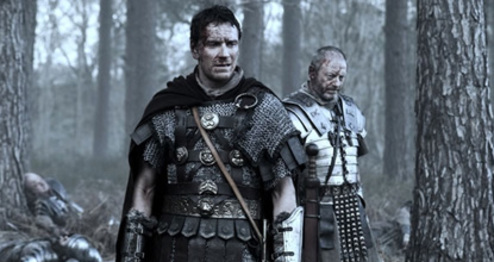
Michael Fassbender surveys the devastation that is Centurion

Director: Neil Marshall

Cast: Michael Fassbender (Quintus Dias), Olga Kurylenko (Etain), Dominic West (General Titus Flavius Virilus), Liam Cunningham (Brick), David Morrissey (Bothos), JJ Feild (Thax), Noel Clarke (Macros), Riz Ahmed (Tarak), Dimitri Leonidas (Leonidas), Ulrich Thomsen (Gorlacon), Imogen Poots (Arianne), Paul Freeman (Gnaeus Julius Agricola), Rachael Stirling (Drusilla), Less Ross (Septus)

It’s an old fable: the “missing” Roman legion, the 9thLegion that allegedly marched to Scotland around 120 AD. We don’t know what happened (if anything) but it usually gets tied into Hadrian’s decision to build his famous wall. Anyway, Neil Marshall’s film tries to plug the gap, with the Legion eradicated on an ill-judged expedition north to settle affairs there once for all. A “ragtag bunch” of survivors (all of whom match expected character tropes) have to run over hostile countryside, led by surviving senior officer Centurion Quintus Dias (Michael Fassbender) to get back to safety and Roman lines.

It’s a Neil Marshall film, so you can expect blood-letting aplenty and high-octane action on a budget. And you more or less get it, mixed with his love for accelerator-hitting chases and against-the-odds action. It’s entertaining enough, but its main problem is that it feels a little too by-the-numbers, as if all the thought about how to make it original and exciting went straight into the look and style of the film – all drained out colours and serious claret – and none at all into storytelling or character.

You sort of end up caring for the characters in a functional way – largely because they are all such familiar types – but their personalities seem to have been designed entirely around the various deaths that have been invented for them. So the enthusiastic meet unjust ends, the likeable fall to cruel chance, the world-weary give their lives for one more stand, the selfish meet justice. At the end, the characters you would basically expect to stumble to the finish line do. It’s a film that lacks any uniqueness.

In fact, what gives the characters life is the professional character actors playing them, all of whom can do what they are doing here standing on their heads and look like they were largely there with an eye on pleasant after-shooting hours in a series of local pubs. It’s hard otherwise to think what attracted them to these cardboard cut-outs and pretty familiar structure.

Not that there is anything wrong with what Marshall does with his film here – it’s a lot of fun when stuff is happening, it’s just that nothing feels like it carries enough weight or originality to survive in the memory. Everything is fine but nothing is really inspired. There is very little sense of Ancient Rome or any other place. The Romans are basically squaddies, an idea that sounds interesting until you remember turning period warriors into versions of modern soldiers is hardly new, while the Brits chasing them are woad-covered psycho stereotypes.

So while it passes the time, Centurion does nothing special with it. It feels like a wasted opportunity – that with a cast this good and a decent premise, plus a nice little historical mystery to pin it onto in order to give it depth, Marshall could have come up with something that was more than the sum of its parts rather than less. Perhaps it needed more time with its ragtag group so they actually became characters rather than plot devices. Perhaps it needed to take more of a rest from its constant chasing to allow quieter moments of reflection and character. Perhaps it’s just a chase film that is never quite compelling enough to make you overlook these things. Either way, Centurion isn’t an all-conquering empire of  film.

The Cruel Sea (1953)

The Cruel Sea (1953)

Command is a lonely, pressure-filled place in this complex and exceptional war film

Director: Charles Frend

Cast: Jack Hawkins (Lt Commander George Ericson), Donald Sinden (Lt Keith Lockhart), John Stratton (Lt Gordon Ferraby), Denholm Elliott (Lt John Morell), John Warner (Lt Baker), Stanley Baker (Lt James Bennett), Bruce Seaton (PO Bob Tallow), Liam Redmond (PO Jim Watts), Virginia McKenna (WRNS Julie Hallam), Moira Lister (Elaine Morell)

In 1953, The Cruel Sea was a colossal hit at the UK box office. With only a few years separating viewers from the sacrifices and struggles of war, it’s not hard to see why. The Cruel Sea is all about those struggles and sacrifices, about carrying on and doing your duty despite it all. But it’s also a film that understands the impact these have, and that that stiff upper lip is often covering a trembling bottom one. That stoic front is sometimes just that: a front. 

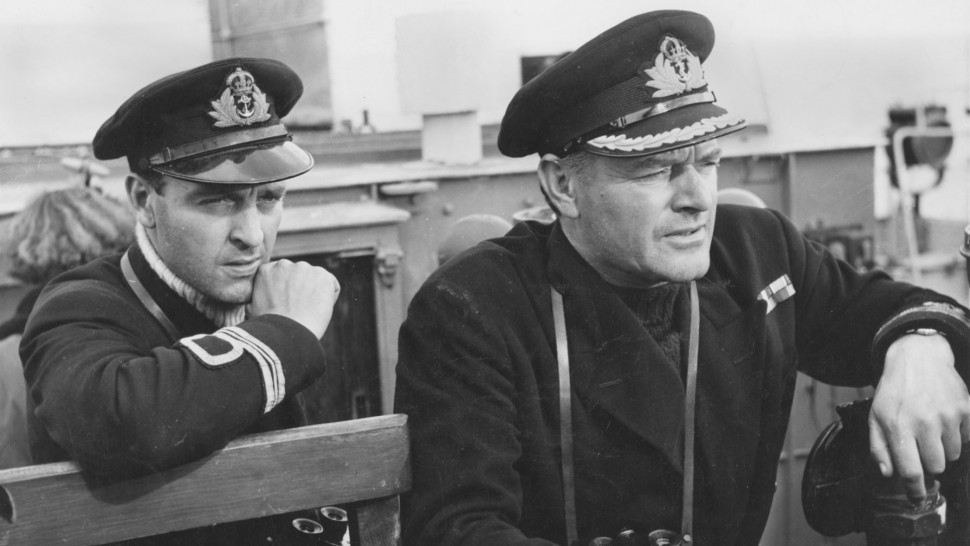
Jack Hawkins plays Lt Commander George Ericson, commanding a corvette on convoy duty in the Atlantic ocean. His mission? Make sure those ships make it through and destroy U-boats wherever possible – and everything else is secondary to that. But of course the real battle is against the cruel sea itself: and everyone sailing on her is at threat at any moment from losing their life. In the mid of this the men deal with losses at sea, losses at home, and the constant pressure of always being ready to do-one’s-duty.

On the surface, The Cruel Sea is pretty much the quintessential 50s British war movie. The upper lips are stiff, the accents are super clipped. Everyone is pulling together, regardless of class. Duty, king and country come before everything. But actually, this is a more complex film than all that. The Cruel Sea drills down into the psychological cost of war, and the impact of putting duty to the war above and beyond the needs of the regular sailor. Protecting the convoys and taking out these u-boats come first, and if that means sacrificing lives then it’s got to be done, regardless of the psychological impact that might have on the guy who makes the call.

Jack Hawkins is that guy, and this role pretty much cemented his niche in mainstream as the gruff, duty bound, slightly distant, quintessential officer type. But Hawkins performance here is that entire impression as a front, hiding his own doubt and guilt. During this film Ericson not only has to deal with his first ship sinking – with a huge loss of men – but also his decision to prioritise sinking a u-boat over saving men from a downed convoy ship trapped in the water. The depth charges he orders lead to the deaths of those men in the water: “bloody murderer!” screams an outraged crewman under his command.

And bloody murderer is exactly what Ericson thinks he is. Its’ the tough – and probably right – decision but the deaths of those sailors don’t sit easy with him. He’s the tough captain who can make the call – but his next shore leave sees him getting guiltily drunk and then tearfully expressing his doubts and guilt to his second-in-command. It’s clear that the pressure of making these calls, of sacrificing lives is something Ericson cannot wear lightly – and Hawkins performance in these moments breaks through the reserve of the 1940s to show a real depth of post-traumatic stress and guilt. Hawkins’ performance is raw, touching and above all real – and you feel he is expressing the survivor guilt of a generation who had all made tough calls during nearly a decade of war.

The Cruel Sea is all about those tough choices, and learning to deal with them. It’s also about that difficult balance between life at sea and life at home. Some families suffer terrible losses, some sailors come home to find loved ones have been killed in the blitz, others find that their wives have failed to stay loyal in the long months they have been away. At sea, there are more than enough pressures and threats, and that cruel sea takes a continuous toll, which is hard to forget. 

The scenes shot at sea have a professional tension and to them, and a really capture that sense that the most noble thing to do is to get on with doing your duty. The officers and men keep a reserve and a determination, as well as aiming to keep their spirits up as much as they can. There is very little patience for those who can’t or won’t put the good of the many first. Stanley Baker’s braggart second-in-command – an insecure stickler for rules, who is clearly both incompetent and cowardly – is treated with contempt and swiftly persuaded to jack it in for a spurious health reasons.

Meanwhile, the rest of the officers are decent, hard-working, determined and put duty and the lives of others in front of their own. Donald Sinden, underplaying (and a world away from the larger than life characters he would go on to play) is excellent as the young officer who grows in statue and authority, as well as having a very sweet romance with Virginia McKenna’s WRNS officer. John Warner and a young Denholm Elliott are equally good as young officers who have to deal with tragedy.

Because dealing with tragedy is what this film is about. The war at sea is long, often boring and punctuated with danger and loss. The opponent is hard to see, and the clashes with them never clean cut or open. For years of campaigning, you can count on one hand the number of direct clashes Ericson and his crew have with visible u-boats. Despite this, each of these attacks carries huge costs. The war at sea is unrelenting, tough and terrible: but also calls for men who are able to put themselves second, no matter the cost. It’s a great look at the mentality of a whole generation: no wonder it was such a hit.

The Four Feathers (1939)

John Clements jacks in the soldier’s life, then has to prove he’s not a coward in The Four Feathers

Director: Zoltan Korda

Cast: John Clements (Harry Faversham), Ralph Richardson (Captain John Durrance), C. Aubrey Smith (General Burroughs), June Duprez (Ethne Burroughs), Allan Jeayes (Geveral Faversham), Jack Allen (Lt Thomas Willoughby), Donald Gray (Peter Burroughs), Frederick Culley (Dr Sutton), John Laurie (Khalifa)

Who doesn’t love a sweeping boys own adventure? The Four Feathers is a prime example of a classic late Victorian adventure story by AEW Mason, where stiff-upper lipped British men do what must be done for honour, Queen and country in the face of hordes of dangerous ruthless natives. Okay, you can see typing that why some of these attitudes can be seen as “troubling today” – and the film’s occasional non-PC stumbles (John Laurie blacks up – as does every other actor playing a speaking African – as radical leader Khalifa, while his army is referred to by an on-screen caption as “fuzzy-wuzzies”). But it’s a product of its time, and its attitudes are really less racist, than the sort of patronising parental colonialism, where the Khalifa has to be stopped as much because he is a danger to his fellow natives as he is the British rulers.

Anyway, putting it’s “of its time” attitudes to one side, The Four Feathers is an endearing, enjoyable and wonderfully made adventure story. After the death of General Gordon (see Charlton Heston’s epic Khartoum) in 1885, war is declared on the Khalifa in the Sudan. However young Harry Faversham (John Clements) resigns his commission on the day of the announcement that his regiment will be shipped out, feeling his obligation to join the army has ended with his father’s death and worried that he will prove a coward. His friends Durrance (Ralph Richardson), Willoughby (Jack Allen), Burroughs (Donald Gray) and fiancée Ethne Burroughs (June Duprez) are singularly unimpressed and all send him white feathers of cowardice. Realising he has led down everyone, Faversham disguises himself as mute, Sangali native (including facial brand – ouch!) and heads out to the Sudan to help his friends and regain his honour: and do they need it, as Durrance is blinded and Willoughby and Burroughs captured by the Khalifa.

The Four Feathers was shot on a huge budget at the time, with extensive on-set location shooting, and it barrels along with an old-fashioned sense of adventure that is hard not to get a little bit swept in. Of course, it’s also easy to question some of the film’s colonialist, white-man’s burden attitudes and also its opinions on what constitutes bravery and nobility (leaving the army because you never wanted to be in it in the first place is seen as yellow-bellied nonsense, which I suppose makes sense for a film made just before World War Two). 

But take it as a product of its own time, and the film works extremely well – easily the best version of the many that have been made of AEW Mason’s book. While epic, it gives us a low-key, dignified lead character who it’s easy to admire and relate to. John Clements plays the role with an expected upper-class stiffness in places, but he’s also a man bursting with desires to be something more than a soldier, then plagued with guilt and self-loathing when he believes he has betrayed all those he is closest to. Clements’ performance anchors the film extremely well, and makes Faversham into an admirable, very human protagonist, pushing himself to insane levels of deprivation and suffering to redeem himself in his own eyes, as much as in his friends.

Those friends are also not painted as arrogant buffoons or cruel, knee-jerk bullies. Ralph Richardson mines a great deal of sympathy from Durrance, a man determined to do his best but (its implied ) living under a deep sense of inadequacy and fear himself, who knows he is second best in most things, especially in love, and who accepts the ill fortunes that befall him with an eventual stoic good-nature. The film’s most successful sequence, features a wordless disguised Faversham, guiding the blind Durrance not only back to the British troops, but also helping him to find some will to carry on living. Its sterling work from Richardson, and his physical intelligence – his initial blindness is almost comically blundering, before the character trains himself to move and act almost as if he still had his sight – makes for further emotional connection.

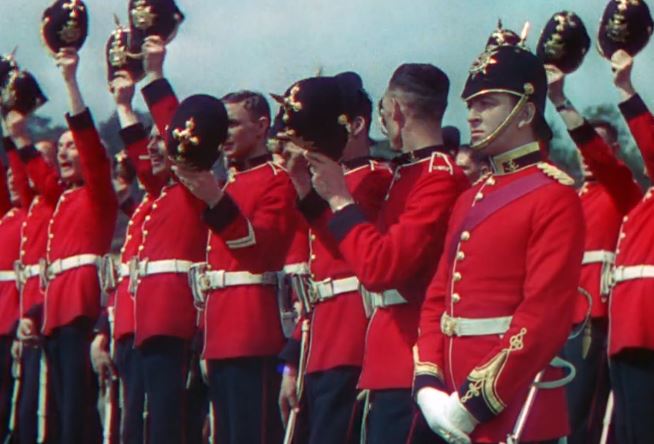
All this is set in a sweeping, marvellously entertaining, grand-scale by Zoltan Korda. No expense was clearly spared, and the large scale sequences of battles and attacks – as well as the shots of armies moving across the desert wasteland – carry a great deal of scale and impact. The film barrels along with an impressive force, throwing events and actions at us throughout, all while juggling the personal stories of its lead characters. The technicolour shooting of the film has a classic gorgeousness about it, and the film has more than its fair share of decent lines. The film highlights a number of rather stirring battle set pieces, as red coated Englishman fight against overwhelming odds, the sort of thing that we are meant to frown at today but actually remains rather gripping.

The Four Feathers may be dated in places, but as a piece of classic entertainment from its era it’s hard to beat. The action adventure is full of bangs, shots and stiff-upper lipped Brits overcoming trials and tribulations. Faversham is a grounded and relatable character, and his doubts and fears make him admirable, not least because of the great lengths he goes to in order to overcome them. The Four Feathers still entertains today because it feels like exactly the sort of classic Sunday afternoon adventure story that appeals to boys of all ages.

The Hurt Locker (2009)

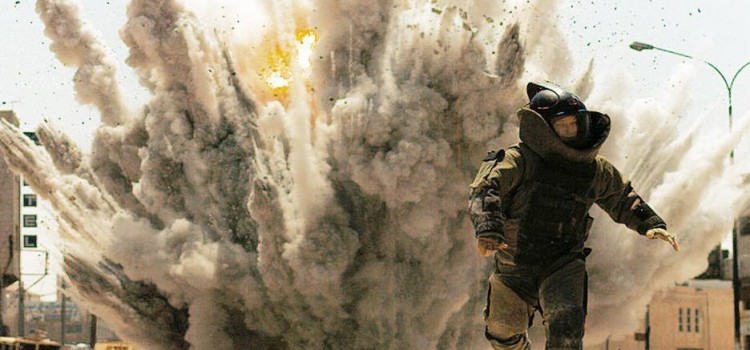
Danger awaits round every corner in the shocking The Hurt Locker

Director: Kathryn Bigelow

Cast: Jeremy Renner (Sgt William James), Anthony Mackie (Sgt JT Sanborn), Brian Geraghty (Specialist Owen Eldridge), Guy Pearce (Staff Sgt Matthew Thompson), Christian Camargo (Lt Colonel John Cambridge), David Morse (Colonel Reed), Ralph Fiennes (British Mercenary), Evangeline Lilly (Connie James), Sam Spruell (Contractor Charlie)

There have been few wars in history as controversial as the Iraq war. Despite this, it’s hard to think of a film that really has nailed the complex social, political and military causes behind the war – or managed to engage with the deep unease much of the Western world feels for the campaign. While there have been great films about Vietnam, that other opinion-dividing conflict of the last 50 years, there hasn’t been one about Iraq yet – perhaps because the wound is still so fresh. The Hurt Locker gets closest by far – largely because it is a film that makes war its subject, not Iraq; it could just as easily be set in the fields of France as the streets of Baghdad.

After the death of their Staff Sergeant (Guy Pearce) while defusing an IED in Baghdad, Explosive Ordnance Disposal (EOD) unit members Sgt Sanborn (Anthony Mackie) and Specialist Eldridge (Brian Geraghty) are joined by a new team leader Sgt William James (Jeremy Renner). However, they both – particularly the by-the-book Sanborn – grow increasingly concerned about James’ maverick methods and willingness to take personal risks to defuse bombs. Slowly, tensions rise in the team.

The Hurt Locker makes no comment whatsoever on the controversy behind the decision to intervene in Iraq. Instead, its focus is entirely on the psychology of those who go to war, and the sorts of personalities it can attract, from those with a keen desire to do their duty to others who get a certain “buzz” from risk and conflict that they cannot find elsewhere in their lives. As the film’s opening words say, “War is a Drug”. And there are few characters more afflicted by an addiction to that drug than Sgt William James.

Not that James is a villain. One of the film’s many strengths is that he is far from a lunatic. Played with a career-defining charisma and intensity by a then almost-unknown Jeremy Renner, James takes personal risks (defusing bombs without the huge rubber safety suits, turning off his comms to concentrate, returning to bombsites to collect trophies or lost items) but he also shows concern and empathy for his fellow soldiers and (largely) avoids putting them in danger. With the team pinned down by snipers in the desert, he calmly reassures Eldridge and talks Sanborn quietly through taking down the snipers. He develops bonds with people and later in the film shows great compassion and willingness to put himself in danger to save a man unwillingly attached to a suicide vest.

James’ struggles are to deal with the modern world and its shallow obsessions compared to the thrill of putting your life on the line (as the film brilliantly illustrates with a final vignette of James back home at the end of rotation, staring blankly at a wall of cereal boxes in a supermarket). On campaign, he talks dismissively of his child and claims to not know or understand his relationship with his wife. But this is a front – it’s clear his family life is far more settled than he suggests – and is actually more connected to his guilt at enjoying his time on military posting more than he does the neutered warmth of family life. Renner excels at all this complex psychology, crafting a man who is aware of his addiction, can’t combat it but feels a deep guilt for it.

The Hurt Locker is about how this rush of war can be more compelling and life-affirming than hearth and home. It’s also perhaps a commentary on how we ourselves get a rush from watching action and war films – that it’s only a few steps from enjoying watching the excitement of conflict, to enjoying being in the middle of that kind of action. Is James really that bad? Defusing bombs is a difficult and demanding job – and James knows (rightly) that he is one of the best at doing it. And shouldn’t a man enjoy his job? Renner’s glee at a job well done is balanced by guilty awareness that he shouldn’t be enjoying himself as much as this.

Kathryn Bigelow is in her element directing this burst of male testosterone, assembling a film that is gripping, tense and hugely exciting. It’s essentially constructed around a series of set-pieces, each of them more unsettling than the one before. Bigelow’s direction is impeccable, as each of these sequences is both unique in tone and utterly compelling. Bigelow became the first woman to win Best Director at the Oscars – and her acute understanding of men enamoured with the buzz of adrenalin is what gives the film much of its narrative force.

It also helps that the film she has assembled here is a technical marvel, brilliantly shot by Barry Ackroyd with a scintillating display of hand-held cameras, cleverly focused details and immersive story telling. The Hurt Locker is a film both drenched in sun and darkness, with burning yellows and oppressive greys. It’s a film that captures the incredibly alien, heat-stoked insanity of Iraq, and the journalistic style and camerawork make everything we watch feel even more immediate.

In the middle of this, the psychological drama between the maverick James and the cautious, procedure-led Sanborn (played by an equally impressive Anthony Mackie, whose every moment buzzes with frustration and anger at the dangers he sees James inflict on them) plays out wonderfully. Bigelow has an immediate understanding of how the adrenalin and testosterone of combat quickly bubble up into violence and aggression off the battlefield, with these two men often becoming like rutting stags, struggling to place their own supremacy on the team – with Brian Geraghty’s weaker Eldridge the pawn between the two.

The Hurt Locker does what it does so well that it’s easy to overlook its flaws. Its narrative is so pure that you regret it gives barely a second to addressing the issues in Iraq or how the behaviour and attitude of the soldiers there (mostly angry and abusive towards the local population) may be contributing to the problems. It also struggles to add much narrative originality to the story, beyond its set-pieces – in particular James’ friendship with a young Iraqi boy seems like the forced stuff of movie convention in a film that prides itself on reality. When dialogue takes over from action, many of the psychological points it raises have been seen in countless films past. You could argue that the film is largely at its weakest when it tackles any questions of plot at all, and that what Bigelow has really done here is make one of the finest boots-on-the-ground immersions you are going to see.

And if The Hurt Locker is just that then, you know what, that’s fine too. Because when it does this it’s one of the best in the game. Brilliantly assembled, shot and edited (those many Oscars were well deserved) it’s a gripping war film that relies a little too much on some of the conventions of war and combat films, while also focusing very intently on how war affects the psychology of the men at the sharp end. It gives a truly unique perspective of the dangers (in every sense) and is brought to life by a series of fine performances, with Renner and Mackie outstanding. Wonderfully directed, and smashingly tense, it’s a worthy contender in the upper echelons of any list made of great war films.

Zulu (1964)

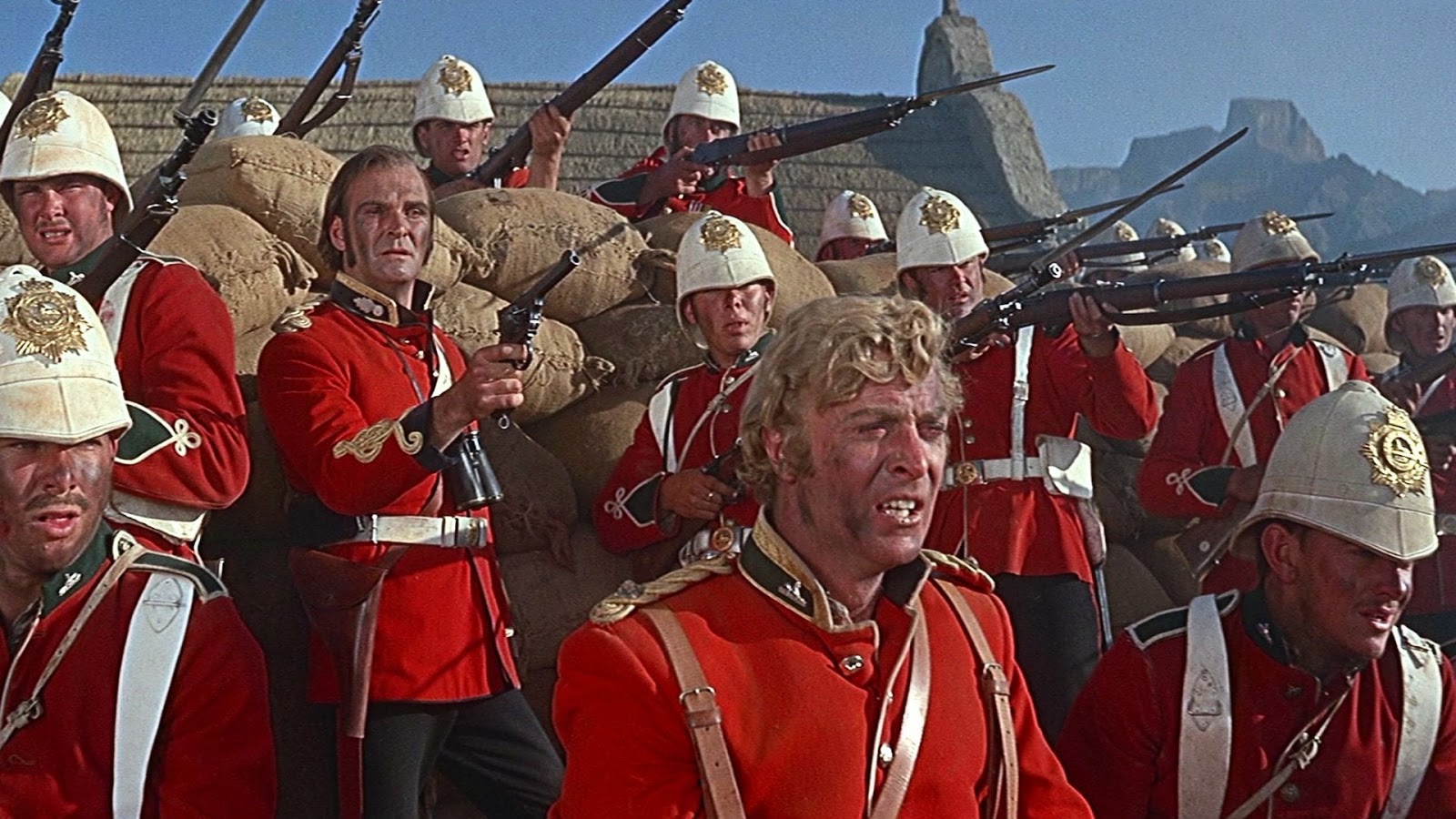
Michael Caine and Stanley Baker are under siege in classic Zulu

Director: Cy Endfield

Cast: Stanley Baker (Lt John Chard), Michael Caine (Lt Gonville Bromhead), Jack Hawkins (Reverend Otto Witt), Ulla Jacobsson (Margareta Witt), James Booth (Pvt Henry Hook), Nigel Green (Colour Sgt Frank Bourne), Patrick Magee (Surgeon Major James Reynolds), Ivor Emmanuel (Pvt Owen), Paul Daneman (Sgt Robert Maxfield), Glynn Edwards (Cpl William Allen), Neil McCarthy (Pvt Thomas), David Kernan (Pvt Fredrick Hitch)

There are some films so well-known you only need to see a frame of them paused on a television to know instantly what it is. Zulu is one of those, instantly recognisable and impossible to switch off. A few notes of John Barry’s brilliant film score and you are sucked in. Zulu has been so popular for so long, it’s almost immune to any criticism, and deservedly so because it’s pretty much brilliant.

The film covers the battle of Rorke’s Drift in the Zulu War of 1879. Rorke’s Drift was a small missionary supply station, near the border of Zululand with the Transvaal. The British had instigated the Zulu war with a series of impossible-to-meet ultimatums (the Natal government wanted to restructure Southern Africa into a new confederation of British governed states and Zululand was in its way). The British had of course massively underestimated the disciplined, dedicated and organised Zulu armies and the war started with a catastrophic defeat of the British (nearly 1,500 killed) at Isandlwana by an army of 20,000 Zulu (who lost nearly 2,500 killed themselves). Isandlwana took place on the morning of the 22nd January – and by the afternoon nearly 4,000 Zulus had marched to Rorke’s Drift, garrisoned by 140 British soldiers.

The film opens with the aftermath of the Isandlwana defeat (with a voiceover by Richard Burton, reading the report of the disaster written by British commander Lord Chelmsford). The camera tracks over the bodies of the British, as the Zulu warriors move through the camp (the film omits the Zulu practice of mutilating the bodies of their fallen opponents, which is just as well). Action then transfers immediately to Rorke’s Drift where Lt John Chard (Stanley Baker), a Royal Engineer temporarily assigned to the base to build a bridge, is senior officer by a matter of months over Lt Gonville Bromhead (Michael Caine – famously billed as “Introducing Michael Caine”). Chard takes command of the preparations to repel the siege, building fortifications, arming the walking wounded, and carefully making the defensive line as tight as possible to cancel out the Zulu numbers (the exact opposite of what happened in Isandlwana).

Zulu is drama, not history. Much has been changed to make for better drama. Chard and Bromhead were not as divided along class lines. Nigel Green (excellent) plays Colour Sergeant Bourne exactly as we would expect a Colour Sergeant to appear – a tall, coolly reassuring martinet “father to his men” – so it’s a surprise to learn the real Bourne was a short 24-year old nicknamed the Kid (the real Bourne was offered a commission rather than a VC after the battle). Henry Hook, here a drunken malingerer with right-on 60s attitudes towards authority, was actually a teetotal model soldier (his granddaughter famously walked out of the premiere in disgust). Commissioner Dalton is a brave pen pusher, when in fact it was he who talked Chard and Bromhead out of retreating (reasoning the company wouldn’t stand a chance out in the open) and then fought on the front lines. Neither side took any prisoners – and the British ended the battle by killing all wounded Zulus left behind, an action that (while still shameful) is understandable when you remember the mutilation the Zulus carried out on the corpses of their enemies at Isandlwana the day before.

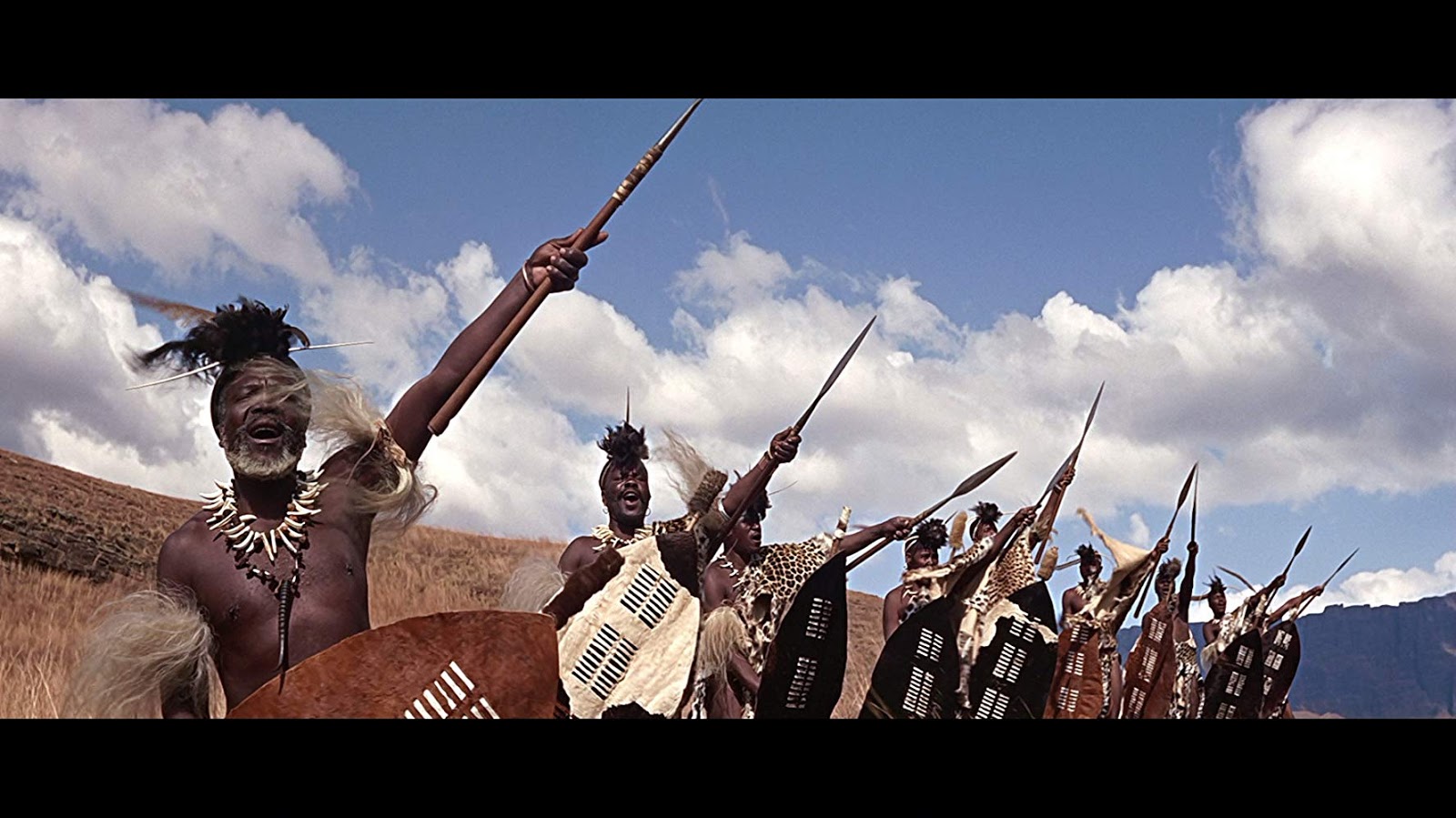
But it doesn’t really matter, because this isn’t history, and the basic story it tells is true to the heart of what happened at Rorke’s Drift. Brilliantly directed by Cy Enfield, it’s a tense and compelling against-the-odds battle, that never for a moment falls into the Western man vs Savages trope. Instead the Zulus and the soldiers form a sort of grudging respect for each other, and the Zulu army is depicted as not only disciplined, effective and brilliantly generalled but also principled and brave. The British soldiers in turn take no joy in being there (Hook in particular essentially asks “What have the Zulu’s ever done against me?”), admire as well as fear their rivals and, by the end, seem appalled by the slaughter. (Chard and Bromhead have a wonderful scene where they express their feelings of revulsion and disgust at the slaughter of battle.)

It’s a battle between two sides, where neither is portrayed as the baddie. We see more of it from the perspective of the defenders of the base, but the Zulu are as ingenious and clever an opponent as you are likely to see. The opening scenes at the court of Zulu king Cetshawayo’s (played by his actual great-grandson) allow us to see their rich culture and their own fierce traditions, grounded in honour (and spoken of admiringly by missionary Otto Witt, played with an increasingly pained then drunken desperation by Jack Hawkins, as he begs the British to flee and prevent bloodshed). Many of the Boer soldiers in the base compare the British soldier unfavourably with his Zulu counterpart. The film goes out of its way to present the Zulu people as a legitimate culture, and a respected one.

But its focus has to be on the British, as this is a “base under siege” movie, and to ratchet up the tension successfully it needs to chuck us into the base, playing the waiting game with the rest of the men. The Zulu army doesn’t arrive until over an hour into the film – the first half is given over entirely to the wait, the hurried preparations and the mounting fear as the seemingly impossible odds start to seep into the British. The men react in a range of ways, from fear, to anger, to resentment, to grim resignation. The first half also plays out the tensions between Chard and Bromhead, one a middle-class engineer, the other the entitled grandson of a General. 

Caine is that entitled scion of the upper classes, and he plays it so successfully that it’s amazing to think it would only be a couple of years before he was playing Harry Palmer and Alfie. Caine nails Bromhead’s arrogance, but also the vulnerability and eventual warmth that hides underneath it. Set up as a pompous obstruction, he demonstrates his bravery, concern and even vulnerability. It’s a turn that turned Caine from a jobbing actor into a major star (Caine originally auditioned for Booth’s part as the working-class Hook. Booth later turned down Alfie). It also meant that Stanley Baker’s excellent turn, in the drier part as the cool, controlled Chard, buttoning down his fear to do what must be done, gets unfairly overlooked.

The film never lets up the slow build of tension – and then plays it off brilliantly as battle commences. Perhaps never on film have the shifts and tones of proper siege combat been shown so well. This is perhaps one of the greatest war films ever made, because it understands completely that war can highlight so many shades of human emotion. We see heroics, courage, self-sacrifice and unimaginable bravery from both sides. We also see fear, pain, horror and savagery from both. Several moments of bravery make you want to stand up and cheer or leave a lump in your throat (I’m a sucker for the moment Cpl Allen and Pvt Hitch leave their wounded bay to crawl round the camp passing out ammunition).

Enfield’s direction is masterful, the first half having so subtly (and brilliantly) established the relative locations and geography of everything at Rorke’s Drift, you never for one minute get confused about who is where once battle commences. The combat after that is simply extraordinary, a triumph not just of scale and filming but also character and storytelling. We are brought back time and time again to characters we have spent the first half of the film getting to know, and understand their stories. Eleven men won the Victoria Cross at Rorke’s Drift (more at one engagement than at any other time in history), and each of the winners is given a moment for their courage to be signposted. All of this compelling film-making is scored with deft brilliance by John Barry, with the sort of score that complements and heightens every emotional beat of the film.

Strangely some people remember this film as ending with each of the garrison being killed – I’ve seen several reviews talk of the men being “doomed”. Perhaps that impression lingers because there is no triumphalism at the end of the film. After the attack is repelled, with huge casualties, the soldiers don’t celebrate. They seem instead shocked and appalled, and simply grateful to be alive. After the final deadly ranked fire of the British, as the smoke clears to show the bodies of their attackers, the men seem as much stunned as they do happy. Bromhead talks of feeling ashamed, Chard calls it a “butcher’s yard”. Duty has been done – but the men were motivated by wanting to survive. The film doesn’t end with high fives and beers, but people quietly sitting, gazing into the near distance. There are small moments of dark humour from the survivors, but never cheers.

It’s all part of the rich tapestry of this enduring classic. Historically, many believe the celebration of the victory at Rorke’s Drift was to deliberately overshadow the catastrophe of Isandlwana (and that the number of VCs handed out was part of this). But, even if that was partly the case, it doesn’t change the extraordinary bravery and determination to survive from the soldiers. And the film doesn’t even try to get involved in the politics of the situation. The men must fight “because they are there” and the rights and wherefores of the war (which the film ignores completely) are neither here nor there. Instead this is a celebration of the martial human spirit, packed full of simply brilliant moments, wonderfully acted and directed, and an enduring classic. It allows you to root for the besieged but never looks down on or scorns the besiegers. It pulls off a difficult balance brilliantly – and is a brilliant film.

The Battle of Algiers (1966)

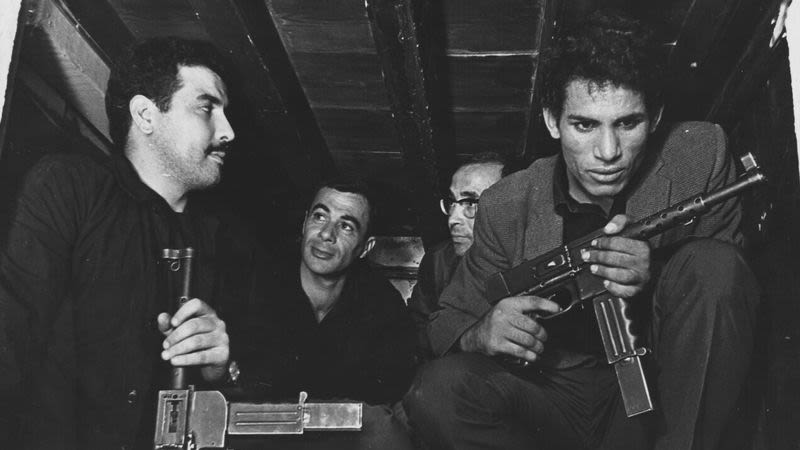
The French military move into Algiers in Pontecorvo’s neo-realist masterpiece The Battle of Algiers

Director: Gillo Pontecorvo

Cast: Jean Martin (Colonel Mathieu), Yacef Saadi (Djafar), Brahim Hadjadi (Ali La Pointe), Tommaso Neri (Captain). Ugo Palette (Captain), Fusia El Kader (Halima), Mohamed Ben Kassen (Petit Omar)

Sometimes, when watching The Battle of Algiers, you have to catch yourself and remember everything you are watching was staged rather than real footage. That right there is the greatest strength of this film, and its ongoing legacy. It feels more real than the news, it looks more authentic than reality. Match that with the fact that (and it says a lot for the world that this is the case) its themes remain painfully resonant today, and you can see why it has had such a lasting and profound impact on film-makers.

Pontecorvo’s film dramatises (although that almost feels like the wrong word) events in Algiers, capital city of French Algeria, from November 1954 to December 1957 when the Algerian War of Independence turned the city into a near warzone, with its hub being an increasingly brutal struggle for control of the Casbah between the French authorities (and then army) and the Algerian National Liberation Front (FLN) cells. 

That description only gets a flavour of the film, which reconstructs the story with a truly awe-inspiring immediacy that feels like a slice of real life. The film has a fearless willingness to depict the dangerous struggle and violence in a combat between terrorists and soldiers. So we get violence on both sides, torture, murder, beatings, bombings of young civilians and other acts of brutality, all chronicled with a documentary realism that never feels exploitative or distasteful.

The film is often hailed as being scrupulously even-handed. I’d argue it isn’t quite – what it does do is recognise that both sides are human. The cause of Algerian independence is clearly one the film finds sympathetic, and while it shows acts of terror from the Algerians, the real acts of violence and prejudice come from the French authorities and citizens. The film doesn’t turn the Algerian terrorists into unspoilt martyrs, but it certainly regards their cause as right. So it can show them killing civilians and engaged in acts of violence, but still admire their cause (the film was made with the involvement of several former members of the NLF both in front of and behind the camera).

The film’s depiction of the French soldiers also gives more of an impression of even-handedness. These soldiers are not brutal or sadistic, but functionaries doing about a job (just following orders?) with a ruthless efficiency. The casting of Jean Martin (the only professional actor in the film) as French commando leader Colonel Mathieu also perhaps weights things, as Martin gives an engaging, morally conflicted performance, and the film lays great stress on Mathieu’s own experiences during the Second World War in the French Resistance and (it’s implied) in a concentration camp. 

The French soldiers go about their task of pacifying the terrorists with a campaign of capture, enhanced interrogation and systematic elimination of cell leaders, using their superior resources and training, in a way that the CIA (which screened the film for its agents in 2003 to help them understand terrorist cells) described as being a complete success militarily, but a total failure politically. It stamps out the Algerians in the Casbah, in a way that reduces casualties and restores order – but totally fails to win over the precious hearts and minds.

And Pontecorvo knows it’s hearts and minds that his film is all about. His camera immerses us in the heat and tension of the Casbah, picking out the faces of the non-professional extras (and actors) that populate his film, showing the bubbling tensions and resentment slowly building in a population that doesn’t start out as bitter and extremist, but becomes more and more so as the French stamp out the Algerian independence movement. People swirl around the action, increasingly objecting to the strict control procedures that segregate the Casbah from the rest of the city, and at several points crowding into potentially violent mobs, spurred on by some members of the NLF.

The NLF also has little compunction in the tactics it has to employ in order to stand any chance against the French. Pontecorvo frames the film around the experiences of Ali la Pointe (a striking performance from non-professional Brahim Hadjadi). It opens with la Pointe trapped by the French soldiers, flashing back to his initial recruitment, radicalisation and increasingly pivotal role as a cell leader under more the more urbane and political Djafar (Yacef Saadi, another non-professional playing a version of himself). 

La Pointe is our audience surrogate – and it’s surprising how we find ourselves drawn towards him. Especially since within the first 15 minutes he’s moved quickly from murdering gangsters in the Casbah to shooting cops and leading riots. Pontecorvo shoots and edits these moments of terrorist action and planning with a Hitchcockian skill. One particularly brilliant sequence follows three NLF women being selected, prepared for, traveling to and carrying out a series of bombings of cafes and bars in Algiers (the victims at one seem to be exclusively teenagers and young people).

The film is full of moments like this, all filmed with a gripping down-to-earth black-and-white realism, buzzing with tension. It’s brilliantly assembled and totally compelling, a documentary slice of Italian neo-realism that presents a fascinating look at the dangerous politics of resistance and occupation. The French military’s heavy-handed tactics are totally effective – even torture is shown to yield enough results to justify its use – but they are also completely wrong, morally repugnant but executed by soldiers going about their duty with no bitterness (Mathieu frequently tells the press that he hopes for a bright future for Algiers and even doubts the wisdom of occupation in the long run).

Pontecorvo’s film remains alarmingly prescient and relevant today – and it’s actually a little scary how little the world has changed. You can just as easily imagine the same events happening in Iraq or Afghanistan today. It’s told here with no sensationalism but a mostly objective even-handedness, that makes clear the side it favours but doesn’t demonise the other. As a slice of history turned into film it’s impeccable.

Patton (1970)

George C Scott triumphs as Patton in this excellent World War Two biopic

Director: Franklin J Schaffner

Cast: George C Scott (General George S Patton), Karl Malden (General Omar Bradley), Michael Bates (General Bernard Montgomery), Edward Binns (Lt General Walter Bedell Smith), Lawrence Dobkin (Colonel Gaston Bell), John Doucette (General Lucian Truscott), James Edwards (Sgt William Meeks), Frank Latimore (Lt Colonel Henry Davenport), Richard Münch (General Alfred Jodl), Morgan Paull (Captain Richard Jenson), Siegfriend Rauch (Captain Oskar Steiger), Paul Stevens (Lt Colonel Charles Codman), Karl Michael Vogler (Field Marshall Erwin Rommel), Peter Barkworth (Colonel John Welkin)

Patton was garlanded with eight Academy Awards in 1970, but rarely seems to get a mention when people list landmark best pictures. This is unfair, as Patton is a marvellous, intelligent, professional piece of film-making that rewards re-viewing: not least because, in George C Scott, it has one of those performances you simply must see, an extraordinary melding of actor and real man to such a great extent many people can’t believe they are seeing the real thing when watching newsreel footage of the actual Patton.

Patton is nominally a war film, but it’s actually an intriguing character piece. It follows the career of General George S Patton (George C Scott) during the course of the Second World War. Patton was a soldier’s soldier, a dyed-in-the-wool military man with a warrior’s instinct and a poet’s soul. The sort of man who berated men for not wearing proper uniform, then astounded them with thoughtful reflections on classical history. The film charts his command in Africa against Rommel, the invasion with Sicily (and feud with British counterpart Bernard Montgomery), his benching after striking a soldier suffering from shellshock in a military hospital, and his command of the Third Army during the Normandy invasion, including his pivotal role in the Battle of the Bulge.

With a script co-written by Francis Ford Coppola and Edmund North (later president of the Screenwriter’s Guild), Patton was a warts-and-all portrait of one of America’s most famous generals that came out amidst the country’s growing disillusionment with Vietnam. It was embraced by both sides of the argument because it very skilfully walks a tight-rope: for the hawks, there is enough of the “if we had more like him …” stance. For the doves, the film doesn’t shy away from Patton’s egomania, lack of tact and love of war (he even strongly advocates immediately turning on Russia – ‘cos they’ve already got all the men in Europe anyway – which you can interpret as visionary or insane depending on which side of the fence you are on).

At the centre of everything, George C Scott is quite simply a force of nature as Patton – I don’t think it’s an exaggeration to say this is surely one of the greatest Best Actor winning performances ever. Patton is in nearly every scene, and even the one’s he’s not in he’s the subject of every conversation, and Scott totally dominates the movie. You can’t put your finger on it, but he quite simply becomes Patton. It’s extraordinary, but the actor totally disappears and you feel you are watching some remarkable act of resurrection (fitting since Patton had a profound belief in reincarnation).

Scott’s Patton rages, he shouts, he goes into fits of childish egomania – but he’s also sensitive, intelligent and poetic. He can write a touching letter to the bereaved mother of his adjutant, expressing his sorrow, but also write how tragic it is that he will miss the wars to come. Scott is ramrod in his posture, and more than embraces the theatricality of Patton himself – when an adjutant tells the General sometimes his soldiers don’t know if he’s joking or not, the General softly replies “It’s not important for them to know. It’s important for me to know”.

It’s easy to eulogise over Scott at the expense of all else – but the film is so focused on Patton that he is intrinsically linked with the film’s success. The film is episodic, but every scene tells us something different about the man. Although since the film starts with one of the greatest opening scenes in movie history, we feel like we pretty much know him from the start.

It opens with an enormous American flag, in front of which Patton emerges in full dress uniform to encourage new soldiers to do their duty and, most of all, to “remember that no bastard ever won a war by dying for his country. He won it by making the other poor dumb bastard die for his country.” Scott famously refused to do this scene when told it would open the picture, as he felt nothing else in his performance could emerge from its shadow (they eventually told him it would go later in the film – no word on how he responded when he first saw the film!).

In a nut shell you get the whole movie. Is the giant American flag ironic or does the film really mean it? Patton is both strangely terrifying and also awe-inspiring, charisma, determination and force seeping from every pore of his body. Scott nails every detail of this speech, just as he nails every other part of the performance, while the camera work reinforces his mythic status (or his hubris depending on where you stand) as a symbol of Americana.

Schaffner’s direction of the film is easy to overlook, largely because it is refreshingly unflashy. It’s superbly professional –not a single scene falls flat. He marshals each scene with extraordinary effect, and manages the film’s difficult balancing act of sly satire and hagiography brilliantly. He also, within an epic canvas, works very well with actors – there are a host of great cameos in here, not least from Michael Bates as a preening Montgomery and Edward Binns as an exasperated Bedell Smith. Karl Malden is the only other really major character as Patton’s junior (later commanding) officer and he is perfect as the honest professionalism in contrast to Patton’s flash.

And the film gives us plenty of Patton’s flash. The man who loved war and combat, also loved performing – and does so with abundant skill. But the film isn’t afraid to show his warts: in Sicily he threatens to sack a general who refuses to risk his men’s lives on a risky operation, primarily motivated by Patton wanting to reach Messina before Montgomery. Later, when striking the scared soldier, his actions are tough to watch even as part of you sees his point about other men having been wounded in the line of duty (the playing of the soldier as a teary whiner probably doesn’t help). The film never fails to show that Patton’s worst enemy is his own arrogant lack of thought – he constantly shoots his mouth off with no thought for the impact.

The film is brilliantly constructed. The photography is excellent, the editing superbly marshals a long film of many individual scenes into a story that seems a lot tighter and forward moving than it probably is. Schaffner makes us feel we go on a clear journey with this character – helped as well by Jerry Goldsmith’s excellent score that conveys a great deal with ancient mythic weight, playing off Patton’s own belief in resurrection.

Patton is often forgotten a bit – but it is a great film, well made, brilliantly balanced, wonderfully written and directed. And at its centre: what a performance. George C Scott is simply astoundingly brilliant, completely transformed into the old general. His Oscar (which Scott declined, thinking awards phony) was as well-deserved as these things get. A wonderful film, a true epic, and a marvellous character study of an enigma – it deserves to sit near Lawrence of Arabia in the personal epic stakes (to which it has more than a few similarities).

Enemy at the Gates (2001)


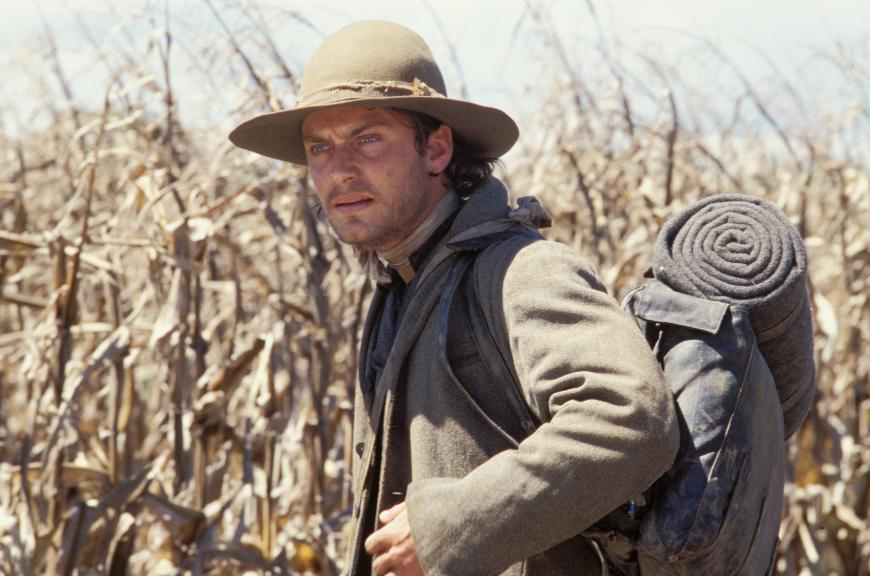
Jude Law takes aim in wonky Stalingrad drama Enemy at the Gates

Director: Jean-Jacques Annaud

Cast: Jude Law (Vasily Zaytsev), Joseph Fiennes (Commisar Danilov), Rachel Weisz (Tania Chernova), Bob Hoskins (Nikita Khrushchev), Ed Harris (Major Erwin König), Ron Perlman (Koulikov), Eva Mattes (Mother Filipovva), Gabriel Marshall-Thomson (Sasha Filippov), Matthias Habich (General Friedrich Paulus)

The Second World War in film almost always focuses on the heroics of the Western Front, where the rights and wrongs are usually pretty clear (the Western powers are noble, the Nazis savage). So it’s different to set a film on the Eastern front – where the Second World War was arguably really won and lost, and where morality is much more complex. The Nazis are terrible, but Stalin’s Russia was no picnic either.

Stalingrad in 1942: Soviet tactics involve giving every other man a gun, and ordering the second man to follow his partner and take his gun when he is killed. Witnessing the sharpshooting skills of young soldier Vasily Zaytsev (Jude Law), political Commissar Danilov (Joseph Fiennes) decides to turn him into the romantic hero the Soviets need to help inspire them. He’s so successful in doing so that the Germans send their own expert sniper, Major König (Ed Harris), to find and kill Zaytsev. Meanwhile, the friendship between Danilov and Zaytsev becomes complicated when they both fall in love for the same woman, sharpshooter and German translator Tania Chernova (Rachel Weisz).

It’s quite something for a film to be denounced by both sides of the war it’s depicting: this probably means it’s doing something right, as it doesn’t deny the hellish atrocities carried out on both sides (even if many of these are implied). The real reason to be outraged is probably more to do with its general flatness and shoving of the great battle into the standard war-movie clichés. There are some attempts to suggest what we are seeing is a true story, but other than a man called Zaytsev existing, there is very little of truth on show. Instead we get a Hollywood view of Soviet Russia: where the characters we like are regular joes, while the ones we don’t are full-on Commie zealots.

The film starts well, with an extended sequence that follows Zaytsev and several other soldiers boarding boats, crossing the river, arriving in Stalingrad and being marched immediately into the front line. Half the men are killed – the fleeing remainder are swiftly machine gunned by their officers for cowardice. It brings back memories of Saving Private Ryan and, while not as good, gives the impression we are going to see a “horrors of war” film – which the film doesn’t turn into.

Instead we get an increasingly melodramatic plotline around love triangles and sniper duels that never really feels like Russian lives at the time. In fact, the film fails to capture any real sense of Soviet Russia, other than its dirt and ruthlessness. Danilov and Zaytsev celebrate their newfound fame with a sort of giddy laddishness that just doesn’t fit any Russian’s understanding of what being noticed in Soviet Russia would surely mean. When the film does try to sound Soviet it stumbles: there is a painful (unintentionally) funny moment when Zaytsev talks about his dream job to be working in a factory, because factory work seems so noble.

The love triangle also seems ripped from Mills and Boon. Not a lot of it rings true, with Danilov turning into some sort of jealous head-boy. The romance blossoming between Zaytsev and Tania can’t decide whether it’s two souls coming together, or whether it has the air of a “last romance” with death around the corner. So it’s either overblown and overplayed, or not given enough room to build. It doesn’t help that there are a number of strange choices – not least a sex scene where Rachel Weisz seems more uncomfortable and in pain than in the throes of passion.

Maybe it’s that none of the performances of the lead actors feels either particularly Russian or soldierly. Jude Law fails to convince as a man from peasant hardship. He’s also saddled himself with a wooden “peasant” accent that not only makes Zaytsev sound like a mockney chancer, but also sound like a worse actor than he is. Joseph Fiennes is more school prefect than Soviet Commissar. Rachel Weisz is the most natural of the three, but her character makes little real sense: sometimes she’s gung-ho, others she talks about wanting this war to end. None of these actors really brings the right charisma needed – in particular Law looks as overwhelmed by the events around him as Zaytsev claims to feel.

The film belongs to the sniper sequences, and the duel of wits that develops between Zaytsev and König. Ed Harris’ part is as limply written as the rest, but Harris has a movie star charisma the others lack, and suggests a great deal of reserved arrogance and professional coldness. He’s the best thing about the movie. Annaud shoots the slow-burn waiting of sniping with a tension – and the film rather bravely stresses König’s superiority time and time again. As the film zeroes in on these two men trying to outmatch each other, it feels like it’s about something – and also that it’s relieved to leave the war at large behind.

Because for a film set in the Eastern Front, this feels unnerved by there being right and wrong on both sides. It even feels squeamish about sniper shooting. After his initial display of skill, we literally don’t see any sniper work from Zaytsev again – the “cowardly” killing from a distance of regular German soldiers is handed out to other characters. Russians are sorted into good and bad, with the good showing they are “just like us” by quietly denouncing their government. König can’t just be a professional, but the film has to try and nudge him into being a cold-hearted killer. It’s a film about the complex morality of war, that wants to make it as simple as possible.

It’s still well-made, but you wish that more time had been directed towards the script, to give us a story that was slightly better and characters that felt a bit more real. James Horner supplies a decent score (interestingly it also shows how much of film music is re-used, as key refrains in this film are strongly reminiscent of Willowand Troy). But the lead actors are all miscast (Bob Hoskins isn’t much more convincing as a bulldog Khrushchev) and it feels like a film that’s running away from a complex series of issues to try and present something as close as possible to goodies vs. baddies. The War on the Eastern Front was a hugely complex thing: this film hardly scratches the surface.

The Guns of Navarone (1961)


Gregory Peck leads one of the first men-on-a-mission films in The Guns of Nararone

Director: J. Lee Thompson

Cast: Gregory Peck (Captain Keith Mallory), David Niven (Corporal Miller), Anthony Quinn (Colonel Andrea Stavrou), Stanley Baker (Private “Butcher” Brown), Anthony Quayle (Major Roy Franklin), Irene Papas (Maria Pappadimos), Gia Scala (Anna), James Darren (Private Spyro Pappadimos), James Robertson Justice (Commodore Jensen), Richard Harris (Squadron Leader Barnsby), Bryan Forbes (Cohn), Allan Cuthbertson (Major Baker), Walter Gotell (Oberleutnant Meusel), George Mikell (Hauptstaumführer Sessler)

The Guns of Navarone is the archetypical “men on a mission” classic – it was the first major film to feature a team of specialists, all played by famous actors, going behind the lines to carry out some impossible task, leaving a trail of explosions and dead Nazis in their wake. Guns of Navarone was lavished with box-office success – and Oscar nominations, surprisingly – and although it’s a little too long, and a little weakly paced at times (as Thompson himself has admitted) it’s still got a cracking, bank holiday afternoon enjoyability about it. It’s not perfect, but honestly who could resist it?

In 1943, 2,000 British soldiers are stranded on the Greek island of Kheros. The Royal Navy plans to rescue them – but the way is blocked by two massive, radar controlled guns, in an impenetrable mountain base. The air force can’t take it out: so it’s up to Commando leader Major Roy Franklin (Anthony Quayle) to put together a team to do it. Recruiting mountaineer-turned-intelligence-agent Keith Mallory (Gregory Peck), explosives expert Miller (David Niven) and Greek-resistance leader Andrea Stavrou (who else but Anthony Quinn?), Franklin leads the team in. But when he is injured, the ruthless Mallory takes command – and leads the team in a perilous behind-the-lines raid.

I’d not seen Guns of the Navarone for a few years, and I’d forgotten what a brilliantly fun, boys-own-adventure thriller it is. I’d also forgotten what a lot of time is given early on into establishing what a team of bad-asses this group are. There seems to be no limit to their ruthless, knife wielding, gun running, cold-eyed killer bravery. And they hired a hell of a cast to play it as well – so damn good that you completely forget Peck, Niven, Quayle and Quinn are all just a little bit too over-the-hill for the derring-do they are called on to carry out.

Guns of Navarone brilliantly explains the mission aims, all the stakes and introduces each of the characters and their basic backstory, before the film basically gives us a series of action set-pieces – on a boat, at the coast, on a cliff, in a village, in a German cell, in Greek ruins, in a German base. It covers everything, and each scene is directed with real verve and increasing tension, with a simplicity to camera-work and editing that really lets the action breathe. The final sequence, waiting for the booby trap to explode among the guns, is a brilliantly done “rule of three” waiting game, with the tension building up each time.

The film is also rattling good fun, and gives each of its actors’ set-piece moments. Gregory Peck grounds the film perfectly as the increasingly ruthless Mallory, willing to sacrifice a number of pawns to achieve the target, but has a war weariness that still makes him sympathetic (as a side note, Peck’s German accent was so woeful all his German was dubbed). Niven plays Miller as a mixture of louche whiner, chippy middle-class man and natural-born troublemaker – and gets some knock-out speeches on the morality of war (Niven by the way nearly died after catching pneumonia during the boat wreck sequence).

Anthony Quinn had a monopoly on playing exotic roles at the time – from Mexicans to Arabs, from Gaugain to Zorba the Greek – so no great surprise he plays the Greek colonel here. He’s terrific though, a cold-eyed ruthless killer – and the sequence where he pretends to be a cowardly awkward fisherman is wonderful (not least for Stavrou’s reaction to Miller’s praise for his performance – a half shrug and a “so-so” hand gesture, one of my favourite ever “character” touches in the movies). Irene Papas is perfect as his female equivalent, while Anthony Quayle puts together another of his “decent army officer chaps” as boys-own adventurer Franklin. Baker and Darren don’t get huge amounts to do, but Baker does well with a “lost my taste for this killing malarkey” sub-plot.

Many of the character beats were so well-done they basically became archetypes for every “group on a mission” film since (the austere leader, the difficult whiner, the old-school traditionalist, the ruthless warrior, the maverick, the one who’s lost his nerve – and, uh, I guess James Darren is the “sexy” one). The actors play off each other superbly. There are also some great cameos – Robertson Justice is great as “the man in charge”, Walter Gotell very good as an archetypical “worthy adversary” German – there is even a slightly bizarre cameo from Richard Harris as an Aussie pilot (yup you read that right). 

Navarone’s pace doesn’t always quite work – the gaps between the action sequences do lag. It takes nearly 45 minutes for our heroes to even get to Navarone. The film also can’t quite decide its stance on warfare. We get Miller’s passionate speeches on the pointlessness of missions when wars are always going to happen anyway. The unmasking of a traitor leads to a long debate on the morality of killing them or not. Several of the characters question the point and morality of war. But then, the film spends plenty of time on Alistair MacLean thriller beats: there is killing-a-plenty of German soldiers, gunned down with ruthless efficiency (not quite as many as Where Eagles Dare but pretty close!). There are small references to Greek villages paying a heavy price in retribution for the gang’s action – but these considerations never even slow them down, or make them stop to think.

Not that it really matters – this is a boy’s own action film, full of hard-as-nails actors grimly “doing what a man’s gotta do” throughout. And, despite being a little too long and aiming for a depth it doesn’t always follow through on, it’s brilliantly assembled, the action sequences are tightly directed, and the acting has a square-jawed confidence to it. Niven is pretty much perfect as the slightly dishevelled Miller, and the clashing relationship between him and Peck growing into respect, has fine bromance to it. Navarone is the first of its kind, and it’s still (and always will be) one of the best – really exciting, really thrilling, really damn good fun.

The Heroes of Telemark (1965)


Kirk Douglas runs rings around the Germans in The Heroes of Telemark

Director: Anthony Mann

Cast: Kirk Douglas (Dr Rolf Pedersen), Richard Harris (Knut Straud), Ulla Jacobsson (Anna Pedersen), Michael Redgrave (Uncle), David Weston (Arne), Roy Dotrice (Jensen), Anton Diffring (Major Frick), Ralph Michael (Nilssen), Eric Porter (Josef Terboven), Sebastian Breaks (Gunnar), John Golightly (Freddy), Alan Howard (Oli), Patrick Jordan (Henrik), William Marlowe (Claus), Brook Williams (Einar)

During the Second World War, Telemark in Norway was the main production factory for Heavy Water, a key component for the German nuclear programme. Norwegian commandoes were ordered to destroy the factory, which they did with a cunning plan. This film dramatizes the story – adding more guns and violence – but does at least make the lead characters Norwegian. Knut Straud (Richard Harris) is the leader of the resistance, Rolf Pedersen (Kirk Douglas) the professor who identifies what the factory is churning out. Parachuted back into Norway after secretly travelling to Britain to discuss issues with the allies, they start to plan a raid.

The Heroes of Telemark is sub-par boys-own action stuff, a sort of cross between Where Eagles Dare and The Guns of Navarone but nowhere near as good as either. Despite being crammed with derring-do, it’s strangely unmemorable, and although the stakes are really high, you never feel like you care. Everything in the film, bizarrely, feels a little bit easy. Our heroes are not particularly challenged (Nazi bigwig Terboven even berates his guards at the base for letting our heroes walk in and blow up the factory all while wearing British uniforms) but there isn’t any real price paid. The only heroes who bite the bullet are so heavily signposted for death, you actually spend most the film waiting for them to cop it.

Part of the problem is both Kirk Douglas and Richard Harris feel miscast in the lead roles. It’s also pretty clear (alleged) on-set tensions carried across into shooting – not only do the two characters not really seem to like each other, you don’t get any feeling of a growing bond between them as the film goes on. You end up not really caring about either of them – and since virtually everyone else on the team is hardly defined at all as a human being, that’s quite a big loss.

Douglas plays a bizarre professor of physics whose character varies wildly from scene to scene depending on the plot. Introduced making out with a student in a dark room, Pedersen initially denounces the boys-own heroics of the resistance. No sooner is a gun placed in his hand though, than he starts turning into a regular “ends justify the means” superman. Marry his new-found ruthlessness with his regular horn-dog attitude to women, and he’s a hard guy to like. I’m not sure a hero today would climb into bed with his estranged wife (a glamourous and pretty good Ulla Jaconssen) and then get shirty when she fails to put out. The part feels like an anti-hero role, reworked to give the Hollywood mega-star some action.

Richard Harris is similarly out-of-place as Knut Straud (a character based on the real commando who carried out the raid). He spends the whole film looking sullen and furious – he’s going for intense devotion to duty, but instead he looks like the whole thing is a tedious chore. Harris isn’t really anyone’s idea of an action star, and he’s an odd choice for the film altogether. For different reasons, just like Douglas, his stubborn touchiness makes him hard to like.

Following these rather disengaging figures means the derring-do constantly falls flat. It doesn’t help that Anthony Mann’s direction lacks thrust, drive and energy and never really gets the pulse going. Even during the most daring commando sequences, it never feels particularly thrilling. It’s a very easy film to drift away from, never managing to be as taut or tight as it should. The world-shattering stakes of the German nuclear programme are never clearly explained, or kept at the forefront. Chuck in some rather obvious doubles work (no way is Douglas that good a skier) and a few wonky model shots (the boulder Harris and co roll down the hill to try and take out Terboven’s car is all too clearly made of papier mache) and you’ve got a film that never gets going.

It also lacks an antagonist. Eric Porter has a couple of decent scenes here and there as Reichskommisar for Norway Josef Terboven, but he disappears from the film for ages. The Nazis end up as a faceless bunch of German soldiers, and are so easily overcome or fooled that they hardly count as challenges. As such, the clashes and arguments really come within the commando organisation itself, but since Harris and Douglas so clearly don’t like each other, even their brief reconciliation doesn’t ring that true.

The Heroes of Telemark will pass the time on a bank holiday afternoon. You get some decent performances – Roy Dotrice is very good as a possible quisling – and the odd good scene (Redgrave gets a good death scene) but it never really comes to life like it should. Mann’s direction is too plodding, and the pacing of the film so slack that it never becomes exciting or engaging. There are so many better movies on a similar theme you could be watching.