The Private Life of Henry VIII (1933)

The Private Life of Henry VIII (1933)

Carry on Henry as Korda’s comedic historical epic cements the popular perception of the monarch

Director: Alexander Korda

Cast: Charles Laughton (Henry VIII), Elsa Lanchester (Anne of Cleves), Binnie Barnes (Katherine Howard), Merle Oberon (Anne Boleyn), Wendy Barrie (Jane Seymour), Everley Gregg (Catherine Parr), Robert Donat (Thomas Culpeper), Franklin Dyall (Thomas Cromwell), Miles Mander (Wriothesley), Laurence Hanray (Thomas Cranmer), John Loder (Thomas Peynell)

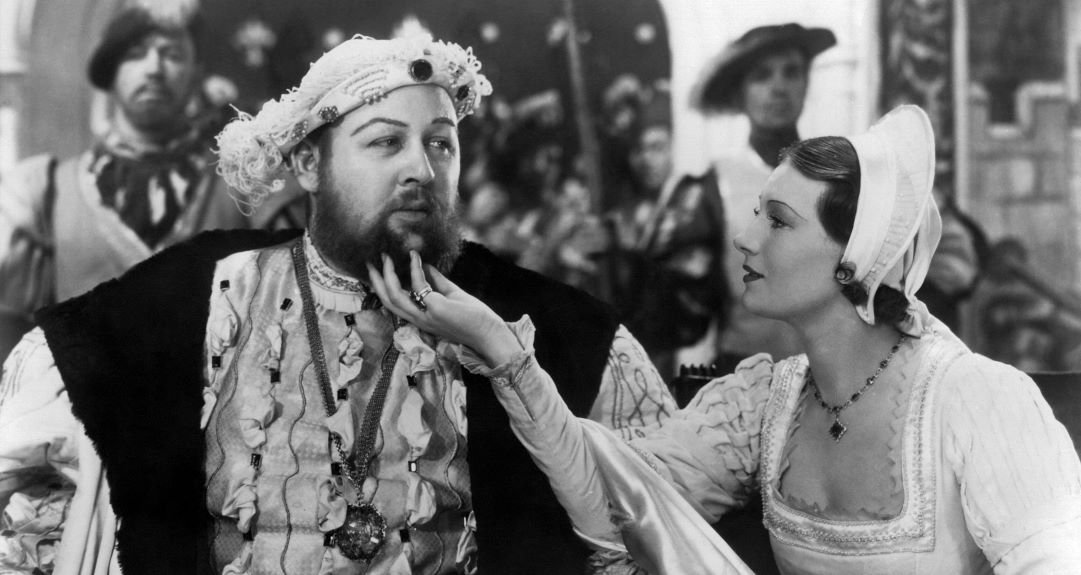
“A Great Guy With His Chopper” was the tag-line for Carry On Henry starring Sid James as a smirking, rogueish Henry. But it might as well have been the tag-line for this Oscar-winning film, that pretty much cemented the public’s perception of Henry VIII as a lusty, fun-loving king, chucking chicken legs over his shoulder when he wasn’t busy marrying wives. Korda’s handsomely filmed Tudor epic is more knock-about farce than history but was the then most successful British film ever (the first to be nominated for Best Picture) and scooped an Oscar for Laughton as the Merrie Monarch.

The Private Life of Henry VIII skips over the meat of most Henry flicks. Catherine of Aragon is dead (the films comment on her in the opening credits describes her story as being “of no particular interest”, news to scholars of the English Reformation) and with Anne Boleyn (Merle Oberon) prepping for her head to be lopped off with a sword. From there history is left firmly behind as Bluff Hal flirts with Catherine Howard (Binnie Barnes) – who has eyes for his pal Thomas Culpeper (Robert Donat) – marries Anne of Cleves (Elsa Lanchester) who uggs up to get out of it – and ends up as a hen-pecked old guy under a blanket, bossed around by Catherine Parr (Everley Gregg).

For those interested in history, don’t expect to find out anything here. Despite walk-on parts for the headline names of the Henrician reign (Cromwell, Cranmer and others dance around the margins) and some impressive sets and Holbein-influenced costumes, this is really a cheeky-comedy, popping gags at the monarch’s famed lothario. Just as well then that the gags are all pretty good, the pace kept up and the energy of all involved adds hugely to the sense of fun.

A lot of that is, of course, led by Laughton as Henry VIII. Laughton charges around, hand on hips, legs splayed and peppers every other line with outbursts of crude laughter and childish tantrums. Laughton, in short, has a whale of time, piling into every scene with lusty relish. There is a twinkle in his eye throughout even the film’s most laboured gags (the sequence of Henry spitting and throwing food over his shoulder while bemoaning “There’s no delicacy nowadays…Manners are dead!” would easily outstay its welcome without his delighted playing of it).

What’s also striking about Laughton’s performance is the depth he gives it under the humour. Korda’s film wants us to enjoy the outlandish, larger-than-life qualities of the king, but it’s not afraid to look at the darker soul below the surface of the man many call “England’s Stalin”. Laughton’s Henry is a man who greets news of Jane Seymour’s death with a few brief seconds of sadness, before a shrug of the shoulders and a cheerful enquiry about his son. His tantrums and egotism constantly dance on the edge of tyranny. He manhandles lords and servants, screams and stamps when he doesn’t get his own way and shows not a jot of remorse or guilt at the deaths he causes (he’s even seen impatiently tapping a window waiting for the sword to fall on Anne).

Despite this though, you still sort of end up feeling sorry for him. Perhaps because Laughton manages to also make him feel strangely naïve and trusting for all his school-boy bluster. Henry is torn apart with grief at the betrayal of Catherine and Culpeper (something he really should have spotted as it is almost literally going on under his nose). Korda presents a few fairly serious scenes, after a lot of comedic banter, with Henry first assaulting those bringing him the news and then collapsing into a shuddering mess of tears. A beautifully-framed shot in his chapel, shows Henry berating himself for the faults of Catherine, Laughton’s tear-stained face communicating his “mea culpas” with a soft, regret-filled quietness.

But what’s stuck in the public perception is the comedy. The film’s finest – and central – sequence covers the short marriage with Anne of Cleves, inevitably played by Elsa Lanchester. She delivers a superb performance of physical and verbal comedic charm. Henry famously was ‘unattracted’ to Anne (I’ve always believed this syphilitic, obese, gouty man just couldn’t blame himself for his inability to get it up so claimed it was the woman’s fault). Legend of Anne’s ugliness have cruelly stuck, but the film presents it as a rather amusing pantomime of fake stumbles and gurning faces used by Anne to save herself from one-day heading to the block under this tyrant.

Laughton and Lanchester’s natural chemistry (the first of their multiple collaborations on screen) sees the real-life husband-and-wife at complete ease and the wedding-night game of cards are the most relaxed and hilarious in the whole film. “The things I do for England…” Henry mutters, but there is a suspicion these two are much better suited than history assumes.

Korda pulls this altogether into a true crowd-pleaser. There is a farcical energy to the crowds providing a wry commentary on the executions. The film is crammed with some gorgeous sets – Laughton’s first entrance is a straight-restaging of Holbein. A sequence where Henry utterly fails to sneak into Catherine Howard’s bed-chamber (due to guards announcing “the King!” around every corner) is quite wonderfully staged. The cast are very fine: Merle Oberon makes a huge amount of Anne’s shrewdness (in the film’s most historically accurate sequence), Robert Donat is very charismatic as Culpeper, Binnie Barnes suitably flirty and empty-headed as a sex-pot Catherine Howard (even if she is considerably older then the real Catherine).

The Private Life of Henry VIII pulls all its material together into a luscious farce, with the odd serious moment, that might not make any sense at all when compared to history but makes a lot of sense when you compare it to stage farce. This was the first – and best – Carry On Henry.

Ivan the Terrible Parts 1 & 2 (1944/46)

Ivan the Terrible Parts 1 & 2 (1944/46)

Eisenstein’s final film sees him bravely turn Stalin’s dream project into a criticism of his whole regime

Director: Sergei Eisenstein

Cast: Nikolay Cherkasov (Ivan Vasilyevich ‘the terrible’), Serafima Birman (Efrosinia of Staritsa), Pavel Kadochnikov (Vladimir of Staritsa), Mikhail Zharov (Malyuta Skuratov), Amvrosy Buchma (Alexei Basmanov), Mikhail Kuznetsov (Fyodor Basmanov), Lyudmila Tselikovskaya (Tsarina Anastasia), Mikhail Nazvanov (Prince Andrew Kurbsky); Andrei Abrikosov (Philip, Metropolitan of Moscow)

The Soviet Union is at war, but Sergei Eisenstein is riding high. Fully restored to favour with the powers-that-be in the USSR with his flashy-but-traditional propaganda pic Alexander Nevsky, the master-of-the-montage was personally selected by Stalin to direct a three-part epic on the dictator’s hero, Ivan the Terrible. (You might wonder what attracted the paranoid, bloodthirsty dictator to a strong man Tsar best known for ruthless purges…) Stalin wanted an epic painting Ivan as a hero, who sometimes did bad things for the right reasons, all wrapped up in a neatly accessible package.

And he almost got it. Part 1 was met with acclaim and the Stalin Prize. Presenting Ivan as a successful politician and soldier, a true strong man binding the nation together and winning the admiration of his people, outfoxing his enemies at court (even though they successfully secretly murder his wife Anastasia), who retreats into Cincinnatus-like retirement only to be dragged back to save the country. It was the General Secretary’s wish-fulfilment wet-dream. Then came Part 2.

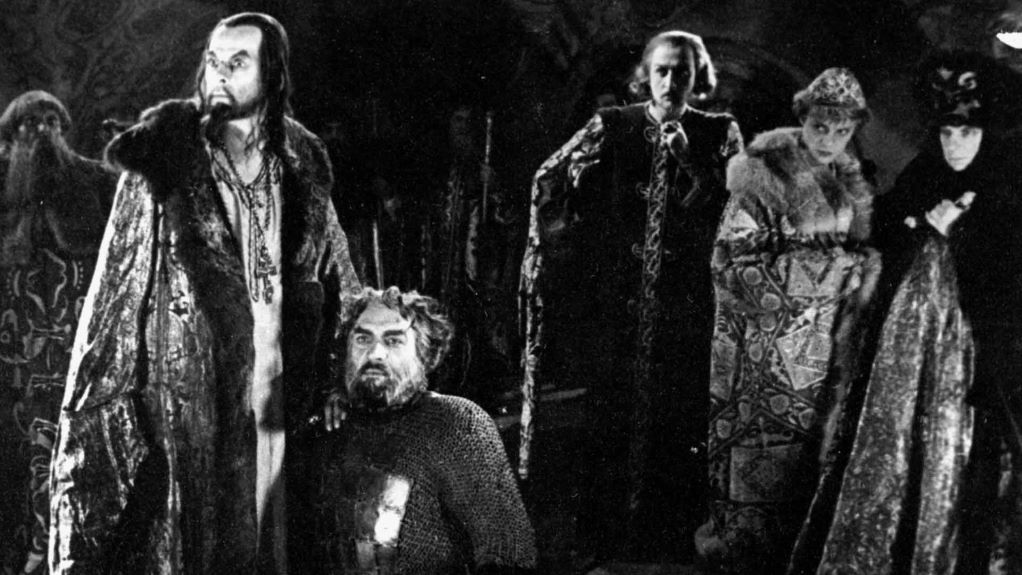
Part 2 was was immediately locked away in the vaults and all work on Part 3 ended instantly (every frame of footage shot was burned). If Part 1 was the dictator’s ideal Ivan-as-Stalin, then Part 2 was Ivan-as-Stalin that he definitely didn’t want to see. Now Ivan was ‘the Terrible’ doubling down on his nickname. Even worse, he did this while appearing unhinged, paranoid or (worst of all) manipulated by his poisonous advisors, none more so than jovial Beria-like Malyuta Skuratov (Mikhail Zharov). This Ivan rubbed out opponents, used terror as tool and focused all his anger and vengeance on those around him. Not something Stalin wanted to see, or was going to let anyone else see. Part 2 only emerged in 1958 ten years after Eisenstein’s death and 5 years after Stalin’s.

What the world ended up with, after they were allowed to see it, is a strange and hard-to-categorise film which has divided opinion for decades. To some it’s an artistic masterpiece, a triumph of symbolism and suggestion, with every shot crammed with intelligent and informed call-backs to artistic, psychological or sociological thinking. To others, it’s a somewhat turgid, hard-to-follow mess that serves as final expression of Eisenstein’s lack of interest in plot and character, not helped by his directions to the cast to echo Japanese theatre Kabuki style acting full of striking poses.

But you can’t deny the courage it must have taken Eisenstein to make this film. To have the guts to present something that deviated away from what history’s most ruthless dictator wanted and try and locate in it an unavoidable (if soft-pedalled) criticism of Stalinism. And can you blame Eisenstein if he tried to hide some of this behind art references and psychological games? Ivan the Terrible isn’t exactly easy – or fun – watching, but sometimes you just need to tip the hat to someone who has the guts to do things like this.

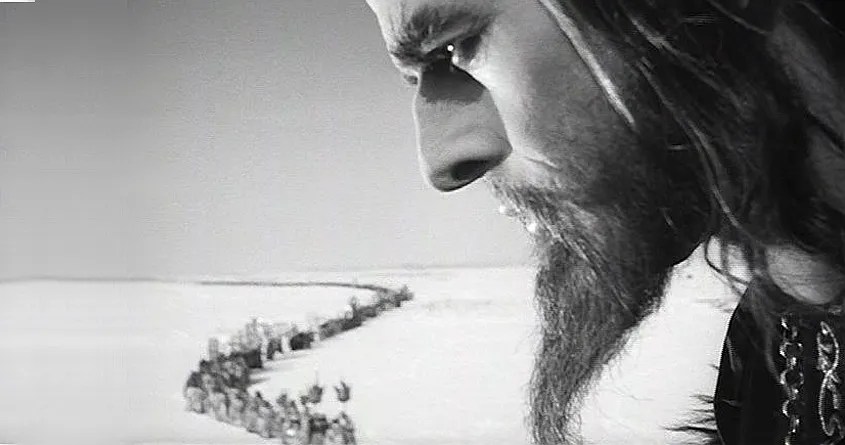
And there is plenty to admire in it. Eisenstein isn’t always recognised for his ability with the composition of shots – after all he’s the fast-cutting director’s dream – but Ivan the Terrible plays right back to his roots as a painter and designer. There are gorgeous shots here, my favourite being a looming close-up of Ivan’s face while behind him a never-ending procession of Russians slog through a white-out landscape to beg him to take back the throne. Ivan’s palace is a subterranean series of mole-like caverns, lavished with truly striking (and highly symbolic) devotional art. Firey angels are plastered across the walls above Ivan while plotting Boyars are shot huddled under mighty frescos of Death. The shadow work is extraordinary: light casts imposing, monstrous, giant black curtains. Astrolabe shadows dominate walls and advancing figures cast mighty shady pools in front of them.

Eisenstein takes his montage and arty suggestiveness of his editing work in Battleship Potemkin and October and translates it into images. The images do the work his banned formulist leanings had. Every image is rigidly thought-through and designed to make a specific implication or inference. It turns Ivan the Terrible into something ripe for analysis and exploration, the sort of film you could happily spend hours deconstructing.

It’s a film crammed with symbolism – some of it, if I’m honest, a little too clever-for-its-own-good. There are references to the work of Holbein, Botticelli, Rublev and a host of mythological figures. Sexual imagery is thrown in with blasting cannons at the siege of Kazan. It uses mirroring and contrasts throughout. Ivan’s coronation that opens in Part 1 will be echoed in a mock coronation of his would-be successor Vladimir (a fine performance of child-like simplicity and sweetness from Pavel Kadochnikov) in Part 2. As a child, Ivan will witness the death of his mother caught in the light of the doorway, very similar to the light in the doorway Vladimir will walk through to his death.

Characters are constantly positioned in framing that suggests (or hammers home) their personalities, motivations and desires. Vladimir will be cradled in his arms in a confessional Freudian clinch with first his mother and then (in an identical shot) with Ivan. The mock jovial Malyuta is given the physicality of the faithful dog he claims to be, while the villainous Efrosinia (a pantomimic, hissable Serafima Birman) rises from the ground like the serpent she feels like in almost every scene. Most of these characters are drawn in the broadest, most unsubtle strokes. It makes for some laughably unsubtle moments, but also a sort of primitive energy.

Unfortunately, it is also a film that dumps traditional narrative and characterisation for something highly stylised and impressionistic. Nowhere is this clearer than in Nikolay Cherkasov’s performance as Ivan. Constructed of a series of wild-eyed poses that would not look out of place in a silent movie, this is an over-the-top performance of hyperbolic mannerisms that probably has to be seen to be believed. There is nothing natural about this at all. It is all deployed to create a series of artistic poses and effects: what it is not designed to do is create a character we can relate to or understand.

Maybe this is how Eisenstein hoped to get away with implicit criticism of Stalinism? Ivan endorses the purges that happen, but we don’t seem him organising and initiating them. Was that, to Stalin, the worst crime of all – after all a strong man leads, even if his leadership is cruel. It’s also why, perhaps, he turned Malyuta into a jovial fixer (nevertheless Mikhail Zharov gives the film’s finest performance) rather than the ruthlessly ambitious killer he was. Part 2 shows an Ivan who allows executions not just out of ruthless paranoia but also a weakness of personality. Of all things, Stalin couldn’t take that.

Ivan the Terrible rockets along with very little sense of time, narrative or coherent, logical sense. Between the first and second scenes not only do years go by, but Cherkasov’s appearance changes so much it will take the viewer a few minutes to work out who he is. Characters sometimes go several scenes without being named. There is a Shakespearean pace to the narrative, even if it frequently flies over events, motivations, timescales and locations so quickly it’s hard to follow. It’s highly stylistic acting styles frequently make it hard for modern audiences not to raise a snigger.

Eisenstein was perhaps a little too keen to be seen as an artist, and Ivan the Terrible is at times – a bit like October – watching an overly enthusiastic art student showing you just how clever they can be. But, for all that, it’s intriguing and even if it’s not exactly entertaining, it offers many opportunities for intriguing analysis. And the very fact he dared to make a film that criticised Stalinism and then show it to Stalin is always going to be worth something.

Dark Victory (1939)

Dark Victory (1939)

Bette Davis almost single-handedly lifts another tear-jerker into something grander

Director: Edmund Goulding

Cast: Bette Davis (Judith Traherne), George Brent (Dr Frederick Steele), Humphrey Bogart (Michael O’Leary), Geraldine Fitzgerald (Ann King), Ronald Reagan (Alec Hamm), Henry Travers (Dr Parsons), Cora Witherspoon (Carrie Spottswood), Dorothy Peterson (Miss Wainwright)

Judith Traherne (Bette Davis) is vivacious and fun-loving. From her grand Long Island home, her days are taken up with racehorses and fast cars, her nights with parties and booze. No wonder she keeps having headaches and making those small falls, right? Pushed to check it out at the insistence of her best friend Ann (Geraldine Fitzgerald), it doesn’t take long for brain specialist Dr Frederick Steele (George Brent) to diagnose a brain tumour. An operation is a short-term success, but Judith’s condition is terminal. At best, she has a year to live. Steele and Ann decide to keep the news from Judith – but when she discovers the truth she decides to live life to the full with Frederick, the man she has grown to love.

Watching Dark Victory is a reminder of the sometimes-limited opportunities for women in Hollywood at the time. If an actor as radiantly talented as Bette Davis were a man, she would have been playing earth-shattering roles in stirring dramas. This was when Tracy, Muni and March were playing explorers, scientists, world leaders and campaigners. Davis, like other women, saw the vast majority of strong roles for women centred on screwball comedies or as loving wives and mothers. As such she made a career propping up effective, sentimental twaddle like Dark Victory.

Which is to be a little harsh, I will admit, on a fine if unambitious tear-jerker. Dark Victory had been a Broadway play – and a flop. The stage had exposed a little too clearly the blatant emotional manipulation of the story of a woman who falls in love in the final year of her life then facing death with self-sacrificing fortitude. On film though, it could be made to work, not least through the full-throated commitment and intelligence of Bette Davis’ acting.

Davis is too often button-holed into the “camp icon” bucket, but Dark Victory – much like Now Voyager – sees her real strong suit, turning ordinary women, tinged with sadness, into portraits of deep tragedy and emotional self-sacrifice. Davis evolves Judith from a shallow, fun-loving playgirl into someone thoughtful, caring and empathetic. Davis avoids almost completely the obvious histrionics you could resort to playing a woman dying of a terminal brain tumour.

Instead, she meets her diagnosis with a carefully studied casualness that hides her fear, confronts the realisation that she has been deceived with a betrayed disappointment rather than carpet-chewing fury, and faces death with an unselfish concern for others (a physical tour-de-force as Davis acts blind – the final stage of her condition – but hides this from her husband so as not to cause him to abandon a medical research conference he has postponed frequently for her sake).

It’s all, of course, very standard material for a tear-jerking “woman’s picture” of the 1930s. A flighty woman finds love, happiness and inevitable tragedy. Davis fizzes around much of the film’s first 30 minutes with a Hepburnesque energy and wit, jodhpurs and champagne glasses abounding. A great deal of sweet charm brilliantly adds to the poignancy as, in her first consultation with Steele, she fails to identify blindfolded the same object being placed in both hands (a dice, a pencil and a piece of silk, all instantly identified in her left are met with confused incomprehension in her right). This is highly skilled, emotionally committed acting that pays off in spades as the gentle, thoughtful, caring woman underneath is revealed.

It helps that Davis has a trusted director in Edmund Goulding. Never the finest visual stylist or most compelling technician, Goulding’s great strength was his finesse with actors. He worked especially well with Davis, his careful focus on performance over technical flair giving her an excellent showpiece for her skills. Davis paired again with George Brent, a solid but generous actor (with whom Davis started a long-running affair) never better than when breathing humanity and life into an on-paper stiff roll as a noble surgeon who falls in love with his patient.

Brent and Davis’ chemistry and comfort with each other squeeze out all other potential romantic sub-plots, despite the actors in the roles. Lord knows what the Irish Republican Brent made of Bogart’s bizarre Irish accent as Judith’s roguish horse trainer. Bogart looks hilariously uncomfortable, his accent coming and going and he lacks affinity for the role or the film. He still comes off better than the rather wet Ronald Reagan as Judith’s playboy friend. Instead, the film’s finest supporting performer is the wonderful Geraldine Fitzgerald, sparky, firm-jawed and endlessly loyal while torn up with grief for her friend.

Dark Victory, though, rises and falls on the success of Davis’ performance. It certainly makes no secret of the fact that we are heading towards a tragic ending. A parade of doctors emerge to confirm to Steele that, yes, the disease is terminal. When Judith uncovers her case notes, she flips through an army of letters from eminent surgeons repeating the phrase “Prognosis: negative” – she even then asks Steele’s secretary to explain the wording. We are building up constantly towards a show-stopping, three-hankie, climax of Judith’s inevitable decease.

And yet the film still manages to get you. Again, it’s the low-key but honest performance of Davis that makes this. The moment of tragic realisation that death is arriving, then the studied determination to carry on regardless and to spare her loved ones as much pain as possible. It’s the self-sacrificing decency and honour of the very best of the “women’s pictures”. Davis delivers on it so utterly successfully, it does make you wonder what triumphs she might have had if she could have played the sort of roles males stars played, as well as breathing such conviction-filled life into gentle weepies like this.

Beau Travail (1999)

Beau Travail (1999)

Denis poetic, art-house classic is intense, searing and transformative, crammed with beautiful images

Director: Claire Denis

Cast: Denis Lavant (Adjudant-Chef Galoup), Michel Subor (Commandant Bruno Forestier), Grégoire Colin (Légionnaire Gilles Sentain), Richard Courcet (Légionnaire), Nicolas Duvauchelle (Légionnaire)

I think it’s fair to say Beau Travail will not be to everyone’s taste. For every person (a bit like me) who comes out of the film humming ‘Rhythm of the Night’, they’ll be another who will never have made it far enough into the film to even understand why anyone would. Denis’ poetic film, shot like a combination of art project and choreographic exercise almost wilfully foregoes plot and character in favour of experience. Framed around a voiceover that could be almost anything from a diary, to a letter to a suicide note, Beau Travail is a film that wants you to be as uncertain about its aims and intents, as its lead character is about his own.

Denis’ film is a remix of several literary sources, most notably Melville’s Billy Budd – though you can also make a case that there is more than a trace of Othello in there. Set in a French Foreign Legion unit based in Djibouti under the command of veteran Forestier (Michel Subor), our focus is his Adjudant-Chef Galoup (Denis Lavant). Galoup is a rigid stickler for duty and an obsessive legionnaire, distant from those around him. He takes an almost instant, irrational, dislike for new recruit Sentain (Grégoire Colin) who can form easy rapport with those around him. Galoup schemes to destroy Sentain. In a framing device, Galoup recounts the story having left the Foreign Legion.

It should probably be restated that this brief summary of the plot pretty much covers every detail in this brief but poetically open-ended film. It takes over a third of the film’s runtime for the unexplained conflict at the film’s heart to even begin and Denis scrupulously avoids anything you could categorically call an answer. Which in a way is an answer in itself. Because Beau Travail is, it is easy to forget, a memory piece. It’s framed with Galoup remembering his career in the Foreign Legion, and everything we see in the film is filtered through his recollections. How reliable are these? How much do the strangely intricate, beautifully choreographed desert training sequences reflect reality and how much are they the result of an unreliable narrator?

Perhaps Galoup’s motiveless loathing for Sentain is rooted in his own inability to understand himself and his own longings. Embodied in a performance of immense physical exactitude by Denis Lavant, Galoup is a tightly drawn spring, a mass of careful, well-chosen movements. He’s naturally content with the labours of the French Foreign Legion: scrupulously ironing creases into his clothes, making his bed with careful perfection, striding through the desert wilderness. At the nightclub with his men, he’s a distant observer – he can’t even really take part in their campfire sing-alongs. He only finds physical ease in their ritualised training sequences.

These training sequences are extraordinary, more like Gene Kelly dance sequences than anything you might associate with training. While in the dance clubs the men are awkward movers, on the training field they have sinewy grace. Ritualised fight training sees their bodies move through pre-set positions with a striking, musical beauty. Even back and leg stretches see twenty men moving with perfect co-ordination in the desert sand, leaving matching trails in the dust.

There is a reason why the title translates as Beautiful Work. The film is a continual stream of military tasks in the desert, most of which seem pointless. Camps are built, holes are dug, rocks are smashed. It’s combined with a series of domestic tasks treated with an equal almost fetishistic relish. Men whip water from their laundry as they peg it up to dry. In unison they iron their shirts into a perfect finish. Potatoes are peeled with casual ease. The training they undertake, powering through assault courses, sees them move with a graceful physical ease. There may never seem to be a point to all the things they do but it’s done with a real beauty. You can totally imagine this idealised vision of unison is exactly how Galoup would want to remember his days in his beloved Legion.

Denis’ transformation of Galoup’s memories of the Legion’s work into unspoken dance sequences, also points towards the increasing homoerotic undertone. This feels like more than a clue about Galoup’s undefined hostility to Sentain who is in many ways a spiritual brother-in-arms. But Lavant’s simmeringly intense, buttoned-up (literally) Galoup could never express such feelings. Is that why some of these training sequences that he remembers feel oddly sexualised? A wrestling practise session, bare-chested, feels like nothing less than aggressive competitive hugging. In one training session Galoup and Sentain walk around in an ever-decreasing circle in what feels like the entrée to a tango or a romantic clinch.

It’s not just Galoup. Michel Subor’s professional soldier Forestier watches the topless training sessions with an unspoken (unrealised) fascination. Galoup’s idolisation of his commander – he even carries a dogtag bracelet of Forestier’s in his exile like a totem – is another motivation, jealousy clearly on his mind as his commander takes a shine to the brave new soldier. Galoup it’s suggested is a man who barely understands himself, let alone others, lashing out with violence and aggression at others due to longings he barely feels or understands in himself.

All of this plays in Denis’ slow, observant, film full of carefully composed cross-cuts taking us in and out of the camp and nearby town and throws up a chorus of Djiboutian women who observe the men and interject at crucial points. Beautifully shot by Agnes Godard, it’s a film of striking images often beautifully composed into intriguing montages that go from nightclubs, to deserts, to seemingly abandoned military vehicles. It is I think vital, at every point, to remember that everything we are seeing is being framed through the memories of a man who, Denis implies, is deeply repressed in (possibly) several ways.

Frequently we see scenes Galoup can have no knowledge of. Others– like Sentain finally provoked into striking his senior officer – are played out with a near-dream like unreality. The eventual fate of a character in the desert could be wish-fulfilment for Galoup – after all he could have no idea. Does he imagine his Legionnaires singing to him as he boards his flight to exile? Above all, as he wanders without purpose through the streets of Marseilles, what is he intending to do? Why is he writing his reflections (if you can call such vague narrative interjections that)? Is it an elaborate suicide note?

All of this comes to a head in Denis’ fascinating and beautifully striking final scene. As Galoup lies on his bed – perfectly made – gun in hand, the camera pans across his body to focus on one of his arm muscles twitching rhythmically. Then we cut to Galoup in that Djubati nightclub: but now he looks like a different man, casually dressed, relaxed – and he explodes into a no-holds-barred dance to Rhythm of the Night, full of the frentic, effortless, improvisationary energy he’s denied himself utterly. Is he imagining a fraction of the life he could have had if he was able to embrace feelings and emotions in himself he can barely understand? (A critic observed, Galoup may be so repressed the closest he can get to imagining being gay is relaxed dancing.) Denis told Lavant to dance ‘as if between life and death’. Is this his idea of an afterlife?

Beau Travail won’t be for everyone – and even at its slim 93 minutes, it’s refusal to interject much in the way of pace or characterisation (aside from Galoup, almost every other character is a cipher and Galpoup has crushed almost any trace of personality in himself). But go into it expecting not a throbbing tragedy (as I did at first) but instead something almost akin to a half-remembered dream and it will provide an experience you will be eager to revisit and explore.

Further reading

My Brilliant Career (1979)

My Brilliant Career (1979)

Edgy and very good feminist film about a prickly and difficult woman struggling against a lack of choice

Director: Gillian Armstrong

Cast: Judy Davis (Sybylla Melvyn), Sam Neill (Harry Beecham), Wendy Hughes (Aunt Helen), Robert Grubb (Frank Hawdon), Max Cullen (Peter McSwatt), Pat Kennedy (Aunt Gussie), Aileen Britton (Grandma Bossier), Peter Whitford (Uncle Julius)

In turn of the century Australia, it’s fair to say women were not awash with choices as Sybylla Melvyn (Judy Davis) discovers. Growing up on a dust covered farm, she dreams of becoming something – an artist, a singer, a writer, a connoisseur of culture, anything rather than spending her life as a wife and mother. She is dispatched by her parents to her wealthy maternal grandmother (Aileen Britton), determined to scrub her up, shave off her rough edges and find her a good marriage. Sybylla resists, but much to her surprise finds herself attracted to old childhood friend, Harry Beecham (Sam Neill). But will Sybylla choose marriage over finding her own path in life?

Adapted from a semi-autobiographical novel by Miles Franklin (the pen name of Stella Maria Sarah Miles Franklin), My Brilliant Career was a feminist watershed in Australian cinema, also one of the first Australian films directed by a woman. Gillian Armstrong was fascinated by a story that, while a period piece, still spoke strongly to a time when women were moving out of stereotypical traditional roles they had been pigeon-holed into. My Brilliant Career is a costume drama that looks at the stark reality for women at the time (wife, mother or “spinster”). And while men could dream of lives of cultural and artistic fulfilment or economic ambition, women faced innumerable barriers.

The frustrations help explain why Sybylla is such a prickly, at times maddening, frustrated woman trapped in a constant stream of situations where her choices are narrow or she cannot decide what she wants. On her parents’ farm, her interest in art and classical music turns her into a sort of freakish bluestocking (or larrakin), her slow plonking of Schumann on the family’s out-of-tune piano sounding to them like sounds from the end of the world. Among the well-off hoi polloi of Australia, she seems scruffy and wild and her knowledge of working-class drinking songs and enjoyment of rough-and-tumble games and dancing lead to raised eyebrows (it’s telling she switches to playing the bawdy tunes of her parents’ local drinking hole on the grand piano of her grandmother’s house – she is an outsider everywhere she goes).

Sybylla is brought to life in a sensational, star-making performance by Judy Davis. Davis isn’t afraid to make Sybylla often difficult and even a little unlikeable. She’s capricious and often infuriatingly vague about what she wants. She has high-blown dreams of an artistic life, with no fixed idea about what that might mean. She is adamantly opposed to marriage, but flirts outrageously. She scorns the uncultured dirt of the poor but finds the fussy exactitude of the rich oppressive. She’s a mass of contradictory and confused impulses, all caught up in her limited opportunities: marry as everyone wants her to do and, even if she loves the man, say goodbye to the ability to make her own choices.

This is captured perfectly in Davis’ shabby impertinence. She makes Sybylla someone never afraid to speak her mind: smutty jokes at dinner tables, blunt refusals of “I’m-doing-you-a-favour” proposals. Davis makes her defiant and difficult, but also strangely vulnerable (she’s very sensitive about her appearance – not surprising considering barely a scene goes by without someone commenting on her plainness, freckles, messy hair or some combination of all three). Davis charges about the screen with a masculine tom-boyishness. She trudges through fields, clambers up trees, drives horse and carts with aggressive pace. She rarely looks comfortable in her clothes. She has a sharp, at times even cruel, sense of humour, never suffers fools and doesn’t allow anyone to talk down to her.

Armstrong’s film however makes clear this is all in the nature of the teething problems of a young woman still mystified about what she wants from life. And who can blame Sybylla at the unattractiveness of the various alternatives put to her (basically a range of glorified servant roles). She is even dispatched to serve as a governess to a group of scruffy farm children, again tellingly the only time she truly embraces the comfort of formal clothes, as if cementing her place as not among the mud. (This sequence does show Sybylla’s social flexibility as, much to her surprise, she forms a bond with these coarse workers.) It’s a situation made particularly difficult when she has two viable suitors thrust at her.

The first she can dismiss with ease – a pompous stuff-shirt played with smackable smugness by Frank Hawdon. The other is far more viable: a kindred-spirit of a sort played by an attractively charismatic Sam Neill. Harry and Sybylla capture in each other the exact qualities the other finds attractive but would cause long-term disaster in marriage. Sybylla is attracted to Harry’s humour and intelligence but would find his settled landowning life restrictive. Harry is drawn to Sybylla’s free-spirited independence but long-term would find it infuriating. Nevertheless, the temptation to marry is strong for both of them.

Armstrong’s film expertly builds the unspoken, awkward courtship between these two. They take it in turns to ignore and provoke jealousy in each other. When thrown together they go from surly silence into bawdy flirtation (including an epic outdoor pillow-fight across Harry’s farmland). The question always remains though whether marriage is the right choice for either of them. Not least as it would potentially end Sybylla’s dreams of exploring the world and her place in it.

My Brilliant Career is lusciously designed (by Luciana Arrighi) and beautifully shot (by Donald McAlpine). Gillian Armstrong brings a strong visual eye to the film – there are some superb compositions involving windows and walls creating visual barriers between characters and some terrific transitions (the finest being a cut that visually compares Sybylla’s beside her bed with her mother in her dining room at home). The film builds a wonderfully subtle feminist picture, with several women – Sybylla’s mother who has married for love and found poverty, her aunt (well played by Wendy Hughes) jilted by an unsuitable husband, her great aunt who chose freedom but is deeply lonely – presenting potential life paths that further illustrate the paucity of choice.

It makes for a prickly but eventually very involving film, with a sly wit, very well filmed that gradually makes us care deeply for a character who is initially as irritating and challenging for the viewer as she can be for the characters. With a brilliant performance by Judy Davis, My Brilliant Career is an important milestone in the Australian New Wave and a superb debut for Gillian Armstrong, that mixes strong thematic ideas and beautiful visuals.

The Leopard (1963)

The Leopard (1963)

Possibly the most luscious film ever-made, Visconti’s epic is a beautiful film of rage against the dying of the light

Director: Luchino Visconti

Cast: Burt Lancaster (Don Fabrizio Corbera), Alain Delon (Prince Tancredi Falconeri), Claudia Cardinale (Angelica Sedara), Paolo Stoppa (Don Calogero Sedara), Rina Morelli (Princess Maria Stella of Salina), Romolo Valli (Father Pirrone), Terence Hill (Count Cavriaghi), Serge Reggiani (Don “Ciccio” Tumeo), Leslie French (Cavalier Chevalley), Pierre Clémenti (Francesco Paolo Corbera), Lucilla Morlacchi (Concetta Corbera), Ida Galli (Carolina Corbera), Ottavia Piccolo Caterina Corbera)

There might not be a more visually ravishing film than Visconti’s The Leopard. Every detail of costume and set design is perfect in this gloriously stately, carefully crafted adaptation of Giuseppe Tomasi di Lampedusa’s only novel. It’s a perfect match for the autumnal melancholy of Visconti’s elaborate work, as an ageing prince in the Risorgimento rages quietly against the dying of the light. The Leopard is a delicate and carefully-paced film that carries a sweeping romanticism.

It’s 1860 and if the Sicilian aristocracy “want things to stay as they are, things will have to change”. Italy is forming itself into a nation and Sicily is in a state of civil war. On one side, the forces of the revolutionary republican Garibaldi – on the other, the old-guard of Francis II of the Two Sicilies, clinging to keep Sicily part of the Bourbon empire. Watching all this, Don Fabrizio Corbera, Prince of Salina (Burt Lancaster), scion of a noble family, watching the inevitability of change but clinging to tradition. His nephew Tancredi (Alain Delon) embraces first the fervour of Garibaldi, then Angelica (Claudia Cardinale) the radiant daughter of nouveau riche Don Sedara (Paolo Stoppa). But is there a place for the prince in this new world of democracy and the power of the middle classes?

The Leopard hails from the same wistful remembrance of things past that powers Brideshead Revisited in the English language. In Visconti, son of Milanese nobility, it found its perfect director. Visconti didn’t just know the world behind the declining place for the nobility: he’d lived it. He brings every inch of that to the luscious beauty of The Leopard, a mournful final hurrah of a generation and way of living that has no place in the present and is only an echo of the past.

The Leopard is crammed with simply stunning period detail. Visconti shoots this with a calm, controlled, observant camera, that moves and pans slowly through sets, carefully following its players. It’s set in a world of elaborate drawing rooms and stunning vistas. Costumes are intricate in their period detail. Dinners are grand celebrations of the opulence of this bygone era. Every detail in the set is perfect to the minutest detail – you feel a drawer could be pulled open and only period-appropriate props would be contained inside.

Visconti though never makes the film a slave to its period trappings. The careful details of the prince’s life serve to stress how bygone and dying these days are. It’s a film full of moments of small but telling undercutting that stress how this world is crumbling. In church, wind blows dust across the gathered Corbera family, coating them in dirt. They mock the newly empowered Don Sedara – and the pompous chap’s ineffectiveness is hammered home when a band keeps interrupting his attempt to declare the results of a rigged unification plebiscite – but Fabrizio is desperate to secure a marriage alliance with him and it’s clear Sedara is very much in the political ascendancy.

Could Fabrizio have done more to preserve his way of life if he wasn’t so clearly entering the twilight of his years? He’s virile enough, dashing from the family home (priest in tow) to spend a night in town with his mistress. He can climb the hills and hunt with the best of them. He half considers that it’s not outside the realm of possibility for him to have a crack at Angelica himself. But this is truly the Lion in Winter. He’s powerless to defend the traditional position that guarantees his influence and lacks the drive and youth Tancredi has to fashion himself a new one. For all his wry wit and handsome features, he becomes a sweaty, mournful figure at a celebration ball watching the young people dance all night and musing on where his own vitality went.

That long ballroom sequence – a near 45-minute extended scene that ends the film – is one of the triumphant tour-de-forces of cinema. A gorgeous culmination of the beauty of the entire piece, Visconti also manages to present it as a final hurrah of a whole way of life. This celebration is crammed with military figures who call the shots and filled as much with older people struggling to keep the pace as it is young ones with an eye on something far more modern than the pleasures that thrilled their parents. At the heart of this, Visconti’s camera carefully follows the prince as he moves from room to room, a quiet, lonely observer, tears in his eyes at moments, reflecting on his mortality and rousing his youthful fire only for a single dance with Angelica.

As this rusting monument to the old ways, Visconti was gifted with a Hollywood star. To be honest, at first he was far from happy when he received Burt Lancaster. But – once you get over the oddness of Lancaster being dubbed by a plummy Italian accent – it’s a near perfect marriage of actor and role. Always a graceful and elegant actor, Lancaster becomes Italian – there is more than a foreshadow of the Godfather to him – and his genteel, noble face is perfect for this bastion, just as his expressive eyes are perfect for the part’s delicacy and sadness. It should be a bizarre miscasting, but it lands perfectly and much of the success of the final ball sequence is his ability to communicate so much from such small moments.

Visconti places him at the heart of this languid, precise film and contrasts the prince’s gentle moving out-of-step with the future with the dynamism and openness to compromise of his nephew. Tancredi – a youthful and passionate Alain Delon – is energetic and with a casual ease switches passions personal and political. Starting the film as a red-shirted revolutionary, he ends it as a uniform-clad member of the elite. Professing his love for the prince’s daughter, he ditches her on a sixpence for Angelica. Not that anyone can blame him: Claudia Cardinale is gorgeous but also shows the elemental charisma that Leone was to use to such great effect in Once Upon a Time in the West. Cardinale also feels like someone between two eras: attracted to the casual and flexible Tancredi but perhaps more drawn to the elegant grandeur of the prince.

The Leopard works as extraordinarily well as it does because it is so well paced. This is a film that requires an inordinate length, lingering shots and scenes, and for action to be happening elsewhere. Our single burst of action is to see Garibaldi’s forces fight in the streets of Palermo: other than this, momentous events happen elsewhere off-screen. The camera moves instead to study the scenery or the passing of normal people on the streets. We are always given the sense of this family and its world being cut off and left behind by real events. Tancredi starts the film explaining his conversion to Garibaldi in detail: later he will barely mention why he’s changed uniforms or feel the need to say why he is accepting positions the revolutionaries reject.

It’s not a surprise that a cut-down version of The Leopard was a major bomb when released in America. The three-hour run time is needed to truly understand the drift and ennui Visconti’s film is exploring. It does it in a film dripping with gorgeous period detail and full of scenes awash with interest, but the point is this is a film of slow, deceptive but finally overwhelming impact. The quiet, controlled, predictable life that generations of the prince’s family has known, dies with the same polite, grand silence as it largely lived. The Leopard is a stunning tribute to the passing of an era.

Solaris (1972)

Solaris (1972)

Tarkovsky’s search for inner meaning and depth in the framework of space

Director: Andrei Tarkovsky

Cast: Donatas Banionis (Kris Kelvin), Natalya Bondarchuk (Hari), Jüri Järvet (Dr. Snaut), Vladislav Dvorzhetsky (Henri Burton), Nikolai Grinko (Kelvin’s Father), Olga Barnet (Kelvin’s Mother), Anatoly Solonitsyn (Dr. Sartorius), Sos Sargsyan (Dr. Gibarian)

When Tarkovsky saw 2001 he was not impressed, calling it “a lifeless schema with only pretensions to truth”. Tarkovsky thought science fiction was in thrall to machinery and effects, rather than intellectual heft. (By the way, it shows how much Tarkovsky saw himself as a philosopher-poet, that he felt Kubrick a lightweight). Tarkovsky’s aim with Solaris was to present science fiction about people and ideas, rather than technology. Solaris is in equal parts fascinating and frustrating, wilfully slow (as Tarkovsky liked it) but also hypnotic, a film that never quite manages to marry up his stated aim to explore human feelings with his own intellectualist distance as a film-maker.

Adapted from Stanislas Lem’s novel, Solaris is set in an unspecified future and revolves around psychologist Kris Kelvin (Donatas Banionis). Kelvin is sent to a station orbiting the alien world of Solaris, an ocean world that quite possibly might be a gigantic living brain. It’s hard to tell if that’s the case, because contact with the planet has proved impossible over decades. Now the last three scientists on Solaris station are sending back strange reports and Kelvin’s job is to decide if the programme should continue. On the station he discovers the planet has somehow accessed the inhabitant’s dreams and made figures from their subconscious flesh – and he is horrified and then overwhelmed when his late wife Hari (Natalya Bondarchuk) appears on the station, a ghost made real by the strange powers of Solaris. How human is she? And does it matter?

Lem cordially disliked Tarkovsky’s Solaris. He couldn’t understand why the film didn’t exactly follow the book – where were the long chapters of scientific philosophical discussion? He felt it a shallow palimpsest of his work. I like to imagine that infuriated Tarkovsky, a director who prided himself on his intellectualism like few others. Huffily retorting films are different from novels, nevertheless he later claimed Solaris was the least favourite of his films, preferring the pretentious Stalker. But Solaris is ghostly and haunting in a way that the self-important Stalker (for me) never is.

Tarkovsky’s view of man’s exploration of the stars is that it blinds us to the more rewarding search for truth and meaning here on Earth. Not for nothing does the film start with a long, wordless, sequence following Kelvin walking through the grounds of his father’s dacha. Reeds dance in the river, long grass strokes Kelvin’s waist, rain spatters down from the sky.  Nature is a key part of what makes us human – on the station, the scientists affix paper streamers to air vents to replicate the sound of wind among the trees, to make Solaris feel a little more like home. To Tarkvosky space is a boring, featureless mass, and Solaris nothing but a pale shadow of Earth’s glories.

What’s the point of hitting the stars, if we are cold and lifeless ourselves? Kelvin is this at the start of the film, a distant, emotionless man, plagued with regret, barely engaged emotionally with his world. A mysterious child runs around his father’s house – we assume it must be Kelvins daughter (Tarkovsky never confirms) but our hero never takes an interest in her. This will change with the appearance of Hari, exactly as he remembers her – unaged (she died at least twenty years ago) and a strange mix of who she was and his half-remembered memories.

But Kelvin isn’t ready to explore this yet. He puts the ghost in a rocket and shoots her off into space. Pointlessly, as his fellow inhabitants of the station tell him. They’ve tried similar with their own ‘visitors’ – they always reappear when they wake from sleep. And Kelvin can’t do the same again with the second Hari. Especially as this Hari is so distressed at the slightest separation from him, she tears her way through a metal door after he closes it on her.

It turns Solaris into Tarkovsky’s real aim: an exploration of what lies within, rather than ethereal dreams among the stars. As Dr Snout says, real exploration would require mankind to find a mirror not a rocket. Solaris becomes about how far Kelvin will go to emotionally connect to a woman who may or not be real and both is and isn’t the person he remembers. How much will he put aside his doubts and reconnect with feelings he has long suppressed? And in Hari’s case, as her self-awareness grows with every minute of her ‘existence’, how much will she change? And, as she is born from Kelvin’s guilt at her suicide, is she always destined to embrace self-destruction?

Solaris (1972 Andrei Tarkovsky) Donatas Banionis and Natalya Bondarchuk

These ideas become the heart of Solaris, unfolding in Tarkovksy’s trademark style. Solaris is awash with long unsettling takes and an eerie lack of music – and even, in places, ambient sound – in which the actors move with a coldness and lackadaisical precision. Solaris is, in many ways, an awkward fit for the director. Tarkovsky is not one to embrace raw emotion. Donatas Banionis remains, throughout, an austere and unknowable figure, whose exact feelings remain at times unconnectable behind his stoicness. Solaris is like a terrible ghost story that looks at the impact of loss with the same professional interest Kelvin as a psychologist has. At times Tarkovksy seems like a philosopher juggling the enigma of humanity, but getting a little bored with the question. Crude as he would find it, an emotional outburst or two would do wonders for Solaris.

But perhaps that would sacrifice part of what makes Solaris as compelling, haunting and lingering as it can be. Because there is a feeling the whole thing is taking place in a drained-out dream that could cross into a nightmare. Hari is beautifully played by Natalya Bondarchuk, carefully balancing the slow flourishing of a shadow into a human, scared and alarmed by the onslaught of emotions she cannot understand. Her slow of a distinct personality, rather than as an extension of Kelvin, contrasts with the cagey uncertainty of the rest of the characters. And makes us wonder how real they might be, since she feels at times the most vibrant.

Tarkovsky’s film uses his style to wonderful effect throughout. His lack of interest in the trappings of the modern world actually adds to its eerie disconnect. Clothing and technology basically look exactly like the 1970s, cars are unchanged, the space station is a grimy wreck. Kelvin’s journey to the space station takes about 45 seconds of screen time – compare to the long, dreamlike drive Burton takes through the city (actually – and clearly – Tokyo). Tarkovsky’s heart is in the poetry of a horse’s movement. It adds to the sense of space exploration as a chimera and the 45 minutes the film takes in its prologue on Kelvin’s father’s dacha reminds us that understanding the world around and inside us is where Tarkovsky feels our aims should be directed.

Solaris ends with a sequence that has stayed with me for decades. Kelvin repeats his long walk through his father’s land, all of it this time in a chilling stillness. Not a gust of air or ripple on the water. He approaches his father’s house to see rain falling inside. A long cut back shows the truth. It’s a close to the theme Lem felt was least engaged with by Tarkovsky: the impossibility of communication between two species so fundamentally different they can only offer a simulacrum of each other’s behaviour.

Tarkovsky is straining for a different type of psychological journey. Solaris offers little in the way of emotional investment – it’s far too restrained, cold and distant for that. Such emotions are placed at the heart of Soderbergh’s remake – but that sacrificed the austere, ghostly haunting of this. Solaris plays like a construct from the planet of our emotions, thoughts and fears, its characters moving in journeys of discover in our world much as Hari does in theirs. It’s unknowability and discordant stillness and jagged long-shots make it unique. It’s one of the Tarkovsky films I always want to revisit.

A Tree Grows in Brooklyn (1945)

A Tree Grows in Brooklyn (1945)

Easy-going father-daughter sentimentality in Kazan’s debut, which softens up an already gentle novel

Director: Elia Kazan

Cast: Peggy Ann Garner (Francie Nolan), Dorothy McGuire (Katie Nolan), Joan Blondell (Aunt Sissy), James Dunn (Johnny Nolan), Lloyd Nolan (Officer McShane), Ted Donaldson (Neeley Nolan), Ruth Nelson (Miss McDonough), John Alexander (Steve Edwards)

In 1912 an Irish-American family, the Nolans, struggle to make ends meet in Brooklyn. Mother Katie (Dorothy McGuire) keeps a close eye on the purse strings to ensure she can keep a roof over the head of her children: 13-year-old Francie (Peggy Ann Garner) and young Neeley (Ted Donaldson). Problem is, Katie also has a third child: her husband Johnny (James Dunn), a happy-go-lucky dreamer and “singing waiter” who is also a hopeless drunk. Johnny, with his “live-your-dreams” outlook on life, natural charm and instinctive understanding of people, is Francie’s idol. With another child on the way, and the Nolan cash reserves at breaking point, can the family hold together?

A Tree Grows in Brooklyn drips with sentimental, old-fashioned, easy-watching charm. Adapted from a best-selling novel by Betty Smith, it strips out most of the plot (which covers nearly 17 years rather than the single one featured here) and considerably waters down the original’s content. (It also, hilariously, avoids any appearance at all of the eponymous tree at the centre of the Nolan tenement block, which is cursorily referenced only twice.) Smith’s book was a semi-auto-biographical chronicle of a life of struggle survived by a daughter who flourishes, but the film is more of an optimistic fable of the triumph of family love.

It feels strange that this is the first film of Elia Kazan, who would become better known for hard-hitting, location-shot, method-tinged dramas rather than the tear-jerking charm here. Kazan was later sceptical about the film – highly critical of what he considered his overly theatrical staging, particularly of the scenes set in the Nolan home – and even at the time stated he was so unsure about what he was doing that the film was effectively co-directed by cinematographer Leon Shamroy. But Kazan’s skill with actors shines through and he invests it with a great deal of pace and emotional truth.

His main benefit is the very strong performances from Garner and Dunn in the film’s most important relationship. Both actors won Oscars (Garner the juvenile Oscar, Dunn for Best Supporting Actor) and it’s the loving meeting of hearts and minds between father and daughter that lies at the film’s heart. Francie is a young girl dedicated to education – slavishly, but obsessively, reading through the local library in alphabetical order, regardless of suitability of the books – who dreams of going to a better school and bettering her life. It’s a dream that her mother struggles to grasp – largely unable to see beyond the immediate needs of putting food on the table – but which her father understands and is desperate to support.

This bond is partly what leads to Francie’s idolising her doting dad. And Johnny is doting. He’ll do things her mother won’t dream of doing – including weaving an elaborate fantasy to win her a place at that better school. He’ll joke and laugh, sing songs and entertain her while indulging her artistic leanings. Unfortunately, he’ll also make promises to reform he won’t keep, stumble home late at night or be found, drunk in the street, having boozed away every penny he’s earned.

Dunn poured a lot of himself into this self-destructive dreamer. A vaudeville comedian who had a successful run of films with Shirley Temple in the 1930s, he had blown most of his fortune in bad investments. By the 1940s was struggling to find work with his drink problem widely known. But he was also charming, decent and kind, but seen to lack the drive to build a successful career. In effect, Johnny was a version of his own life, and Dunn not only nails Johnny’s charm but also laces the performance with a rich vein of sadness, guilt and shame, but still loved by all.

While Johnny jokes and laughs with the neighbours, Katie cleans the hallway of their tenement block to earn extra bucks and moves the family to a smaller room to save what money she can. Played with a fine line in drudgery and put-upon stress by Dorothy McGuire (in a role as thankless as Katie’s life is), Katie remains unappreciated by her daughter (who sees her as a moaner who won’t cut her father a break) and by her husband as being too obsessed with the purse-strings.

The major flaw, for me, of A Tree Grows in Brooklyn is that the film falls almost as uncritically in love with Johnny as Francie. Getting older it’s hard not to see Johnny as essentially irresponsible and selfish, a well-meaning but destructive force on the family, the cause of the poverty which has made Katie crushed, dowdy and increasingly stressed and bitter. She essentially suffers everything – skipping meals, slaving over multiple jobs, saying no to every desire Francie has – while Johnny flies in, cracks jokes, says yes to everything and disappears when its time to work out how to deliver.

A Tree Grows in Brooklyn, however, wants to tell a sentimental story of a father-daughter bond and hasn’t got too much time for Katie – or for making Francie really face the flaws in her father and the virtues of her mother (for all the film gives mother and daughter a late reconciliation). There is something fake about this (tellingly the book gives a sharper realisation for Francie and subtly changes Johnny’s fate to make it less idealised). But all edges are shaved off here and the family divisions are bridged as easily as poverty is eventually solved. (There is also considerable watering down of the liberated lifestyle of Katie’s sister, engagingly played by Joan Blondell).

It makes for a film that’s warm, comforting and essentially light and even a little forgettable. It’s all too easy to drop off in front of it on a Sunday afternoon. Try as you might, you can’t say that about other Kazan films. A little more grit to this would have increased its impact considerably.

Au Hasard Balthasar (1966)

Au Hasard Balthasar (1966)

Bresson uses an animal to make a powerful spiritual point in a simple but insightful movie

Director: Robert Bresson

Cast: Anne Wiazemsky (Marie), Walter Green (Jacques), François Lafarge (Gérard), Philippe Asselin (Marie’s father), Nathalie Joyaut (Marie’s mother), Jean-Claude Guilbert (Arnold), Pierre Klossowski (Miller), Jean-Joel Barbier (Priest), François Sullerot (Baker), Marie-Claire Fremont (Baker’s wife)

Robert Bresson valued naturalism in his actors above all things. So much so he would make them rehearse even the simplest actions hundreds of times, to drain all artificiality and performance from it and make it as ‘real’ and controlled as possible. He worked best with non-professional actors, whose lack of training meant there was one less barrier of artifice for him to break down. So, its perhaps not a surprise that one of his best collaborators, in one of his finest films, was such a non-professional he wasn’t even human. He was a donkey.

Au Hasard Balthasar (or Balthasar, at random) also throws in Bresson’s other great strength: a profound, but not overbearing, spirituality, a mark of Christian faith that turned simple stories told on an intimate scale into searching and intriguing metaphors for the human condition. He achieves something quite remarkable here, with a film that places a donkey near its centre but then becomes a meditation on the human condition and our capacity for cruelty and selfishness. And the donkey himself becomes a passive, Christ like figure, undergoing his very own passion on the way to his own Calvary where he will literally die because of – and maybe for – our sins.

Balthasar’s life is one of seemingly random, disconnected movements from one owner to another, all of whose lives loosely entwine. First, the kindly Marie (Anne Wiazemsky) who, as a child, adopts Balthasar and brings him into her home. This blissful life lasts a short time before the donkey is palmed off to farmhands then a baker whose delivery boy Gérard (François Lafarge) is a tearaway and criminal. Gérard treats the animal poorly – largely because he envies Marie’s love for it. They enter into an abusive relationship, while Balthasar is taken on by alcoholic Arnold (Jean-Claude Guilbert) who uses him to guide tourists up the Pyrenees. Balthasar works as a circus animal and a beast of exhausting labour for a miller, while in the background the threat of Gérard and his malign influence on Anne and his abuse of Balthasar lurk.

Perhaps the most striking thing about Au Hasard Balthasar is how readily Bresson embraces the nature of the donkey. Balthasar is never anything other than a dumb animal. He has no insight into what is happening around him. Instead, he stands passively chewing. He only rarely seems to recognise and respond to people. Events happen to and around him, but there is no attempt to show them having any impact on him. He is – and remains – simply a donkey, incapable of anything other than what a donkey can do. Bresson allows not a second of anthropomorphism. Babe this isn’t.

Instead, what happens to this donkey tells us more about the humans he encounters around him. This gives us a stunning insight into humanity and how we treat those below us. To most the donkey is not a person or even a creature, it is just a tool. As the miller says, it will be worked until it can work no more and then it will be euthanised. Gérard sees it as a petty scab to pick, a chance for a bit of casual sadistic fun, tying fire-crackers to its tail and watching its distress. The closest to a companion he has, outside of Marie, is Arnold – and even Arnold works him incessantly and drags him back to servitude from a brief release at the circus.

What Bresson does with this, is invest this donkey’s story with immense spiritual impact. The events that happen to Balthasar parallel the stages of the cross, moments of tenderness from strangers and friends mixed with labours dragging his own cross and the mockery of those who watch him. He’s met with indifference and disregard so many times, that his suffering eventually seems to be providing some sort of chance of retribution for the deeply flawed characters around him, that by treating him well the might save their own souls. Instead, Gérard will drag him over the border carrying smuggled goods and he will, uncomplainingly, suffer the punishment for him.

We can but hope that it is to give Gérard a second chance. But I doubt it. Bresson’s impact with his actors, beating the ‘acting’ out of them gives them a flat naturalness – but also allows us to layer our own feelings on top of them. Gérard is a choir boy with an angelic voice – but he’s also a selfish sadomasochist and a bully, charismatic but naturally cruel. Nevertheless, he has a demonic charm. The baker’s wife willingly covers him his theft and showers him with gifts.

And of course, Marie is drawn towards him with self-destructive yearning. She should love her childhood friend Jacques, but he’s a dull, uninspiring, sap. Gérard is rough, tough, wears a leather jacket and can sing like an angel and (you imagine) cuss like a demon. Their first encounter sees Marie torn between fear, fascination and attraction, as a roadside encounter leads to a sexual encounter in a car that has the whiff of lack of consent. Despite this, Marie returns again and again to Gérard, throwing away parts of her life and family to hang on his arm.

It’s only Balthasar it seems she can connect with. Perhaps because they are both sacrificial figures. Marie’s father loses his farm due to pride and stubbornness. She devotes herself to a bad man and rejects the one who idealises an idea of her. Marie’s motives defy logic to us – but maybe this is because she is closest to the donkey and, like him, content (condemned?) to lead a life where she is buffeted by events and people rather than controlling them.

Bresson plays this all out with a quiet, unfussy, contained camera, playing shots out in controlled takes and carefully selecting moments to cut to Balthasar. He avoids moral judgements but presents actions as they are. After all, shouldn’t a miller work a donkey hard? Shouldn’t a baker need him to walk miles? Don’t we go to the circus or zoo all the time and not think about the animals performing for us? Things are presented as they are and we are not pushed towards one view or another.

Except at the end as Balthasar makes his final sacrifice, lying down on his personal Calvary as Schubert plays on the soundtrack (the film’s only real sustained use of music). Quietly, life drains from this animal as sheep flock around him as if to pay tribute. It’s profoundly simple but somehow intensely moving – as if the pointless culmination of this life somehow sees the donkey transcend into something higher and more meaningful, and eternal symbol of virtue and sacrifice.

It’s what makes Au Hasard Balthasar linger in the memory. Bresson’s signature simpleness and restraint, his deliberate, observatory distance from characters and events leave it open to us to interpret what we will. Maybe it’s just a story about a dumb animal. Maybe it’s a story about all of us, about how we exploit things around us and how we treat each other with selfishness and greed. Eventually Bresson leaves it up to us to decide what we can take from it.

Alexander Nevsky (1938)

Alexander Nevsky (1938)

Eisenstein offers one of the great battle scenes in an epic that abandons his earlier style

Director: Sergei Eisenstein

Cast: Nikolay Cherkasov (Alexander Nevsky), Nikolay Okhlopkov (Vasili), Andrei Abrikosov (Gavrilo), Dmitry Orlov (Ignat), Vasili Novikov (Pavsha), Nikolai Arsky (Domash), Valentina Ivashova (Olga), Aleksandra Danilova (Vasilisa), Vladimir Yershov (Hermann von Balk), Sergei Blinnikov (Tverdilo)

And we think directors are under pressure in modern Hollywood. Eisenstein hadn’t made a film in ten years after an ill-fated tour in America, that largely left him under suspicion back home in the USSR. He’s patented montage directing style had been denounced as ideologically unsound. His last film had ended in over-budget disaster, in the aftermath of which the head of Mosfilms had been arrested, tried and executed for treason. Eisenstein was in the last chance saloon and told he could make one film. Imagine having Stalin breathing down your neck.

He picked, from a bundle of possible projects, Alexander Nevsky. A medieval Russian hero, Alexander Nevsky led Russia to historic military victories over the Germans and the Swedes. (He also had the freedom of history knowing almost nothing about Alexander beyond that). Alexander Nevsky would zero in on his victory over the invading Teutonic knights in the “Battle of the Ice” and present Nevsky (Nikolay Cherkasov) as a Russian Henry V, a legend who knew only victory, leading a unified Russia against a barbaric and cruel (German) foe. What better subject when Hitler was on the door?

Eisenstein was given a team of Stalinists to work with (to ensure he never strayed into his “formalist” style) as well as trusted cinematographer Eduard Tisse and legendary Soviet composer Sergei Prokofiev. The film would essentially be the build-up to the central battle, a propagandist celebration of the strength and unity of the Russian spirit against wicked invaders. (It’s easy to forget that Eisenstein was one of the greatest propagandaists ever.) Nevsky – seven-foot, shot often from below so he towered over the frame and played by Stalin’s favourite actor, the charismatic Nikolay Cherkasov – would be a clear stand-in for the USSR’s leader.

Alexander Nevsky is strikingly different from Eisenstein’s earlier films. Obeying strict instructions, it is shot in a more formal, almost operatic, style with longer takes and a greater dependency on camera set-ups than Potemkin or October’s use of editing and montage. This translates into the battle that makes vivid use of speed, motion and immediacy in front of a camera, with carefully timed-cuts rather than fast-editing ala Potemkin. It doesn’t prevent this being one of the most influential battles ever placed on screen. It serves as a clear structural inspiration for Olivier’s Henry V (right down to Nevsky and the knight’s leader taking part in a mano-a-mano fight in the middle of the battle) and its DNA runs through countless films that followed, right up to Jackson’s Lord of the Rings.

This is an all-out brawl, a mass of bodies and weapons piling into each other with the camera (and the viewer) in the middle. The soundtrack is drowned out in a barrage of clashing swords, and we frequently see our Russian heroes framed centrally and slightly from below in mid-shot, hewing away on all sides with swords, axes and spears. At times Eisenstein employs faster film – particularly for the movement of troops – but it’s striking how clear and lack in impressionism the editing is. There are no cuts to suggestive details or the sort of flexing hands on straining horse’s reins you might expect from his other work. Instead, narrative clarity and masculine patriotism is to the fore.

None of this stops the battle from being compelling. A furious back and forth on the ice which culminates (inevitably) in the ice breaking and many German foes sinking to the bottom of the river in their heavy armour. Eisenstein, the master propagandist, makes no attempt to humanise the Germans. The Teutonic knights are nearly to a man, steel-bucket-headed stormtroopers, impersonal robots who cruelly follow any orders. At the sack of Pskov, they toss children and babies into bonfires without a backward glance and think nothing of slaughtering the helpless. Their leader is an arrogant sadist, who faces capture with a whimper. He serves alongside hypocritical churchmen who bless the slaughter of innocents and conspire with turncoat Russian monks to subvert Novograd.

On the flip side, the Russians are united in nobility and determination. They are led from the front by Nevsky who places weapons in the hands of the peasants and motivates all around him with his wisdom, humility and courage. Cherkasov is hugely charismatic as this idealised leader – even if little is called of him as an actor other than inspired speeches and standing hands-on-hips in manly determination. He forms a bond with a brave-but-Falstaffian blacksmith (Dmitry Orlov) standing in for the ordinary Russians, who jokes about but (unlike Falstaff) fights like a tiger.

As do all the Russians. All disagreements are put to one side. Two nobles feuding over their love for the same woman form a bond of brotherly mutual respect on the battlefield. The bereaved daughter of a Pskov noble, straps on chainmail and fights in the frontline. Peasant and noble hold the line together. The most despised character is Russian traitor Tverdilo (a snivelling Sergei Blinnikov) who betrays Pskov, wheedles for advantage and (literally) stabs people in the back.

The battle – and the rest of the action – plays out to a stunning score from Prokofiev. At turns martial, terrifying, tension-filled and triumphant, Eisenstein cut portions of the film to directly match Prokofiev’s rhythms. He’s equally well-served by Tisse, who shoots the film with a mix of epic stateliness and visceral immediacy. Interestingly it’s in the editing that the film looks most primitive today. At one point in the battle the Germans move from right-to-left charge to left-to-right (a strangely disconcerting switch) while the clash between Nevsky and the Teutonic leader is disjointedly cut with obvious, jarring, jumps.

But then Eisenstein didn’t want to be accused to succumbing to this formalist style. Stalin was showed the film and loved it. Allegedly apart from one reel which was promptly utterly destroyed (or it was destroyed before he saw it, his acolytes anticipating his dislike – the story varies). The film was a huge hit – until Stalin signed a pact with Germany in 1939, at which point it was banned. When the Germans broke the pact in 1941, it was back with a vengeance, a stirring example to all Russians of the glory of fighting back against the aggressor, with it’s “don’t tread on me” message (which Eisenstein throws up in text on the screen) a rallying cry in a new patriotic war.

There isn’t much to Alexander Nevsky outside of the battle – it’s all build-up, battle and then tiring up of loose ends. There isn’t much in the way of characters – never a major interest to Eisenstein. But he did creep some things under the wire, not least an effecting end-of-battle sequence that sees the dead and dying Russians on the field whisper or call out the names of their loved ones quietly before they expire. But in a film as triumphant as this one about the indomitable might of the Russian people, Stalin could let that slide. Alexander Nevsky might be a simpler, less striking film than Eisenstein’s earlier work – but it’s still an influential piece of cinema.

Watch Alexander Nevsky here (why this video has a full colour image fronting it I have no idea…)

Further reading

As a quick note… A new feature I’m trying out here. Probably more for classic films than recent releases.