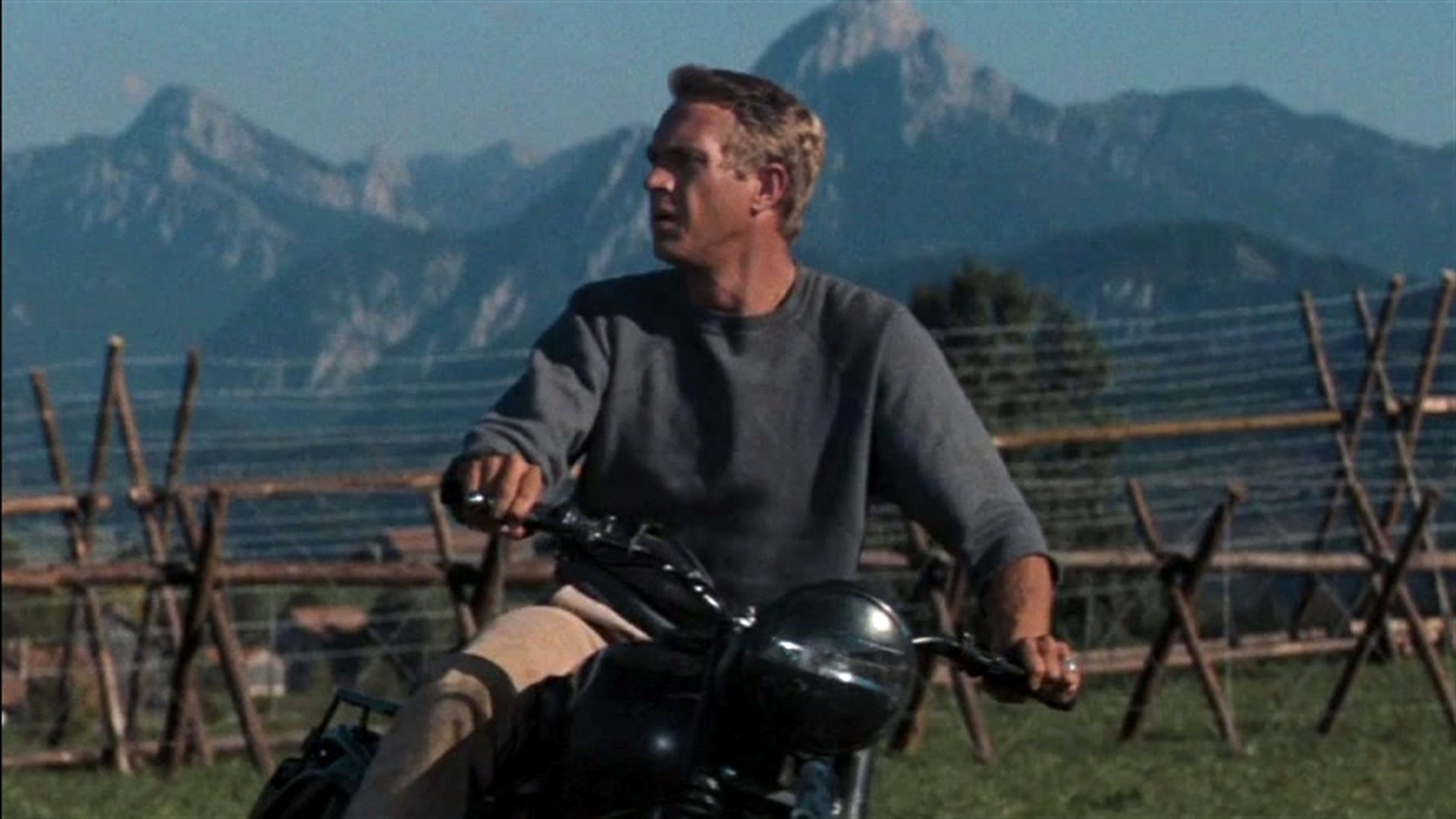
Shane (1953)

Alan Ladd as the mysterious gunslinger Shane

Director: George Stevens

Cast: Alan Ladd (Shane), Jean Arthur (Marian Starrett), Van Heflin (Joe Starrett), Brandon de Wilde (Joey Starrett), Jack Palance (Jack Wilson), Ben Johnson (Chris Calloway), Edgar Buchanan (Fred Lewis), Emile Meyer (Rufus Ryker), Elisha Cook Jnr (“Stonewall” Torrey), Douglas Spencer (“Swede” Shipstead), John Dierkes (Morgan Ryker), Ellen Corby (Liz Torrey)

On the surface Shane is pretty much the definitive “white-hat-black-hat” Western. Crikey, Jack Palance’s vicious gunslinger Wilson practically wears nothing but black. Alan Ladd’s heroic Shane does what needs to be done, and the kid loves him to bits. But Steven’s film is more complex and intriguing than that. Because Shane is in fact only a few degrees away from Wilson. When he rides into the homestead, he is already weighted down by the memory of all the people he’s killed. Shane is no saint. He’s a tired man whose shed too much of other people’s blood to ever feel anything but an outsider.

Shane arrives at the Starrett farm. Joey (Brandon de Wilde), the boy-of-the-house immediately hero-worships this mysterious stranger with the distinctive guns. Joe Starrett (Van Heflin) is at first hostile but takes Shane in as a farm worker and he and his wife Marian (Jean Arthur) – maybe particularly Marian – are drawn towards this reserved but good-natured man. Starrett and the other homesteaders are in the middle of a feud with local cattle rancher Rufus Ryker (Emile Meyer), who wants to drive them off the land so he can use it for his cattle. Violence seems inevitable – but how long can Shane keep his unspoken pact to himself to put down his guns and try a life of normality?

Shane is one of Steven’s finest films, beautifully filmed with Oscar-winning photography and told with a lavishly poetic sense. It works so well because it juggles both a simple story, with a deep poetic understanding of humanity. You can see why this is “a Western for those who don’t like Westerns”. It’s got a beautiful, understated sense of struggle to it – the homesteaders against the bullying of Ryker – beautifully mixed with a sense of the dangerous glamour of violence. Match that with some wonderfully hissable villains and the honesty and decency of the Starretts and Shane’s quiet dignity, and you’ve got a perfectly judged morality play.

But the film works because there is so much operating on multiple levels. Which brings us back to Shane himself. Sure, he’s a decent guy. We expect him to be the hero. He fulfils much of that function in the plot. He’s kind and loving with the kid. He holds his cool and never seems to get angry. But why is this? The film makes clear that Shane has a past. A past of gun-slinging violence. And if Shane is still standing at the end of a life like that, he must have been good. And ruthless.

What was it that made Shane so desperate for a change? To try a life of normality, chopping down stumps and putting up fences on a farm? I suspect Shane in his prime wasn’t that different from the calm, cool and ruthless Wilson. You can see the guilt in his eyes when he finally shoots his weapon (at a rock!) two thirds into the film. This is a man who knows that killing carries a terrible burden – and he clearly knows all too well after sending so many to their graves. At the end of the film, with his emotional pean to Joey (“There’s no living with killing”) he’s speaking from the heart. And only someone who has killed many, many people – who doesn’t look remotely worried when facing off with Wilson and Ryker – could really know that.

It’s an idea that you could miss in the film, but it’s there all the way through. The casting of Alan Ladd – who was never better – is crucial to the success of this. Imagine the strength and power a Wayne or Cooper or Stewart would have given Shane. They would never have felt so slight, or beaten down by a life of violence. But Ladd’s smallness, his sadness and his reluctance works for the part. Stevens continually shoots him as an outsider, on the edge of scenes or even isolated in crowds. He can fade into the background in the way other stars couldn’t have done. He feels like a man who knows he has been a moral failure, who isn’t redeemed by star quality.

Stevens plays with our expectations of Shane through the reactions of the Starretts. Joe is (tellingly) instinctively hostile to him at first, before Shane wins him over. Marian’s reaction is however fascinating. She is both slightly repelled by what she can see as Shane’s past violence, but also increasingly drawn towards him. Is this because Shane’s internal knowledge, his worldliness, his depths of sadness make him more of a thoughtful kindred spirit than her husband can be? Joe is a simple man, decent beyond words, but not a thinker. Shane is more – for all his danger – and Marian feels like a woman who has accepted her place but perhaps dreamed of more. She would never act on this, but Shane to her seems to represent a path not taken.

And Joey? Shane is everything a boy could dream of in a hero. The man with few words who appears over the horizon with nothing but a six shooter. Stevens camera cuts back again and again to Joey’s adoring, worshipping face – and it’s an excellent performance from (the Oscar-nominated) Brandon de Wilde, as a young boy on the edge of becoming a teenager who wants to be a man, but still looks with the eyes of a child. Stevens throughout places the audience on the same level with Joey. Like him we want to believe in Shane, to see him play the hero. It’s part of the films skilful construction that it finishes before it occurs to you that the character the audience most closely related to was the uncritical, unknowing child. On first viewing we stare at Shane with the same hero worship as Joey.

Shane wants a life of normality. Shane isn’t a million miles away from Eastwood’s revisionist Unforgiven. In fact, Munny’s life in that film is basically Shane’s, without Ladd’s humbleness. The brutal killer who wants to leave it all behind, but is dragged back in. Who finally faces off and guns down a horde of enemies in a saloon bar before riding off into legend. Sure, Shane will be remembed with more fondness by those he leaves behind – and he saves the homesteaders – but just like Munny he does it by leaving a trail of bodies behind him.

Steven’s beautiful film is both a compelling narrative of goodies and baddies, but also a profound, fascinating and challenging film. It’s wonderfully made and has a host of reliable actors at the top of their game. Ladd is superb, Jean Arthur brings great depth to Marian, Van Heflin’s Joe is a the sort of simple, decent, salt-of-the-Earth type the West was made of. Facing them, Jack Palance makes the most of limited screentime (and got an Oscar nomination) as the sneering, bad-to-the-bone Wilson. It’s a perfect mixture of small, intimate scale that seems to be taking place in an epic environment. It’s influence has been so profound it’s virtually an archetype. An American classic.

Lifeboat (1944)

The survivors face the weather, the sea and their own suspicions in Hitchcock’s Lifeboat

Director: Alfred Hitchcock

Cast: Tallulah Bankhead (Constance Porter), William Bendix (Gus Smith), Walter Slezak (Willi), Mary Anderson (Alice MacKenzie), John Hodiak (John Kovac), Henry Hull (Charles J Rittenhouse), Heather Angel (Mrs Higley), Hume Cronyn (“Sparks” Garrett), Canada Lee (Joe Spencer)

Spoilers: If you can spoil a film made 76 years ago… but the ending will be discussed

The middle of the Atlantic at wartime. A ship has been sunk by a German U-boat, which was itself sunk in the exchange. A single lifeboat picks up survivors, a mixture of passengers, crewmen – and a German sailor from the U-Boat. Low on food and water, with only a faint idea of where they are, can they survive long enough to find either land or another ship? That’s even before we can overcome questions of trust – or not.

Taken from a scenario written by John Steinbeck, Alfred Hitchcock was originally attracted to Lifeboat because he fancied the idea of directing a film that was set in only one location. And a tiny one at that! Needless to say, such is the imagination and skill the film has been made with that you will soon forgot that it all takes place effectively in one tiny room. Instead, as the camera skilfully cuts and moves through the boat, finding intriguing angles and never once let the pace slip, you’ll be sucked in this intriguing story of survival and morality.

Lifeboat was attacked at the time precisely because of these difficult questions of morality. Unlike many other war films of the time, it wasn’t just interested in propaganda. Instead the German here – later revealed to be the captain of the U-Boat – is not only the films most charming and engaging character, brilliantly played by Walter Slezak, he’s also the only one that has any real idea about how to survive. Need a sailor? He’s best qualified. A navigator? The only man with a clue. Need to lop a gangrenous leg off? Willie can do it with a pen knife. His resourcefulness needs to be weighed in the balance though with his lies, manipulations and hording of supplies.

But the fact the film presents us with a Falstaffianly rogueish German, rather than a monster – and also makes him the most effective of the survivors – was a problem at the time. Combined with the fact that the representatives of the allies are a mixed and divided back. A chippy socialist sailor. A decent but ineffective radio operator. A jobsworth nurse, possibly carrying someone else’s husband’s child. An ambitious gossip columnist. An industrialist who assumes he should call the shots. And a black steward who even needs to take a moment to think about before they decide to treat him as an equal, or even use his real name. A unified and decisive group of allies, this ain’t.

The events of the film then develop in a host of challenging ways. Sure, our heroes eventually come together – but its in a murderous fury that sees them lynch Willie, beat him to death and throw him overboard. Willie saves their lives – but he also hordes water and then persuades the delirious Gus (whose leg he amputated) to throw himself overboard when Gus spies his secret water stash.

This lynching scene is the heart of the film – indeed most of the action is a slow, tension-filled, build towards it. And, for all that Willie is a seemingly unrepentant Nazi (dropping broad hints about having spent some time in Paris) who we are told ordered the shooting of survivors in the water, its hard not to feel some sympathy for him as Hitchcock cuts to a close up of his horrified eyes as he realises what the passengers are about to do. Just as the passengers, waking to find Gus gone and Willie assuring them it was for the best, take a on a monstrous inhumanity as they murder him.

Hitchcock described them later as a pack of dogs. Of the passengers, alarmingly it’s the two most decent (Hume Cronyn’s gentle radio operator and Mary Anderson’s nurse) who turn the most savage in the onslaught. Only Joe – perhaps remembering other lynchings he may have witnessed? – keeps a horrified distance from the slaughter. In a traditional propaganda film, as many critics wanted at the time, this would be a moment of triumph. The allies coming together to vanquish their common foe.

Instead, it intentionally leads a queezy and unsettling taste in the mouth. Hitchcock seems to be challenging us to ask just how we feel about this. Willie has done terrible, greedy, awful things. He’s got a lot of blood on his hands. But do we feel its right for these guys to murder him – and as brutally as they do here? (Hitchcock shoots the lynching at a distance, the passengers descending on Willie like a mob, his bloodied face emerging at one point before being dragged back in). There is nothing really triumphant about this. And, after the deed, no one seems sure how to process it. Rittenhouse even suggests Willie deserved his fate for his ingratitude after they hauled him from the water.

As safety is finally found near the end, it’s not clear what anyone has learned. The whole ghastly cycle looks like it might be repeated when a young German sailor is hauled onboard after another supply ship is sunk. Some passengers are ready to butcher him immediately – the sailor fortunately is armed. Sanity just about prevails, but already the passengers are beginning to revert, right down to starting to address Joe by the common short-hand name for a black steward, George.

But then at the same time, it’s not as simple as that. After all, these German sailors sunk a ship killing hundreds of people. During the first night on the boat a baby dies in his mother’s arms – the mother then throws herself overboard the next night, despite the passengers attempt to restrain her. Those deaths are discussed again at the end when the passengers obliquely wonder if they did the right thing. The film won’t say for sure, but leave it to you to decide. And it’s that rich sense of unease that helps make this a rather overlooked masterpiece for Hitchcock. A lot more than just a technical triumph, it’s a searching and questioning film.

Braveheart (1995)

Braveheart (1995)

Gibson’s Oscar-winning epic mixes great action and bad everything else – how did it win?

Director: Mel Gibson

Cast: Mel Gibson (William Wallace), Sophie Marceau (Princess Isabelle), Patrick McGoohan (Edward I), Angus MacFadyen (Robert the Bruce), Brendan Gleeson (Hamish), David O’Hara (Stephen), James Cosmo (Campbell), Peter Hanly (Prince Edward), Catherine McCormack (Murron MacClannough), Ian Bannen (Bruce’s Father), Sean McGinley (MacClannough), Brian Cox (Argyle Wallace)

Think back to 1994 and a time when no one really knew who William Wallace was and Mel Gibson was the world’s favourite sexy bad-boy. Because by 1995, William Wallace had become the international symbol of Scottish “Freedom!” and Mel Gibson was an Oscar-winning auteur. Can you believe a film like Braveheart won no fewer than five Oscars, including the Big One? History has not always been kind to it – but then the film was hardly kind to history, so swings and roundabouts.

It’s the late 13th century and Scotland has been conquered by the cruel Edward I (Patrick McGoohan) – a pagan apparently, which just makes you think that Gibson and screenwriter Randall Wallace simply don’t know what that word means. William Wallace (Mel Gibson) saw his whole family killed, but now he’s grown and married to his sweetheart Murron (Catherine McCormack). In secret, as the wicked king has introduced Prima Nocte to Scotland, giving English landlords the right to do as they please with brides on the wedding night. When Murron is killed after a fight to avoid her rape, Wallace’s desire for revenge transforms into a crusade to win Scotland its freedom. A brilliant tactician and leader of men, battles can be won – but can Wallace win the support of the ever-shifting lords, such as the conflicted Robert the Bruce (Angus MacFadyen)? Will this end in freedom or death?

Even in 1995, Braveheart was a very old-fashioned piece of film-making. You can easily imagine exactly the same film being made (with less sex and violence) in the 1950s, with Chuck Heston in a kilt and a “Hoots Mon!” accent. In fact, watching it again, I was struck that narratively the film follows almost exactly the same tone and narrative arc as Robin Hood: Prince of Thieves – with the only difference being if that film had concluded after the Sheriff’s attack on Sherwood Forest with Robin Hood gutted alive in the streets of Nottingham.

This is a big, silly cartoon of a movie, that serves up plenty of moments of crowd-pleasing violence, low comedy, heroes we can cheer and villains we can hiss. Mel Gibson, truth be told, sticks out like a sore thumb with his chiselled Hollywood looks and defiantly modern mannerisms. The film takes a ridiculously simplistic view of the world that categorises everything and everyone into goodies (Wallace and his supporters) and the baddies (almost everyone else).

It’s also far longer than you remember it being. It takes the best part of 50 minutes to build up to Wallace going full berserker after the death of his wife. A later section of the film spends 30 minutes spinning plates between Wallace being betrayed at the Battle of Falkirk and then being betrayed again into captivity (you could have combined both events into one and lost nothing from the film). There is some lovely footage of the Scottish (largely actually Irish) countryside, lusciously shot by John Toll and an effectively Celtic-influenced romantic score by James Horner. In fact, Toll and Horner contribute almost as much to the success of the film as Gibson.

Gibson is by no means a bad director. In fact, very few directors can shoot action and energy as effectively as the controversial Australian. The best bits of Braveheart reflect this. When he’s shooting battles, or fights, or brutal executions he knows what he’s doing. Even if I’d argue that Kenneth Branagh managed to make much less than this look more impressive in Henry V. The battles have an “ain’t it cool” cheek to them, that invites the audience to delight in watching limbs hacked off, horses cut down and screaming Woad-covered warriors ripping through stuffy English soldiers. It’s probably not an accident that the film channels more than a little bit of sport-fan culture into its Scottish warriors.

Where Gibson’s film is more mundane is in almost everything else. The rest of the film is shot with a functional mundanity, mixed with the odd sweeping helicopter shot over the highlands. Its similarities to Robin Hood: Prince of Thieves are actually really strong, from the matey bonhomie of the gang at its heart, its pantomime villain, the moral certainty of its crusades and the fact that Mel Gibson is no more convincing as a 13th-century Scot than Kevin Costner was as Robin Hood. But at least Prince of Thieves knew it was a silly bit of fun. Braveheart thinks it’s got an important message about the immortality of Freedom.

Alongside that, it’s a film that focuses on giving you what you it thinks you want. Gladiator – in many ways a similar film – is a richer and more emotional film, not least because it has the courage to stick to being a film where the hero is faithful to his dead wife and whose triumph is joining her in death. In this film, there are callbacks throughout to the dead Murron – but it doesn’t stop Wallace banging Princess Isabelle, or the film using the same sweeping romantic score to backdrop this as it did for the marriage of Murron and Wallace. What on earth is it trying to say here?

It goes without saying that the real Wallace did not have sex with Princess Isabelle and father Edward III – not least because the real Isabelle was about ten when Wallace died and I’m not sure putting thatin the film would have had us rooting for Wallace. Almost nothing in the film is historically accurate. Wallace is presented as a peasant champion, when he in fact was a minor lord (the film even bizarrely keeps in Wallace travelling Europe and learning French and Latin – a big reach for a penniless medieval Scots peasant). Even the name Braveheart is taken from Robert the Bruce and given to Wallace. The Bruce himself – a decent performance by Angus MacFadyen – is turned into a weak vacillator, under the thumb of his leprous Dad (a lip-smacking Ian Bannen).

The historical messing about doesn’t stop there. Even Wallace’s finest hour, the Battle of Stirling Bridge, is transformed. The film-makers apparently felt the vital eponymous bridge “got in the way” – a sentiment shared by the English, who in reality were drawn into its bottleneck and promptly massacred. Instead we get a tactics free scrap in a field – fun as it is to watch the Scots lift their kilts, it hardly makes sense. The Scots culture in this film is a curious remix of about five hundred years of influences all thrown into one. Prima Nocte never happened. The real Edward II was a martial superstar – but here is a fey, limp-wristed sissy (the film’s attitude towards him stinks of homophobia). Almost nothing in the film actually happened.

But the romance of the film made it popular. It’s a big, crowd-pleasing, cheesy slice of Hollywood silliness. The sort of film where Wallace sneaks into someone’s room at the top of a castle riding a freaking horse and no-one notices. It tells a simple story in simple terms, using narrative tricks and rules familiar from countless adventure films since The Adventures of Robin Hood. It looks and sounds great, enough to disguise the fact that it isn’t really any good. Because it has a sad ending, scored with sad music, it tricked enough people to think it had depth and style. In fact is a very mediocre film, hellishly overlong, that turns history into a cheap comic book. It remains in the top 100 most popular films of all time on IMDB. It’s about as likely an Oscar winner as 300.

Lincoln (2012)

Daniel Day-Lewis gives on the great transformative performances as Lincoln

Director: Steven Spielberg

Cast: Daniel Day-Lewis (Abraham Lincoln), Sally Field (Mary Todd Lincoln), Tommy Lee Jones (Thaddeus Stevens), David Strathairn (William Seward), Joseph Gordon-Levitt (Robert Lincoln), James Spader (WN Bilbo), Hal Holbrook (Preston Blair), John Hawkes (Robert Latham), Jackie Earle Haley (Alexander Stephens), Bruce McGill (Edwin Stanton), Tim Blake Nelson (Richard Schell), Joseph Cross (John Hay), Jared Harris (Ulysses S Grant), Lee Pace (Fernando Wood), Peter McRobbie (George Pendleton), Gloria Reuben (Elizabeth Keckley), Jeremy Strong (John Nicolay), Michael Stuhlbarg (George Yeaman), David Costible (James Ashley), Boris McGiver (Alexander Coffroth)

It took me three viewings until I felt I got Lincoln. Previously – in the cinema and the first time at home – I respected it. I admired the skill with which it was assembled. But I had found it hard to see it as much more than a critically acclaimed civics lesson, Spielberg at his most prestige. Returning to it the third time with the pressure well and truly off, suddenly I discovered a film I’d never seen before, an intensely dramatic telling of the perilous struggle to pass the Thirteenth Amendment to abolish slavery. A vibrant, beautiful and surprisingly intense story of how close Congress came to vetoing it. What had seemed a stuffy museum piece, instead came to life as a dramatic piece of cinema. It goes to show you should never be afraid to give something another go. Or two.

This biopic of Lincoln goes down a very modern route of avoiding covering the Great Man’s entire life. Instead it zeroes in on little more than a crucial month. It’s January 1865 – in what we know are the final months of the President’s life – and Abraham Lincoln (Daniel Day-Lewis) confronts a terrible choice. Civil war has torn America apart for year and peace may be on the horizon. But Lincoln fears a reformed America, with all its Southern slave states back in the fold, will find a way to end his Emancipation Proclamation and restore slavery to its height. To prevent this, Congress must ratify the Thirteenth Amendment to the Constitution ending slavery. But, with many in Congress worried that such an Amendment will end any chance of peace, Lincoln is in a terrible position. Should he sacrifice peace for abolition? Or vice versa? Either way, it will be a no-holds barred fight on the floors of Congress.

Spielberg’s film is near perfect in its shooting and editing, while its historical detail is brilliantly on-point. You couldn’t fault a moment of its making. However, what makes the film a success is the director’s skilful ability to combine graceful (even stately) old-fashioned film-making expertise, with a truly compelling sense of the passions and dangers we face when democracy is in action. And the overwhelming tension when the stakes are high and we have no guarantees of the end result. Another film – the stately civics lesson I once took the film for – would have shown the passage of the bill as a Whiggish inevitability, a progress filled march to a better world.

Lincoln isn’t like that. This is a film that shows politics then and politics now ain’t that different. For every principled man, there a dozen looking out for the main chance, marking time or who are too scared to worry about right and wrong. The Amendment is delivered not by impassioned oratory from the President. It’s carried by skilled floor management and the employment of a trio of political lobbyists with briefcases stuffed with cushy job offers in the rebuilt America.

Votes are brow-beaten out of people, threats and persuasion are used in equal measure. There is no winning people over with poetic oratory. At one point, Lincoln makes a simple and heartfelt plea for one congressmen to do the right thing: the guy votes against him. One of the film’s moments of triumph sees fervent abolitionist Thaddeus Stevens refuse to be provoked into expressing his true views on the floor, instead offering a statement that he does not believe in equality “in all things”, knowing any other answer will be used to build opposition against the bill. Is there any other film in American politics where one of the biggest cheer moments is one of our heroes compromising and spinning his true views into something far less threatening?

It’s all part of the film’s demystification of American history as not being something made from marble, but instead being real and true. If anything though, this sense of realism – of danger and the very real possibility of defeat – makes the final vote (a long sequence that almost plays out a congress vote in real time) both far more dramatic and also surprisingly moving. Because we appreciate every step of the backroom handshakes, fights, compromises and (let’s be honest) corruption and shady deals that got us here. And, more than anything, the film has made clear Lincoln is willing for this brutal war (the horrors of which, both in battle and bloody aftermath, intrude at key points in the film) to go on for as long as it takes, to ensure this Amendment.

Lincoln is the heart of the film: and it’s almost impossible to state how central Daniel Day-Lewis is to the film’s success. This is an extraordinary performance. I don’t think you can understate how venerated Lincoln is in the American memory. With his distinctive features and a permanent memory of him sitting like a marble God in the centre of Washington, it’s hard for many to imagine that this was ever a real man. But Day-Lewis has turned in a performance here that transforms Lincoln into a living, breathing man but never once compromises his greatness.

From the voice (a wispy lightness, a million miles from the deep, Shakespearean accent you would expect – and entirely accurate) to the ambling walk, to the film’s embracing of Lincoln’s eccentric monologing, his love of whimsy and jokes, his autodidact passion for language, his warmth and love for his family – and his righteous anger when frustrated by those who cannot see the big picture – this is extraordinary. Day-Lewis is compelling in a way few actors can be. His Lincoln is superbly human. Every moment is beautifully observed, but this is so much more than an actor’s tricks. His Lincoln is someone you can come out of the film convinced that he was talking to you, that you understand him as a human being not a cipher. I felt I knew and understood Lincoln more from watching this film than I ever had from a history book. It’s breathtaking.

Of course it inspires everyone else in the cast to give their best. The at times difficult marriage between Lincoln and his wife gives some wonderful material for Sally Field (easily her finest performance in decades). Mary Todd Lincoln is aware she will always be a disappointment for her husband as a partner, but equally feels that her public mourning for this lost child speaks of a deeper humanity than her husband. Loyal if questioning, she’s also abrupt and clumsy enough at times to be a liability.

Tommy Lee Jones is exceptional as Thaddeus Stevens, prickly, difficult but also morally pure (the film has helped rediscover the unjustly overlooked Stevens). Previous Lincoln performers Strathairn and Holbrook give very good support. James Spader is great fun as colourful lobbyist. Joseph Gordon-Levitt is all restricted ambition as Lincoln’s son. Jared Harris shines in a few scenes as Grant. Gloria Reuben has a few beautiful moments as Mary’s confidante Elizabeth Keckley.

Lincoln is a film shot with all the prestige of an American Merchant-Ivory, in love with the power of democracy. But it’s also open-eyed on how a system like America’s works, and how perilous delivering “the right thing” can be. Emotional and engrossing, it’s powered above all by a towering sublime performance by Daniel Day-Lewis who might as well be the 16th President reborn. It took me three viewings to see the richness here – but I am so glad I stuck it out.

Vita and Virginia (2018)

Gemma Arterton and Elizabeth Debicki struggle to bring a love story to life in Vita and Virginia

Director: Chanya Button

Cast: Gemma Arterton (Vita Sackville-West), Elizabeth Debicki (Virginia Woolf), Isabella Rossellini (Lady Sackville), Rupert Penry-Jones (Harold Nicholson), Peter Ferdinando (Leonard Woolf), Gethin Anthony (Clive Bell), Emerald Fennell (Vanessa Bell), Adam Gillen (Duncan Grant), Karla Crome (Dorothy Wellesley)

The love affair between Bloomsbury group writers Vita Sackville-West (Gemma Arterton) and Virginia Woolf (Elizabeth Debicki) inspired a successful epistolatory play by Eileen Atkins. It’s got all the elements you need for a love story: sadly none of those make their way into this limp, lethargic, languid film which drains any trace of passion from its material.

Where did it all go so wrong? The film expands the plays concept (two actors performing the various letters between the two lovers) into a series of conversations and throws in as characters the other members of the Bloomsbury circle. Sadly, what it fails to do is convey a sense of joi d’vive to any of this. The Bloomsbury crowd not only come across as pompous bores, but they never even really seem to be enjoying themselves. They certainly find it hard to get passionately worked up about any of these marvellous artistic ideas we keep being told they are having. The only thing we really see them talk about is sex, probably because it’s easier to put that on screen than writing.

The failure of the film is increased by the sadly misjudged performances by the two actors at its heart. It’s already a struggle to get any sense of chemistry between these two – I can’t put my finger on why this is, but there isn’t the undefinable ‘spark’ between them. Perhaps it’s partly because they both choose such wildly diverse acting styles, that their scenes never quite click together.

Debicki goes for a stately fragility, mixed with an emo waviness and seems to be playing every scene as if she subconsciously stating “my character committed suicide you know”. Arterton seems to try and compensate for Debicki’s overstated lip wobbling, by going for a jolly hockey-sticks brashness. Neither performance compliments the other and the effect is feeling like two very good actresses feeling constrained in different ways by the material.

It’s not helped by the flatness of much of the filming. I’ve seen Chanya Button’s work elsewhere (notably on television with some great work on WW2 drama World on Fire), but here she seems uncertain how to bring visual interest to this story. Too many scenes are shot with a murky lack of visual interest. Moments of letter reading are presented as the actors addressing the camera. Stylistic flourishes – such as Virginia’s visions of swiftly growing vines at moments of emotion – seem to come out of nowhere and jar with much of the rest of the traditionalism of the rest of the filming.

So instead, two fascinating intellectuals end up coming across as slightly self-absorbed bores in a relationship that never catches fire. Most of the rest of the cast fail to make an impact: Rupert Penry-Jones gets closest as Vita’s husband who oscillates between embracing their open marriage and demanding a wife who will fulfil a more traditional role. But for the rest, it’s hard to get any sense of their personalities with some performances – especially Adam Gillen – tipping too far into gurning comedy.

The general lifelessness of the film is made somehow even worse by the bizarrely left-field score. It’s a strikingly anachronistic slow-paced drum-and-base inspired sound that wouldn’t seem out of place in the late hours of a nightclub. Here it not only feels horrendously out of place – not least because it’s the only anachronistic touch either in the film-making of the performances, which are otherwise scrupulously correct – but it’s incessant throbbing beat actually helps make the film even slower, as if you were watching it in a slightly intoxicated haze.

Vita and Virginia should really have crackled with the vibrancy of the real-life characters and the passion of their love for each other and their shared ideas. Instead it’s a tedious bore that never sparks into life.

Odds Against Tomorrow (1959)

Harry Belafonte, Ed Begley and Robert Ryan are a mismatched crime team in Odds Against Tomorrow

Director: Robert Wise

Cast: Harry Belafonte (Johnny Ingram), Robert Ryan (Earl Slater), Shelley Winters (Lorry), Ed Begley (Dave Burke), Gloria Grahame (Helen), Will Kuluva (Bacco), Kim Hamilton (Ruth Ingram), Mae Barnes (Annie), Richard Bright (Coco), Carmen de Lavallade (Kitty), Lew Gallo (Moriarty)

Johnny Ingram (Harry Belafonte) life is on the skids. His career as a singer isn’t bringing in the money to fuel his gambling addiction or help support his ex-wife. Owing money to gangsters, he’s roped into taking part in a bank heist master-minded by bitter ex-cop Dave Burke (Ed Begley). It should all go smoothly. Unfortunately, Burke has also recruited Earl Slater (Robert Ryan) as muscle – and Slater has channelled all his own insecurities and resentments into virulent racism. Can Johnny and Slater work together to make the heist work?

Wise’s picture – with a script by the black-listed Abraham Polonsky – is on paper a crime drama. But it’s really hardly interested in the heist (which is almost laughably simple) the planning of which doesn’t even start until the film is nearly an hour old. Instead, the focus is on putting together a neat parable for racial divide in America. Because if even criminals are more preoccupied with feuding over the question of the colour of each other’s skin than making a score, why on Earth should we be surprised that such problems arise in every walk of life?

Attitudes are mapped out early in the film, largely thanks to Wise’s crisply efficient story-telling. Ingram playfully tips off a group of mixed-race kids to watch his car; Slater singles out a black child from this same group with a smilingly delivered racial epitaph. In the building, they both have strikingly different conversations with a black elevator attendant. Its clear tensions will abound – not least because Slater won’t work a job with a black man and Ingram is rightly disgusted with him.

Belafonte produced the film and he plays a very different type of black American than most films had seen. Black characters frequently fell into being either noble or deferential. Johnny is neither. He’s angry, bitter, drinks and has no interest in compromise of any sort. Johnny is a deeply troubled man, who seems to be making a mess of his life. Above all he doesn’t rise above racial abuse or shrug it off, but angrily confronts it. Fundamentally he’s a chippy screw-up, but he always retains sympathy because we can see he’s really a decent guy, for all his faults.

He’s just not one who’s willing to play the white man’s game to get ahead. He’s quite clear with his wife (very effectively played by Kim Hamilton) that he’s not willing to simply conform with a structurally unfair world. He’s also quite clear with Slater that he doesn’t want to hear whimsical memories of the South during the ‘good old days’. Belafonte does all this with a great deal of energy, even if you feel he doesn’t quite have the range and power for the role.

It’s interesting though that the film finds plenty of room to explore Slater. Played with a fragile self-loathing by Robert Ryan (one of Hollywood’s great liberals, whose career was made up of characters who persecuted minorities), Slater is deeply unsettled and insecure. He’s struggling to adjust to a more modern world where the man isn’t always the hunter-gatherer, and his wife (a rather sweet Shelley Winters) has the fixed job he can’t get. He doesn’t understand the world anymore.

All this makes Slater vulnerable, confused and even a bit pitiable – all qualities Ryan effortlessly brings out in the film’s finest performance – stumbling into bar fights where he responds with far too much violence. His face constantly seems to crumble into something a little like tears. He engages in a brief fling with a flirtatious neighbour (a blowsy Gloria Grahame) simply, it seems, to try and feel better about himself. The only thing that give him strength, it seems, is turning Johnny and all other black people into an alien “other” which he can lambast and attack.

This of course leads to barely concealed tensions during the robbery planning – where Slater repeatedly states he doesn’t trust Johnny to complete anything – and then during the robbery itself when the fundamental distrust between these two leads to a shoot-out and disaster. Caught in the middle, in a polished performance, is Ed Begley’s Burke, lacking the force of character to make this odd couple work together.

Wise’s film sometimes make some obvious choices – after the final climactic shoot-out, a policeman comments “which is which”, which is about as “under the skin we’re all the same” as you can get. But it’s told with a leanness and pace and by focusing on social issues rather than crime, it presents an intriguing snapshot of American attitudes. The vast majority of characters don’t share Slater’s kneejerk racism – but they also don’t even think of challenging it. No wonder Johnny Ingram’s so annoyed – and no wonder he sees that, for all the smiles, it’s a world run by and for the white man where your only chance of success is conform and shut up. Maybe the odds are against tomorrow.

Watchmen (2009)

Watchmen (2009)


Morally complex heroes in Zach Snyder’s visually impressive but slightly empty Watchmen

Director: Zach Snyder

Cast: Malin Åkerman (Laurie Jupiter/Silk Spectre II), Billy Crudup (Jon Osterman/Dr Manhattan), Matthew Goode (Adrian Veidt/Ozymandias), Jackie Earle Haley (Walter Kovacs/Rorschach), Patrick Wilson (Daniel Dreiberg/Nite Owl II), Jeffrey Dean Morgan (Edward Blake/Comedian), Carla Gugino (Sally Jupiter/Silk Spectre), Matt Frewer (Edgar Jacobi/Moloch), Stephen McHattie (Hollis Mason/Nite Owl)

If you asked people to name the greatest Graphic Novel Ever, chances are they would come up with Alan Moore’s Watchmen. This scintillating deconstruction of superheroes and the morality of caped avenging satirises what the impact of superheroes in a real world might be. It had taken decades – and several cancelled attempts – to get a version to the screen. So, if nothing else, Zach Snyder deserves plaudits for merely persuading Hollywood executives to get this expensive, R-rated, morally complex film to the screen. Sure, the final result isn’t perfect, but it’s got a fair bit going for it.

Watchmen is set in an alternative 1985 where Richard Nixon is serving his fourth term and the Armageddon of Nuclear war is just around the corner. Masked vigilantes had been a common sight on the streets – although banned since 1977. The Vietnam war was won (in a few days) by the God-like Dr Manhattan (Billy Crudup), a scientist granted superhuman powers in 1959 after an accident with a field generator. Most other vigilantes are retired, other than right-wing bully the Comedian (Jeffrey Dean Morgan). When the Comedian is murdered by a masked intruder, his fellow members of superhero group the Watchmen, worry someone is eliminating them for reasons unknown.

Snyder’s Watchmen is a visual feast. Snyder – a huge fan of the graphic novel – used it as a visual bible, quoting it in several frames. The film is a beautiful mix of dark, filmic visuals and striking comic book primary colours, while frequently embracing the inky black murkiness of the violent world its depicting. Shot with the same high energy and dynamism as 300, Snyder’s ability to turn pulpy Warhol inspired visuals into fast-paced, filmic action is second-to-none.

What however is more of a shame is the feeling that the main things in Watchmen that interest Snyder might be the visuals. Where the film sometimes fails to come to life is where it deals with the complex morality of its heroes. The original deconstructed the morality of heroes. How a man with the powers of a God could come to look on humanity with an (albeit affectionate) distance. How a masked PI would be so convinced that right and wrong were certain that he would be willing to carry out acts of bone-crunching violence. That a hero could calculate sacrificing millions of lives for the greater good isn’t just acceptable, its recommended. That for others the exhilaration of spending their nights beating up criminals is an escape from the mundane realities of life.

The problem is that Watchmen never quite gets to the heart of these moral questions, of really tackling the rights, wrongs and shades of grey of those ethical quandaries. Rather than delving into them, ideas are too often stated. While its daring for a film to include heroes who are as deeply flawed, violent and, at times, even as unpleasant as this – it still doesn’t quite flesh out the complexities of this.

Too often the film takes a naughty pleasure in its violence and brutality, seeing that as a short-hand for presenting a morally unclear world. And at times wants us to go “how cool is that!” rather than asking “should I be enjoying watching indiscriminate slaughter from a vigilante”. Its telling that the recent HBO series of Watchmen – a sequel to the Graphic Novel set in the modern world – feels more like a true adaptation of the source material than this. That dealt with fascinating ideas about race in America, morality and acceptable sacrifices for the greater good (and still managed to work in plenty of action). By comparison, this film of the source material itself feels less deep. Now of course run time is part of that, but it should have been possible to make a film this long that more successfully combined ideas and visuals.

Snyder’s passion for the material is clear – but the film is often a little too obvious. From cuts to musical cues, it’s a film that pushes the envelope only in terms of its look and feel. It tries its best, but its vision of transmitting the depths of the original sometimes seem to stop at a faithful visual rendition of its style.

But it’s made with a lot of love and passion, not least in the acting. The decision to go largely with unknown actors pays off very well. Earle Haley brilliantly channels his character from the graphic book, a prickly obsessive with an unshakeable moral certainty. Crudup perfectly conveys the vast moral distance a real Superman would probably feel towards normal people. Goode’s chilling coldness and arrogance is perfect. Wilson gives the film heart as the closest thing to a genuinely decent guy. Åkerman does her best with a part that feels slightly underwritten and at times a plot requirement, largely defined by the emotions she provokes in the male character.

There are plenty of excellent moments in Watchmen but I’m not sure it ever really, truly becomes its own thing (in the way the HBO series did manage to do). In trying to so completely ape the visuals, and fit in all the plot, it becomes a companion piece rather than a stand-alone production. If Snyder had perhaps had a bit more courage to tack away from the strict structures of the original source material it could perhaps have helped make a stronger film. However, saying that I can imagine the fans hitting the roof if he had… And Snyder’s ability to persuade the studio to make a film with such a nihilist feel and ending is to be commended. Watchmen is a mixed bag, but when it works it does work well.

Jurassic Park (1993)

Jurassic Park header
Dinosaurs walk the Earth once more in Spielberg’s classic blockbuster Jurassic Park

Director: Steven Spielberg

Cast: Sam Neill (Dr Alan Grant), Laura Dern (Dr Ellie Satler), Jeff Goldblum (Dr Ian Malcolm), Richard Attenborough (John Hammond), Bob Peck (Robert Muldoon), Joseph Mazzello (Tim Murphy), Ariana Richards (Lex Murphy), Samuel L. Jackson (Ray Arnold), Wayne Knight (Dennis Nedry), Martin Ferrero (Donald Gernaro), BD Wong (Dr Henry Wu)

Can you imagine a more exciting film for a 12-year-old boy, than one with dinosaurs walking the Earth once more? And not the sort of rubbery dinosaurs, that we always knew were really models, in classic films. I was 12 when I first saw this film, and these animals really did look 65 million years in the making: they felt real, with roars that deafened the ears and footfalls that made the cinema shake. Dinosaurs are hugely exciting, awe-inspiring beasts. So much so you can forget many of them were also ruthless killers, with really sharp pointy teeth. It’s that mixture of awe and terror that Steven Spielberg understands so well in this exceptional blockbuster, like he mixed Close Encounters and Jaws together in a lab and then let it run loose.

Boffins have worked out a way to clone dinosaurs from frozen DNA, stuck inside prehistoric mosquitoes. Naturally, what else would you do with this discovery but use it to create the most exciting theme park ever seen. What could possibly go wrong? Avuncular billionaire John Hammond (Richard Attenborough) has built the park – and he wants scientists and archaeologists Alan Grant (Sam Neill), Ellie Satler (Laura Dern) and Ian Malcolm (Jeff Goldblum) to give it the thumbs up. Sadly however things are set for disaster during a long, low-staffed weekend when an act of industrial espionage by disgruntled employee Nedry (Wayne Knight) leads to all control over the par being lost and the dinosaurs turning on the guests.

The rights to Chrichton’s novel were sold before the book was published, and it’s classic Chrichton set-up of science trying to play God, and landing us all in a moral quagmire and massacre. But first though, let’s not forget how awe-inspiring dinosaurs actually. It’s a long wait until we see any more detail of one than a fearsome eye. But when we do, Jurassic Park knows that for that brief moment we are all children again. As John Williams’ triumphant theme thunders out, and the characters stagger with breathless, tearful excitement in its wake, a Brachiosaurus towers over the screen. Spielberg’s camera perfectly hammers home the sense of wonder at the size and beauty of this gentle giant. Sure science is arrogant, but then if it wasn’t we’d never reach the stars, right?

Spielberg’s film though isn’t just an awe-inspiring modern-day Planet Earth. Because the makers of this park also created plenty of fierce monsters, from the mighty T-Rex to the scarily smart and vicious velociraptors. And if the first half of the film is about the magic – that imperious brachiosaurus, a sleeping triceratops, a baby velociraptor emerging from its egg – the second half is about the horror of finding out what happens when man’s hubris comes back and (literally) bites him in the ass (and plenty of other places). Because when the Raptors get lose, suddenly this park isn’t magic, but a terrifying death-trap where the guests are the prey to out-of-control exhibits.

The second half of the film – from the moment the T-Rex bursts through its non-functioning electric fence to rip apart two jeeps (and of course eat a lawyer cringing on the toilet) – is a terrifying, giddy, exciting monster-chase, with a director who hasn’t delighted this much in the relentless horror of nature since Jaws. And Spielberg gets to play every game here. Huge dinosaurs stomping on cars. Velociraptors playing ruthless hide-and-seek in isolated power houses. Open spaces becoming terrifying hunting grounds and everyday ones like kitchens become terrible traps. What chance do human beings have when there are “clever girls” like the raptors running around?

Jurassic Park is singularly responsible for elevating the raptor, a previously largely unknown dinosaur, to the front rank of dinosaur fame. There is always a romantic appeal to the T-Rex. It’s the king after all, the biggest and the most famous – and its status in the public perhaps reflects the fact that the film sort of asks us to root for it. After all, it only eats the lawyer. And when the final act comes, it’s the T-Rex’s intervention that saves our heroes bacon. The real monsters are the raptors: supremely clever (they can open doors!), totally ruthless, they hunt in packs, they move super-fast and they look like a disturbing mix between bird, human and lizard. Spielberg makes them one of the most terrifying monsters in film, that more than live up to their extended build-up.

Spielberg directs the entire film with his usual devilish wit and fiendish mastery of the set-piece. The film draws some neat, if simple, story-lines for its human characters. Will Dr Grant overcome his aversion to children? Each of them gets a snippet like this. The actors are often (literally) in the shadow of the dinosaurs, but they are big part of communicating the sense of awe. Neill and Dern go through the motions with a certain charm. Goldblum steals most of his scenes as a rock ‘n’ roll physicist, riffing in the way only he can. Richard Attenborough reinvented himself from a career of creeps to cuddly grandad as a Hammond who shares nothing but his name with the book’s ruthless capitalist.

But the real stars are the dinosaurs. And even almost thirty years on, the special effects are really breath-taking here. These feel like real, living, breathing creatures, and Spielberg knows how to shoot them. Even today it still casts quite a spell. It’s telling that none of the sequels, except Jurassic World (which was made by the people who grew up on this film) gets near to matching the mix of magic and horror that this one hits. Sure, it’s a film so confident of success that it fills one scene with shots of the park merchandise (available in a shop near you now!), but then that’s because it’s got a master at the helm and the greatest attractions in 65 million years.

With its underlying plot of the dangers of mankind’s hubris – plus some rather witty criticism of how a park reliant on wild animals might have struggled to work anyway if the dinosaurs refused to emerge from the shadows of their huge paddocks for the tourists – Jurassic Park gives you something to think about, while still terrifying you with ruthless monsters. It’s a classic.]

Odd Man Out (1947)

James Mason is wounded and on the run in Odd Man Out

Director: Carol Reed

Cast: James Mason (Johnny McQueen), Kathleen Ryan (Kathleen Sullivan), Robert Newton (Lukey), Robert Beatty (Dennis), Cyril Cusack (Pat), FJ McCormick (Shell), William Hartnell (Fencie), Fay Compton (Rosie), Denis O’Dea (Inspector), WG Fay (Father Tom), Maureen Delaney (Theresa O’Brien), Dan O’Herlihy (Nolan), Elwyn Brook-Jones (Tober)

Is it set in Belfast, or is it set in Purgatory? We follow in the footsteps of Johnny McQueen (James Mason), a leader of “the organisation” (the IRA by another name), on the run in an Irish city with a bullet buried in him. With the police looking to bring him to book, Johnny has to find his way to safety – easier said than done when pain and blood-loss keeps you moving between consciousness and collapse. Is this Johnny’s dying fever dream? It’s a tempting interpretation of Carol Reed’s stunning Odd Man Out (the first of a hat trick of masterpieces from Reed over three years, the others being The Fallen Idol and The Third Man).

It’s a perfect marriage of styles. It opens with a sense of documentary realism that would do Rossellini proud, the camera flying over its unnamed Irish city. As we dive into the house where Johnny and his cell are hiding out, planning a robbery for much-needed funds, the film tips into a marriage of noir and classic gangster film. After the disastrous robbery, where Johnny shoots a man dead in a scuffle, the film becomes more and more an impressionistic series of vignettes as an at-times delirious Johnny stumbles from encounter to encounter, meeting a host of people who help or hinder him, many of whom want him for their own ends (from reward to bizarre artistic inspiration). All this is intermixed with his own increasingly tenuous grip on reality, some scenes floating and soaring with Johnny’s own fantasies and visions as the bullet in him slowly drains his lifeforce.

As Reed’s film increasingly moves into a world that is a few degrees less real than our own, you could argue that perhaps Johnny was dead from the start. That this is his own journey through some sort of Dante-inspired purgatory. His own odyssey, where he will encounter some who want to save him and others who want to damn him.  Reed brilliantly helps us share Johnny’s vulnerability by taking the film ever more off-balance. From Johnny’s visions of the past in the air raid shelter where he takes shelter we spiral down into a surreal bombed out house and an ending that has the sniff of Greek tragedy.

No wonder Johnny feels disconcerted, as this is a rag-tag city with its own rules. Half under construction, half well-established, where the streets are a mix of cars and horse-drawn cabs, Johnny’s journey takes him from dotty housewives to tramps to saviour priests and Dickensian artists. As his fever takes hold, so does the bizarreness of his settings, until he finds himself in an abandoned grand house leaking snow from outside, being painted by a drunken artist who wants to capture the moment of death on his canvas. It’s a million miles from the forensic reality of the robbery that the film started with. Yet it never feels out of place.

A large part of that is because of how brilliantly the film invests us in Johnny’s journey – with Reed’s inspired camera-work and story-telling pulling us into his experience. James Mason spends large chunks of the film in silence, but his performance is extraordinary. A man who seems partly aware that he’s dying, guiltily wanting to know if the man he shot died. Who even from the start seems to have lost his purpose, doubting if violence can bring the results “the organisation” wants, dazzled by sunlight after years in prison, who leads his cell through habit rather than inspiration. Mason’s brilliance here is capturing the very essence of suffering humanity, a confused and frightened man who struggles to understand what is happening around him. Buffeted by events, he’s sympathetic because he never feels in control.

Partly that’s because death feels like its always been waiting for Johnny. You can see it from the start, as he sits in his hide out wondering what its all been for. Kathleen (well played by an impressionable Kathleen Ryan) can’t get death off her mind as she talks about finding and saving Johnny or dying with him. Sympathetic priest Father Tom (a devout WG Fay) just wants to have the chance to save his soul. There is a sense of inevitability about the film – helped by Mason’s crumbling weakness – that destruction is coming and nothing can avoid it.

Reed’s film also has a brilliant sense of the compromises and shady questions of right-and-wrong. Johnny is a murderer and a terrorist – even if he also is a man plagued with doubt. Kathleen is a romantic and a fanatic. Hotel owner Theresa plays both ends against the middle. The coppers will do their duty, but they don’t seem vindictive, just determined to do what they must. There are no clear moral answers in this film, everyone has shades of grey.

It all combines together into one of the most inventive, dynamic and compelling British films of the 1940s by a director who was entering a purple patch where he could claim to be the greatest director in the world. This is a perfect fusion of styles – part realist, part impressionist – that puts you into a cold reality before tipping us into a poetic never-world where the boundary between life and death seems blurred. With a superb performance from Mason (and the rest of the cast), this is still one of the all-time greats.

A Soldier's Story (1984)

Howard E Rollins Jnr investigates a racially motivated murder with a difference in A Soldier’s Story

Director: Norman Jewison

Cast: Howard E Rollins Jnr (Captain Davenport), Adolph Caesar (Sergeant Waters), Art Evans (Pvt Wilkie), David Alan Grier (Cpl Cobb), David Harris (Pvt Smalls), Dennis Lipscomb (Captain Taylor), Larry Riley (CJ Memphis), Robert Townsend (Cpl Ellis), Denzel Washington (Pfc Peterson), William Allen Young (Pvt Henson)

A Louisiana military base, 1944. A company of black soldiers prep for Europe to fight for Uncle Sam. All that is put on hold when hard taskmaster Vernon Waters (Adolph Caesar), their sergeant, is shot outside the base. Black JAG officer Captain Richard Davenport (Howard E Rollins Jnr) arrives to investigate the murder – to the hostility of his fellow officers, who are unused to saluting a black man as the common soldiers are. But is Waters murder the result of racism from the town? Or is it due to the tensions within the platoon?

Jewison’s adaptation of a notable stage success by Charles Fuller is a professionally mounted, sharp film – nominated for Best Picture in 1984, but largely forgotten since – that while never quite inspired, does provide plenty of insightful racial commentary on America. It never quite manages to come together as a film – and at times its pace is still better suited to the theatre than the movies –but it counterbalances this with its strength of good acting and an underplayed anger at divisions in America.

Racism is at the heart of the film. Many types of it. Jewison’s opening sequence – depicting Davenport’s arrival on the bus – provides us plenty of sightings of America’s apartheid, segregation being clearly visible in shops, benches and the bus itself. Davenport is addressed as “boy” and instinctive racial unease and disgust is in the eyes of every townsperson we meet. The officers range from paternalistic to patronisingly contemptuous of their men. Every element of the base is designed to remind the soldiers of their second-class status. Davenport is only with great reluctance allowed the trappings of his fellow officers. The film ends with a march of the soldiers towards war – a war they are volunteering to fight in, to protect a country that sees them as less-than-human.

But at its heart this is a film about the real insidious horror of racism. How it can turn someone against themselves. Because the real racial villain, it becomes clear, was actually Sergeant Walters himself. Played with a tightly-wound, self-loathing resentfulness by Adolph Caesar (repeating his stage role and Oscar nominated), Walters loathes the black men under his charge. He sees them as embodying the elements of black culture that (he believes) has led to them being treated so poorly by the whites. He hates their choices in music, in food, the way their talk. Most of all he hates the late Private CJ Memphis (Larry Riley), a good-natured, music-playing, sweet soldier who he believes embodies all the casualness and simplicity that he believes his people need to put them behind them to gain respect.

It’s Fuller’s brilliant insight that the most insidious thing about racism is that it is about creating barriers and hatreds – and it can lead to a black man loathing himself and his own people for not being white. Bad enough that the rest of society is against black people: worse that it is also secretly encouraging them to turn on each other. The tensions in the company all stem from Walters barely concealed unease at his colour, and his fury that his men don’t feel the same way.

Unwrapping in a series of flashbacks as Davenport investigates, the film reveals a fascinating series of tableau that demonstrates the confusion in Walters’ psyche and the impact it has on others. In a society where everything is all against them – as Jewison’s film is at pains to show – these are people who should be sticking together. Instead Walters crusade is to turn them against themselves and each other – to deny who they are in an attempt to become their oppressors. The quest for an acceptance that Walters eventually realises will never happen.

Because, as he bitterly states, no matter how much blood a black man sheds for America, no matter what sacrifices he makes – to many he will still be an “other”. Someone who the people of Louisiana are happy to have fight for them, but wouldn’t share a park bench with. These destructive attitudes are there as well in Davenport’s attempts to investigate, butting up against resentment from junior officers who can’t stomach being spoken to like this by a black man. Howard E Rollins Jnr plays the role with a terrific cool underneath which lies a tightly-controlled fury (he rather effectively channels Poitier in In the Heat of the Night).

A Soldier’s Story is crammed with some wonderful and challenging insights into race. It has a wonderful cast – Art Evans and a young Denzel Washington also stand-out – and a real sense of moral outrage at the evil of racism. What it sometimes lacks is the energy and dynamism the story needs to carry more immediate impact. Too often the film feels a little too safe, a little too conventional to really grip. It wraps up things with a rather conventional feel-good position (with Davenport and Dennis Lipscomb’s Captain Taylor coming to a soapy ‘mutual respect’ position). With the pace slightly off, it can drag at times. However, it’s insight can’t be doubted: it will certainly make you consider that the impact of racism can be even deeper and more damaging than the obvious, initial signs.