Category: Epic

A Passage to India (1984)

A Passage to India (1984)

Lean’s final film is a visually sumptious, if not always completely successful, Forster adaptation

Director: David Lean

Cast: Victor Bannerjee (Dr Azizi), Judy Davis (Adela Quested), Peggy Ashcroft (Mrs Moore), James Fox (Richard Fielding), Alec Guinness (Professor Narayan Godbole), Nigel Havers (Ronny Heaslop), Richard Wilson (Collector Turton), Antonia Pemberton (Mrs Turton), Michael Culver (Major McBryde), Clive Swift (Major Callendar), Art Malik (Ali), Saeed Jaffrey (Hamidullah), Ann Firbank (Mrs Callendar), Roshan Seth (Amit Rao)

David Lean’s final film came after a 14 year hiatus after the overwhelmingly negative reaction to Ryan’s Daughter. (During a disastrous two-hour lunchtime with several prominent US film critics, Lean was asked outright how the director of Brief Encounter could have made “such a piece of bullshit” – the experience shattered his confidence for years). When he returned, it was with this handsome literary adaptation of EM Forster’s classic novel on the tensions in the British Raj. A Passage to India is a wonderful fusion between Lean’s later films that fill the largest canvas, and the carefully judged Dickensian adaptations of his early years.

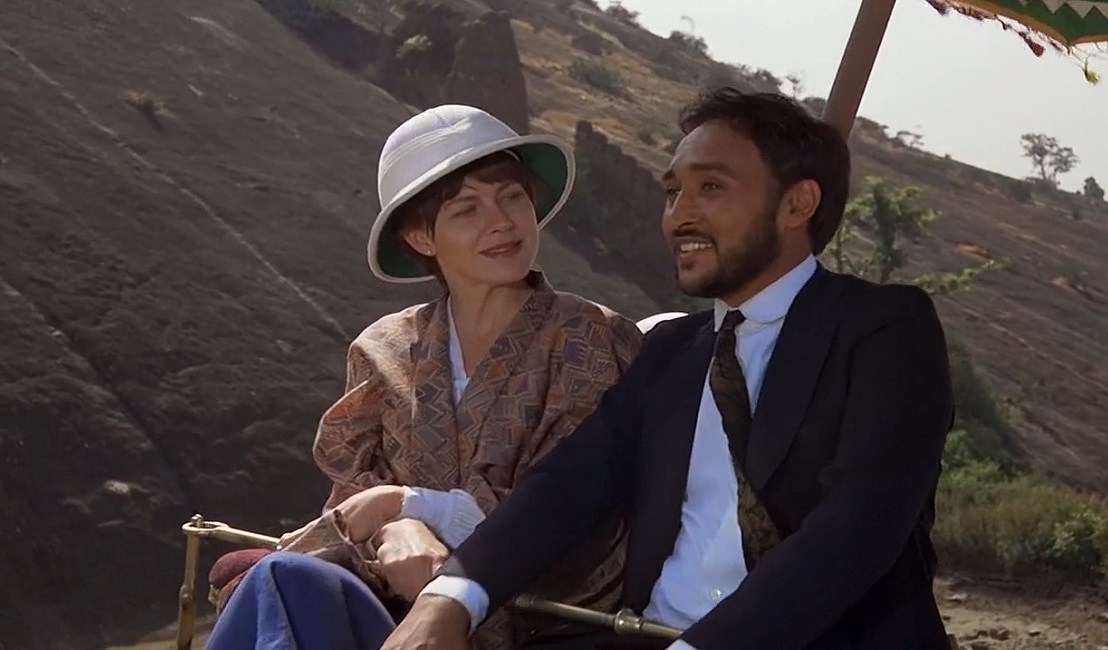
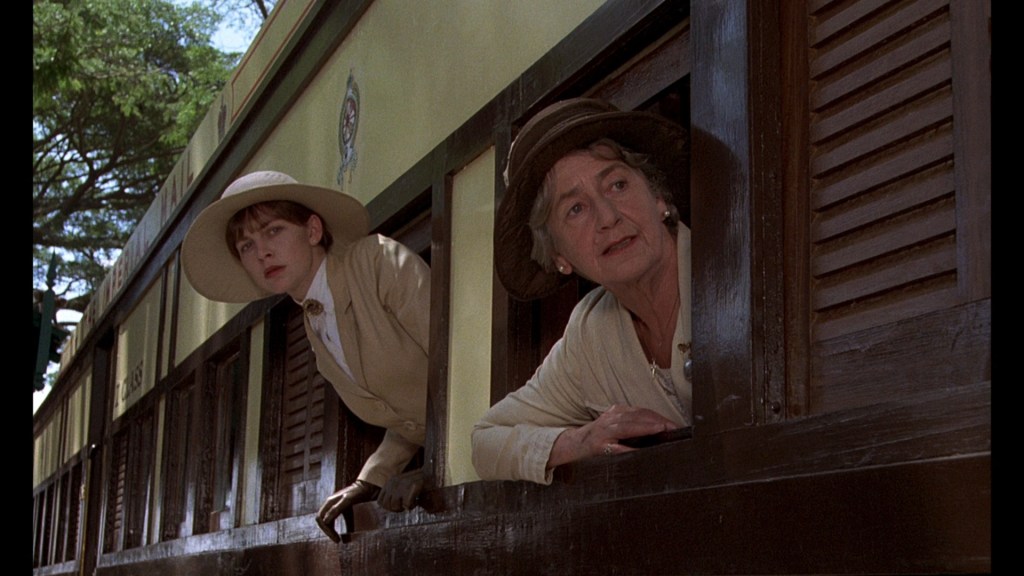
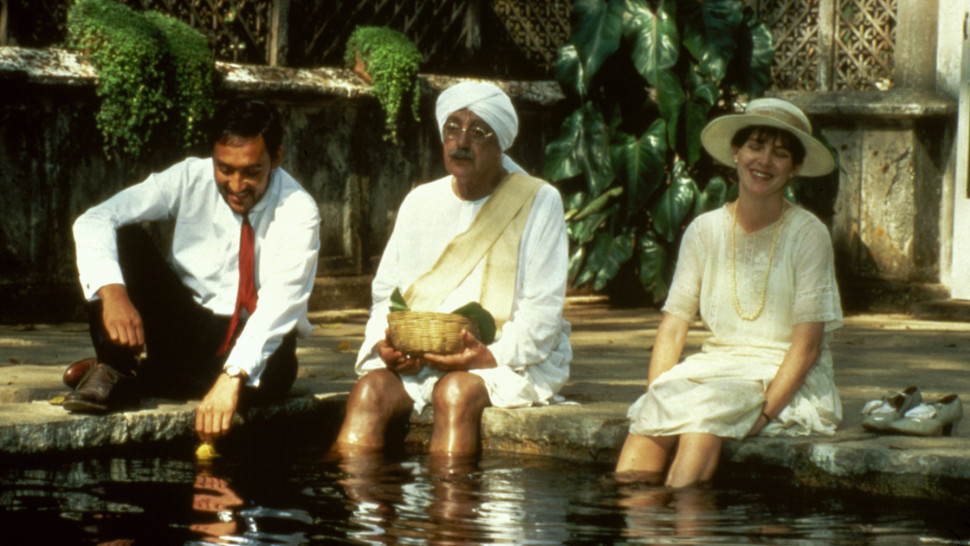
In 1920s Chandrapore, Adela Quested (Judy Davis) has arrived from England with her prospective mother-in-law Mrs Moore (Peggy Ashcroft) to marry the local magistrate Ronny Heaslop (Nigel Havers). The two women are fascinated by India and its culture – and quickly bored with the parts of it the ex-pat community will show them (basically a sort of little-England alcove). When they befriend local Muslim doctor Aziz (Victor Bannerjee) and liberal pro-Indian school superintendent Richard Fielding (James Fox), Aziz invites them on a trip to the local Marabar Caves. During the trip, Miss Quested flees and accuses Aziz of attempted rape. Aziz pleas his innocence – Fielding and Mrs Moore believe him, Miss Quested seems confused – but the case becomes a cause celebre that will explode the tensions between the rulers and the colonised.

Lean’s production of the book (as well as directing, he also wrote the screenplay and edited the film) is a delicate and handsome adaptation, carefully capturing the events of the book and making a manful effort to bring to life its textures and complexities. Forster had worked in India for several years as the secretary to a Maharajah and for many years was in love with an Indian called Masood. He had a unique perspective of Indian/English relations (much of it filtered into the character of Fielding) which he believed was underpinned not only by misunderstanding but also unpassable barriers that Empire throws up between East and West.

A Passage to India doesn’t always quite manage to capture this – perhaps largely because the book’s third act (which focuses in particular on the strains on the friendship between Aziz and Fielding) is truncated down to about 12 minutes of the film’s 2 and half hour run time. This does mean the film’s final impact feels rushed and unclear – and that the final parting of these characters doesn’t carry the impact it should. I can see why this has been done – that section of the book is less interesting, and also shows Aziz, at times, in a less sympathetic light – but it does mean the film misses something of the book’s engagement with moral and intellectual issues in favour of delivering the cold, hard plot of the Caves and the trial.

But these sections are well-judged, carefully structured and expertly executed. Lean’s film is very good on observing the kneejerk racism (some paternal, some outright unpleasant) from the British community. The incongruity of British clubs, garden parties and middle-class homes and lawns in a foreign land. How Indians are only welcome into these settings as silent servants or repurposed into British icons, such as brass bands. The total detachment of the rulers from the ruled: the tour of India arranged by Ronny features the British barracks, court-room and culminates in some ghastly amateur theatricals. Indians exist only to be told what to do and to applaud their rulers.

This is counterpointed with the rich, vibrant, dynamic culture of the Indians. If the film sometimes tips into displaying this as a sort of Oriental mysticism, that can be partly because our experience of it is often filtered through Adela and Mrs Moore who are bewitched and intrigued by a country of colours, emotions and passions unheard of in Britain.

Lean’s film never overlooks the Indians though. Our introduction to Aziz is to see him nearly mowed down on his bike by a speeding government car. His home is kept in good condition, but cannot compare to the wealth of the British. He and his friends talk passionately of the possibility for independence. There is a natural expectation of rudeness and dismissal from the British, that is taken in their stride.

Well played – if the role is a little passive – by Victor Bannerjee, Aziz is the victim we witness events through. Proud to befriend the British women, friendly and over-eager, Aziz is a highly unlikely would-be rapist. Put-upon and dismissed by his British superiors, he’s a lonely widower whose children are living hundreds of miles away, who suggests the trip in a moment of social awkwardness and goes to absurd ends to make the trip a success.

Sadly, its doomed. Leans film does a good job of maintaining much of the book’s mystery of what happens in the caves. Lean also finds a visual way of representing much that lies implied in the book. In an invented scene before  the trip, Adela cycles into the Indian countryside eventually finding a ruined temple filled with sexually explicit statues and hordes of monkeys in heat. Its clear the exposure to sexuality both shocks and unnerves her – but also fascinates her. Later she dreams of the statues she has seen. The same overwhelming feels seem to consume her in the caves – a heightened sense bought on by claustrophobia and a fear of a moment of personal intimacy between her and Aziz, perhaps spinning off into a temporary nervous collapse.

The film doesn’t state it for sure, but the implication is carefully put there. It leads perfectly into the well-staged trial scenes. Lean’s film focuses largely on delivering the plot of the novel, rather than the depths, but in delivering this crucial encounter he finds a marvellous way to use the language of film (music, editing and photography all interplay effectively in the sequences to add to their unsettling eeriness) to dramatise a literary sequence.

It’s not a perfect film. At times languid, it could no doubt have done with a bit more tightening and pace (it takes nearly half the film to reach the caves). While the film benefits from the build of the atmosphere and the tensions between both cultures, if Lean can do Great Expectations in less than two hours you feel he could have done this book more tightly. The unfortunate decision to cast a brown-face Alec Guinness as Brahmin scholar Professor Godbole looks more uncomfortable with each passing year – not least as all other Indian roles are played by Indian actors.

The film does however have a very strong cast. Judy Davis is both fragile, uncertain and at times even deeply frustrating (in the intended way!) as Miss Quested. Peggy Ashcroft won an Oscar (part of a late boom in her screen career – she also won a BAFTA the same year for The Jewel in the Crown) as the very grounded and worldly-wise Mrs Moore. James Fox gives his finest performance as the sympathetic Fielding caught between two worlds and eventually rejected by both.

A Passage to India has a lot of Lean’s visual mastery, but it’s less a sweeping pictorial epic and more of a careful and well-judged literary adaptation. While it does focus more on the plot and less on the meaning of the novel, and it overlong and at times lacking in energy, it also has some fine performances and brings many parts of the novel triumphantly to life. His final film does not disgrace his CV.

The Aviator (2004)

Leonardo DiCaprio excels as Howard Hughes in The Aviator

Director: Martin Scorsese

Cast: Leonardo DiCaprio (Howard Hughes), Cate Blanchett (Katharine Hepburn), John C Reilly (Noah Dietrich), Kate Beckinsale (Ava Gardner), Alec Baldwin (Juan Trippe), Alan Alda (Senator Owen Brewster), Ian Holm (Professor Fitz), Danny Huston (Jack Frye), Gwen Stefani (Jean Harlow), Jude Law (Errol Flynn), Willem Dafoe (Roland Sweet), Adam Scott (Johnny Meyer), Matt Ross (Glen Odekrik), Kevin O’Rourke (Spencer Tracy), Kelli Garner (Faith Domergue), Frances Conroy (Katharine Houghton), Brent Spiner (Robert E Gross), Edward Herrmann (Joseph Breen)

Howard Hughes grew up wanting to make the biggest movies in the world, fly the greatest plans and be the richest man in the world. He achieved all of this. He ended his life a wild-haired long-nailed recluse, terrified of stepping outside his controlled zone, a victim to crippling OCD. Martin Scorsese’s The Aviator is a triumphant, brilliantly engrossing, sumptuous exploration of Hughes’ years of triumph, where everything seemed to go right publicly – even while everything was beginning to go wrong internally.

It’s Scorsese’s second teaming with Leonardo DiCaprio – and while DiCaprio’s boyish good looks don’t really relate to what the real Hughes looked like, his charismatic enthusiasm, passion and determination brings Hughes triumphantly to life. It’s a brilliant performance, which dominates the movie. DiCaprio seems to completely understand power of driving ambition, who will mortgage everything he has time and time again to achieve his dream – and also the force of personality needed to turn those dreams into success. But obsession drives both success and eventual personal disaster. There is always something slightly fragile about DiCaprio – maybe its those boyish good looks – and here he brilliantly captures the tragedy of a man clinging to his sense of self, struggling with the demons within him.

Scorsese’s film gloriously balances the epic with the personal. It so brilliantly relates to the irrational but very convincing fears of those suffering from OCD, that scenes featuring Hughes obsessively plucking tissues from boxes, or stuck in restrooms scared of touching the door carry a real sense of threat. The grandness of much of the rest of the film – and the sense we get have how much more Hughes could have achieved – means the demons he carries are even more affecting. Imagine what he could have done, if he wasn’t terrified of even the smallest germ, or was able to put aside his destructive urge to control every inch of his environment and the people in it.

All this tragedy works because the grandness is so impressive. Scorsese’s film looks beautiful. The filming was inspired by replicating the visual and colour styles of contemporary Hollywood. The early 1930s-set section of the film apes the toned look of early-colour (green appears blue, most strikingly at a golf course) with full colour only appearing when the film hits the years of technicolour. The 1940s sequences are inspired by touches of film noir, leaning into the early days of epic technicolour by the end. It looks striking and also amazing. The production design is similarly breathtaking, while the film is shot and assembled with a wonderfully vibrant energy.

It’s also got plenty of wit. John Logan’s fast-paced script captures the sense of a fun of a man who was determined to turn his dreams into reality. John C Reilly is a lot of a fun as the weary number 2, constantly performing financial gymnastics to keep his bosses dreams afloat. Compulsion and obsession makes Hughes the sort of guy who will rebuild an aeroplane from scratch because of a minor flaw, or will reshoot a film because it will work better with sound. During the shooting of Hell’s Angels he keeps a private fleet of planes on the ground while waiting for clouds that will make the scene work. Frequently thousands of dollars a day are spent keeping projects ticking over, while Hughes waits for perfection. He’s not a man to compromise – and you can see why an artist like Scorsese would relate to that. While the film never lets you forget this obsessive perfectionism cuts both ways – and is as much a symptom of OCD as obsessive handwashing.

Scorsese’s passion for classic Hollywood clearly informs much of the first half of the film, that covers the shooting of Hell’s Angels and Hughes’ relationship with Katharine Hepburn. There are delightful cameos from Hollywood icons like Errol Flynn and Louis B Mayer. Playful references abound. The film’s emotional heart is the bond between the two larger-than-life ambitious figures Hughes and Hepburn. Cate Blanchett (Oscar-winning) is fantastic as Hepburn, a pitch-perfect impersonation that also captures her gsharp, uncompromising intelligence and no-nonsense energy. The chemistry between the two is spot-on.

The film’s second half covers more the aviation of the title, with Hughes’ struggle to break the near-monopoly of the skies owned by PanAm, with his own airline TWA. With Hughes starting to teeter on the edge of OCD collapse, even while energetically setting records in the air and fighting battles in the senate, its perhaps even stronger. It also introduces nemesis in Alec Baldwin’s smoothly manipulative Pan Am chairman Juan Trippe and, most delightfully, an Oscar-nominated Alan Alda as a hypocritically corrupt Senator Brewster. The dinner and senate clashes between Alda and DiCaprio provide glorious energy to power the film’s final act.

It also serves as a last hurrah for Hughes. It’s DiCaprio that really makes the film work as this star burns itself out, finally succumbing to the compulsions that we know will see him end his days locked into a room at the top of a Las Vegas hotel. Moments carry a suggestion of fantasy – is Hughes imagining some of the shady figures he sees at the edges of frames? Are oddly toned late meetings with Ava Gardner (an underpowered Kate Beckinsale) an illusion? It’s all part of the the powerful sense of tragedy of seeing him end, wild-haired, peeing into milk bottles and stuck into loops of repeating phrases over and over again. Scorsese’s film superbly captures the immense sense of lost opportunities.

The Aviator is undeniably grand and triumphant film-making, that looks a million dollars. But it also manages – in thanks to a superb performance from DiCaprio – to capture a tragic sense of a man who burnt himself out at the height of fame and success. It tells two parallel stories without us realising it: a man achieving his dreams, even while his nightmares consume him. With Scorsese’s perfectly judged direction and some wonderful performances, this is both a sprawling epic and a very personal story of loss. While it seems very different from the films we might expect from the master, I think it might be one of his finest works.

Watchmen (2009)

Watchmen (2009)


Morally complex heroes in Zach Snyder’s visually impressive but slightly empty Watchmen

Director: Zach Snyder

Cast: Malin Åkerman (Laurie Jupiter/Silk Spectre II), Billy Crudup (Jon Osterman/Dr Manhattan), Matthew Goode (Adrian Veidt/Ozymandias), Jackie Earle Haley (Walter Kovacs/Rorschach), Patrick Wilson (Daniel Dreiberg/Nite Owl II), Jeffrey Dean Morgan (Edward Blake/Comedian), Carla Gugino (Sally Jupiter/Silk Spectre), Matt Frewer (Edgar Jacobi/Moloch), Stephen McHattie (Hollis Mason/Nite Owl)

If you asked people to name the greatest Graphic Novel Ever, chances are they would come up with Alan Moore’s Watchmen. This scintillating deconstruction of superheroes and the morality of caped avenging satirises what the impact of superheroes in a real world might be. It had taken decades – and several cancelled attempts – to get a version to the screen. So, if nothing else, Zach Snyder deserves plaudits for merely persuading Hollywood executives to get this expensive, R-rated, morally complex film to the screen. Sure, the final result isn’t perfect, but it’s got a fair bit going for it.

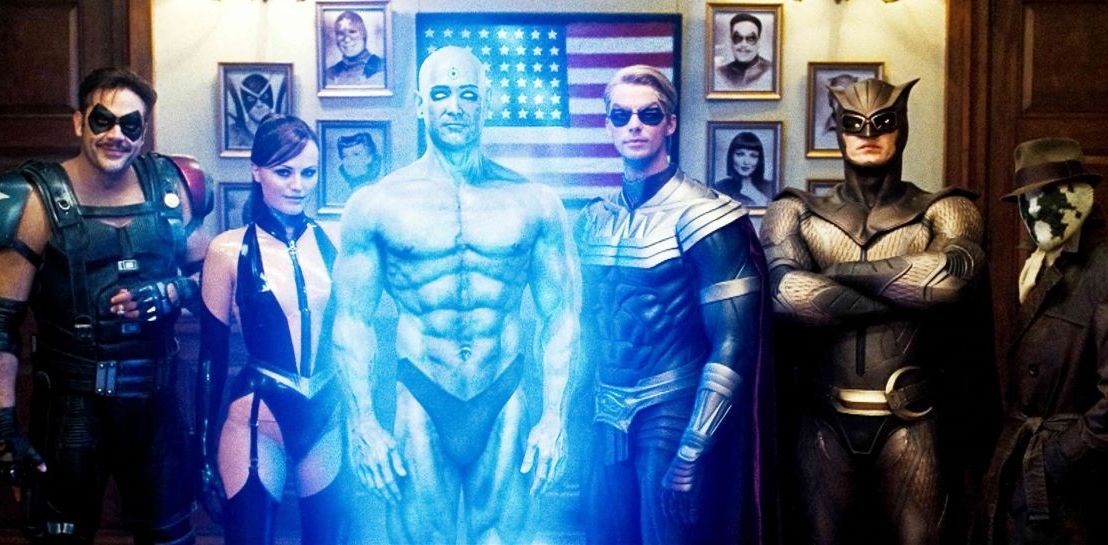
Watchmen is set in an alternative 1985 where Richard Nixon is serving his fourth term and the Armageddon of Nuclear war is just around the corner. Masked vigilantes had been a common sight on the streets – although banned since 1977. The Vietnam war was won (in a few days) by the God-like Dr Manhattan (Billy Crudup), a scientist granted superhuman powers in 1959 after an accident with a field generator. Most other vigilantes are retired, other than right-wing bully the Comedian (Jeffrey Dean Morgan). When the Comedian is murdered by a masked intruder, his fellow members of superhero group the Watchmen, worry someone is eliminating them for reasons unknown.

Snyder’s Watchmen is a visual feast. Snyder – a huge fan of the graphic novel – used it as a visual bible, quoting it in several frames. The film is a beautiful mix of dark, filmic visuals and striking comic book primary colours, while frequently embracing the inky black murkiness of the violent world its depicting. Shot with the same high energy and dynamism as 300, Snyder’s ability to turn pulpy Warhol inspired visuals into fast-paced, filmic action is second-to-none.

What however is more of a shame is the feeling that the main things in Watchmen that interest Snyder might be the visuals. Where the film sometimes fails to come to life is where it deals with the complex morality of its heroes. The original deconstructed the morality of heroes. How a man with the powers of a God could come to look on humanity with an (albeit affectionate) distance. How a masked PI would be so convinced that right and wrong were certain that he would be willing to carry out acts of bone-crunching violence. That a hero could calculate sacrificing millions of lives for the greater good isn’t just acceptable, its recommended. That for others the exhilaration of spending their nights beating up criminals is an escape from the mundane realities of life.

The problem is that Watchmen never quite gets to the heart of these moral questions, of really tackling the rights, wrongs and shades of grey of those ethical quandaries. Rather than delving into them, ideas are too often stated. While its daring for a film to include heroes who are as deeply flawed, violent and, at times, even as unpleasant as this – it still doesn’t quite flesh out the complexities of this.

Too often the film takes a naughty pleasure in its violence and brutality, seeing that as a short-hand for presenting a morally unclear world. And at times wants us to go “how cool is that!” rather than asking “should I be enjoying watching indiscriminate slaughter from a vigilante”. Its telling that the recent HBO series of Watchmen – a sequel to the Graphic Novel set in the modern world – feels more like a true adaptation of the source material than this. That dealt with fascinating ideas about race in America, morality and acceptable sacrifices for the greater good (and still managed to work in plenty of action). By comparison, this film of the source material itself feels less deep. Now of course run time is part of that, but it should have been possible to make a film this long that more successfully combined ideas and visuals.

Snyder’s passion for the material is clear – but the film is often a little too obvious. From cuts to musical cues, it’s a film that pushes the envelope only in terms of its look and feel. It tries its best, but its vision of transmitting the depths of the original sometimes seem to stop at a faithful visual rendition of its style.

But it’s made with a lot of love and passion, not least in the acting. The decision to go largely with unknown actors pays off very well. Earle Haley brilliantly channels his character from the graphic book, a prickly obsessive with an unshakeable moral certainty. Crudup perfectly conveys the vast moral distance a real Superman would probably feel towards normal people. Goode’s chilling coldness and arrogance is perfect. Wilson gives the film heart as the closest thing to a genuinely decent guy. Åkerman does her best with a part that feels slightly underwritten and at times a plot requirement, largely defined by the emotions she provokes in the male character.

There are plenty of excellent moments in Watchmen but I’m not sure it ever really, truly becomes its own thing (in the way the HBO series did manage to do). In trying to so completely ape the visuals, and fit in all the plot, it becomes a companion piece rather than a stand-alone production. If Snyder had perhaps had a bit more courage to tack away from the strict structures of the original source material it could perhaps have helped make a stronger film. However, saying that I can imagine the fans hitting the roof if he had… And Snyder’s ability to persuade the studio to make a film with such a nihilist feel and ending is to be commended. Watchmen is a mixed bag, but when it works it does work well.

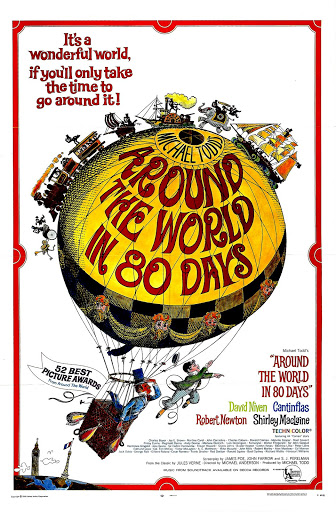
Around the World in Eighty Days (1956)

Around the world header
David Niven and Cantinflas head Around the World in Eight Days in this Oscar-winning epic

Director: Michael Anderson

Cast: David Niven (Phileas Fogg), Cantinflas (Passepartout), Shirley MacLaine (Princess Aouda), Robert Newton (Inspector Fix), Charles Boyer (Monsieur Gasse), Joe E. Brown (Stationmaster), John Carradine (Colonel Proctor), Charles Coburn (Steamship clerk), Ronald Colman (Railway official), Melville Cooper (Mr Talley), Noel Coward (Roland Hesketh-Baggott), Finlay Currie (Andrew Stuart), Marlene Dietrich (Hostess), Fernandel (Paris coachman), Hermione Gingold (Sporting lady #1), Cedric Hardwicke (Sir Francis Cromarty), John Gielgud (Foster), Trevor Howard (Denis Fallentin), Glynis Johns (Sporting lady #2), Evelyn Keyes (Paris flirt), Buster Keaton (Train conductor), Beatrice Lille (Revivalist), Peter Lorre (Steward), Victor McLaglen (SS Henrietta helmsman), John Mills (London coachman), Robert Morley (Gauthier Ralph), Jack Oakie (SS Henrietta captain), George Raft (Bouncer), Frank Sinatra (Piano player), Red Skelton (Drunk), Harcourt Williams (Hinshaw)

In the 1950s, cinema struggled to encourage people to come out of their homes and leave that picture box in the corner behind. Big technicolour panoramas and famous faces was what the movies could offer that TV couldn’t. This led to a trend in filmmaking that perhaps culminated in 1956 with Around the World in Eighty Days triumphing among one of the weakest Best Picture slates ever seen at the Oscars. Around the World had everything cinema knew it could do well: big, screen-filling shots of exotic locations filmed in gorgeous colour; and in almost every frame some sort of famous name the audience could have fun spotting. It’s perhaps more of a coffee table book mixed with a red carpet rather than a narrative film: entertaining, but overlong.

Faithfully following Jules Verne’s original novel (with added balloon trips), Phileas Fogg (David Niven) is a punctilious and precise Englishman of the old school, whose life is run like clockwork and whose only passion is whist. Nevertheless he accepts a challenge from his fellow members of the Reform Club (among them Trevor Howard, Robert Morley and Finlay Currie) to circumnavigate the globe in 80 days or less. Setting off with his manservant – the recently hired, accident prone Passeportout (Cantinflas) – Fogg races around the world, from Paris to Cairo to India to Hong Kong to Japan to San Francisco. Along the way he rescues Princess Aouda (Shirley Maclaine) from death by human sacrifice in India and has to confront the suspicions of Inspector Fix (Robert Newton) who is convinced that Fogg is responsible for a huge theft at the Bank of England. Can Fogg make it back to the Reform Club hall on time to win his bet?

Around the World was the brain-child of its producer Michael Todd. A noted Broadway producer, Todd had been looking to make a similar splash in the movies. Perhaps it’s no surprise that he decided the finest way to do this (after the mixed success of a movie version of Oklahoma) was to produce something that‘s pretty much akin to a massive Broadway variety show. Around the World – as you would expect – is an incredibly episodic film, seemingly designed to be broken down into a number of small sequences either to showcase the scene’s guest star or to provide comic opportunities for Cantinflas to display his Chaplinesque physical comedy.

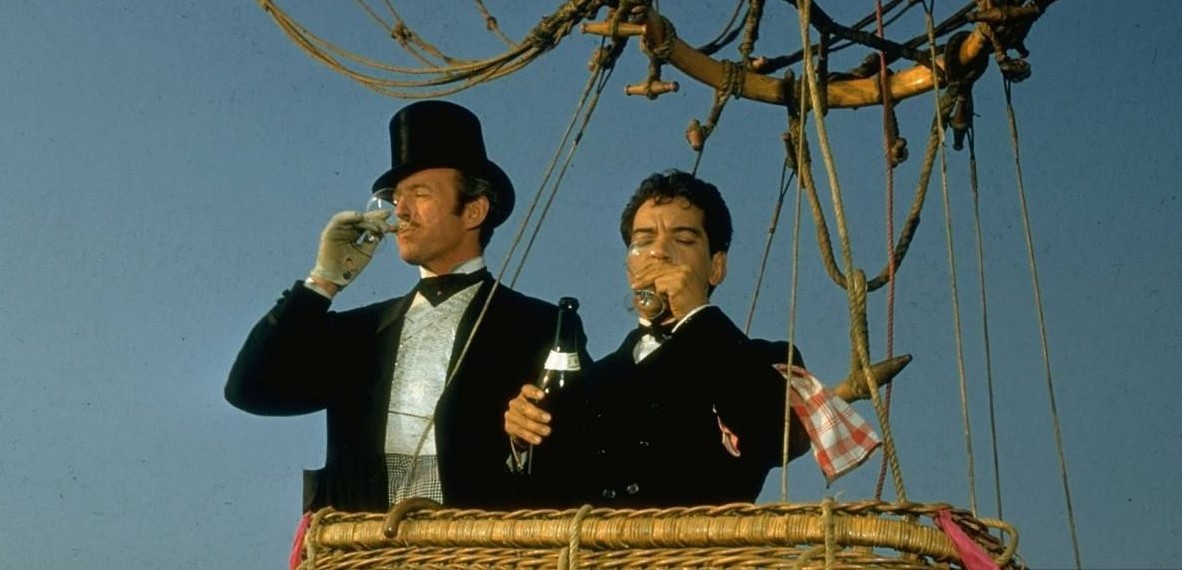
That and lots of opportunities for some lovely scenic photography. Nearly every major sequence is bridged with luscious photography capturing some exotic part of the world – from the coast of Asia to the Great American Plains. It’s pretty clear this is a major attraction of the film: come to the movies and see those parts of the world you’ve always dreamed of, just for the price of a movie ticket! Surely introduction of a hot air balloon to allow Fogg and Cantinflas to travel from Paris to Spain was purely to allow lovely aerial shots of the French countryside and chateaux. It’s the sort of film that proudly trumpeted in its publicity the number of locations (112 in 13 countries!), the vast number of extras (68,894!) and even the number of animals (15 elephants! 17 fighting bulls! 3,800 sheep!). It’s all about the scale.

That scale also carries across to the guest cameos. Between enjoying the scenic photography, viewers can have fun spotting cameos. Can that really be Noel Coward running that employment agency! The chap who owns the balloon, I’d swear that’s Charles Boyer! Wait that steward: that’s Peter Lorre! Good lord that’s Charles Coburn selling Fogg tickets for the steamer! Oh my, Buster Keaton is helping them to their seats on the train! Marlene Dietrich is running that saloon – and good grief that’s Frank Sinatra playing the piano! Most of the stars enter into the spirit of the thing, even if they frequently start their shots with backs to the camera, before turning to reveal their star-studded magnificence. Sadly time has faded some of the face recognition here, not helped by David Niven (perfectly cast as the urbane and profoundly English Fogg, so precise that his idea of romantic talk is to recount past games of whist) probably today being one of the most famous people in it.

Todd marshals all this with consummate showman skill. It’s handsome, very well mounted and generally entertaining – even if it is painfully long (it’s not quite told in real time, but can feel like it at points). The film is nominally directed by Michael Anderson. However, I think it’s pretty clear his job was effectively to point the camera at the things Michael Todd had lined up (be they location or stars) – Todd had already dismissed the original director, John Farrow, after a day’s shooting for not being sufficiently ”co-operative”. To be honest it’s fine as this is an entertainment bereft of personality, instead focused on being “more is more”.

Part of its extended runtime is due to the long comedic sequences given to Cantinflas. A charming performer – and possibly the most famous comedian in Latin-America at the time – Cantinflas can be seen doing everything from bicycle riding, to bull fighting (for a prolonged time), to gymnastics to horseback riding. (Far different from the unflappable and spotless English gentleman Niven is playing.) Your enjoyment of this may depend on how far your patience lasts. I’m not sure mine quite managed to last the course. Sadly one of Cantinflas’ greatest comedic weapons, his Spanish wordplay, was completely lost in translation.

There are some decent sections. The iconic balloon flight is well mounted and gives the most impressive images (the famously vertigo-suffering Niven was replaced by a double for much of this). Others, like the bullfight or an interminable parade in San Francisco go on forever. The casting of Shirley MacLaine as an Indian princess is an uncomfortable misstep (even at the time MacLaine felt she was painfully miscast), made worse by an offensive “human sacrifice” storyline – that got cut when the film was screened in India. Robert Newton though is very good value as the misguided but officious Inspector Fix.

Around the World in Eighty Days is grand, handsomely mounted entertainment. But to consider it as a Best Picture winner feels very strange. It’s not a lot more than an entertaining variety show, its plot impossibly slight (made to feel even more so by its vastly over-extended run time). While you can enjoy it in pieces, it finally goes on too long for its own good. Entertainingly slight as it is, it’s still one of the weakest Best Picture winners ever.

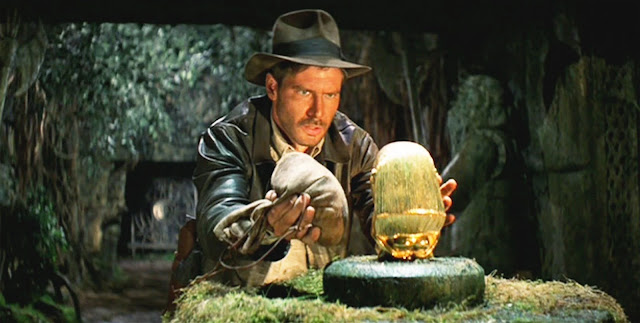
Raiders of the Lost Ark (1981)

Raiders of the lost ark header
Harrison Ford goes in search for treasure in Raiders of the Lost Ark

Director: Steven Spielberg

Cast: Harrison Ford (Indiana Jones), Karen Allen (Marion Ravenwood), Paul Freeman (René Belloq), Ronald Lacey (Major Arnold Toht), John Rhys-Davies (Sallah), Denholm Elliott (Dr Marcus Brody), Wolf Kahler (Colonel Dietrich), Anthony Higgins (Major Gobler), Alfred Molina (Satipo)

Indiana Jones is now one of the most beloved – and instantly recognisable – film characters ever created. So, it’s strange to think that Raiders of the Lost Ark was released to such little fanfare. That soon changed when the film came out. In some cinemas it was so popular it played for the whole year. It became a box-office smash, turned Harrison Ford into Hollywood’s leading movie star for the next 20 years, and made Steven Spielberg Hollywood’s leading director. And it did all that because I’m not sure there is a more entertaining, tightly made, funny, thrilling and (at times) scary adventure film out there. Spielberg and producer George Lucas may have wanted to make a film that aped B-movie adventure serials – but they ended up reinventing an entire genre.

It’s 1936 and the Nazis are in search of occult relics. Their latest target is the Ark of the Covenant, which Hitler believes will make his armies invincible. What chance is there of stopping him finding it? Well obviously the US government must put its trust in Professor Indiana Jones (Harrison Ford), one of the world’s leading archaeologists who also (fortunately) is pretty handy in a fight. Not only that, but his ex-girlfriend Marian Ravenwood (Karen Allen), daughter of his former mentor, holds one of the keys to finding the Ark. Indy and Marian end up on an adventure that crosses continents, taking on the ruthless Nazis and mixing with profound mysteries that man is not meant to know.

Hollywood wasn’t happy about Spielberg making the film. His previous film – the war comedy 1941 – had bombed, losing millions. The studio was insistent with producer George Lucas: if he wanted to see his dream of making an old-fashioned B-movie with his friend Spielberg come true, then he would need to stick tightly to a budget. After all, Spielberg had a reputation for delivering films overtime and overbudget. Our heroes stuck to this deal – and Spielberg has said it was a blessing, as it forced him to keep the film lean, tight and, above all, free of indulgence. Spielberg’s direction is perfect, so good in fact that he set the template for nearly all big-budget directing (in terms of tone, pace, mood and tempo) to come. Every action film since owes something in its DNA to Raiders.

Raiders is far more entertaining – and brilliant – than it has any right to be. It’s effectively a series of set-pieces, threaded together by screenwriter Lawrence Kasdan into a plot. Kasdan’s dialogue though was spot-on – like the film, lean, tight and perfectly focused. With exceptional brevity and focus it brilliantly creates a small core of characters, and then gives them room to bounce off each other. Its dialogue is quotable, fun and punchy. He – with Lucas and Spielberg – also crafts a central character who is flawed but deeply likeable, and a heroine who is independent and dynamic. The script is a big part of the reason why the film is a success – it makes us care deeply for the characters as they get involved in the death-defying stunts and action set pieces that make up a lot of the film.

And we don’t follow any character more than Indy himself. Thank God Tom Selleck had to withdraw at the last minute. George Lucas had resisted casting Harrison Ford as he was worried about the overlap with Han Solo. But the part fits Ford like a glove. Sure, it comes from the same wheel-house as Solo – although Indy is more taciturn, intellectual and a degree less cocksure than Solo, more a man reluctantly forced into danger than a swaggering pirate – but Ford’s skill is faultless. Ford has an everyday quality to him, and he brings a world-weary tiredness to Indiana. He has the confident grin, but he’s just as likely to see that switch to concerned desperation (there is a perfect moment of this in the opening sequence, when the vine he is grasping on a cliff top suddenly works loose). He may be a bit of a rogue (not averse to shooting a swordsman) but he’s also a good man, with the street smarts of a ruffian, who is frequently exasperated by the errors of his sidekicks. This is the sort of man that men want to be and women want to be with – an impossibly difficult trick to pull off.

We relate to Indy because he’s vulnerable. He’s an underdog. The outstanding opening sequence – basically a little mini-movie in itself – showcases this. As Indy heads into a hidden temple for an idol (dodging spiders, bottomless pits, arrows from walls and most famously a huge boulder – a stunt Ford did for real) we get his entire character showcased. He’s astute, resourceful, trusting (sometimes too trusting) and ingenious. But he also takes a hell of a physical pounding, gets scared and above all goes through huge danger only to end up empty-handed. And of course, we find out he can cope with all this, but definitely not snakes (is there a better action set-piece punch line than “Grow a little backbone, will ya!”). It sets the tone for the rest of the film – in fact with the first five minutes alone, Raiders is already better than 99% of all other adventure films.

But then this is a director working at the top of his game. All the elements come together perfectly here: Spielberg always knows when to keep the tempo up, cuts the action superbly and also presents us with a brilliant mixture of tension, excitement and awe. He and Lucas brilliantly understand the power of images – there is a reason why a rolling boulder has become part of cinema’s language. The design of Raiders (one of its five Oscars) is absolutely perfect. Nothing like these temples could really have existed in real life – but as an evocation of 1930s adventure serials they are perfect. Mix that in with that brilliant sound design (those whip cracks for staters) and John Williams’ majestic score (from the classic Indy march to the haunting strains that tie in with the Ark) and this film is a masterclass for affecting the senses.

Then those set-pieces are told with just the right balance between thrills and wit. Again, Harrison Ford is a big part of this: he’s never smug, his trademark furrowed brow suggesting stress as much as his grin communicates relief at surviving. The truck chase – which sees Indy move from horse to truck, to under a speeding truck to back in the driving seat, half the time with a bullet in his arm – is a masterclass in thrills and superb editing. It’s such damn good fun that the film even gets away with a nonsensical beat where a car-load of Nazis is pushed off a huge cliff (the first and last indication that we are anywhere near a cliff in the whole scene!). Just like the opening sequence our hero’s combination of ingenuity, never-say-die determination and vulnerability is what makes it compelling (the Williams score also plays a huge part in building both the excitement and the triumph).

The whole film is a series of triumphant set-pieces. Spielberg also tinges the film with just enough darkness as well. The Nepal gun battle carries a real sense of danger, Indy’s fight with a tough Nazi air mechanic culminates in a quite gruesome death (although the fight beforehand has plenty of wit to it, as Indy is hopelessly outmatched physically by this giant). That’s all before the film’s famous closing sequence as the Ark finally opens up to reveal the power of God – bad news for the assembled Nazis crowded around it. The face-melting horror (and it’s hard to imagine any action adventure film doing something this horrific today) is impossible to forget, brilliantly executed and carries just the right amount of dread.

The darkness though is counter-balanced throughout by sly wit and a sense of fun. Wonderful jokes – from Major Toht’s nunchucks that become a coat hanger to an exhausted Indy responding to Marian’s kisses by falling asleep – pepper the script. The cast are fabulously chosen. Karen Allen is perfect as the independent Marian. Paul Freeman is chillingly austere and charmingly amoral as Indy’s rival Belloq. Denholm Elliott’s Marcus Brody is excellent as an older, wiser version of Indy very different from the comic buffoon he would become. The same can also be said for John Rhys-Davies Falstaffian but shrewd and loyal Sallah.

Raiders of the Lost Ark sees every element come together perfectly. Spielberg’s direction – the film did come in on time and on budget, going on to be the biggest success of its year – is completely perfect. Ford creates a character who from his first appearance is iconic (the zoom to introduce him is a wonderful tip of the hat to John Wayne’s classic entrance in Stagecoach – continuing the homages, the final shot is also a lovely nod to Citizen Kane). Every action set piece is a brilliant mix of thrills, danger, triumph and even a touch of horror (be it gruesome deaths or dreadful beasts). It’s a film that can not fail to entertain, raise a smile – and still have you hiding behind the sofa at points. Lucas and Spielberg wanted to make a film that would remind them of the adventures of our childhood. They were so successful that their film ended up defining the childhoods of millions of us.

Gandhi (1982)

Ben Kingsley excels as Gandhi in Richard Attenborough’s Oscar winning epic

Director: Richard Attenborough

Cast: Ben Kingsley (Mahatma Gandhi), Rohini Hattaggadi (Kasturba Gandhi), Roshan Seth (Jawaharlal Nehru), Pradeep Kumar (VK Krishna Menon), Saeed Jaffrey (Vallabhbhai Patel), Alyque Padamsee (Muhammad Ali Jinnah), Virendra Razdan (Maulana Azad), Candice Bergen (Margaret Bourke-White), Edward Fox (Brigadier General Reginald Dyer), John Gielgud (Lord Irwin), Trevor Howard (Judge Broomfield), John Mills (Lord Chelmsford), Martin Sheen (Vince Walker), Ian Charleson (Reverend Charles Andrews), Arthul Fugard (General Jan Smuts), Geraldine James (Mirabehn), Amrish Puri (Khan), Ian Bannan (Senior Officer Fields), Richard Griffiths (Collins), Nigel Hawthorne (Kinnoch), Michael Hordern (Sir George Hodge), Om Puri (Nahari)

In 1962, Richard Attenborough was approached by Motilal Kothari, an Indian civil servant, who believed Attenborough was the man to bring the life of Mahatma Gandhi to film. All this despite Attenborough having never directed a film. But the life of one of history’s greatest men, and passionate advocate of peace and non-violence, spoke deeply to the socially-engaged Attenborough who dedicated 20 years of his life to bringing the film to the screen, immersing himself in Indian culture along the way and winning the support of Nehru (until his death delayed the project again) and Gandhi’s family. The eventual film was a huge success, cementing the public perception of Gandhi and beautifully capturing both the importance of the story, and its emotional heart.

Opening with Gandhi’s assassination in 1948, the film covers in flashback his life from combatting anti-Indian prejudice in South Africa as a young, British-trained, lawyer to his return to India and long involvement in the campaign to win India its independence from the British Empire, stressing non-co-operation, his eventual success but also his failure to hold the Hindu and Muslim parts of the country together and his attempt as “father of the nation” to put an end to religious violence, a failure that will eventually lead to his assassination. 

Attenborough’s grand, epic film marshals thousands of extras to bring to life pages of history. At times events fly by with speed, but Attenborough never loses sight of the emotional heart of the story – both Gandhi and the status of Indians as not being masters in their own home. Attenborough directs scenes of real power, most strikingly a heart-rending peaceful march on a salt works (the tax on salt use being a major burden on many poor Indians) that culminates in line after line of peaceful Indian protestors walking calmly forward to be beaten down by soldiers. Despite being the grandest and largest of films, it allows questions of pure morality and decency to lie at its heart and, supported by a parade of British acting greats, keeps the Indians at the heart of their own story and the masters of their own destinies.

The film’s impact though may be directly connected to the gloriously transcendent performance of Ben Kingsley in the title role. For years it was believed the film could only work with a British actor in the title role – imagine how it would be received today if Gandhi had been played by (as it nearly was) a browned-up Anthony Hopkins or John Hurt (who famously told Attenborough he looked absurd). Instead half-Indian unknown RSC actor Ben Kingsley took the role. Kingsley so completely and utterly immersed himself in Gandhi – everything, the physicality, the morality, the voice, the intellectualism – that not only has he become so completely associated with the role but it’s hard to imagine anyone else playing it.

Ageing almost 50 years over the course of the film, Kingsley’s Gandhi is above-all moral, softly-spoken, observant and considerate – the very spirit of the original man seems to be up on the screen. Far from the sort of histrionics you might expect from a subject of an epic movie, Kingsley is not afraid to be quiet, gentle even underplayed. He completely understands that the charisma and power in Gandhi laid in his moral authority, not his speech-making, but his careful example-setting of even-handedness, patience and desire for peace. 

But Kingsley is also willing to show Gandhi as shrewd and stubborn, even while mixing it with both a deep pain at the loss of life. Kingsley is superbly good at the smaller quieter moments – he wrings heart-rending force from the loss of his wife (a similarly impressive and quietly authoritative performance from Rohini Hattaggadi), which partly works because the film quietly centres the truth and faith in their marriage. This is extraordinary work from Ben Kingsley, that seems to carry not just the entire film but the sense of a nation.

Attenborough though was a director who was at his best when working with actors, and his ability to coax truthful and heartfelt moments from quiet scenes are what gives the other sequences the emotional force to make them work. Attenborough seemingly called in every favour to assemble the supporting cast that backs up Kingsley, many of them juggling only a few scenes. Among the stand-outs we have a martially certain Edward Fox as General Dyer, an archly arrogant John Gielgud and a frustrated John Mills as viceroys, Trevor Howard representing decent British rule as an honest Judge and Martin Sheen as a reformist minded journalist. That’s to overlook dozens of others in small roles, all of them clearly committed to the intention of the project.

The film though allows the Indians themselves to take centre stage, even if it is easy to criticise some of the simplifications of many of the issues that would eventually culminate in partition. The film has a clear hostility towards the idea of religion, seeing it as the root of much of the violence that erupted in India in the last years of Gandhi’s life. While Roshan Seth is excellent as Nehru, the character is portrayed more as the faithful follower of Gandhi than the shrewd politician in his own right (it’s a role most of the other leading members of congress are also placed in). Alyque Padamsee carries a high level of charisma as Jinnah, founder of Pakistan – but the film can’t quite resist painting him into the corner as a semi-villain, ignoring Gandhi’s desperation to get Jinnah to invest in a united India.

It’s part of what has been seen since as the film’s more hagiographic stance towards Gandhi. Certainly later historiography has outlined a few shades of grey in Gandhi – although I would argue that seeing him as a man and not a saint only heightens (similar to Mandela) the awe at what he went on to achieve. The film’s whistle stop tour of Indian history – taking in every major event and personality, some in a matter of moments – looks particularly old-fashioned now with our current trend being biographical films that focus only on crucial moments, not the whole life. It adds a slight air of schoolboy history to the project, an unfortunate side-effect of the passionate earnestness with which the story is told.

But then even in 1982 – when it lifted 8 Oscars including Best Picture, Director and Actor and most of the technicals – it was seen as slightly old-fashioned. Attenborough has generously repeatedly said that he believed Steven Spielberg was more deserving of Best Director for ET. And it’s true that Attenborough was in many ways a producer at heart with these epics than an inspired director like Lean. His marshalling of crowds, finances and simply forcing the will together to make the picture – and to allow it to focus on Indians rather than Westerners – is a tribute to his organisational skills. His strengths as a director were more in performances, and as with many of his epic films the most memorable moments are smaller, intimate ones. The larger moments are shot with an assured professionalism rather than inspiration, but Attenborough understands how to wring emotion from moments and how to let character drive action.

Gandhi works above all because even today you can see it is a passionate labour of love, that everyone involved in clearly believed in passionately. It may well be that at times it is workmanlike or simplistic – and covers the sweep of history with an earnest completeness, even while it is unafraid to be critical certainly of the British – but it still invests it crucial moments with humanity, life and deep emotion. You can’t help but be moved by it – and you are instantly stunned by the sheer brilliance of Kingsley as Gandhi, one of those performances like George C Scott as Patton which seems more like the man than the real thing. Gandhi may be old fashioned, but that’s not a crime when the quality is still there.

The Treasure of the Sierra Madre (1948)

Three men go in search of The Treasure of the Sierra Madre

Director: John Huston

Cast: Humphrey Bogart (Fred C Dobbs), Walter Huston (Howard), Tim Holt (Bob Curtin), Bruce Bennett (James Cody), Barton MacLane (Pat McCormick), Alfonso Bedoya (Gold Hat)

Is there anything that warps the human character more than greed? Humanity sometimes seems driven only by the desire for more, to fill our pockets with cash and leave the rest behind. It’s greed that becomes the subject of John Huston’s masterful The Treasure of the Sierra Madre – and specifically the effect it has on Humphrey Bogart’s Fred C Dobbs. If you can pick up as much gold as you want off the ground around you, why does it become so difficult to watch others take it away?

Dobbs and Bob Curtin (Tim Holt) are down-on-their-luck drifters in Mexico, bumming spare change off American businessmen and struggling on hand-to-mouth jobs for shady businessmen. So how could they resist the chance to team up with fast-talking old-timer Howard (Walter Huston) who knows that there’s gold in dem da hills? Heading into the wilderness – partly financed by Dobbs’ lucky small lottery win – the three men strike lucky and start pulling the gold from the ground. Problem is as the piles grow, so slowly does the men’s suspicion each other – not least Dobbs, who grows increasingly paranoid and unbalanced at the thought of any danger to his gold. In the wilderness of Mexico, with bandits across the countryside can the men’s growing suspicion of each other be held off long enough to get the gold back home?

Based on a novel by B Traven – an author so notoriously private that even today no one knows who he was – John Huston’s classic is part adventure story, part treatise on the human condition. It’s also gloriously entertaining at every turn. One of the first major Hollywood films to be shot largely on location, it drips with the sultry heat of Mexico, beautifully filmed by Huston. Huston’s masterful script also packs the film with a punch, from quotable titbits (most famously the oft-misquoted “Badges? I don’t have to show you any stinkin’ badges!”) to its Shakespearean touches as a rambling, mad, paranoid Dobbs walking alone through the desert wilderness like a cut-price Lear.

Dobbs is the heart of the film – and there is perhaps no anti-hero more ‘anti’ in the whole of Hollywood than this ruthlessly selfish, obsessive paranoiac. Bogart probably gives his finest performance ever as the scruffy, sweaty, unshaven and bitter drifter who finds he can’t abide the idea of having to give away any of what he sees as his share of the loot. And, worse than that, becomes convinced that the whole world is out to take it from him. 

Bogart digs deep into the weasily, rat-like greed of this man. Bogart fought long and hard to play who he called “the worst shit you ever saw”. Dobbs has a strange moral code and sense of honour that’s entirely personal. Having his character impugned by others is an affront he can’t abide – though murder and violence are perfectly acceptable. He’s the sort of guy who will savagely beat a man who stiffs him for wages and then precisely take only what he’s owed from the guy’s wallet. Bogart is perfect as the cold-eyed loner who talks big at first about partnership, but later whines about how he staked most of the starter capital so should be getting a larger share of the profits. Bogart, in perhaps one of the biggest snubs in Hollywood history, missed out on an Oscar nomination in a notoriously weak year for Best Actor. Perhaps, the vision of Rick Blaine bitterly muttering to himself, covered in flies and filth, while plotting the murder of his friends in the Mexican outback was too much for the voters to take. Either way, Bogart’s late mental collapse into near-Shakespearean envy, jealousy and twitchy paranoia is as effective as it is subtly done.

More fortunate at the Oscars were the Huston family. John had written the part of Howard for his father Walter. It bought Huston Snr the Oscar for Best Supporting Actor. Walter Huston is wonderful as this fast-talking eccentric, rocketing through his dialogue at a hundred miles an hour, as if he has lived so long through the events he is talking about that he barely has the time or patience to tell the story at a normal pace. Huston adds touches of wonderful eccentricity, to Howard’s insane jig of joy when finally finding the site of the gold, to his infectiously unrestrained cackling laughter. 

Eccentric as he is though, Howard is a decent and honourable man who has every intention of sharing the gold and is well aware of its corrupting influence. The wily Howard is also the only essential member of the crew – the only one with the experience to survive in the wilderness, the only one who can recognise and knows how to mine for gold. The most loyal to the fellowship, he’s the good angel to Dobb’s bad. In the middle of this moral spectrum, John Huston places Tim Holt’s Bob, a plain-speaking, more naïve figure who has elements of both characters in his pride and hunger for gold, matched with his sense of honour and loyalty. The film partly becomes an unspoken struggle for the soul of Holt’s Bob, as we wait to see which way he will fall. 

Not that any of these men are angels. They are all determined to protect what they have. Struggling in shoot-outs with bandits is fine. They even vote on whether or not to execute a fellow drifter (played by Bruce Bennett) who encounters their stake and enquires about joining them for a share. Bennett’s Cody is, by the way, the smartest character in the film, who sees with pathetic ease through the nervy lies told by the three men, as well as acutely analysing their situation and options with a sharpness that seems beyond all of them. 

Of course by that point suspicion between them – specifically Dobbs and Bob – has already grown dramatically. Dobbs takes to spying on his fellows and digs a separate hiding place to which he carefully takes his own share (Curtin takes to doing the same). John Huston includes a marvellous sequence where the three men each wake up in turn during the night – and react with suspicion on noting the absence from the tent of the others. Later Bob will think long and hard before saving Dobbs from a mining cave-in. Only Howard seems less affected about the gold – although with his talk of the corruption he has seen in the past, perhaps he was a Dobbs himself in the past, now grown wiser and more accepting of the easy-come-easy-go nature of gold. 

Huston’s Oscar winning script (he also lifted the Oscar for Best Director, although Best Picture went to Laurence Olivier’s Hamlet) keeps the rich vein of irony running throughout the script, even while it shows how susceptible men are to corruption. The film’s final act – and the eventual fate of the gold – is a treat, a natural extension of the films theme of mankind being a dog-eat-dog world. What else can you do but sit in the dust and laugh at it all? 

There are no heroes really in The Treasure of the Sierra Madre – even the mountain remains named only in the title of the film – just three men, scruffy, seedy and not that smart, struggling to grab what they can from the earth. Life becomes more and more cheap as the film goes on – Dobbs and Curtin are like brothers at the start, but increasingly come to see both other people and each other as expendable rivals. With Dobbs like some scruffy Smaug, the film boils down to each man confronting his own emptiness. The only character with any emotional hinterland is the drifter Cody, looking for gold for his wife and kids (his story has real impact on Curtin), the rest are just living from moment to moment.

John Huston’s classic is a marvellous musing on the nature of greed and humanity, superbly filmed by Huston with not a single false note in acting or writing. Perfectly placed, it mixes a western vibe with a Shakespearean grandness – and has a simply wonderful performance by Bogart. A classic that really delivers.

Crouching Tiger, Hidden Dragon (2000)


Michelle Yeoh and Zhang Ziyi defy gravity and danger in Crouching Tiger, Hidden Dragon

Director: Ang Lee

Cast: Chow Yun-Fat (Li Mu Bai), Michelle Yeoh (Yu Shu Lien), Zhang Ziyi (Yu Jiaolong), Chang Chen (Luo), Cheng Pei-pei (Jade Fox), Suhung Lung (Sir Te), Li Fazeng (Governor Yu), Gao Xi’an (Bo), Wang Deming (Prefect Cai Qiu), Li Li (May)

Ang Lee is the sort of director who can turn his hand to anything – is there a director with a more eclectic CV? From costume dramas to comic book films, coming-of-age 1970s stories to gay cowboys, he seems able to do everything. But the film that cemented him as a blockbuster director was Crouching Tiger, Hidden Dragon, an awe-inspiring, visually stunning, beautifully made martial arts film, told with a poetic grandiosity that opened the West’s eyes to a whole genre of film-making.

Li Mu Bai (Chow Yun-Fat) is looking to give up the warrior lifestyle, and surrenders his legendary sword “Green Destiny”. Mu Bai asks Yu Shu Lien (Michelle Yeoh), a professional bodyguard, to guard the sword on its way to its new owner. Mu Bai and Shu Lien have long held feelings for each other, but her late fiancée being Mu Bai’s best friend led them to never act on (or truly speak of) their love. The sword is stolen by a mysterious warrior, soon revealed to be the daughter of the local governor, Yu Jiaolong (Zhang Ziyi). Jiaolong has been trained by Jade Fox (Cheng Pei-pei), who murdered Mu Bai’s former master. Gradually the sword becomes the centre of a complex clash between these characters, of conflicting emotions and desires.

Despite its gravity-defying visuals, what Crouching Tiger, Hidden Dragon is really about – and perhaps why it works as well as it does – is contrasting the principles and standards of two different generations. Li Mui Bai and Yu Shu Lien have both lived lives governed by restraint and self-denial, not least in denying their own love. Jiaolung and Luo, on the other hand, are far more willing to act on their emotions – even if these lead to destructive consequences. It’s the human stories like this that ground the drama and make it something with heart that you can invest in.

Jiaolong isn’t willing to tame her wild spirit, and Lee’s film explores within it the nature of mentor-mentee relationships, and the level of confinement that comes from training: Jade Fox wants to control Jiaolong, and both resent each other for the restrictions they have placed on each other. Mu Bai wants to train Jiaolong – but she doesn’t want to submit herself to a master. Mu Bai has spent his whole life searching for Jade Fox to avenge his master. The shadows that masters place over their apprentices hang over the whole movie.

It’s also a refreshing movie that places women so firmly at the centre. Its central figure is Jiaolong, a young woman with an instinctive mastery of the art of Wudang – and she has the fiery defiance and impulsiveness you would expect of a traditional male figure. Jiaolong is a loving but damaged figure, confused and poisoned by Jade Fox’s resentment. She can love with great feeling and also feel a prickly resentment towards the same person – a feeling she expresses time and again. Zhang Ziyi is terrific in the role, an electric screen presence, it’s impossible to take your eyes off her.

She is contrasted throughout the film with Shu Lien, expertly played by Michelle Yeoh. Shu Lien has lived years of control over her feelings, but carries great reserves of emotion. Yeoh’s eyes are crowded with emotion, and she conveys a great sharpness. Shu Lien is a shrewd, kind but reserved character – someone who realises too late the price she has paid. For all the combat in the film, you feel that the real clash is between these two women and how they have chosen to live their lives.

In the lead male roles, Mu Bai is played with a serene calm by Chow Yun-Fat. Yun-Fat is so reserved that he’s not always as interesting as he could be – despite having a few beautifully played moments. Chang Chen as Lo is a more conventional romantic figure, but he has a lot of charisma – and it’s also a refreshing balance that he is both the more traditionally “female” character in the relationship, but also feels like a worthy partner for Jianlong.

But the thing that makes the film really memorable is its extraordinary beauty. Ang Lee is a master at marrying up marvellous, dynamic images with intelligent, thematic plotting. The battle scenes are of course the most memorable, and they are truly striking, wonderfully choreographed by Yuen Woo-ping. These defy gravity and are extraordinarily graceful in timing and movement – as striking and genuinely beautiful to watch as they are exhilarating. They look marvellous and Lee films them with a disciplined simplicity to allow us to appreciate their beauty. 

On top of that, the overall design and feel of the film is wonderful. Every scene is carefully framed and beautifully composed. Tan Dun’s score is marvellous (amazingly the whole lot was composed, produced and recorded in just two weeks) and really helps to strength the emotions in the scenes themselves. Lee’s masterful direction never loses track of the emotions and relationships that underpin the action sequences, and makes them develop and grow organically from the story, rather than fight scenes for the sake of it.

Crouching Tiger works because it has a strong story, while showing some beautiful and breathtaking fight sequences, the likes of which many people had never seen before. It’s a well-paced movie, that packs a lot into a tightly controlled run time and its thematic richness gives every scene something to reward the viewer with. The real hero here is Ang Lee. Lee is not just a director who can deliver action, he is a man with an intimate emotional understanding. In particular, he has shown in his films an empathy and warmth towards women, and an appreciation of their worldview, in a way few other male directors have managed. Crouching Tiger still stands up – it’s still strikingly different, well acted, looks gorgeous and has a lot of emotional investment.

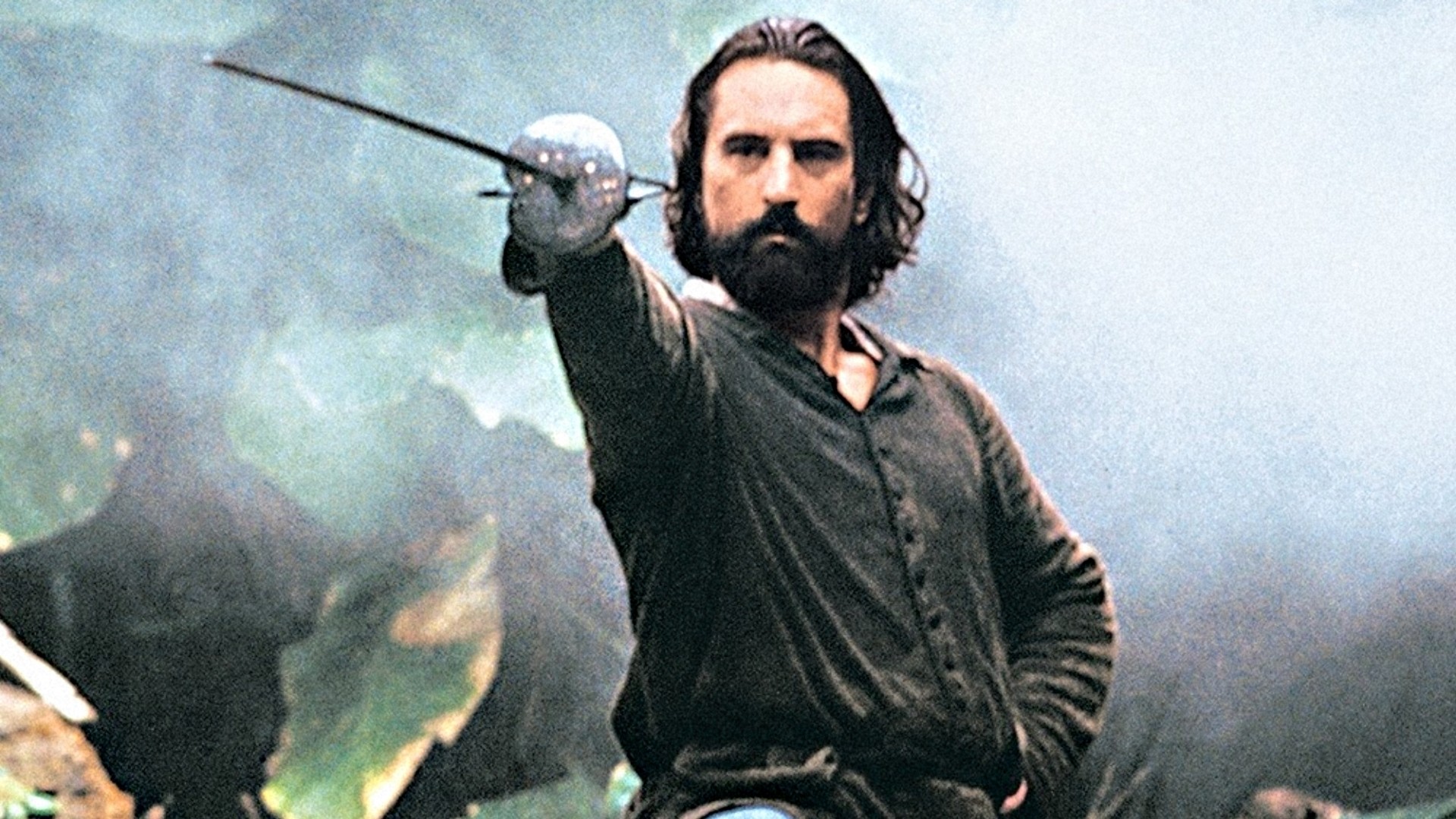
Apocalypto (2006)


Rudy Youngblood is on the run in Mel Gibson’s Mayan experience epic

Director: Mel Gibson

Cast: Rudy Youngblood (Jaguar Paw), Dalia Hernández (Seven), Jonathan Brewer (Blunted), Morris Birdyellowhead (Flint Sky), Gerardo Taracena (Middle Eye), Raoul Trujiilo (Zero Wolf)

In the early 1500s, the Mayan civilisation is at its final peak before its collapse. However, it is a civilisation built on human sacrifice and exploitation. A peaceful village is brutally attacked by Mayan soldiers, who take the women to be sold into slavery and the men to be sacrificed to the sun. Jaguar Paw (Rudy Youngblood) manages to save his wife and child, but is captured and taken to the Mayan capital where he struggles to survive, escape and find his family.

Setting a film in the long gone Mayan civilisation, in an entirely dead language, with no stars is a brave choice for any film-maker. So you have to tip your hat to Mel Gibson, for all his undoubted unpleasantness, that he was brave enough (or powerful enough) to put the project together. It could have been a grand folly but, thanks largely to Gibson’s undoubted prowess as a film-maker, it’s a relentless experience movie, with moments of horror expertly mixed with terrifying edge-of-the-seat tension. It’s a clear sign that, for all his personal issues, Gibson is a very fine director.

The chase, when it comes in the final third is unrelenting, and brilliantly shot and edited. Gibson uses a range of different cameras, from those mounted on Youngblood, to tracking shots, to aerial shots to throw us into the middle of the action. Trees blur by, the soundtrack pounds, the camera doesn’t let up. Gibson also knows to throw in quieter moments – pause points, moments to take breath for both the pursuers and the pursued. Jaguar Paw carries a dreadful wound – and runs on the same level of adrenalin as the film provokes in its audience.

Of course, it’s also, as per a Gibson film, very bloody stuff. Faces are bludgeoned. Bodies are cut to pieces. A jaguar literally rips a man’s head apart. The film wants us to experience this bloody world first hand. As a piece of film-making, it’s addictive in its unremitting violence and tension. It’s also compelling how the odds slowly change throughout the chase – like a Die Hard in the jungle, the further the pursuit heads into the jungle, the greater confidence Jaguar Paw possesses, and the more he is able to turn the tables on his pursuers. This also highlights the savage danger of nature itself – the jungle is full of potential dangers, from jaguars to hornets to poisonous animals.

It’s far from perfect of course. The script is dire – the subtitled content we read if often terrible clunky. The opening sequence is a long series of jokes about eating a wild pig’s bollocks. There are strange anachronistic turns of phrase – at one point a collapsing tree nearly takes out the convey of slaves, leading Zero Wolf to shout “I’m walking here!”. If you were in any doubt about the essential crudeness and simplicity of Gibson’s sense of humour, you only really need to read the subtitles.

But because the film is subtitled and feels like a brave piece of film-making, it’s very easy to assign a depth to it that the film doesn’t really have. It is, to all intents and purposes, an 80s action film transposed to an ancient civilisation. It would like to think it has some profound message about the nature of man. But it’s largely an experience movie that throws you into an old civilisation and wants you to vicariously feel the suffering of its central character. It’s Gibson at his most visceral, throwing us into worlds of violence, tapping into elemental feelings of pity and horror. 

I guess there are themes in there about the universal corruption and cruelty of great civilisations, with their violence, greed and cruelty – and we know the conquistadors are just round the corner. But other than presenting this as is, the film doesn’t make too much of an effort to draw real contrasts with our world. It is what it is. The audience is there to feel the fear and the horror of the innocent villagers being fed to the Mayan human sacrifice machine. Any pretence to this being a profound movie on top of that is just that: a pretence.

But Gibson can shoot the hell out of a film, and this is tense, engrossing viewing – largely because you’ve not really seen anything else really like this. The scenes at the Mayan sacrifice temple are horrifyingly hypnotic in their orgy of death. Our villagers have a chilling powerlessness in the face of this death machine that awakens all our feelings of vulnerability and sympathy. Violence and murder is shown to be central to Mayan civilisation – and it might not carry that thematic idea forward too much, but at least it’s an interesting suggestion.

But Gibson’s primary purpose here is to make a high-octane chase movie – an actioner, set in a primitive civilisation, where human beings on foot carry all the energy of the chases, and the stakes feel impossibly high. You have to admire Gibson’s power as an immersive film-maker, and the unique vision he presents, difficult as it can be to watch. It’s something truly unique, often shockingly so. And if it is, at heart, part chase part slasher with slightly more depth, it’s also something you can’t imagine many other directors having the chutzpah to put together.

Mad Max: Fury Road (2015)


George Miller’s Mad Max: Fury Road – a crazy car chase film

Director: George Miller

Cast: Tom Hardy (Max Rockatansky), Charlize Theron (Imperator Furiosa), Nicholas Hoult (Nux), Hugh Keays-Byrne (Immortan Joe), Rosie Huntington-Whiteley (The Splendid Angharad), Nathan Jones (Rictus Erectus), Riley Keough (Capable), Zoë Kravitz (Toast the Knowing), Abbey Lee (The Dag), Courtney Eaton (Cheedo the Fragile), Josh Helman (Slit)

Sometimes films seem designed to give you a visceral thrill, to throw you into an experience and see whether you sink or swim. To pull off that sort of hard-edged momentum, you need a film-maker skilful enough to create an addictive energy that never slackens and never gives you a second to question the film while it’s going on. Mad Max: Fury Road has such a director in George Miller, and its demented, high-octane excess, married with a film-making style that felt modern, vibrant and grounded in reality, surprisingly made it one of the most acclaimed films of 2015.

In a post-apocalyptic future Australia, the world is a ruined desert and basic requirements like water, greenery and fuel are more valuable than anything. In a rocky outcrop, cult-leader Immortan Joe (Hugh Keays-Byrne) rules one of the few populations by controlling access to the water. “Road warrior” Max Rockatansky (Tom Hardy) is captured by Immortan Joe’s warriors and put to work as a “blood bag” to transfuse into Immortan Joe’s warriors. However, this coincides with a planned escape by Immortan Joe’s wives (the few remaining women capable of conceiving children). Led by road warrior Imperator Furiosa (Charlize Theron), the women flee to find a mysterious paradise in the wilderness. Cue an almighty chase and running battle between Furiosa’s road carrier and Immortan Joe’s forces, desperate to reclaim the wives.

Mad Max: Fury Road is a bizarre, extreme, surreal thrill ride, a high-octane road chase, crammed with action, thrills and dynamism. It’s directed with extraordinary vibrancy by George Miller, who makes it fresh and scintillating. Miller crams the action and design with an explosion of style. Everything is amped up to 11, from the look to the characterisations and motivations. But what makes this such a well-directed film is that Miller shoots much of it with careful, professional clarity: so many other films would be cut with a frantic craziness, but this has a polished traditionalism to it. Basically Miller knows the actual content of the story is “insane” enough that he doesn’t need to gild the lily with bizarre, swooping camera angles or choppy editing. 

That’s partly why this film has had such a strong positive reaction. While being insanely OTT, it’s actually quite an old-fashioned piece of film-making, and it looks like a lot of it was shot for real on location, using real practical stunts. This may or may not be the case, but it certainly looks like this. And in an era where so many action films are about superheroes, and crammed with special effects, to have a world where things feel grimy and real, where the objects we are watching feel like they exist, is like a breath of fresh air. The design throughout the film accentuates this sense of reality. It makes things feel like they have depth and force. It immediately adds stakes to the action.

That action takes place in a unique looking world. The visuals in this film are crazy. The design of Immortan Joe’s half-nude soldiers, with their silver paint aerosol and petrol smeared faces, is terrifyingly cultish. The look of the many different vehicles is immediately striking, with each being clearly of the same world, but each distinctive in look, like some Wacky Races. The steampunkish mix of cobbled-together remains of technology to create the cars and trucks is brilliantly done. It’s a film that looks like nothing else, and shot with radiant streaks of yellows and blues, mixed with scenes shot in almost painterly black and white. It’s an explosion of style, but not straining too hard to force itself upon you like so many films do. 

The film also has a simple structure and storyline, that allows it to focus on the action. It’s slick, steamlined and very focused. The villains are clear, and their motivations easy to understand. They are presented with a certain depth, but their essential villainy is easy to have a gut instinct against. This also helps us bond with our heroes – despite the fact that most of the wives have only the most briefly sketched of characters. But we totally understand their position, fear and desire for freedom. Just as the film is a primal explosion of “fight or flight”, so are the feelings our heroes carry. Everyone can relate to them.

It’s also great that this is an action film where the women largely drive (literally!) much of the action. The film may have the Mad Max name on it, but the true lead of the film is Furiosa. It’s her actions that drive the film, it’s her conflicts that are at its heart, the film is her journey and Max is largely along for the ride (again literally!). Charlize Theron is very impressive in the lead, a strong warrior woman, but also someone with a buried poetic soul and a clear emotional arc. Tom Hardy delivers as the grizzled Max, but this is very much Theron’s film.

Mad Max: Fury Road is an exciting and engrossing film. But it’s made with such professional inspiration on the visuals that it invites people to read into it a lot more depth than I think is actually there. It’s got such old-fashioned control and brilliance to it, while being so explosive and vibrant, that it’s tempting to read into it a thematic complexity. Let’s be honest, this is a chase movie. It’s a hell of a chase movie, but it’s a chase movie.

It may be set in a world of post-apocalyptic totalitarianism, but it’s not trying to tell us anything hugely original about what such a world may be like. It creates such a world with huge inventiveness, but it’s not an enlightening film. Similarly, this is a film that places women at the centre of its action, but I’m not sure you could call it a film that has much to say about feminism. Most of the women in this film are still defined primarily by their breeding abilities. Furiosa may be the leader, but most of the rest of the women are under her protection. The film does something different with gender, but it also does a lot of quite traditional things. 

It’s really tempting to see great symbolism in such a dynamic and striking piece of film-making. But thematically there isn’t much there. Miller directs a film that is brilliant too experience, so brilliant you expect there to be more at its heart. In truth there isn’t really – it’s largely what it appears to be on the tin. There’s nothing wrong with that though. You just need to know what you are going to get. This is not some great game changer of a motion picture, that will reinvent and reposition the genre. It is a skilfully made and compelling chase movie, where a group of people run to a point, turn around and head back, being chased all the way. It’s shot with a near poetic, old-school brilliance – but it’s still just a chase movie. Accept it as that – a high-octane action thriller – and you will be swept away. Look to it for the thematic depth some have claimed it carries and you will be disappointed.